Best döner kebab in Berlin: the honest guide to a Berlin invention
Berlin: Private Kreuzberg Food and Street Art Tour
Where is the best döner kebab in Berlin?
Mustafa's Gemüse Kebab at Mehringdamm 32 (Kreuzberg) draws queues of 30-90 minutes but is worth it once. Rüyam Gemüse Kebab at Badstrasse 38 (Wedding) serves an equally good kebab with zero wait. Both charge €4-5. Avoid kebab shops near major tourist attractions where the same product costs €7-9.
Mustafa’s Gemüse Kebab at Mehringdamm 32 (Kreuzberg) draws queues of 30–90 minutes but is worth it once. Rüyam Gemüse Kebab at Badstrasse 38 (Wedding) serves an equally good kebab with zero wait. Both charge €4–5. Avoid kebab shops near major tourist attractions where the same product costs €7–9.
| Where | Kreuzberg (Mehringdamm), Wedding (Badstrasse), Neukölln (Karl-Marx-Strasse) |
| Cost | Around €4–5 standard; €7–9 in tourist zones; €12–16 sit-down Iskender |
| Time needed | 10 minutes at Rüyam; up to 45–90 minutes queueing at Mustafa’s |
| Getting there | U6/U7 Mehringdamm, U8 Pankstrasse, or U7 Karl-Marx-Strasse |
| Best time | Weekdays before 11:30 or after 21:00 to avoid Mustafa’s queue |
A Berlin invention, not a Turkish import
This is one of those origin stories that actually holds up to scrutiny. The döner kebab you eat in Berlin — flatbread stuffed with sliced meat, shredded salad, and yoghurt sauce — was not brought wholesale from Turkey. The Turkish doner (döner means “rotating” in Turkish) existed long before as a restaurant dish, typically a platter of sliced meat served with rice and salad. What West Berlin produced in the early 1970s was something different: a portable, handheld format designed for eating on the street.
Kadir Nurman, a Turkish guest worker from Stuttgart who relocated to West Berlin, is the figure most associated with the modern döner kebab. In 1972, he set up a stand near Zoo station (Bahnhof Zoologischer Garten) and began selling döner in bread. The logic was practical: German workers eating on a lunch break did not want to sit at a restaurant. Nurman adapted the meat format for the street, added vegetables and sauce, and created a product that was cheap, filling, and fast. He died in 2013 without the fortune the invention might have earned him — he never patented it.
The broader story involves West Germany’s postwar labour shortage. From 1961 onward, Germany signed recruitment agreements with Turkey, and hundreds of thousands of Turkish gastarbeiter (guest workers) arrived to fuel the Wirtschaftswunder economic miracle. They settled in working-class districts like Kreuzberg and Wedding, districts that West Berlin’s affluent residents had little interest in partly because of their proximity to the Wall. By the 1980s, Kreuzberg had one of the highest concentrations of Turkish residents in Europe. The döner kebab grew out of that community and spread nationally from Berlin.
Today the numbers are staggering. The Verband der Deutschen Döner-Kebab-Wirtschaft (the German Döner Kebab Association) estimates that around 400 million döner kebabs are sold per year in Germany, generating revenue in the billions of euros. It is, by some counts, the single most popular fast food in the country — outselling hamburgers. Berlin alone has more than 1,000 döner shops. What started at a stall near Zoo station is now an industry.
For context on Berlin’s other iconic street food — the currywurst — and how the two compete for the title of Berlin’s defining quick meal, see the Berlin currywurst guide. The two dishes represent completely different communities and histories, but both are inseparable from the city’s identity.
Anatomy of a Berlin döner
Understanding what goes into a good döner helps you evaluate what you’re being served. Here is the breakdown.
The bread. A proper Berlin döner uses Fladenbrot, a Turkish-style flatbread baked fresh — ideally on-site or delivered daily from a Turkish bakery. The standard format is a Dönertasche (literally “döner pocket”), where the bread is sliced horizontally and filled. The alternative is a dürüm, where the same filling is rolled into a thinner, softer wrap (yufka dough). The dürüm is slightly less messy and works well with wetter fillings. Both are legitimate — it comes down to preference.
The meat. Traditional döner uses a veal and lamb mix, formed into a large cone and stacked on a vertical rotisserie spit. The outer layer is sliced off as it cooks, producing thin, slightly charred strips of meat. Chicken döner (Hähnchen) became common in the 1990s and is now at least as popular as the mixed meat version. Better shops source their meat carefully; cheaper operations may use pressed meat with higher fat content and filler. You can usually tell from the texture and how it behaves on the spit — pure meat shreds naturally, pressed meat has a more uniform, almost rubbery quality.
The salad base. Standard inclusions are shredded iceberg lettuce, red cabbage, sliced tomato, raw onion, and cucumber. Most shops add all of these by default. You can ask for specific items to be left out. The freshness of the vegetables is a reliable quality indicator — limp lettuce and watery tomatoes suggest produce that has been sitting too long.
The sauce. Three options dominate: joghurt (a yoghurt and herb sauce, usually with dill and mint), scharf (a red pepper paste, spicy but not usually extremely hot), and knoblauch (garlic sauce, heavy and rich). You choose at the counter. Many regulars ask for joghurt and scharf together. Asking for “alles” gets you all three. Start conservatively if you’re unfamiliar — the scharf from some shops is genuinely hot.
The extras. A Gemüse Kebab — the style Mustafa’s made famous — adds grilled vegetables to the filling: typically courgette, roasted red peppers, and corn. Fresh herbs (parsley, mint) and crumbled feta cheese are also standard additions at vegetable-forward shops. These extras push the flavour profile away from pure meat and toward something lighter and more complex. Not every shop offers them.
Customising your order. The staff at any competent döner shop will take your order ingredient by ingredient if you ask. Point at what you want. “Ohne Zwiebeln” means without onions. “Mit allem” means with everything. “Scharf?” means “spicy?” — they’re checking if you want the hot sauce. Knowing a few of these phrases moves the process along.
Best döner spots in Berlin
This list focuses on consistently good quality across multiple visits, not just viral reputation.
Mustafa’s Gemüse Kebab
Address: Mehringdamm 32, 10961 Berlin Transport: U6 or U7 to Mehringdamm, then 2 minutes on foot Price: €4.50–5.00 (cash only) Hours: Roughly 10:00–02:00 on weekdays, later on weekends — closes when the meat runs out
This is the shop that appears in every Berlin food guide and generates queues that look alarming from the outside. The queue moves faster than it appears. A 50-person queue at peak time is typically a 35–45 minute wait, not two hours.
What Mustafa’s actually does well: the grilled vegetables are consistently good, the bread is baked fresh, and the chicken döner has a slightly smoky flavour from the charring on the outer layer. The feta and fresh herbs genuinely add something. It deserves its reputation as a quality product.
What the reputation obscures: Rüyam (see below) serves a döner that most serious food people consider equally good, and has no queue. Mustafa’s is worth doing once, especially if you’re already in Kreuzberg and the time investment fits your day. It is not worth restructuring an entire afternoon around, particularly if you have limited time in Berlin.
Mehringdamm is in the heart of Kreuzberg, which gives you reason to be in the area anyway — see the Kreuzberg food guide for what else to combine with the visit. The neighbourhood sits directly along the former line of the Berlin Wall, and the Berlin Wall complete guide gives context for why Kreuzberg developed the way it did.
Rüyam Gemüse Kebab
Address: Badstrasse 38, 13357 Berlin (Wedding) Transport: U8 to Pankstrasse, then 5 minutes on foot Price: €4.00–4.50 (cash preferred) Hours: Roughly 11:00–22:00, closed Sunday
This is the local alternative that Berliners who actually eat döner regularly tend to recommend. Wedding is a less-visited district north of Mitte — fewer tourists, more residential, no Instagram queues. Rüyam serves a Gemüse Kebab that is, by most informed assessments, functionally equivalent to Mustafa’s. The vegetable mix is similar, the bread is fresh, the chicken is properly cooked.
The practical case for Rüyam over Mustafa’s is strong for most visitors: no wait, slightly lower price, and you get to see a part of the city that very few tourists visit. Wedding is also a historically interesting district — it was part of West Berlin but retained a strong working-class character that Kreuzberg’s gentrification has partially erased.
Imren Grill
Address: Karl-Marx-Strasse 78, 12043 Berlin (Neukölln) Transport: U7 to Karl-Marx-Strasse Price: €4–5
Imren is the Neukölln equivalent — consistent, unhurried, with a following among Berlin food writers for the quality of their beef döner specifically. Neukölln borders Kreuzberg to the south and has a similarly large Turkish-German community. Karl-Marx-Strasse is a busy high street with no tourist veneer. Imren is a practical choice if you’re in Neukölln for any other reason, and Neukölln’s covered market and street life make it worth the detour regardless.
Doyum Restaurant
Address: Admiralstrasse 36, 10999 Berlin (Kreuzberg) Transport: U8 to Schönleinstrasse
Doyum operates more as a sit-down restaurant than a street food counter, which means it is a different experience entirely. The meat sourcing is taken seriously — the restaurant supplies its own preparation rather than buying pre-made döner stacks. The Iskender kebab here (döner meat over bread, smothered in tomato sauce and yoghurt, then finished with browned butter) is one of the better versions in Berlin. Expect to pay €12–16 for a full Iskender plate. It does not compete with Mustafa’s on speed or price, but it is a more complete meal.
Vöner
Address: Boxhagener Platz area, Friedrichshain Transport: U5 to Samariterstrasse or tram to Boxhagener Platz Price: €5
The vegan option. Vöner has been operating in Friedrichshain for over a decade and uses seitan-based “meat” that holds together on a rotisserie spit convincingly. The texture is different from animal protein but not unpleasantly so. The salad and sauce components are identical to a standard döner. For vegan visitors, this is the most credible option in Berlin. It is not a compromise — it is genuinely good on its own terms.
The queue at Mustafa’s: honest assessment
The queue at Mustafa’s is real and moves at approximately 10–15 people per 10 minutes during peak operation. The staff are fast and the ordering process is streamlined. A queue of 40 people from the back of the line to the counter is typically 25–35 minutes, not an hour.
Peak times to avoid: 12:30–14:00 (lunch rush) and 18:30–20:30 (after-work and tourist dinner traffic). Saturday afternoon is consistently the worst time of the week. If you arrive before 11:30 or after 21:00 on a weekday, you may walk up with only a handful of people ahead of you.
The honest comparison with Rüyam: if you have 90 minutes to spend on a döner, Mustafa’s is a valid experience — the food is good and queuing alongside a genuinely mixed crowd (locals, tourists, regulars on lunch break) has a certain Berlin character to it. If you have 15 minutes, Rüyam is obviously the answer. Neither choice is wrong. Mustafa’s is worth the queue exactly once.
Tourist traps to avoid
Döner shops near major tourist sites follow a consistent pattern: higher prices, lower quality, and less care about the product because turnover is guaranteed regardless. Specific zones to be cautious in:
Alexanderplatz and surrounding streets. The döner shops immediately around Alexanderplatz charge €7–9 for a standard Dönertasche. The meat is often pre-sliced and kept warm rather than cut fresh from the rotating stack. There is nothing catastrophically wrong with these — they will fill you up — but you are paying tourist tax for a diminished product.
Hackescher Markt area. Similar dynamic. The area around Hackescher Markt is heavily visited and döner shops here have adjusted prices accordingly. If you’re in Mitte for Museum Island or exploring the central districts, factor in walking 10–15 minutes to a residential street before eating.
Hauptbahnhof food court. The Berlin central station has döner outlets that are airport-quality at airport prices. Functional, not interesting.
Checkpoint Charlie corridor. The stretch of Friedrichstrasse around Checkpoint Charlie and Topography of Terror is one of the highest tourist-density zones in Berlin. Any food establishment here prices for that reality. There is no compelling reason to eat döner in this area.
Signals that a döner shop is cutting corners: a laminated menu with glossy photos, prices displayed only in round numbers above €7 with no explanation, pre-made sandwiches sitting wrapped in the display case, no Turkish written anywhere on the menu or behind the counter, and meat that appears to be a uniform cylinder rather than a natural cone shape (suggesting pressed, manufactured meat rather than properly formed cuts).
Döner and Berlin’s Turkish community
Understanding the döner means understanding Kreuzberg. From the 1960s onward, Turkish gastarbeiter settled in Kreuzberg because it was the affordable, unfashionable district of West Berlin — a divided city with a depressed property market and a wall on three sides. The Turkish community built mosques, brought family members over under reunification rules, opened restaurants and market stalls, and effectively created a neighbourhood that Germans started calling Klein Istanbul (Little Istanbul).
Oranienstrasse became the main commercial and cultural axis — a street with Turkish grocers, tea houses, and later a thriving alternative and counterculture scene that mixed Turkish-German residents with West Berlin’s leftist and artistic population. That cultural overlap is part of why Kreuzberg has the personality it does. See the East Side Gallery guide for context on how reunification changed the city’s geography and culture — the Wall’s fall in 1989 partly drained Kreuzberg of its isolated energy and began a slow gentrification that is still ongoing.
Berlin’s Turkish-German population today is estimated at roughly 100,000–200,000 people out of a city of 3.8 million, making it the largest Turkish diaspora community in Germany and one of the largest outside Turkey itself. The community runs the gamut from third-generation Berliners with no memory of Turkey to recent arrivals. Türkiyemspor Berlin, a football club founded in 1965 by Turkish guest workers, remains active and represents one of the longest-running cultural institutions of that migration.
The döner kebab is inseparable from this history. When you eat one, you are eating something that emerged from a specific set of economic and social circumstances — a community that was recruited to build West Germany’s economy and then built its own culture within that economy. That is worth knowing.
Beyond the classic döner: what else to order
Good döner shops — especially Turkish-run ones in Kreuzberg and Neukölln — typically serve several other dishes worth knowing.
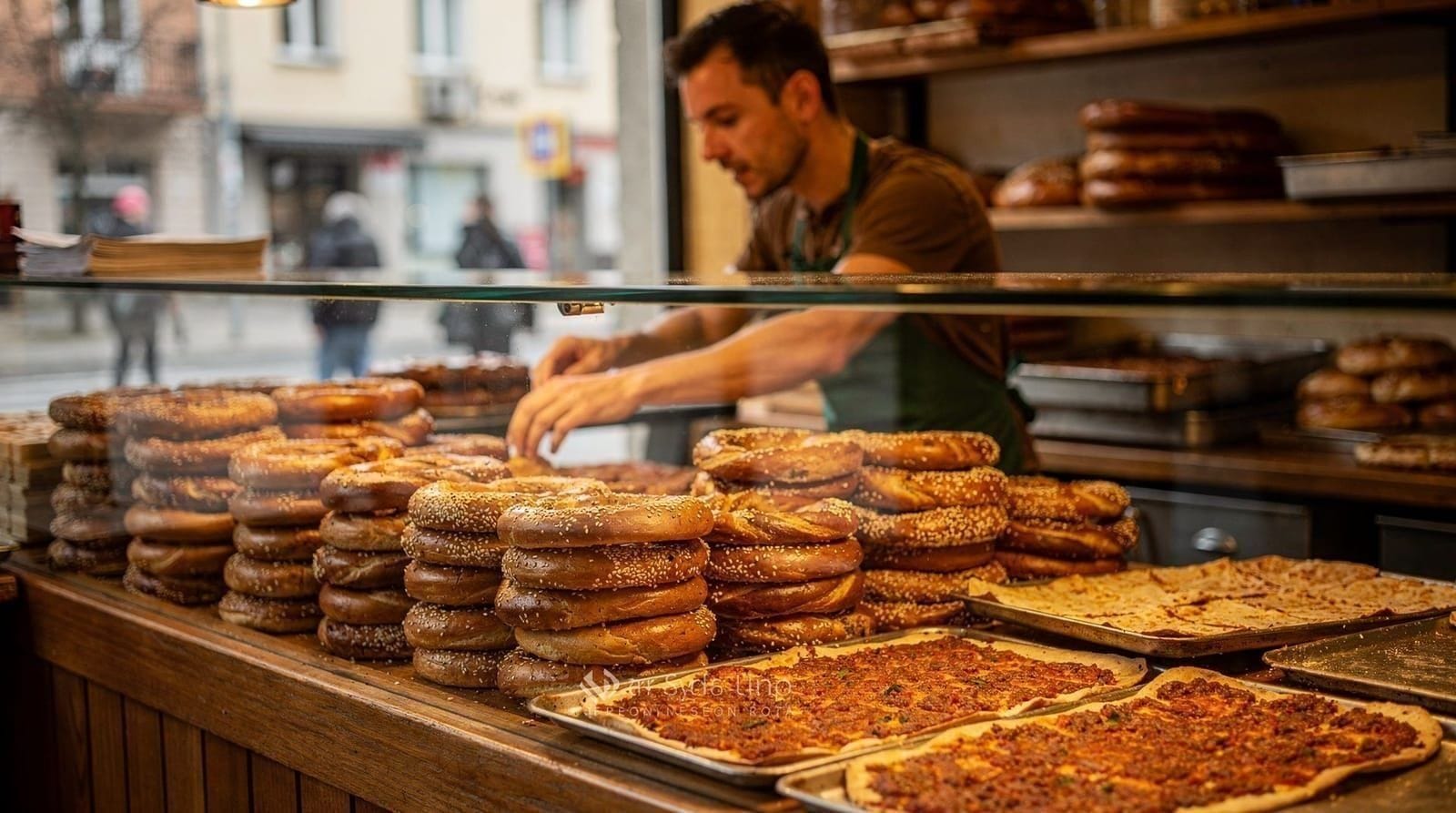
Lahmacun. Sometimes called Turkish pizza, though that term undersells it. A thin, crispy flatbread topped with spiced minced meat, onion, and parsley, baked in a hot oven. You eat it rolled up with salad and lemon juice. At a good shop it costs €2–3 and is arguably more interesting than the döner. Ask if it’s made fresh or reheated — the difference matters.
Gözleme. A large savoury flatbread (yufka) folded over a filling — typically spinach and feta, or minced meat — then cooked on a griddle. Costs €3–4. You often find it at market stalls rather than döner shops specifically; Mauerpark on Sundays has reliable gözleme stalls among the flea market vendors.
Iskender kebab. A sit-down dish: döner meat laid over cubes of bread, covered in tomato sauce and yoghurt, then finished with browned butter poured over at the table. It is named after Iskender Efendi from Bursa, Turkey, who allegedly created the dish in the late 19th century. At a proper Turkish restaurant in Berlin — Doyum in Kreuzberg is a good example — expect to pay €12–16. It is worth trying at least once if you want to understand what döner meat tastes like when treated as a restaurant ingredient rather than street food.
Börek. Flaky pastry (yufka layered with oil or butter) filled with feta and parsley, or spinach, or spiced minced meat, then baked or fried. A pastry shop version costs €2–3 per slice. Every Turkish bakery in Kreuzberg sells it. It has nothing to do with döner but shares the same shops and the same community.
Köfte. Grilled spiced meat balls or patties, usually lamb or beef. Some döner shops offer a köfte wrap as an alternative. At a sit-down restaurant, köfte comes with bread and salad. It is simpler than döner but the spicing — cumin, sumac, pepper — makes it worth trying.
Why döner prices keep rising
The jump from €3.50 to €4.50–5.00 between 2022 and 2026 is not arbitrary. Meat prices (particularly veal and lamb) rose sharply through the European energy crisis, as did the cost of running rotisserie grills and ovens in shops with high energy consumption. Rent in Kreuzberg and Neukölln has also risen as both districts gentrified, pushing up overheads for small operators who often run on thin margins. The Verband der Deutschen Döner-Kebab-Wirtschaft has periodically warned that further price rises are likely as long as meat and energy costs stay elevated. For visitors, the practical upshot is that €4.50–5.00 is now the realistic floor for a proper Dönertasche in Berlin — anything advertised much cheaper is worth being cautious about, since it likely signals corners cut on meat quality or portion size.
Döner in Berlin versus other German cities
Berlin remains the spiritual home of the German döner, but the product has evolved differently in other cities. Hamburg and Cologne have their own strong döner scenes, often with slightly different bread styles and regional sauce preferences. What sets Berlin apart is density and competition: with more than 1,000 shops citywide, quality control happens through customer choice rather than any formal grading system — a mediocre shop in Kreuzberg simply loses business to the one two doors down. Visitors arriving from other German cities sometimes expect the Berlin döner to taste dramatically different; the more accurate framing is that Berlin has more good options concentrated in fewer square kilometres, particularly around Kreuzberg, Neukölln, and Wedding.
Guided food tours covering Kreuzberg
If you want structured context rather than solo exploration, guided food tours in Berlin’s Turkish and street food neighbourhoods provide both the tastings and the history in one go. The Berlin street food scene guide covers the independent exploration angle in more detail.

The Kreuzberg food and street art tour combines döner, Lahmacun, and other neighbourhood food with a walking explanation of Kreuzberg’s history — the Wall, the Turkish community, the counterculture. It is one of the more coherent ways to eat and learn simultaneously. The tour typically includes 4–5 food stops, which means you are eating properly rather than nibbling at samples.

The street food cultural walking tour covers a broader geographic range and is better if you want to understand Berlin’s street food beyond the Turkish quarter. It typically runs through Kreuzberg and Mitte, touching on currywurst and döner alongside newer food concepts. See the Berlin food tour guide for a comparison of what different tour formats offer.
Both tours are worth considering if you have 3–4 hours and want the explanation alongside the food. If you’re comfortable navigating independently, the money you save goes straight to more döner.
Practical tips before you go
Cash. The majority of döner shops, including Mustafa’s and Rüyam, operate cash only or strongly prefer it. Bring small bills. A €50 note at a €4.50 purchase creates friction. Aim for €10s and coins.
Halal. Halal meat is standard at approximately 95% of Turkish-run döner shops in Berlin. It is not something you need to ask about specifically — the default is halal. The few exceptions are non-Turkish operators who have entered the döner market.
Portion size. A standard Dönertasche is genuinely filling — 300–400g of food including bread and vegetables. Most adults find one sufficient for a meal. If you’re splitting between two people, a dürüm wrap is slightly easier to share than a pocket.
Sauce strategy. If you’re unfamiliar with a shop’s scharf sauce, ask to taste it before committing. Some Berlin döner shops use a genuinely hot pepper paste. Others use a mild red sauce that adds flavour without heat. There is no standard.
Standing up. Most döner transactions at counter shops happen fast. You eat standing at the counter, or walking, or find a nearby bench. There are usually no seats. This is part of the format — it is street food, not a restaurant experience.
Timing at Mustafa’s. If you specifically want Mustafa’s: Tuesday, Wednesday, or Thursday before noon or after 21:00. Saturday between 14:00 and 20:00 is the worst possible slot.
Language. German works fine at every döner shop in Berlin. English is understood at most. Pointing works everywhere. The Turkish words you might find useful: “tavuk” means chicken, “karışık” means mixed (meat), “az acı” means mildly spicy.
Comparing the top spots
| Shop | District | Price | Wait | Best for |
|---|---|---|---|---|
| Mustafa’s Gemüse Kebab | Kreuzberg | €4.50–5.00 | 30–90 min | The full experience once |
| Rüyam Gemüse Kebab | Wedding | €4.00–4.50 | None | Equal quality, no queue |
| Imren Grill | Neukölln | €4–5 | Minimal | Beef döner specifically |
| Doyum Restaurant | Kreuzberg | €12–16 (Iskender) | None (sit-down) | A full restaurant meal |
| Vöner | Friedrichshain | €5 | Minimal | Vegan option |
Pairing a döner stop with the rest of Kreuzberg or Wedding
A döner is rarely the only reason to be in a neighbourhood. In Kreuzberg, Mehringdamm sits within walking distance of the Kreuzberg neighbourhood guide’s other highlights, and Oranienstrasse’s street art is covered in the Kreuzberg urban art guide. Wedding, home to Rüyam, is less covered by typical itineraries — pairing the trip with a look at the Berlin techno clubs guide area context or simply walking Müllerstrasse gives the detour more purpose than the kebab alone. Anyone doing a wider food crawl should also see the Berlin street food scene and Berlin vegetarian and vegan guides for what else the same districts offer.
Frequently asked questions about Best döner kebab in Berlin
Did Berlin invent the döner kebab?
The modern German version — served in flatbread with salad, vegetables, and yoghurt sauce — was developed in West Berlin in the early 1970s by Turkish gastarbeiter (guest workers). Kadir Nurman is widely credited with selling the first bread-based döner at Zoo station in 1972. The Turkish-style doner on a skewer existed long before, but the Berlin format (the Dönertasche) is a local innovation.What does a döner kebab cost in Berlin?
A standard Dönertasche (meat, salad, sauce in flatbread) costs €4-5 at neighbourhood shops. Prices have risen from €3.50 in 2022 due to energy and meat costs. Tourist-area shops charge €7-9 for the same product. Always check for a price list displayed inside the shop.How long is the queue at Mustafa's?
Mustafa's Gemüse Kebab at Mehringdamm 32 typically has a 30-60 minute queue at peak times (12:00-14:00 and 18:00-21:00). On Saturday afternoons it can reach 90 minutes. Arrive before 11:30 or after 21:00 for shorter waits. The shop closes when the meat runs out, usually by 23:00 on weekends.What is a Gemüse Kebab?
Gemüse means vegetables. A Gemüse Kebab (like Mustafa's) uses grilled vegetables — courgette, peppers, corn — as the primary filling alongside chicken or mixed meat, with fresh herbs and feta cheese. It differs from a standard Dönertasche by having more vegetable content and a lighter profile. It became popular in Berlin through Turkish-German fusion.Are there vegan or vegetarian döner options in Berlin?
Yes. Several shops now offer a falafel wrap (falafeltasche) or a vegan döner made with soy protein or seitan. Rüyam offers a vegetarian option. Vöner at Boxhagener Platz, Friedrichshain, specialises exclusively in vegan döner and has a solid reputation. Expect to pay €4-5.What sauce goes in a Berlin döner?
Standard options are Joghurt (yoghurt and herb sauce), scharf (spicy red pepper sauce), or knoblauch (garlic sauce). Most shops offer all three. You choose at the counter. Asking for 'alles' (everything) gives you all three sauces at once, which works well.Is Kreuzberg the best neighbourhood for döner?
Kreuzberg (especially along Mehringdamm and Oranienstrasse) has the highest concentration of quality döner shops in Berlin, reflecting the neighbourhood's large Turkish-German community. Wedding (north, around Badstrasse and Müllerstrasse) is less touristy and has equally good options at slightly lower prices. Neukölln is also strong.
Top experiences
Bookable activities with verified prices and instant confirmation on GetYourGuide.