Berlin food tour guide: what's worth booking and what to skip
Berlin: Downtown Food Tour with 8 Authentic Local Tastings
Are Berlin food tours worth it?
Yes, for first-time visitors who want context alongside the food. The best tours combine 6-10 tastings with neighbourhood history for €40-70 per person. Skip generic 'highlights' tours that hit the same tourist-zone stops. The Kreuzberg and Mitte food tours tend to be the most substantive.
Berlin food tours range from genuinely excellent to overpriced tourist traps. The best ones combine 6-10 tastings with neighbourhood history for €40-70 per person. Skip generic “highlights” tours that string together the same tourist-zone stops you’d find on your own. The Kreuzberg and Mitte food tours tend to be the most substantive — they give you access to spots that require local knowledge, and the guides provide the kind of context that turns a snack into a story.
| Cost | Around €40–75/person (group); €120–200 for two (private) |
| Duration | 2.5–4 hours |
| Tastings | 6–10, adds up to a light meal, not dinner |
| Best neighbourhoods | Kreuzberg (diversity), Mitte (convenience) |
| Booking | 48 hours ahead recommended; a week ahead in July–August |
Guided vs self-guided: the honest tradeoffs
A guided food tour costs €40-75 per person. A self-guided afternoon in Kreuzberg costs €15-25 and gives you the same food. So why pay the premium?
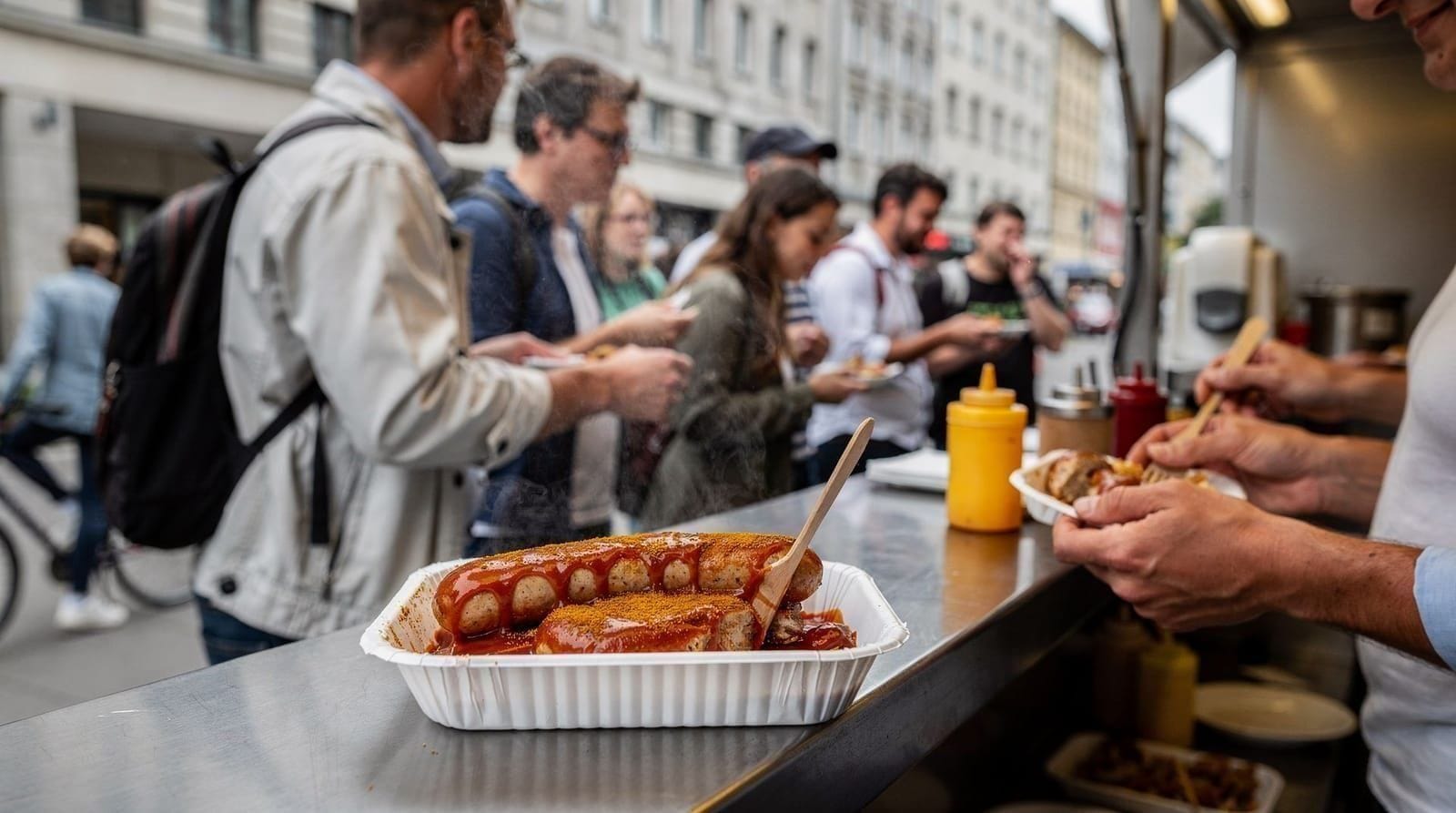
The honest answer: guided tours are worth it if you value three specific things. First, access — good guides take you to spots you genuinely would not find without local knowledge, including unmarked döner counters, family-run bakeries that don’t speak English, and street food vendors who’ve been in the same spot for decades. Second, context — knowing that currywurst was invented in West Berlin in 1949 by Herta Heuwer, who traded with British soldiers for ketchup and curry powder, changes what the dish means when you eat it. Third, efficiency — you cover more ground and make fewer bad decisions in 3 hours with a guide than you would alone.
The downsides are real. Fixed pace means you can’t linger where you’d like to. Group dynamics vary — a group of 16 people at a small market stall can feel awkward. Some tours feel performative, hitting the same five Instagram-friendly spots for the same photos. And if you’re already familiar with Berlin or German food culture, you’ll be hearing information you already know.
If you’d rather go self-guided, see the route suggestions later in this guide. The saving of €30-50 per person is meaningful, and Berlin’s street food scene is legible enough to navigate independently once you know where to look.
Types of Berlin food tours
Walking tasting tours are the most common format. You walk 3-5km over 2.5-4 hours, stopping at 6-10 food vendors or restaurants for tasting portions. Prices run €40-75 per person for group tours of 8-16 people. This is the best format for first-time visitors.
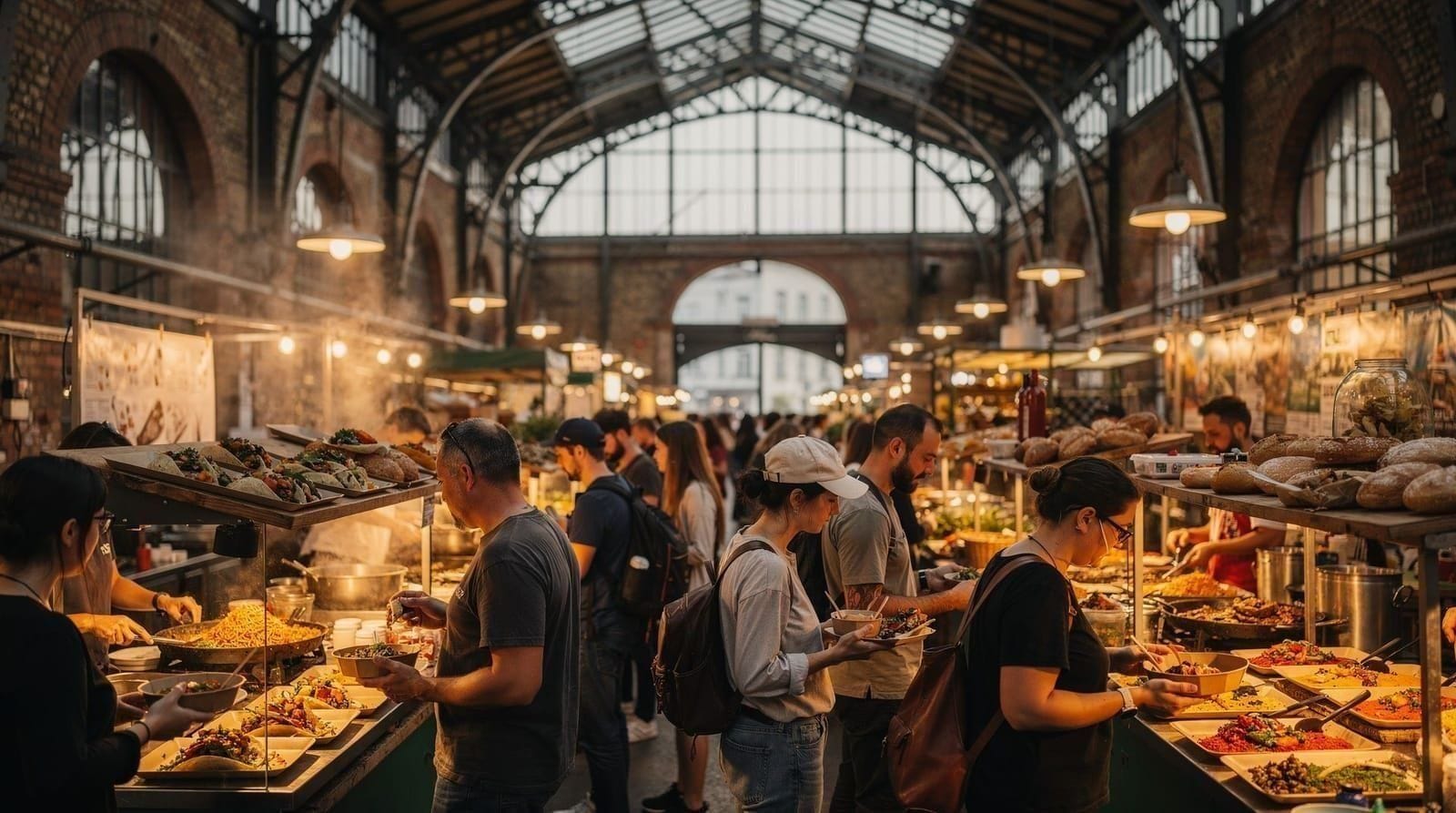
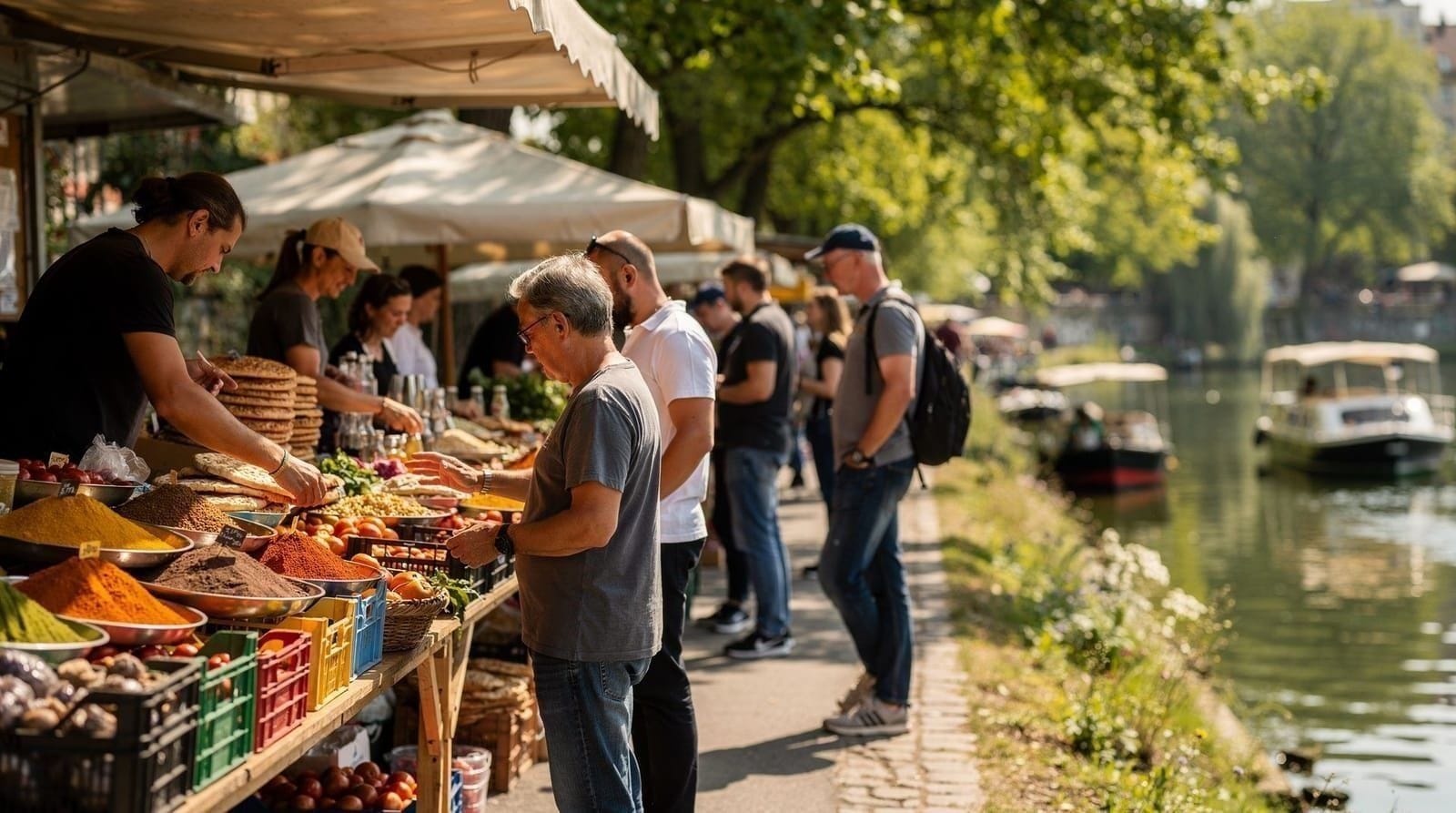
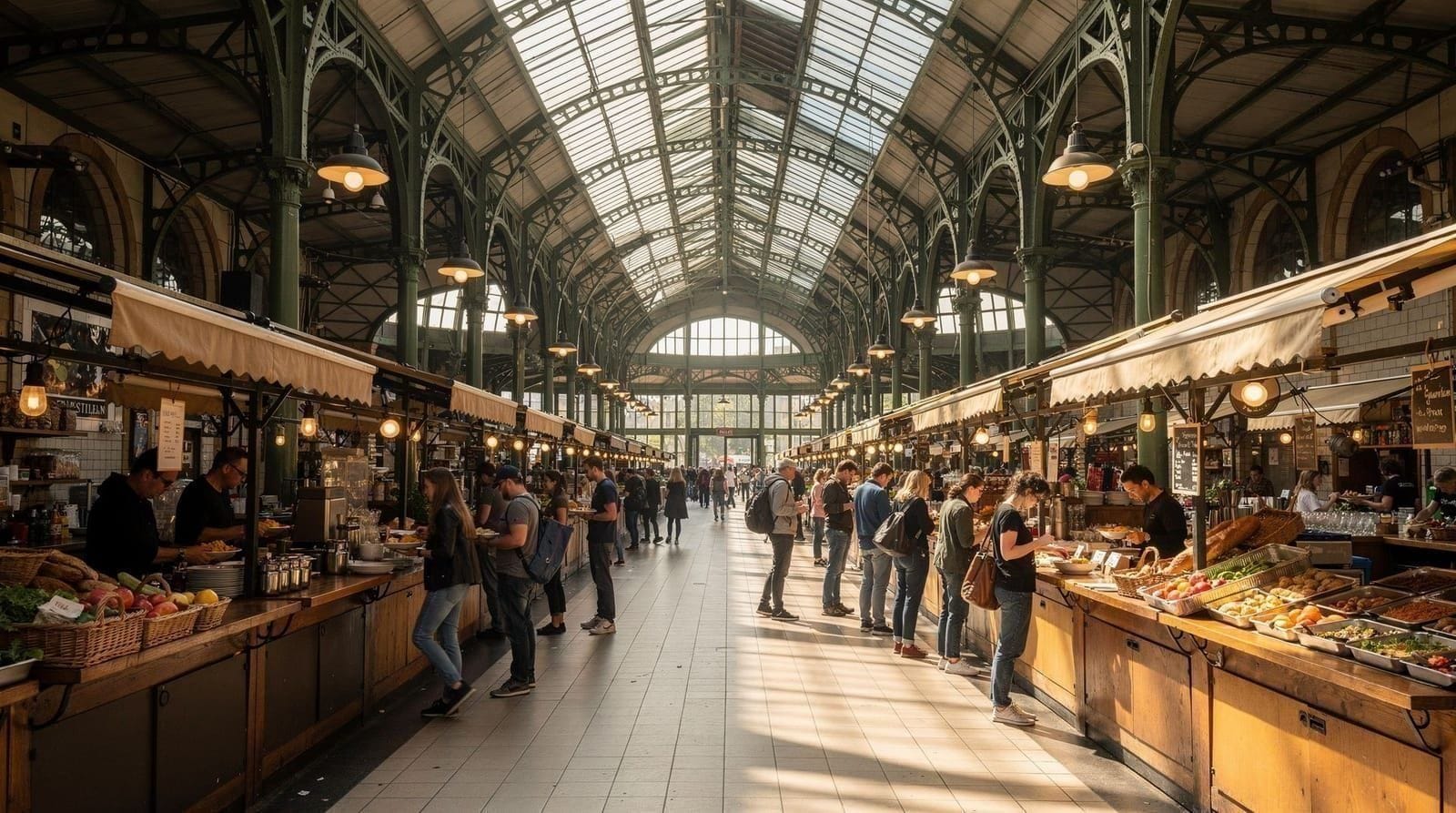
Market tours focus on one or two food markets — typically Markthalle Neun (Eisenbahnstrasse 42, Kreuzberg) or the Türkenmarkt on Maybachufer. They work best on Saturday mornings when stalls are fully stocked. The Markthalle Neun Street Food Thursday (every Thursday, 17:00-22:00) is also worth building a visit around. See best markets to eat in Berlin for market-specific detail.
Bike food tours cover more ground — typically Kreuzberg and Mitte in one session — by cycling between stops rather than walking. They suit people who want to see more of the city alongside the food. Allow 3.5-4 hours and expect to cycle 10-15km.
Private tours cost €120-200 for two people and scale up from there. The main advantage is pace control and the ability to skip stops that don’t interest you. If you have a specific dietary need or a very particular interest (say, Berlin’s Jewish culinary history or its natural wine scene), a private guide can build around that.
Cooking class plus market tour is a niche but excellent format. You visit a market with a chef, select ingredients, then cook a meal together. These typically run 3-4 hours and cost €80-120 per person. If this sounds like your kind of afternoon, the Berlin cooking classes guide covers the best operators in detail.
Format comparison
| Format | Duration | Cost/person | Best for |
|---|---|---|---|
| Walking tasting tour | 2.5–4 hrs | €40–75 | First-time visitors |
| Market tour | 2–3 hrs | €35–60 | Saturday mornings, market-focused visits |
| Bike food tour | 3.5–4 hrs | €50–80 | Covering more ground, active travellers |
| Private tour | 3–4 hrs | €120–200 (for two) | Dietary needs, specific interests, pace control |
| Cooking class + market | 3–4 hrs | €80–120 | Hands-on learners, smaller groups |
The best neighbourhoods for food tours
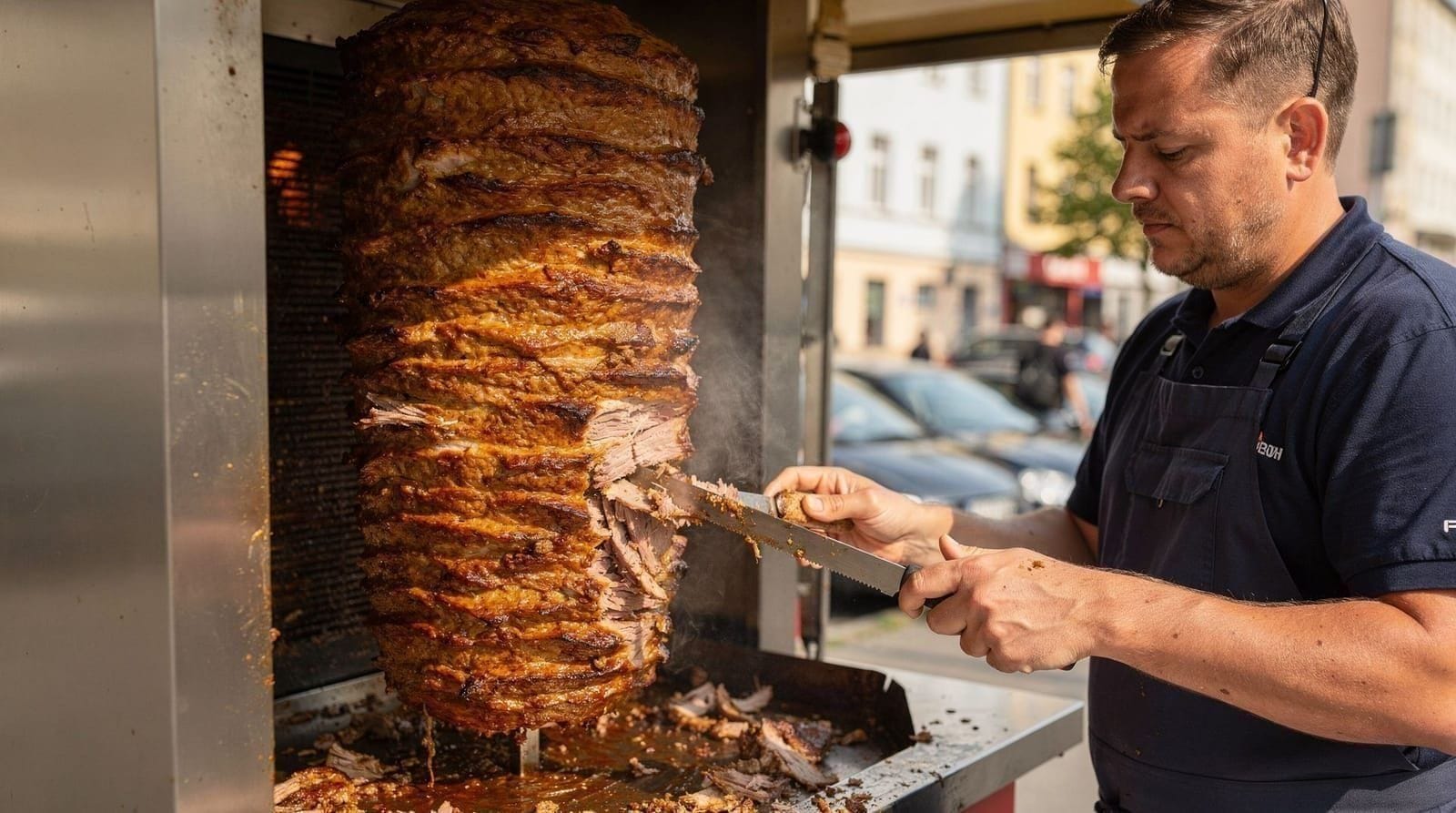
Kreuzberg is the most interesting neighbourhood for a food tour. The area has a large Turkish and Arab community, a strong craft food scene, and Markthalle Neun, one of the best food halls in Germany. A Kreuzberg tour will typically include Turkish pastry, freshly made döner, German street food, and craft beer or natural wine. The neighbourhood’s street art adds visual interest between stops. This is the pick for anyone who wants diversity and authenticity over convenience.
The Kreuzberg food guide goes deeper on the neighbourhood’s food culture if you want to supplement a tour with independent exploration.
Mitte is the most convenient starting point for visitors staying in central Berlin. Tours here tend to hit the big-name German food classics — currywurst, Schmalzbrot (bread spread with lard and topped with onion), Berliner Pfannkuchen (the jam doughnut that gave Kennedy’s speech its punchline). The downside is that Mitte has more tourist-facing food spots than Kreuzberg, and you’ll occasionally feel like you’re being moved between set pieces. Still, it’s a solid introduction for first-time visitors.
Prenzlauer Berg suits people interested in artisan food and high-quality brunch culture. The neighbourhood has farmers markets, independent bakeries, and a different demographic than Kreuzberg or Mitte — more local families and long-term residents, fewer package tourists. The Mauerpark flea market on Sunday mornings has food vendors worth stopping at even outside a formal tour. Prenzlauer Berg food tours are less common but tend to be run by smaller, independent operators with genuine local knowledge.
Neukölln is an emerging scene with raw authenticity. Arab and Lebanese food dominates, alongside Vietnamese restaurants, Korean grocery shops, and low-key craft beer bars. You’ll find fewer formal guided tours here, which is partly why it’s interesting — the operators who run Neukölln tours tend to be deeply embedded in the community rather than running a commercial product. Prices are typically lower than Kreuzberg tours.
If Turkish food specifically is what draws you to Kreuzberg, it’s worth reading the Berlin Turkish food guide before booking — it covers the difference between a tourist-facing döner counter and the family-run spots that guides on genuine Kreuzberg tours actually take you to, so you can judge whether a given itinerary is worth the premium over going independently.
What a Kreuzberg-style itinerary typically looks like
Most structured Kreuzberg tours follow a similar shape even when the specific stops differ: an opening stop near Kottbusser Tor or Görlitzer Bahnhof for context on the neighbourhood’s Turkish Gastarbeiter history, a bakery stop for simit or pastries, a mid-route döner or falafel stop timed to avoid the worst lunch queues, a craft beer or natural wine stop reflecting the newer wave of Kreuzberg openings, and a closing stop — often something sweet — near Oranienstrasse or Wrangelkiez. Knowing this shape in advance helps you evaluate a tour listing: if it skips the history context entirely and just lists food stops, it’s likely to feel more like a snack crawl than the “story” that makes the premium worth paying.
What to expect on a food tour
Group size matters more than most listings mention. The sweet spot is 8-12 people — enough for a social atmosphere, small enough to navigate a market stall comfortably. Tours capped at 16 are acceptable. Anything above 16 tends to be unwieldy, especially at smaller stops. Check the maximum group size before booking.
Walking distance is typically 3-5km over the tour duration. Wear comfortable shoes — cobblestones and uneven pavements are common in older Berlin neighbourhoods. In spring and autumn, bring a waterproof layer. Berlin’s weather is changeable and most tours run regardless of rain.
Meal replacement potential: a properly structured food tour with 8-10 tasting portions adds up to a light meal, not a snack. You should not eat a full lunch before a lunchtime tour. That said, tasting portions are deliberately modest — you’ll want a proper dinner in the evening. Don’t expect to be genuinely full afterwards.
Cash vs card: most stops on guided tours are pre-paid, so you don’t need cash for the tastings. But carry €20-30 in cash if you want to buy extra at market stops — some smaller vendors are cash-only. Card acceptance has improved significantly in Berlin over recent years, but it’s still patchy at street food level.
Tipping: guide tips are discretionary. €3-5 per person at the end of a group tour is normal for a guide you found helpful. Don’t feel obligated if the tour didn’t deliver.
Red flags when booking a food tour
Some operators don’t deserve your €50. Watch for these warning signs:
Tours that promise “all of Berlin in 3 hours” are lying to you. Berlin is vast and no food tour covers it. What they actually mean is “Mitte highlights plus a photo stop near the Brandenburg Gate.” Avoid.
Tours priced under €25 per person almost always cut corners — smaller portions, lower-quality stops, guides with limited local knowledge, or a group size of 20+. The economics don’t work at that price point.
Operators who don’t list the neighbourhoods or specific stops in their tour description are hiding something. Good operators tell you exactly where you’re going because they’re proud of their itinerary.
Listings with no reviews from the past six months should be treated with caution. Berlin’s food landscape changes quickly, and a guide who was great in 2023 may be running a stale itinerary in 2026.
Be wary of tours led by guides who clearly don’t live in Berlin. The best food tour guides are residents with personal relationships with the vendors — they introduce you by name, the vendor expects you, the experience feels genuine. If a guide is reading from a script, that relationship doesn’t exist.
The main guided tour options
The Berlin downtown food tour with 8 tastings concentrates on Mitte and covers the core Berlin food canon: currywurst with its West Berlin origin story, Schmalzbrot, Berliner Pfannkuchen, and a selection of German regional produce. It’s the most structured of the city’s food tour offerings and works well as a first introduction. Eight tastings over roughly three hours is a reasonable count — you’re not being rushed through, but there’s enough variety to feel like a genuine survey of the city’s food identity.

The Kreuzberg food and street art tour is the most immersive option currently available. It treats the neighbourhood’s food and visual culture as two sides of the same story — the same waves of immigration that brought Turkish bakeries and Lebanese mezze also brought the muralists whose work covers the walls on Oranienstrasse. The food stops include genuine Kreuzberg institutions rather than tourist-facing operations, and the guide’s knowledge of the neighbourhood’s political and social history adds real depth. This is the tour to book if you have time for only one and you want something that goes beyond the standard food crawl format.

The street food cultural walking tour takes a different angle, framing Berlin’s food scene through the lens of immigration and multiculturalism. Berlin’s culinary identity is inseparable from its history as a divided city that absorbed waves of migrant workers — Turkish Gastarbeiter from the 1960s, Vietnamese communities from the GDR era, more recent arrivals from the Middle East and the Balkans. A tour that treats this seriously, rather than just presenting “ethnic food” as exotic novelty, is worth seeking out. This one does.

The local food hidden gems tour focuses on spots that don’t appear in guidebooks or on food Instagram. That promise is hard to verify until you’re on the tour, but the format — smaller groups, less predictable itinerary, greater dependence on the individual guide’s network — tends to produce the most genuine experiences. It’s better suited to return visitors who’ve already done a standard food tour and want to go deeper.

Self-guided food route alternative
If you’d rather save the money and plan your own route, here’s a practical itinerary that covers similar ground to a guided tour.
Tuesday or Friday morning: Start at the Türkenmarkt on Maybachufer (operating hours 11:00-18:00 on Tuesdays and Fridays). This is one of Berlin’s best open-air markets — Turkish and Middle Eastern produce, fresh bread, olives, cheese, and prepared food. Buy a simit (sesame-crusted bread ring) and a portion of börek. Budget €8-12.
Late morning: Head to Markthalle Neun at Eisenbahnstrasse 42. On Thursdays from 17:00-22:00 this becomes Street Food Thursday, one of Berlin’s best food events. Outside of Thursday evenings, the hall itself has permanent vendors selling cheese, charcuterie, coffee, and natural wine. Worth a visit regardless.
Lunch: The Mehringdamm area in Kreuzberg is where you’ll find some of Berlin’s best döner kebab. The queue outside Mustafa’s Gemüse Kebap (Mehringdamm 32) is not a myth — it regularly stretches 30-45 minutes — but the vegetable kebab is genuinely exceptional. See the best döner kebab in Berlin guide for alternatives if you don’t want to queue.
Afternoon: Take the U-Bahn to Prenzlauer Berg and find Konnopke’s Imbiss (Schönhauser Allee 44a), one of Berlin’s most historically significant currywurst stands. It has operated under the S-Bahn viaduct since 1930. The currywurst here is the East Berlin style — a different recipe from the West Berlin version invented by Herta Heuwer. The Berlin currywurst guide explains the difference in detail if you want to understand what you’re eating.
Evening: If you’re interested in what Berlin’s craft beer scene looks like, the Berlin craft beer guide covers the best taprooms and bottle shops, many of which are concentrated in Kreuzberg and Neukölln.
This self-guided route costs roughly €25-35 per person in food, compared to €40-75 for a guided tour. What you give up is the narrative thread, the guide’s relationships with vendors, and the efficiency of having someone else make the decisions. What you gain is pace control and the ability to spend an extra 20 minutes somewhere that interests you.
The self-guided route above works particularly well for repeat visitors to Berlin or for anyone travelling with a group large enough that a private tour’s per-person cost becomes hard to justify — split five ways, a €150 private tour is €30 per person, close to what the self-guided route costs anyway, minus the narrative context. For a first Berlin visit alone or as a couple, the maths tilts back toward a guided group tour: the per-person cost stays reasonable, and the context genuinely adds value you can’t easily replicate by reading guides beforehand.
Timing: when to book a food tour
May to September is the best period. Outdoor stalls and beer gardens are open, markets are at their most diverse, and the weather makes walking pleasant. Summer tours fill up fastest — book Saturday tours at least a week ahead in July and August.
October and April are shoulder months with fewer crowds and lower prices on some operators. The food scene doesn’t change much, but outdoor stops can be cold in the morning.
November to March sees fewer outdoor options. Some market-based tours shift formats in winter. That said, Berlin’s Christmas markets (late November through December) offer their own version of a food crawl — Glühwein, Lebkuchen, roasted chestnuts, Reibekuchen (potato pancakes). They’re tourist-heavy but genuinely atmospheric, and you don’t need a guide to navigate them. The main markets at Gendarmenmarkt and around the Kaiser Wilhelm Memorial Church are the most established.
Summer heat: Berlin can hit 35°C in July and August. Morning tours (starting 09:30-10:00) are significantly more comfortable than afternoon tours on hot days. Check whether your tour has a shaded route component.
Dietary restrictions: specific advice
Vegetarians are well served by Kreuzberg tours, which include enough Turkish and international food stops to avoid the all-meat German food problem. Most operators accommodate vegetarians if you notify them at booking. The alternative stops (cheese, börek, vegetable-based dishes) are usually just as interesting as the meat options.
Vegans have a genuine advantage in Berlin. The city has one of Europe’s highest concentrations of vegan restaurants and vegan-friendly street food. Most tour operators can accommodate vegans — but you must confirm in advance, not at the meeting point. A good operator will restructure specific stops rather than just skip them. If they can’t tell you which stops they’ll adapt, book elsewhere. The Berlin vegetarian and vegan guide covers the broader restaurant scene.
Halal: tours with Turkish food stops naturally include halal options, since most Turkish food in Berlin is halal by default. The bigger issue is pork — currywurst and Schmalzbrot are both pork products. Ask the operator which stops involve pork and what the alternatives are.
Kosher: this is the hardest restriction to accommodate on a standard food tour. Berlin has a small but active Jewish community and a handful of kosher-certified restaurants, but they don’t typically feature on food tour itineraries. If kosher certification matters to you, a standard food tour is probably not the right format — contact specialist operators directly.
Gluten-free: difficult in a street food context. Most bread-based stops (pretzels, bread rolls, döner in pita) can’t be easily substituted. Operators can often replace a stop with something different, but you’ll miss some of the most iconic food. Confirm with the operator before booking.
Combining a food tour with the rest of your trip
A food tour works best slotted into the first day or two of a Berlin visit rather than the last — it gives you a mental map of neighbourhoods and specific restaurant names you’ll want to return to later. Kreuzberg and Mitte tours in particular double as informal orientation walks: the guide is effectively pointing out the same streets you’ll cross later heading to museums or nightlife. If your schedule is tight, treat the tour as dinner or lunch for that day rather than an extra activity squeezed around meals — trying to fit a full food tour on top of a normal dinner reservation leads to being uncomfortably full and wastes money on food you can’t finish.
Frequently asked questions about Berlin food tour guide
How much do Berlin food tours cost?
Group food tours (8-16 people) cost €40-75 per person and last 2.5-4 hours. Private tours start at €120-200 for two people. Most tours include 6-10 tastings, which amounts to a light meal rather than a full dinner. You should not need to eat before joining a food tour, but plan dinner afterwards if you are hungry.What food do Berlin food tours typically include?
Most tours hit currywurst, döner kebab, Berliner Pfannkuchen (jam doughnut), and pretzels as baseline stops. Better tours add regional German specialities: Sauerbraten, Sauerkraut, Rote Grütze (red berry compote), Streuselkuchen, Schmalzbrot (bread with lard). Some Kreuzberg tours include Turkish and Middle Eastern food.Which Berlin neighbourhood has the best food tours?
Kreuzberg and Mitte have the densest concentration of quality food tour operators. Kreuzberg tours tend to be more diverse (Turkish, German fusion, craft food) and give a more authentic neighbourhood feel. Mitte tours are more central but hit some tourist-facing spots. Prenzlauer Berg is good for brunch and café culture.Do Berlin food tours cater for dietary restrictions?
Most operators accommodate vegetarians and vegans if given 24-48 hours notice. Gluten-free is harder to manage in a street food context. Email the operator before booking — good operators will confirm which stops can be adapted. Avoid booking a food tour without checking if your restrictions can be accommodated.What time of day is best for a Berlin food tour?
Morning tours (10:00-13:00) hit markets and bakeries at their best and are cooler in summer. Afternoon tours (14:00-17:00) work well for street food as lunch crowds thin out. Evening tours (17:00-20:00) include more beer and bar stops but fewer market experiences. For food markets specifically, Saturday morning is ideal.Can I do a Berlin food tour without booking in advance?
Some operators offer walk-up spots on less busy weekdays, but booking at least 48 hours in advance is recommended, especially in July-August. Popular Saturday tours often fill up a week ahead. Most operators have a cancellation window of 24-48 hours with a full refund.Are Berlin food tours child-friendly?
Most group food tours are suitable for children over 8 who can walk 3-4km and handle 2.5-3 hours of walking. Check the tour description for age minimums. Evening tours with bar stops are adult-focused. For families, a self-guided food trail around Markthalle Neun on Thursday (Street Food Thursday) is a good alternative to a structured tour.Should I book a food tour on the first day of my Berlin trip?
Yes, ideally. A food tour in Kreuzberg or Mitte on day one or two gives you a working map of neighbourhoods and specific restaurant names you'll want to return to, so the rest of your trip benefits from the orientation as much as the food itself.How full will I be after a food tour, and should I still plan dinner?
A properly structured tour with 8-10 tasting portions adds up to a light meal, not a full dinner. Don't eat a large meal beforehand, but do plan a proper dinner afterwards if the tour finishes in the afternoon or early evening.
Top experiences
Bookable activities with verified prices and instant confirmation on GetYourGuide.