Berlin street food scene: Markthalle Neun, Street Food Thursday, and beyond
Berlin: Guided Street Food & Cultural Walking Tour
What is Berlin's best street food experience?
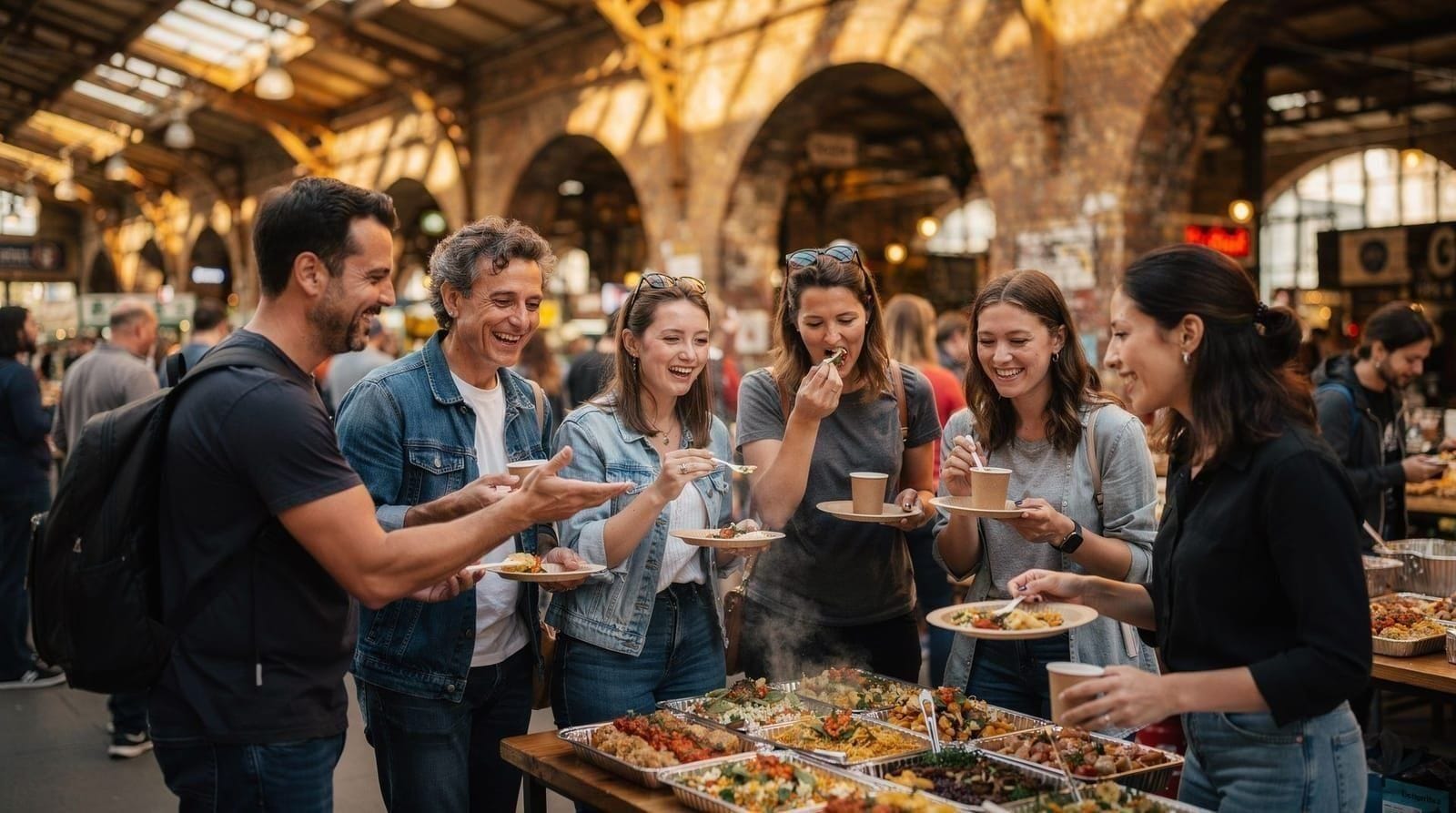
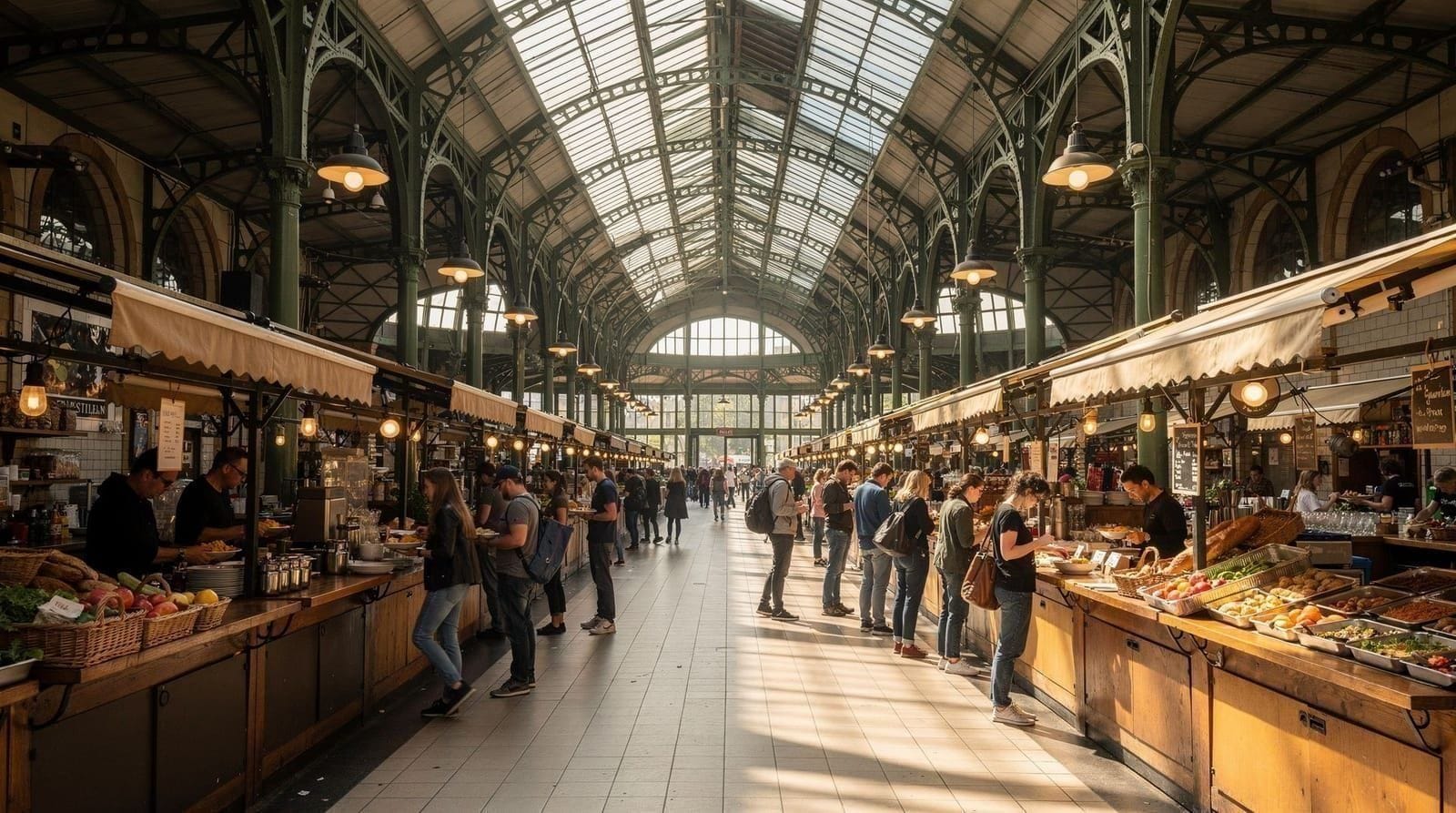
Markthalle Neun's Street Food Thursday (Eisenbahnstrasse 42, Kreuzberg, every Thursday 17:00-22:00, entry free) is the most consistent street food event in Berlin. Around 30-40 vendors set up inside a 19th-century covered market hall. Arrive by 18:00 to avoid queues. The Türkenmarkt on Maybachufer (Tuesday and Friday, 11:00-18:00) is the best outdoor market.
Markthalle Neun’s Street Food Thursday — Eisenbahnstrasse 42, Kreuzberg, every Thursday 17:00-22:00, free entry — is the most consistent street food event in Berlin. Around 30-40 vendors set up inside a 19th-century covered market hall. Arrive by 18:00 to avoid the worst queues. For outdoor markets, the Türkenmarkt on the Maybachufer canal runs Tuesday and Friday from 11:00 to 18:30 and is the best genuine open-air food market in the city.
| Best weekly event | Street Food Thursday, Markthalle Neun, Kreuzberg |
| Best outdoor market | Türkenmarkt, Maybachufer, Tue & Fri |
| Entry | free at almost all venues |
| Budget per meal | around €10-20 |
| Cash needed | yes, most stalls |
| Best arrival time | early — 17:30-18:00 for Thursday market |
Why Berlin’s street food scene is different
Berlin has one of the most genuinely diverse street food cultures in Europe, and it did not get that way by accident. The city’s post-war division, its role as a Cold War flashpoint, and the waves of labour migration that followed reunification all shaped what you eat standing on the pavement here.
The Turkish community — established through the Gastarbeiter guest worker programmes of the 1960s and 70s — created the foundations of the döner kebab as Berliners know it today. Vietnamese refugees settled in East Berlin under GDR-era bilateral agreements, creating the community that now runs the Dong Xuan Center and dozens of pho restaurants. Lebanese, Arab, Korean, and West African communities followed in the years after reunification. The result is a street food landscape where you can eat Venezuelan arepas, Sichuan noodles, Turkish börek, and Ethiopian injera within a few hundred metres of each other — and where all of it is reasonably priced because the competition is intense and the customer base is local.
The Imbiss — the standing snack kiosk — is the oldest layer of this culture. You can read more about it below, but the short version is that Berliners have always eaten standing up, quickly, without ceremony. This is not a city with a strong sit-down lunch culture. Street food is not a trend here; it is the default mode for a substantial portion of the population.
This matters for how you should plan a visit: rather than treating street food as a single “experience” to check off, most Berliners treat it as how Tuesday lunch works. That framing is useful for visitors too — a Markthalle Neun evening or a Türkenmarkt shop are worth building an itinerary day around, but the smaller, everyday Imbiss stops are just as authentic and require no planning at all. You will pass dozens without noticing; the ones worth stopping at are covered further down.
Gentrification has created real pressure on some of the most authentic spots, particularly in Kreuzberg and Neukölln where rents have risen sharply since the early 2010s. Some long-standing family-run stalls have closed or relocated. But Berlin still generates new independent food operators at a rate that keeps the scene fresh. The key is knowing where to look — and which events to skip.
Markthalle Neun: the essential stop
The building at Eisenbahnstrasse 42 in Kreuzberg opened as a public market hall in 1891 — one of 14 covered Markthallen built across Berlin under a city plan to improve food distribution and hygiene. By the late 20th century, most of those 14 halls had been demolished or repurposed. Markthalle Neun was saved from conversion into a supermarket in 2011 when a community collective took over the lease and began operating it as a mixed-use food market with a strong local and artisan emphasis.
The hall itself is worth seeing regardless of whether you eat anything. The iron-framed Victorian roof, the original tile work, and the open floor plan are in better shape than most structures of that age. It sits in the heart of Kreuzberg, a neighbourhood that rewards walking — the streets around it are dense with independent cafes, bakeries, and Turkish grocers.
Street Food Thursday
The main event runs every Thursday from 17:00 to 22:00. Entry is free. On a typical evening you will find between 30 and 40 vendors, a mix of regulars and rotating guests. The vendor mix shifts seasonally but usually includes handmade pasta, Thai curries, Venezuelan arepas, Japanese-influenced dishes, Georgian khachapuri, and several dessert and natural wine stalls.
Practical logistics: arrive by 18:00 if you want the full selection without queuing excessively. By 19:30 the hall is at capacity and queues at the most popular stalls can run 20-25 minutes. Some stalls sell out entirely by 20:30. Most vendors prefer cash; a few accept cards, but do not rely on it. Budget €12-18 per person for a genuine meal — order two or three smaller portions rather than one large dish, because variety is the point. The hall has limited seating but most people eat standing or perch wherever space appears.
Saturday morning market
Less talked-about than Street Food Thursday but equally worth your time: the Saturday market runs 09:00-15:00 and focuses on local producers. You will find raw-milk cheeses, sourdough bread, seasonal vegetables from Brandenburg farms, smoked fish, honey, and cold-pressed oils. It is a proper farmers’ market rather than a street food event, but the quality is genuine and prices are fair. Get there before 11:00 for the best selection.
Getting there: U1 or U3 to Görlitzer Bahnhof, then a 5-minute walk east along Skalitzer Strasse and south on Eisenbahnstrasse. The hall is easy to miss from the street — look for the entrance between the low commercial buildings.
The Türkenmarkt: Berlin’s best outdoor food market
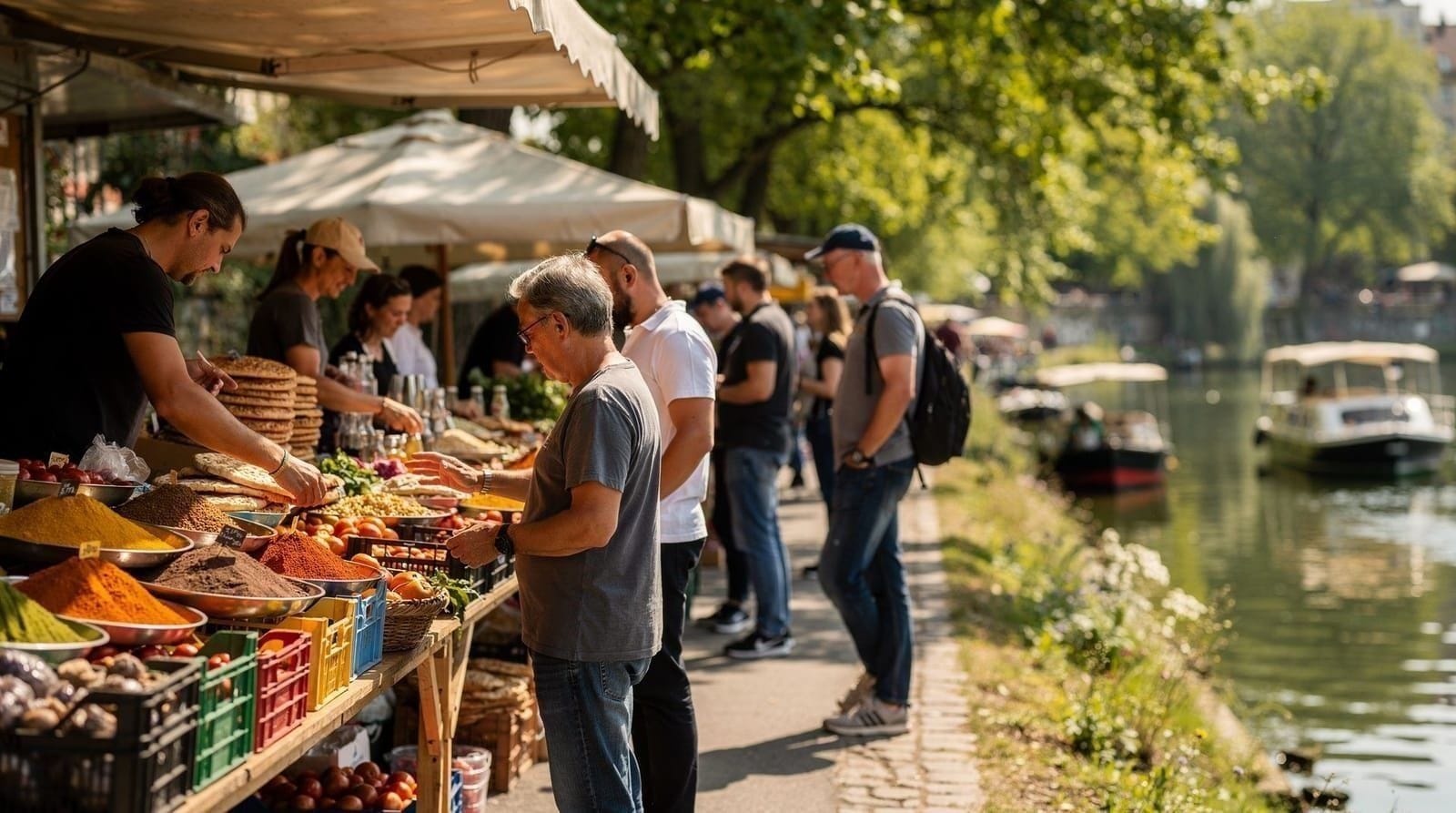
The Türkenmarkt (Turkish Market) runs along the Maybachufer canal in the boundary zone between Kreuzberg and Neukölln, every Tuesday and Friday from 11:00 to 18:30. It has been running in roughly this form since the 1970s and remains one of the few markets in Berlin that has not been meaningfully touristified.
The stalls — around 80 to 100 on a busy Friday — divide broadly into produce (fresh vegetables, fruit, herbs), dry goods (olives, spices, pulses, rice), dairy (Turkish beyaz peynir cheese, fresh kaymak, butter), and cooked food. The cooked food section is where you want to spend money: freshly baked simit (sesame rings, €0.50), gözleme (stuffed flatbread cooked to order on a griddle, €3.50-5), börek in various fillings (€2-3 per slice), and occasionally a stall doing proper Turkish breakfast spreads.
Most produce prices run €1-3. A bag of olives costs €2-3. A large block of white cheese is €3-5. Sucuk (dried beef sausage) and pastirma (cured beef) are available from several stalls at prices significantly below supermarket rates.
The market is not a tourist event. The announcements are in Turkish and German. The clientele is predominantly local residents shopping for the week. You will not find any stall selling “authentic Berlin souvenirs” or offering free samples to passing tourists. This is a point in its favour. Go with a canvas bag, bring cash (€20-30 is plenty for a substantial shop), and be prepared to navigate a busy, narrow towpath.
Getting there: U8 to Schönleinstrasse, then a 10-minute walk, or take bus 104 to Maybachufer directly.
Food trucks and pop-up events
Berlin’s food truck scene operates without fixed addresses. Most operators post their weekly locations on Instagram, and the best way to track them is to search local food truck accounts in the weeks before your visit. That said, there are several reliable recurring events.
Bite Club at Arena Berlin
Bite Club is the most substantial recurring food truck market in Berlin. It runs on selected weekends from May to September at Arena Berlin, Am Flutgraben 2, Treptow — a venue on the Spree riverbank south of the city centre. Entry costs €1-2. On a good weekend, 30-50 vendors are present, ranging from established food trucks to pop-up operations. Live music runs in the evenings. The crowd is young, local, and knowledgeable about food. Quality control is noticeably higher than at tourist-facing markets. Check biteclub.de for confirmed dates, as the schedule shifts year to year.
A word of warning on “food truck festivals”
Signs advertising food truck festivals or street food markets near the tourist zones — particularly around Checkpoint Charlie and Alexanderplatz — often charge €3-5 entry for a collection of mediocre stalls selling the same items at twice the price you would pay in Kreuzberg. The rule of thumb: if there is a ticket booth and the location is within 500 metres of a major tourist attraction, walk on. Genuine Berlin street food events are either free to enter or charge €1-2 at most.
Mauerpark on Sundays
The Mauerpark flea market at Mauerpark in Prenzlauer Berg runs every Sunday from around 09:00 to 18:00. The flea market element — second-hand clothes, records, furniture — is the headline, but there is a substantial food component that runs along the park’s perimeter and through the market itself.
Grilled corn, Berliner Pfannkuchen (jam doughnuts, the local version sold from carts), barbecued meat, waffles, and a rotating cast of street food pop-ups operate among the market stalls. The quality varies: some food operators here are serious, others are opportunistic. The atmosphere compensates — the Sunday market is genuinely lively, the park is pleasant, and the combination of food, flea market browsing, and occasional live performance makes it a worthwhile way to spend a Sunday morning. Arrive before 11:00 if you want to eat before the main crowds arrive.
Getting there: U2 to Eberswalder Strasse, then walk north, or tram M10 to Bernauer Strasse.
Asian street food: the Dong Xuan Center
For the best value street food in Berlin that most visitors never find, go to the Dong Xuan Center at Herzbergstrasse 128-139 in Lichtenberg. This is a large indoor Asian wholesale and retail market that serves Berlin’s Vietnamese community and has grown into one of the most interesting food destinations in the city.
The food hall section has around a dozen stalls serving pho, banh mi, bun bo hue, com tam (broken rice plates), and various Vietnamese snacks. Prices are genuine: a bowl of pho costs €4-6, a banh mi runs €2.50-3.50, and portions are large. This is where Vietnamese Berliners eat, not where tourists are brought. The surrounding market sells Asian grocery items at wholesale prices, and you can pick up lemongrass, galangal, fish sauce, and fresh herbs for a fraction of supermarket cost.
Getting there: tram M8 from Alexanderplatz to Herzbergstrasse, around 15 minutes.
The Turkish food community in Wedding is a separate and equally rich strand — see the Berlin Turkish food guide for detail on that neighbourhood.
The Imbiss: understanding Berlin’s snack kiosk culture
No guide to Berlin street food is complete without explaining the Imbiss. An Imbiss is a standing snack kiosk — a small booth or counter, often with a few high tables outside, serving hot food quickly and cheaply. They are everywhere: at U-Bahn exits, on corner plots, attached to petrol stations, at market edges. They are not restaurants and do not try to be.
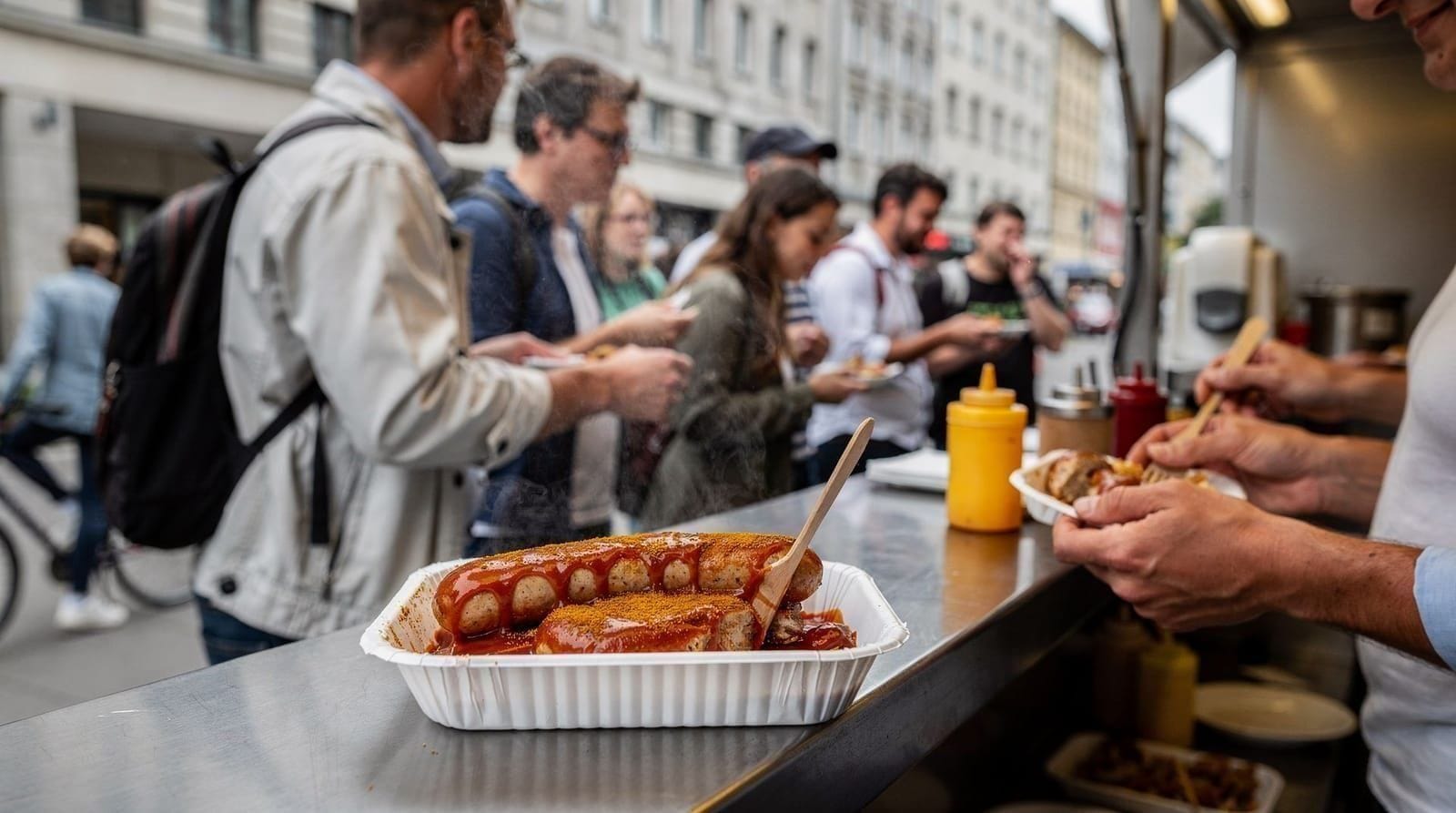
The standard Imbiss menu covers currywurst (pork sausage with curry ketchup and spice powder), Bratwurst (grilled pork sausage), Pommes (chips, served with either ketchup or mayonnaise — the Berlin standard is half-half, called “Rot-Weiss”), and Frikadelle (a fried meat patty, closer to a flattened meatball than a burger). Prices should run €2.50-4.50 per item. If an Imbiss near a major landmark is charging €6 for currywurst, walk two blocks further.
The culture around Imbiss eating involves standing, eating quickly, depositing your paper plate or cardboard tray in the provided bin, and leaving. There is no table service, no need to tip (though rounding up by €0.50 is appreciated at some operators), and no expectation that you will linger. Cash is the norm. Card payment is increasingly available at newer kiosks but not universal.
Spotting a good Imbiss versus a tourist kiosk: look for a local clientele, a menu that has not been translated into six languages and illustrated with stock photos, and a proprietor who appears to have been operating the same corner for a decade. Avoid any Imbiss with a sandwich board promising “Berlin’s best currywurst” in English.
Guided street food tours: when they make sense
Self-guided exploration works well once you know where to go. If you are arriving for the first time, have limited days, or want someone to explain the cultural context while you eat, a guided food tour has genuine value.

The street food cultural walking tour covers Kreuzberg’s main food points with a local guide who can explain the history behind the Turkish market community, the Imbiss culture, and the more recent wave of international street food operators. It typically runs 3-3.5 hours with multiple tastings included in the price.

The guided street food tastings tour focuses more heavily on the eating and less on the walking distance, suitable if you want to concentrate on a specific neighbourhood rather than covering the whole city. Check the current operator’s notes for which markets and stalls are included — the itinerary varies depending on which day of the week you book.

If you want to combine the food angle with the visual culture of the neighbourhood, the Kreuzberg food and street art tour links the two together: the murals and paste-ups that line the streets around the East Side Gallery area and into Kreuzberg are part of the same post-reunification creative explosion that shaped the food scene. The guide covers both.
Honest assessment: a good guided tour is worth €30-45 per person for a first-time visitor. It saves you the time spent finding places and gives you context you would otherwise have to research yourself. For a second or third visit, the self-guided route using this guide is more flexible and cheaper.
See also the Berlin food tour guide for a full comparison of available options.
Seasonal street food: summer and winter
Summer (May to September)
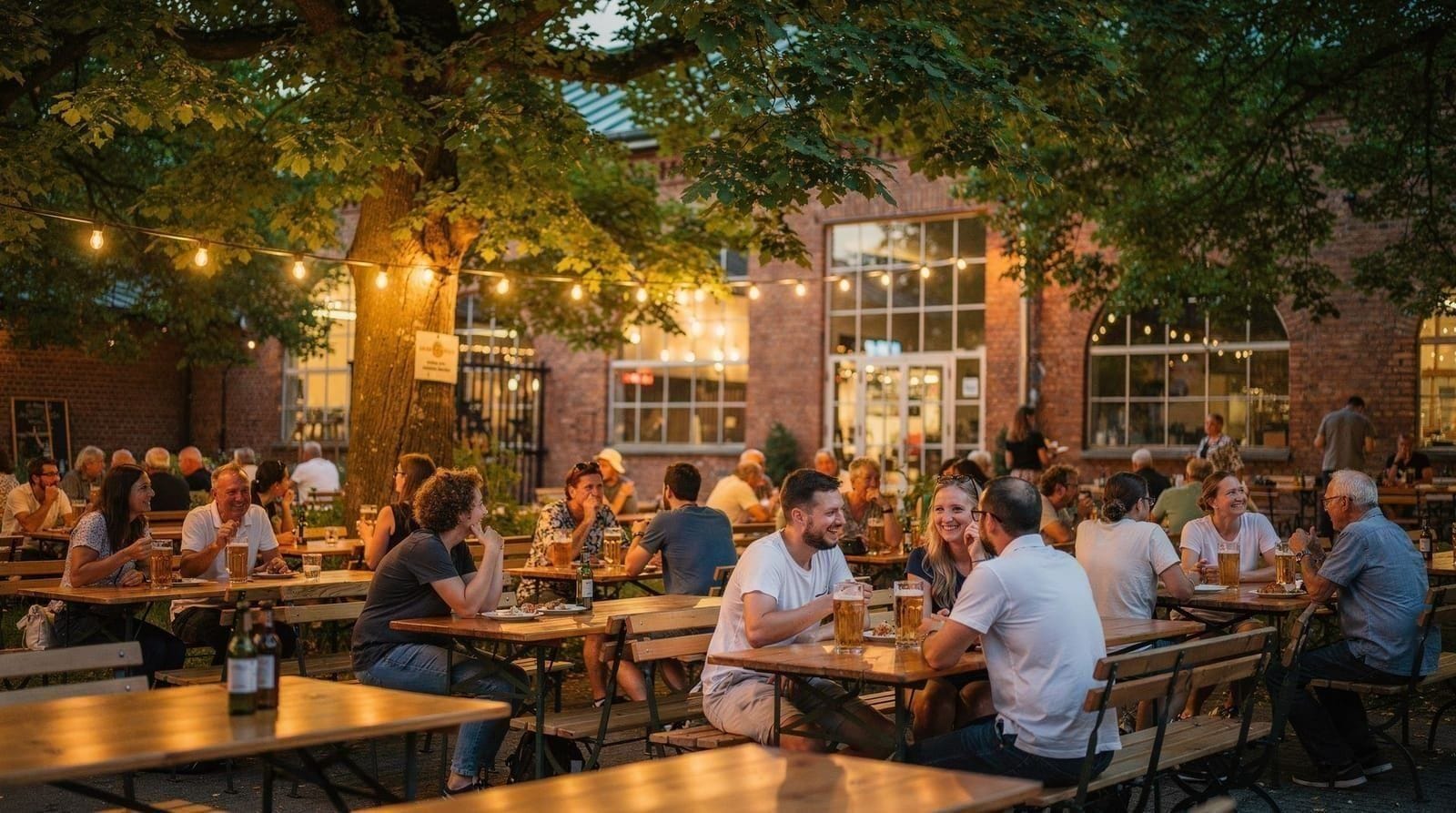
The outdoor street food season runs roughly from May to September. Beer garden culture and street food overlap: most of Berlin’s large Biergärten — Prater in Prenzlauer Berg, Loretta am Wannsee, Kindl im Jagen in the Grunewald — have food operations beyond just sausages. Outdoor Imbiss stands multiply around parks and along the Spree. The Bite Club events are at their best in July and August on warm evenings along the riverbank.
Markets also expand: the Boxhagener Platz market in Friedrichshain (Sunday) picks up a food component in summer, with breakfast stalls and coffee carts joining the regular produce vendors.
Winter (November to December): Christmas markets
Berlin’s Christmas markets function as the seasonal street food hub for two months of the year. Quality varies significantly:
The Gendarmenmarkt Christmas market is the most beautiful setting — two 18th-century churches flanking the market — but it is premium-priced and tourist-facing. Glühwein costs €5-8 per cup (with a €3-5 deposit on the mug). The food stalls are above average in quality but you are paying partly for the location.
The Alexanderplatz market is large, central, and convenient, but the food quality is ordinary and the crowds are genuinely uncomfortable on weekends in December. Use it as a backup rather than a destination.
The Charlottenburg market at Schloss Charlottenburg runs in front of the palace and tends to attract a more local, family-oriented crowd than the central tourist markets. Food quality is solid; pricing is fair.
What to eat at Christmas markets: Glühwein (mulled wine, €3-6), Reibekuchen (potato fritters with apple sauce, €2.50-4), Bratwurst (grilled sausage in a roll, €3-4), Dampfnudeln (steamed sweet dumplings with vanilla sauce, €3-4), and Gebrannte Mandeln (roasted sugared almonds, €3-4 per bag). The food is consistent across markets — quality differences are marginal. Pick your market based on atmosphere and crowd level rather than food offerings.
Practical tips for eating your way through Berlin
Cash is essential. Carry €20-30 in small bills when visiting any street food market or Imbiss. €1, €2, and €5 coins and notes are more useful than €20 or €50 notes at small stalls. Some markets have ATMs inside or nearby, but they charge fees.
Timing matters. The best time to arrive at Markthalle Neun on Thursday is 17:30-18:00. The Türkenmarkt is best on Friday afternoons from 12:00-14:00 when stock is fresh and the crowd is manageable. Mauerpark is best before 11:00 on Sunday. Avoid all outdoor markets in heavy rain — they either thin out significantly or close early.
Portions are often large. At Street Food Thursday particularly, single portions at many stalls are designed to be a complete meal. If you want variety, go with at least one other person and share, or eat half of each dish.
Tipping norms. At standing Imbiss stalls, tipping is not expected but rounding up by €0.20-0.50 is appreciated. At food trucks where you are waited on, €1 tip is appropriate. At guided food events with service, 10% is normal.
Water. Tap water in Berlin is safe to drink. Mauerpark has public water fountains. Markthalle Neun does not — bring a bottle or buy a drink from one of the beverage stalls.
Bags. If you are visiting the Türkenmarkt with the intention of buying produce, bring a reusable bag. Stalls do not always provide bags, and plastic bags cost extra.
Language. At most markets and street food events in Kreuzberg and Neukölln, functional German is an asset but not required. Most operators at Street Food Thursday speak English. At the Türkenmarkt, some stall holders have limited English — pointing and numbers in German (ein, zwei, drei) gets you most of what you need.
Weather. Markthalle Neun is indoors and unaffected by rain, which is part of why it runs year-round. The Türkenmarkt, Mauerpark, and Bite Club are all outdoor and weather-dependent — heavy rain thins crowds and can close individual stalls early, though the Türkenmarkt itself stays open in light rain since it serves the local weekly shop, not just tourists. If your visit coincides with a forecast of heavy rain, prioritise Markthalle Neun over the outdoor options.
Value versus sit-down restaurants. As a rough comparison, a full meal at Street Food Thursday or the Türkenmarkt runs €10-20 per person, roughly half to two-thirds of what a casual sit-down restaurant meal costs in the same neighbourhoods. The trade-off is standing room and no table service, not lower food quality — several of the most talked-about vendors at Markthalle Neun have built enough of a following to open permanent restaurants elsewhere in the city.
For a broader overview of the best markets to eat in Berlin — covering weekly and seasonal options beyond the events above — see the dedicated market guide. And if you are exploring the Berlin craft beer guide, note that Markthalle Neun hosts several craft beer vendors at Street Food Thursday and runs occasional beer-focused events.
Vegetarian, vegan, and halal options
Berlin’s street food scene handles dietary restrictions better than most European capitals, largely a byproduct of the city’s size and diversity rather than any deliberate trend-chasing. At Markthalle Neun on Street Food Thursday, roughly a third of the 30-40 stalls on a given evening will have a genuine vegetarian or vegan option beyond a token salad — look for the dedicated plant-based stalls that rotate through, plus vegetarian versions of pasta, curry, and dumpling stands. The Türkenmarkt is naturally vegetarian-friendly given its produce and dairy focus, though the cooked-food stalls lean toward meat-forward Turkish dishes; gözleme can usually be ordered with a cheese-and-spinach filling instead of meat.
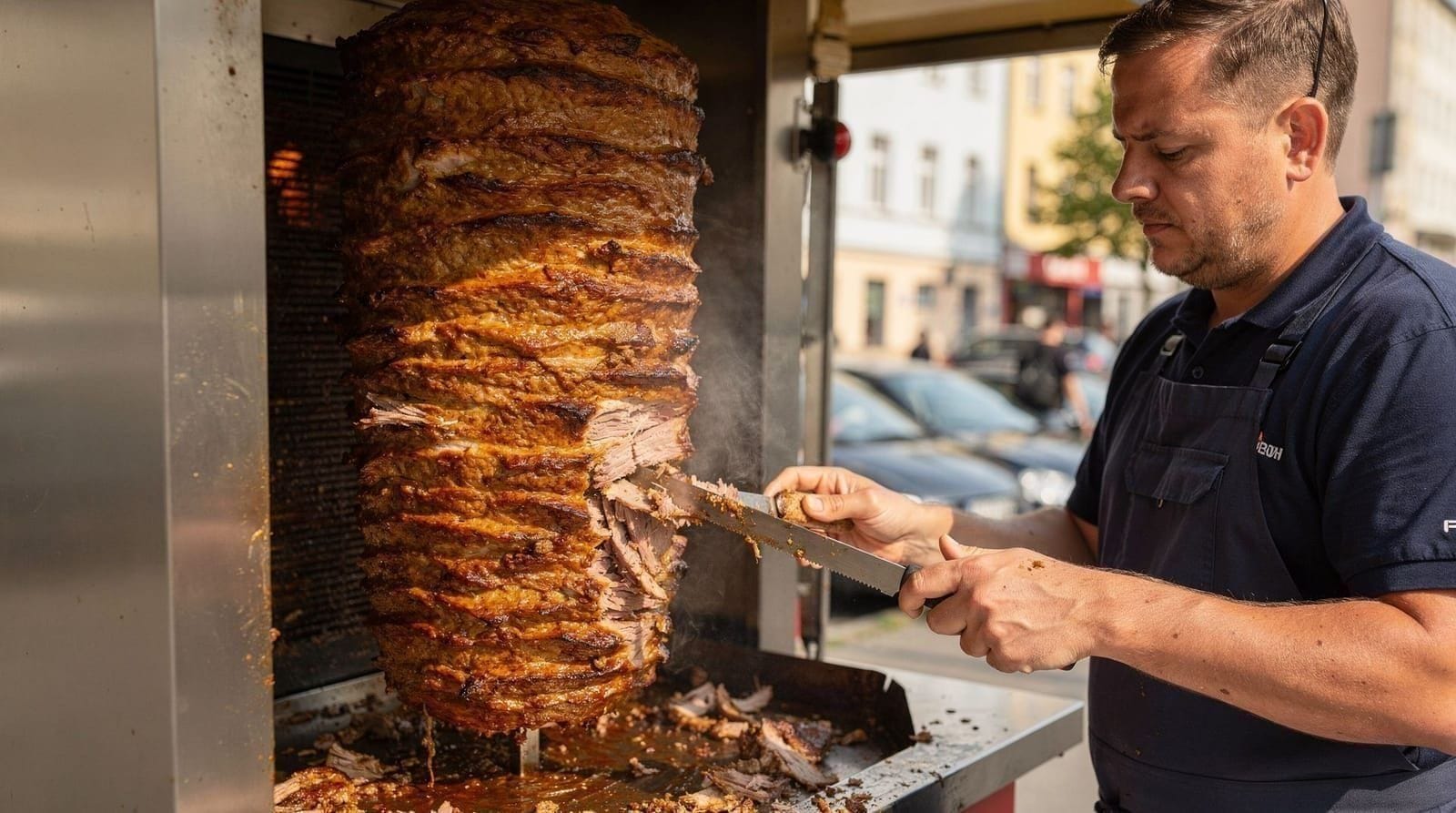
Halal food is widely available given Berlin’s large Turkish and Arab communities — most Imbiss stalls in Kreuzberg and Neukölln serving döner or currywurst-adjacent items use halal meat as standard, though it is worth asking directly if certainty matters, since it is not always labelled explicitly. Vegan options have grown substantially at the Dong Xuan Center’s Vietnamese stalls (tofu-based pho and rice dishes) and among the newer wave of international vendors at Bite Club. The one weak spot is the traditional Imbiss and Christmas market circuit, where sausage-based food dominates and vegetarian choices are often limited to Pommes and pretzels.
Comparing the main street food options
| Event | Day/time | Entry | Best for |
|---|---|---|---|
| Street Food Thursday, Markthalle Neun | Thursday 17:00-22:00 | Free | International variety, indoor, year-round |
| Türkenmarkt, Maybachufer | Tue & Fri 11:00-18:30 | Free | Genuine local shopping, cheap cooked food |
| Bite Club, Arena Berlin | Select weekends, May-Sept | €1-2 | Food trucks, live music, local crowd |
| Mauerpark Sunday market | Sunday 09:00-18:00 | Free | Flea market plus casual street food |
| Dong Xuan Center | Daily | Free | Best-value Vietnamese food, off the tourist map |
If you only have time for one, Street Food Thursday is the safest single choice for variety and reliability regardless of season; the Türkenmarkt is the better pick if you want the most genuinely local, least tourist-oriented experience.
Combining street food with a wider Kreuzberg visit
Markthalle Neun and the Türkenmarkt sit close enough together that a single afternoon and evening can cover both, with time for a walk through the neighbourhood in between. See the Kreuzberg food guide for sit-down options if the standing, market-hall format isn’t for everyone in your group, and the Kreuzberg neighbourhood guide for what else the area offers beyond food. Families with young children who need to sit down properly may prefer to treat Markthalle Neun as a starting point and finish the evening at a conventional restaurant nearby rather than standing for the full visit.
Frequently asked questions about Berlin street food scene
When is Street Food Thursday at Markthalle Neun?
Street Food Thursday (Streetfood Thursday) runs every Thursday from 17:00 to 22:00 at Markthalle Neun, Eisenbahnstrasse 42, 10997 Kreuzberg. Entry is free. Around 30-40 food stalls operate inside the covered hall. Arrive by 18:00 for the best selection — some popular stalls sell out by 20:30. The hall also hosts a Saturday morning food market.Is there an admission fee for Markthalle Neun?
No. Markthalle Neun is free to enter at all times including during Street Food Thursday and the Saturday morning market. You only pay for what you eat and drink. Average spend per person is €10-20 for a meal-sized visit.What is the Türkenmarkt in Berlin?
The Türkenmarkt (Turkish Market) runs along the Maybachufer canal in Kreuzberg-Neukölln, Tuesday and Friday from 11:00 to 18:30. It is the largest open-air Turkish market in Berlin with around 80-100 stalls selling fresh produce, Turkish bread, olives, spices, cheese, and cooked food. It is not a tourist trap — it serves the local community and has genuine low prices.What food trucks operate in Berlin?
Berlin has a rolling food truck scene without fixed locations — trucks announce their positions via Instagram. Longhorn BBQ, Karnivool (Korean-BBQ fusion), and Berliner Döner Manufaktur are among the consistently well-reviewed mobile operators. The Bite Club events at Arena Berlin (monthly in summer, May-September) gather 30-40 food trucks on the Spree riverbank.Are Berlin street food markets open year-round?
Markthalle Neun's Street Food Thursday runs year-round (it is indoors). The Türkenmarkt runs year-round but is more pleasant from April to October. Most outdoor food truck events and Bite Club run May to September. In winter, Christmas markets (late November to December) serve as seasonal street food hubs with Glühwein, Reibekuchen, and Bratwurst.What is Bite Club Berlin?
Bite Club is a monthly outdoor food market held at Arena Berlin on the Spree in Treptow, running May to September on selected weekends. Around 30-50 food truck and pop-up vendors gather with live music. Entry costs €1-2. It attracts a young local crowd and tends to have a higher food quality threshold than regular tourist markets. Check biteclub.de for dates.Where is the best neighbourhood for street food in Berlin?
Kreuzberg has the highest concentration: Markthalle Neun, Türkenmarkt, Bite Club nearby, and the highest density of independent food stalls. Prenzlauer Berg is good for brunch food markets (Mauerpark flea market has food stalls). Friedrichshain's Boxhagener Platz market (Sunday) has a local street food dimension. Avoid tourist-facing areas near Checkpoint Charlie and Alexanderplatz.
Top experiences
Bookable activities with verified prices and instant confirmation on GetYourGuide.