Berlin currywurst guide: history, best spots, and honest prices
Berlin: Downtown Food Tour with 8 Authentic Local Tastings
Where is the best currywurst in Berlin?
Konnopke's Imbiss in Prenzlauer Berg (under the U2 viaduct since 1930) and Curry 36 in Kreuzberg are the two most respected stands. Expect to pay €2.50-3.50 for a standard portion with fries. Avoid stands near the Brandenburg Gate — quality drops and prices jump to €6-8.
Konnopke’s Imbiss in Prenzlauer Berg (under the U2 viaduct since 1930) and Curry 36 in Kreuzberg are the two most respected stands in Berlin. Expect to pay €2.50-3.50 for a standard portion with fries. Avoid stands near the Brandenburg Gate — quality drops and prices jump to €6-8.
| Where | Prenzlauer Berg (Konnopke’s), Kreuzberg (Curry 36) |
| Cost | around €2.50–4.50/portion, avoid €6–8 tourist-zone stands |
| Time needed | 15–30 minutes, plus queue at peak times |
| Getting there | U2 Eberswalder Strasse or U6/U7 Mehringdamm |
| Best time | Before 11:00 or after 14:30 to skip queues |
How currywurst was born in post-war Berlin
The date is precise: 4 September 1949. Herta Heuwer was running a small snack stand at the corner of Kantstrasse and Stuttgarter Platz in Charlottenburg, in what was then the British occupation zone of West Berlin. The city was still rubble in large stretches. Food was scarce, rationing had only recently eased, and the street-food economy was one of the few ways ordinary Berliners could make a living without premises.
Heuwer had something the ruined city lacked: ketchup and curry powder, obtained from British soldiers stationed nearby. She combined them with Worcestershire sauce — another British staple — and added paprika. The result was a reddish, spiced sauce she poured hot over a grilled pork sausage. She called her recipe Chillup, a contraction of chilli and ketchup.
She registered the recipe with the German Patent and Trade Mark Office on 14 February 1951, one of the few people in post-war Germany to formally protect a condiment formula. She continued selling from the same corner until 1974.
A plaque marks the site today at Kantstrasse 101, Charlottenburg. It is not a tourist attraction — it is a plain bronze disc on the wall of what is now a pharmacy. Worth the five minutes if you are in the area, but not a detour.
The broader context matters. The Imbiss — the German word for a small snack stand — became the backbone of West Berlin’s street-food scene precisely because the war had destroyed restaurant infrastructure. People ate standing at high tables from paper trays. It was practical, cheap, and democratic. Currywurst fitted this perfectly: fast to prepare, easy to eat without cutlery, and cheap enough that a factory worker and a civil servant could eat the same thing side by side.
Berlin’s wider street food scene grew out of this same post-war Imbiss culture. Understanding it helps you understand the city.
What exactly is a currywurst
A currywurst is a grilled or fried pork sausage — either a Bratwurst (coarser, more textured) or a Bockwurst (smoother, lighter) — sliced into rounds, covered in a hot tomato-curry sauce, and dusted with additional curry powder on top. It arrives in a small cardboard tray with a tiny wooden fork or skewer. There are no plates. There is rarely a table.
The sauce is the defining element. At its simplest it is ketchup plus curry powder plus a small amount of Worcestershire sauce and paprika. At its most refined — at a stand that makes the sauce from scratch daily — it has layers: sweetness from the tomatoes, heat from the curry, a faint vinegar sharpness, and enough paprika to give it colour beyond orange. Commercial versions use Hela Curry Gewürzketchup or Develey sauce, poured straight from the bottle. They are perfectly edible. They are also noticeably flatter in flavour.
Mit Darm or ohne Darm is the first choice you will face. Mit Darm means the sausage retains its natural casing: it snaps slightly when you bite and has more textural contrast with the sauce. Ohne Darm is skinless — softer, a little milder. Konnopke’s is famous specifically for its ohne Darm version, which has a particular tenderness. Neither is superior; it is texture preference.
What to order alongside it is the second choice. Pommes rot-weiss (fries with ketchup and mayonnaise) is the standard pairing and costs €1-1.50 extra. A Brötchen (a white bread roll, slightly sweet) is the other option — cheaper, and traditional. Some stands sell both. Ordering just the sausage and sauce without sides is also completely normal.
Extra curry means an extra dusting of curry powder on top of the sauce. Ask for it if you want more heat. The powder is not especially spicy — it is more aromatic than hot — but it adds intensity.
The best stands in Berlin, honestly assessed
Konnopke’s Imbiss
Schönhauser Allee 44B, 10435 Prenzlauer Berg. U2 Eberswalder Strasse.
Konnopke’s is the oldest Imbiss in East Berlin. Max Konnopke started selling sausages under the elevated U-Bahn viaduct in 1930 — not currywurst, which did not exist yet, but Bockwurst and other grilled meats. The stand survived the war, the GDR, and reunification, and is still run by the Konnopke family. After a renovation in 2010-2011 forced by the viaduct restoration, it reopened with a small enclosed structure instead of the previous open cart, but the location is unchanged.
The ohne Darm currywurst here (€2.50-3.00 in 2026, with fries around €4.50 total) is frequently cited by food journalists and Berlin locals as the standard against which others are measured. The sauce is made to a house recipe, not from a commercial bottle, and it shows.
Queue strategy: Konnopke’s opens Monday to Saturday at 10:00. Arrive before 11:00 or after 14:30 on weekdays for a manageable wait. Lunchtime (11:30-14:00) on weekdays and all of Saturday can mean a 20-minute queue. It moves, but know what you are in for. The stand is closed on Sundays.
The area around Konnopke’s — Prenzlauer Berg — is worth exploring more broadly. The Mauerpark is a ten-minute walk north, and the whole neighbourhood gives a sense of how gentrified but still characterful East Berlin has become.
Curry 36
Mehringdamm 36, 10961 Kreuzberg. U6/U7 Mehringdamm.
Curry 36 is the West Berlin counterpart: louder, more chaotic, open until 04:00 on Friday and Saturday nights, and permanently busy. The queue rarely disappears entirely, even at 02:00. It is a scene as much as a food stand.
The currywurst here (€2.80-3.20) is solid rather than exceptional. The sauce leans sweeter than Konnopke’s and uses a commercial base, though it is well-seasoned. The fries are good. The real reason to come to Curry 36 is the atmosphere — it is where cooks from nearby restaurant kitchens, club-goers, and taxi drivers converge at 03:00. It is a genuinely Berlin experience.
A second Curry 36 location exists at Potsdamer Platz. The food is identical; the queue is shorter but the setting far less interesting. Go to Mehringdamm for the real thing.
The Kreuzberg neighbourhood around Mehringdamm has some of the best street food in the city. The East Side Gallery is a 20-minute walk east, which makes a reasonable afternoon combination.
Bier’s Kudamm 195
Kurfürstendamm 195, 10707 Charlottenburg. U7 Adenauerplatz.
A West Berlin institution since 1981. Bier’s is quieter and more neighbourhood-oriented than either Konnopke’s or Curry 36 — the regulars are older, the pace is calmer. The currywurst (€3-3.50) is reliable, the sauce is made in-house, and the fries are properly crisp. Worth visiting if you are already in the Charlottenburg area near Charlottenburg Palace.
Witty’s
Wittenbergplatz, 10789 Charlottenburg. U1/U2/U3 Wittenbergplatz.
Witty’s positions itself slightly above the pack on sourcing: the pork is from Neuland-certified farms with higher welfare standards than standard supermarket supply chains. This is reflected in both flavour and price (€3.50-4.00 per portion). The sausage is notably juicier and the sauce is made from scratch. Located outside the Wittenbergplatz U-Bahn station, next to the KaDeWe department store. The clientele is a mix of shoppers, office workers, and people who have done the research. Worth the slight premium.
Chilli und Ciabatta
Gipsstrasse 3, 10119 Mitte.
A more deliberate, sit-down-adjacent take on the Imbiss format. Chilli und Ciabatta does a currywurst (€4.50-5.50) using a proprietary sauce recipe that goes heavier on chilli than most traditional versions. The bread rolls are proper ciabatta rather than supermarket Brötchen. It is a good option if you want something slightly more comfortable without crossing into restaurant territory. The price premium is real but the quality justifies it.
Tourist trap zones to avoid explicitly
Brandenburg Gate area, Unter den Linden, and Pariser Platz. Stands in this zone charge €6-8 for a standard currywurst portion. The sauce is invariably commercial. The clientele is 100% tourist. No local eats here.
Checkpoint Charlie. The Checkpoint Charlie area has multiple Imbiss carts charging similar inflated prices. The quality is poor and the stands exist entirely for visitors who do not know better. Read our guide to Checkpoint Charlie for honest information about the area itself — just do not eat there.
Berlin Hauptbahnhof food court. Convenient if you are leaving on a train. Not worth eating at for currywurst specifically — the quality is chain-standard and the prices are elevated.
Alexanderplatz kiosks and the area near the TV Tower. The TV Tower draws enormous foot traffic, and the stands nearby have priced accordingly. €5-7 is typical. Avoid. There are better options a 10-minute U-Bahn ride in any direction.
How to spot a bad stand instantly: laminated menus with photographs, English-only signage, no queue of locals, sauces in large industrial dispensers without labelling, and prices posted in whole euros with no cents. A good stand has a queue that includes at least some people who are not visibly tourists.
The sauce: commercial versus made from scratch
The sauce is the whole point, and the range of quality is significant.
Commercial sauces — primarily Hela Curry Gewürzketchup (the market leader) and Develey Curry-Ketchup — are widely used and not inherently bad. They are consistent, safe, and recognisable. Most Berliners have eaten them hundreds of times. But they are flat: the flavour is predictable, the sweetness is dominant, and there is little complexity.
Stands that make their own sauce start with a tomato base — often real passata or even fresh tomatoes in summer — add curry powder, Worcestershire sauce, white wine vinegar, paprika, sometimes a small amount of sugar, and reduce it on a hob until it thickens. The texture of a fresh sauce is slightly chunky when you look closely; a commercial sauce pours smooth and uniform. The aroma is a reliable tell too: fresh sauce smells layered and warm, commercial sauce smells sweet and sharp.
Konnopke’s, Witty’s, and Chilli und Ciabatta all make their own. Curry 36 uses a commercial base.
Extra-curry (sometimes written extra scharf) at most stands means an additional tablespoon of curry powder dusted over the finished dish. The powder is typically a mild or medium blend — more aromatic than hot. Ask for it unless you dislike the flavour of curry powder; it substantially improves a commercial-sauce version.
How to eat it correctly
There is no correct way, but there is a context. Currywurst is Stehtisch food — eaten standing at a high table, leaning slightly, managing a cardboard tray in one hand and a small wooden fork in the other. The tray is your plate. The wooden fork is your cutlery. When you are done, the whole thing goes in the bin next to the stand.
Eating while walking is normal. Sitting on a nearby bench is normal. Asking for a second napkin is normal. What is not normal is treating an Imbiss like a restaurant: asking to sit inside, expecting a menu explanation, or complaining about portion size. You ordered a sausage. You got a sausage.
The experience is egalitarian in a way that few food rituals are. At a good stand at lunchtime you will be standing next to a construction worker and a lawyer and a student, all eating the same thing, all ignoring each other politely. That is the point.
Currywurst in Berlin’s culture
The dish has an outsized cultural footprint for something that is, at its core, a sausage with ketchup.
Gerhard Schröder, German Chancellor from 1998 to 2005, publicly declared currywurst his favourite food. He was a Niedersachsen man, not a Berliner, but the statement resonated because it was credible — he was not claiming to like something refined.
Volkswagen’s factory canteen in Wolfsburg serves over five million currywurst portions per year, making it one of the largest single-site consumers of the dish in Germany. VW’s version has been on the factory menu since the 1970s and is considered a modest point of pride.
The Deutsches Currywurst Museum opened in Mitte in 2009 and became genuinely popular, drawing over a million visitors before it closed permanently in 2018. The closure was financial rather than ideological — it was a themed attraction that had run its course. There is no replacement. The history is better absorbed at Konnopke’s and at Herta Heuwer’s plaque than it ever was in a museum with interactive sauce stations.
The Imbiss culture that produced currywurst also survived reunification more intact than many expected. East Berlin’s Imbiss stands — which had operated under GDR state rules and offered a narrower range of food — merged into a single Berlin street food scene after 1989. Konnopke’s, which had been a GDR-era institution, became a symbol of Ostalgie (nostalgia for East Germany) without being kitsch about it. It just kept selling sausages.
Guided food tours that include currywurst
If you want context alongside your eating, a guided food tour is worth considering. The best ones structure a walk around neighbourhood history and stop at stands that a solo visitor might not find.

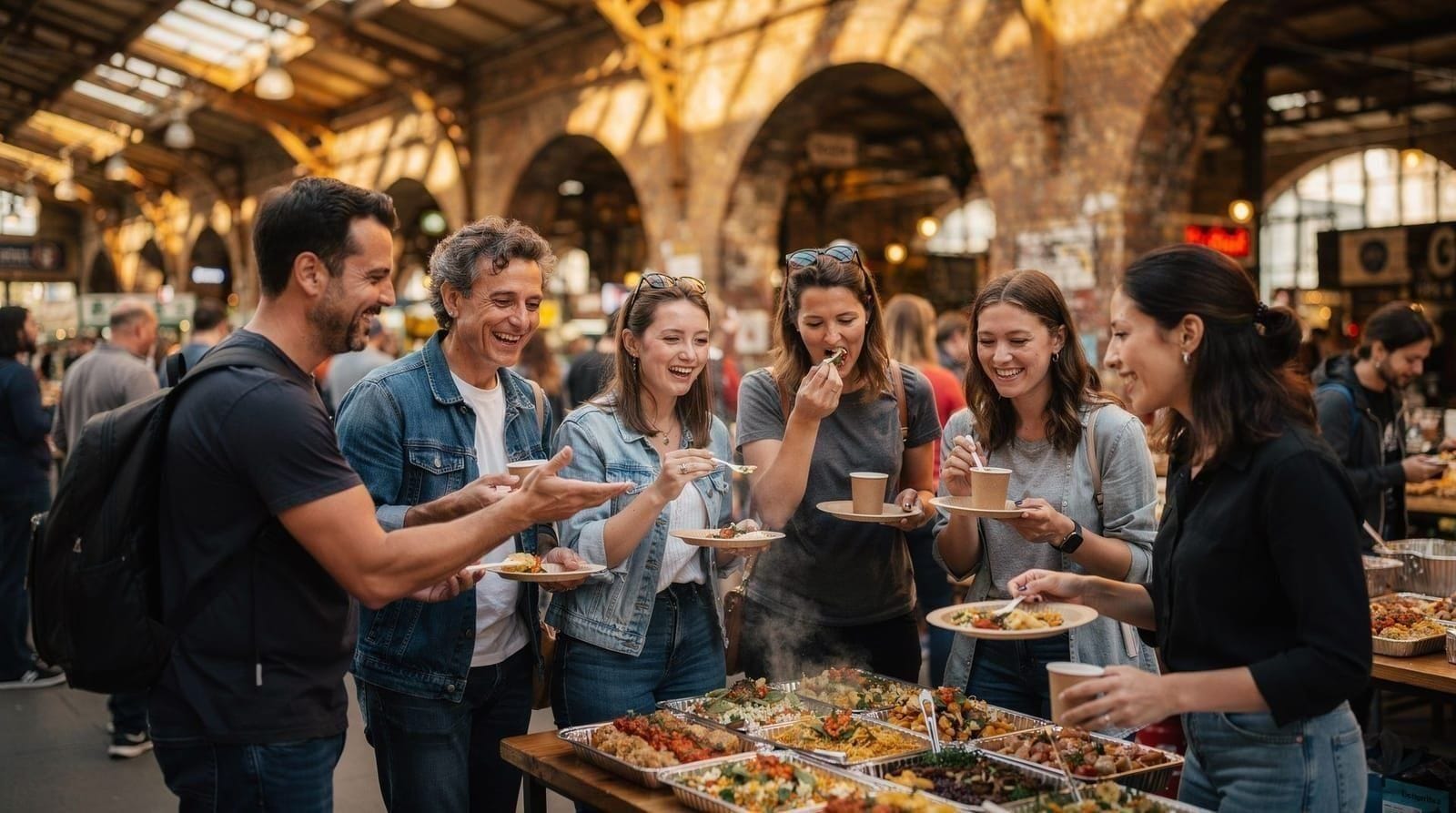
The downtown food tour with eight tastings typically includes a currywurst stop alongside döner, Schmalzbrot (lard bread), and other Berlin staples. The guides tend to be knowledgeable about Imbiss history and will steer you to neighbourhood stands rather than tourist-zone equivalents. A reasonable introduction if you have one afternoon and want someone else to navigate the choices.

The street food cultural walking tour covers a wider geographic area and is better suited to people who want to understand the different neighbourhood food cultures — Mitte versus Prenzlauer Berg versus Kreuzberg — rather than simply eat. Currywurst features, but it is one of several dishes rather than the focus. More useful if Berlin’s street food scene generally interests you.
Both tours are honest additions to a visit rather than tourist traps. That said, neither is necessary — the stands described above are easy to find independently, and the history is summarised in this guide. If you prefer solo exploring, skip the tour and use the time to walk between Curry 36 and the best döner spots in Berlin.
Our Berlin food tour guide covers the full range of organised eating options if you want a broader comparison.
Making currywurst at home after your trip
The sauce is simpler than it seems. The basic ratio that most Berlin Imbiss cooks use as a starting point:
- 400g passata (or good-quality ketchup as a shortcut)
- 2 tablespoons mild curry powder
- 1 tablespoon Worcestershire sauce
- 1 teaspoon sweet paprika
- 1 teaspoon white wine vinegar
- Pinch of sugar
- Salt to taste
Warm the passata in a saucepan, add the dry ingredients, whisk in the Worcestershire and vinegar, simmer for 10 minutes until slightly reduced. Taste and adjust curry powder upward if you want more intensity. The sauce keeps refrigerated for up to a week and improves slightly on day two.
For the sausage itself, look for Bratwurst made with at least 70% pork at any Berlin Supermarkt — Lidl, Rewe, and Edeka all stock decent versions. The Schaller and Weber brand, available in some German delis and online, produces a Bockwurst that translates well. Grill or fry the sausage until the exterior is properly browned — the caramelisation matters — then slice into rounds, pour the hot sauce over, dust with additional curry powder, and serve in a shallow bowl since you presumably have one at home.
It will taste slightly different from the stand version. The charcoal suggestion from a gas grill or cast-iron pan is the same; the context of standing outside under a U-Bahn viaduct at 12:30 with a paper tray is not reproducible.
Beyond the five main stands
Berlin has hundreds of Imbiss stands selling currywurst, and the five profiled above are simply the most consistently recommended — not an exhaustive list. Neighbourhood stands with no online presence and no queue of tourists are often perfectly good, and part of the appeal of currywurst as a category is that quality is fairly evenly distributed once you’re away from the tourist zones. A rough rule of thumb: if the stand has a queue of people who look like they’re on a lunch break rather than a sightseeing break, it’s probably fine. If you’re near Charlottenburg or exploring further out in the city, don’t feel obliged to detour specifically to one of the five named stands — a busy neighbourhood Imbiss will usually do the job just as well for a fraction of the research effort.
Portion sizes are fairly standard across the city regardless of stand: expect roughly 150–200g of sausage, sliced into six to eight rounds, enough sauce to coat every piece without pooling at the bottom of the tray, and a fries portion that’s genuinely a side rather than a separate meal. If a stand serves noticeably less for the same price as its neighbours, that’s a reasonable signal to walk on to the next one.
Currywurst versus döner — which to choose
Berlin’s two defining street foods are often set up as rivals, but they serve different moods. Currywurst is fast and singular — one item, eaten in five minutes, no decisions beyond mit or ohne Darm. Döner is more customisable and generally more filling, better suited to an actual meal rather than a snack between sights. If you’re trying to fit both into a short trip, treat currywurst as the mid-afternoon stop and döner as lunch or dinner — the best döner kebab guide covers the equivalent honest-versus-tourist-trap breakdown for that dish. Neither is objectively better; they’re different enough in format that most visitors end up eating both more than once.
A practical currywurst circuit for one afternoon
If you want to compare stands rather than commit to just one, a realistic half-day route works well. Start at Konnopke’s in Prenzlauer Berg before 11:00 to beat the queue, then walk the neighbourhood — the Mauerpark is ten minutes north if you’re visiting on a Sunday for the flea market. Take the U-Bahn south to Kreuzberg for a second, smaller portion at Curry 36 on Mehringdamm, then continue into the neighbourhood for the wider Kreuzberg food scene. This comparison approach — eating two smaller portions rather than one large one — is the honest way to actually taste the difference between a house-made and commercial sauce in the same afternoon.
Frequently asked questions about Berlin currywurst guide
Who invented currywurst?
Herta Heuwer invented currywurst on 4 September 1949 at her snack stand at Kantstrasse/Stuttgarter Platz in Charlottenburg. She mixed ketchup, Worcestershire sauce, and curry powder into a sauce she called 'Chillup'. She registered the recipe in 1951.What does currywurst cost in Berlin?
A standard portion (sausage, sauce, fries or bread roll) costs €2.50-3.50 at neighbourhood stands. Tourist-zone stands near the TV Tower, Brandenburg Gate, and Checkpoint Charlie typically charge €5-8 for an identical portion.Is Konnopke's worth the queue?
Yes, if you go at off-peak times. Konnopke's opens at 10:00 and queues build fast from 11:30. Go before 11:00 or after 14:30 on weekdays. The stand is under the U2 viaduct at Schönhauser Allee (U2 Eberswalder Strasse, Prenzlauer Berg) and has been there since 1930.What is the difference between currywurst mit Darm and ohne Darm?
Mit Darm means with casing (the sausage has a snap when you bite it). Ohne Darm is skinless, softer and slightly lighter. Both are fine — it is a matter of texture preference. Most Berlin stands offer both; Konnopke's is famous for its ohne Darm version.Is there a currywurst museum in Berlin?
The Deutsches Currywurst Museum in Mitte closed permanently in 2018. There is no replacement. The best way to learn the history is to visit Herta Heuwer's original stand site (now marked with a plaque at Kantstrasse 101, Charlottenburg) and read the signage at Konnopke's.Can vegetarians eat currywurst in Berlin?
Yes. Several stands now offer a vegan version made with a soy or pea-protein sausage. Curry 36 has offered a vegane Currywurst since 2021. Expect to pay €3.50-4.50. The sauce itself is vegan at most places.What drink goes with currywurst?
A cold Berliner Pilsner (€2-3) is the classic pairing. Fritz-Kola or Club-Mate (Berlin-born caffeinated drinks) are popular non-alcoholic alternatives. Avoid the pre-packaged Radler sold at tourist stands — it is overpriced at €3-4.Should I choose currywurst or döner in Berlin?
They're not really competitors — currywurst is a quick, single-item snack, while döner is more filling and customisable, better suited to a full meal. Most visitors end up eating both; a reasonable approach is currywurst as a mid-afternoon stop and döner for lunch or dinner. See the best döner kebab guide for the equivalent honest-versus-tourist-trap breakdown.Can I visit both Konnopke's and Curry 36 in one day?
Yes, comfortably. They're about 20–25 minutes apart by U-Bahn (U2 to U6/U7 via a short connection or a direct route depending on the day). A reasonable plan is Konnopke's before 11:00 to beat the Prenzlauer Berg queue, then Curry 36 in Kreuzberg later, giving you a direct comparison between house-made and commercial sauce in the same afternoon.
Top experiences
Bookable activities with verified prices and instant confirmation on GetYourGuide.