Charlottenburg Palace guide — Berlin's largest royal residence
Berlin: Charlottenburg Palace Entry Ticket with New Pavilion
Do I need to book Charlottenburg Palace tickets in advance?
Advance booking is recommended from May to September but not as critical as Sanssouci. Tickets are available at the gate, though summer afternoons can see 20–30-minute waits. Online tickets cost the same and save time. The Old Palace and New Wing require separate tickets.
Quick answer: The Old Palace and New Wing require separate tickets (combined day pass €22). The gardens are always free. Closed Mondays. Allow half a day for the full complex — it is Berlin’s largest surviving palace and significantly more substantial than a quick stop suggests.
| Where | Spandauer Damm, Charlottenburg — U7 Richard-Wagner-Platz or U2 Sophie-Charlotte-Platz |
| Cost | Old Palace around €19, New Wing around €14, combined day ticket around €22; gardens free |
| Time needed | Half a day for the full complex, 1.5-2 hours for the Old Palace alone |
| Best time | Weekday mornings; closed Mondays year-round |
| Booking | Recommended May-September; walk-up possible other months |
Why Charlottenburg is underrated
Most visitors to Berlin focus their palace energy on Potsdam and Sanssouci, which is understandable given Sanssouci’s UNESCO status and famous profile. Charlottenburg suffers by comparison — it is less picturesque in the brochure shot, harder to reach by public transport than Museum Island, and not Frederick the Great’s most famous commission.
This is a mistake in planning. Schloss Charlottenburg is the best-preserved major baroque palace in Berlin, the only substantial royal residence within the city limits, and the home of artefacts that equal anything in Potsdam — including the Porcelain Cabinet, one of the finest early 18th-century Chinoiserie interiors in Europe.
The palace was commissioned in 1695 by Elector Frederick III (later Frederick I of Prussia) for his wife Sophie Charlotte, after whom the Charlottenburg district is named. The original design by Arnold Nering was expanded repeatedly over the following century; the central tower and orangery wing were added by Frederick I, and the east wing (New Wing) by Frederick the Great after 1740. The result is a 505-metre-long baroque complex that represents roughly 100 years of Hohenzollern architectural ambition compressed into one site.
The palace was severely damaged in World War II — a 1943 bombing raid destroyed much of the interior. What you see today is a reconstruction, completed over several decades, that is remarkably faithful to the pre-war appearance based on historical photographs and inventories. Knowing this changes how you relate to the interiors: the craftsmanship is genuine, but the sense of age is partly constructed.
The Old Palace (Altes Schloss)
The central baroque section — identifiable by its domed tower topped with a copper Fortune figure — is the oldest and most ornate part of the complex. The ticket (€19 adult) covers the state apartments on the first floor.
What you see:
The Royal Chapel on the ground floor is worth your time before heading upstairs — a two-storey baroque chapel with gilded woodwork, completed in 1706.
The State Apartments on the first floor walk you through increasingly elaborate reception rooms used by Frederick I and Sophie Charlotte for court ceremonies. The decoration becomes progressively richer as you move from the entrance hall toward the private apartments.
The Porcelain Cabinet (Porzellankabinett) is the centrepiece of any visit. Completed in 1706, this small mirrored room is lined floor-to-ceiling and onto the ceiling itself with approximately 2,700 pieces of Chinese and Japanese porcelain, mounted in gilded brackets designed to maximise the visual multiplying effect of the mirrors. The effect is genuinely extraordinary and quite unlike anything else in Berlin. This alone justifies the Old Palace ticket.
The King’s private apartments — his bedchamber, the silver room, and the breakfast room — demonstrate the contrast between public baroque formality and personal rococo comfort that is characteristic of early 18th-century royal taste.
Audio guides (included) are available in English and are well-produced, with specific commentary for each room.
Book entry to Charlottenburg Palace including the Old Palace apartments and audio guideThe New Wing (Neuer Flügel)
Frederick the Great added the eastern wing in the 1740s, renovating it in the French-inspired rococo style fashionable during his reign. The New Wing ticket (€14 adult) is sold separately from the Old Palace.
The Golden Gallery (Goldene Galerie) is the architectural showpiece — a 42-metre-long white and gold ballroom that rivals any room in Potsdam for sheer decorative ambition. It was used for court concerts and is occasionally still used for events.
Frederick the Great’s apartments in the New Wing are more personal than the state rooms in the Old Palace: his writing room, music room (he played the flute), and library are furnished with the French-influenced taste that set the cultural tone for much of 18th-century Prussia.
The Romantic Gallery on the ground floor holds 19th-century Hohenzollern portraits and landscapes — less spectacular than the upstairs but worth noting if you have particular interest in German Romantic painting.
The combined palace ticket (€22 adult) covering both Old Palace and New Wing plus the mausoleum and Belvedere is good value if you plan to spend more than two hours in the complex.
Charlottenburg Palace audio tour — self-guided access to the Old Palace and New WingOld Palace vs New Wing: which to see if you’re short on time
| Old Palace | New Wing | |
|---|---|---|
| Highlight | Porcelain Cabinet | Golden Gallery |
| Style | Baroque, formal | French rococo |
| Time needed | 1.5-2 hours | About 1 hour |
| Skip if | You have under 90 minutes total | You’ve already seen Sanssouci’s rococo interiors |
| Best for | First-time visitors, photography | Return visitors, decorative arts fans |
If you can only do one, choose the Old Palace — the Porcelain Cabinet has no equivalent elsewhere in Berlin, whereas the New Wing’s rococo style overlaps with what Sanssouci in Potsdam does at even greater scale.
The palace gardens
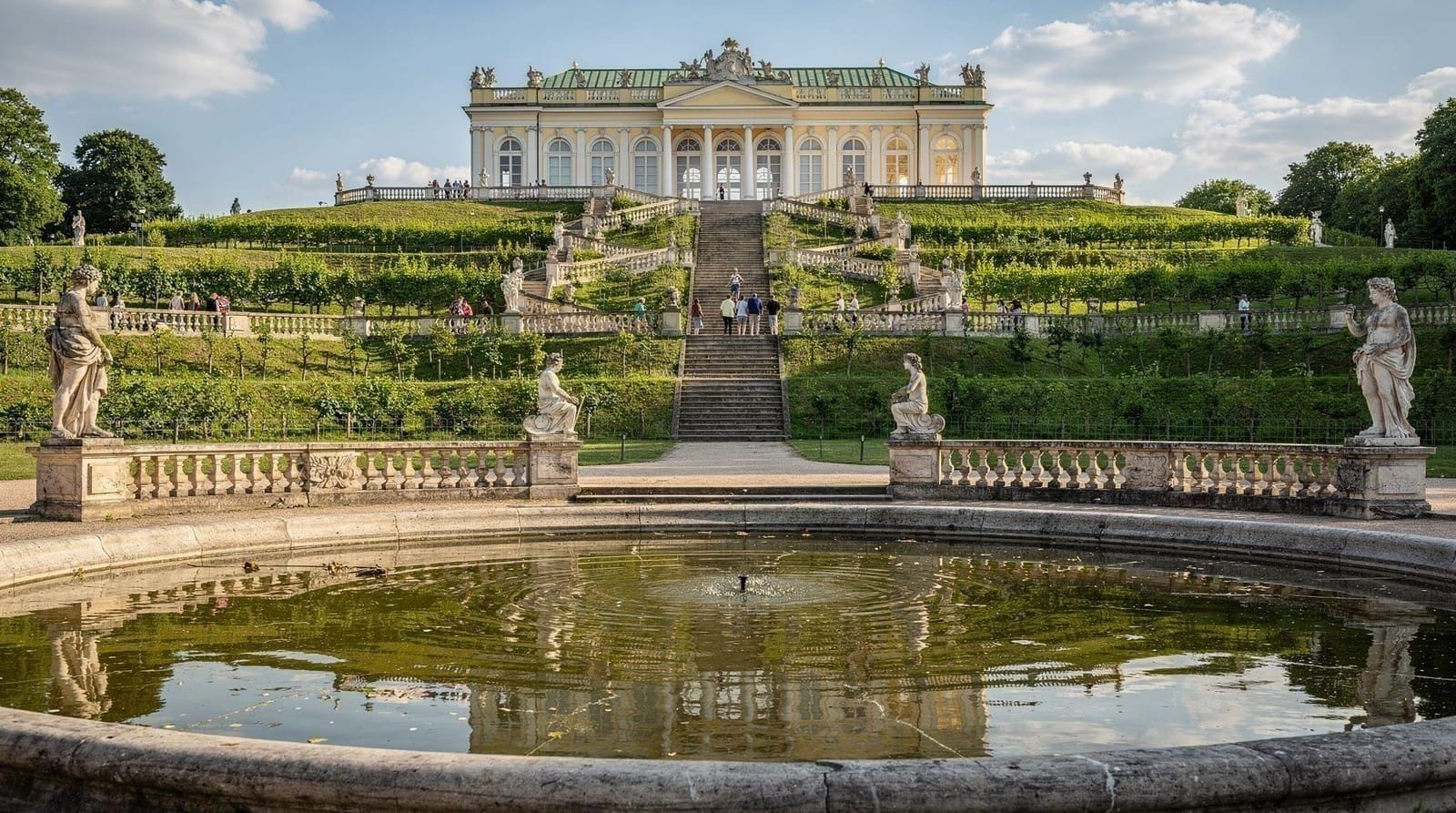
The formal baroque garden directly behind the palace is free to enter and access at all times. It extends roughly 500 metres south from the palace rear facade and is one of the more satisfying formal gardens in Berlin — comparable in layout to a smaller version of the Versailles parterres, with central fountains, clipped hornbeam hedges, and long gravel allées.
At the southern end, the garden transitions to a more informal English landscape park along the Spree. This area is popular with Berliners as a weekend walking space and is less obviously touristic than the formal garden.
Within the park:
Belvedere Tea House (€6): A small porcelain museum on the lakeside housing KPM (Königliche Porzellan-Manufaktur) pieces from the 18th and 19th centuries. The building itself is neoclassical and very photogenic from the lake side. Worth 30 minutes if you have interest in decorative arts.
Mausoleum (free with combined ticket): A Greek-temple style building north of the garden containing the sarcophagi of Queen Louise (died 1810) and later Hohenzollern royals including Kaiser Wilhelm I and Augusta. The interior is sombre and atmospheric.
Schinkel Pavilion (€6 or combined ticket): A small neoclassical villa designed by Karl Friedrich Schinkel in 1825 as a summer retreat for Frederick William III. The interior is one of the finest examples of early 19th-century Prussian interior design in existence.
Getting to Charlottenburg Palace
Charlottenburg Palace is in western Berlin, not reachable on any single metro line from Mitte or Alexanderplatz. The most direct routes:
U7 to Richard-Wagner-Platz: 10-minute walk east along Bismarckstrasse and Spandauer Damm. Clear signage once you exit.
U2 to Sophie-Charlotte-Platz: 12-minute walk north on Nehringstrasse. Pleasant route through a residential neighbourhood.
Bus M45 from Zoologischer Garten: Direct bus service, 15 minutes. Useful if you are coming from Zoo or the Kurfürstendamm shopping area.
From Hauptbahnhof by S-Bahn: S75 or S5 to Westend (10 minutes), then 15-minute walk, or bus M45 connection.
The Charlottenburg neighborhood guide covers the surrounding area including the Kurfürstendamm shopping street, the Kaiser Wilhelm Memorial Church, and the best cafes in the palace district.
Accessibility: The ground floor rooms of the Old Palace are wheelchair accessible; the upper floor of the New Wing has limited step-free access, so check current arrangements at the ticket desk if mobility is a concern. The gardens are flat, gravel-pathed, and comfortable for wheelchairs and strollers alike, which makes them a reasonable fallback if the interior proves difficult on the day.
Combining Charlottenburg with a Potsdam day trip
Several tour operators offer combined Charlottenburg-Potsdam excursions, leaving from central Berlin, visiting the palace in the morning, and continuing to Sanssouci in the afternoon. This is logistically more efficient than attempting both independently in a single day, where the public transport connections between Charlottenburg and Potsdam are time-consuming.
Book a guided excursion combining Charlottenburg Palace and Potsdam Sanssouci in one dayIf you prefer to explore Charlottenburg independently and add context from a guide, the walking tour of the palace district provides neighbourhood context alongside the palace.
Practical notes
Closed Mondays. Open Tuesday–Sunday, 10 am–5:30 pm (closes 4:30 pm November–March).
Photography: Permitted in the gardens and exterior. Some interior rooms prohibit flash photography. Check at the ticket desk for current restrictions as they vary by room.
Families: Children under 18 enter free at the palace (as at all Berlin state museums). The garden is excellent for families with young children. The Belvedere café near the pond is a reasonable lunch stop.
Combination with Museum Island: The Berlin 2-day itinerary covers a logical sequence including Museum Island on day one and Charlottenburg on day two.
Photography from the bridge: The best exterior photograph of Charlottenburg is from the bridge on Luisenplatz, south of the palace, which frames the domed tower across the forecourt. This is also where the famous full-width palace facade shots are taken.
Avoiding the crowds
Charlottenburg is genuinely quieter than Museum Island or Sanssouci at almost any time of year — the trade-off for being slightly harder to reach. Weekday mornings, especially Tuesday and Wednesday right after opening, see the shortest queues at the ticket desk and the most breathing room in the Porcelain Cabinet, which is narrow enough that a tour group can fill it. Weekends from May to September bring the busiest crowds, largely day-trippers combining the palace with Ku’damm shopping.
If your schedule allows it, visiting the gardens in the late afternoon (they stay open later than the palace interior in summer) after the interior crowds have thinned is a good way to see the formal parterre at its most pleasant, with softer light for photography. For a wider view of how to sequence Charlottenburg against Berlin’s other major sights, see the Berlin trip planning guide.
Frequently asked questions about Charlottenburg Palace guide
How much does Charlottenburg Palace cost?
The Old Palace (Altes Schloss) with the residential apartments costs €19 adult, €14 concession. The New Wing (Neuer Flügel) with the royal living quarters costs €14 adult, €10 concession. A combined day ticket covering both plus the mausoleum and pavilion is €22 adult. The gardens are always free. Audio guides are included in the ticket price.How long does Charlottenburg Palace take to visit?
The Old Palace alone takes 1.5–2 hours. The New Wing adds another hour. The formal gardens need 45–60 minutes. A thorough visit covering the palace complex, gardens, and Belvedere tea house realistically takes 4–5 hours. Half a day is a comfortable allocation.Is Charlottenburg Palace closed on Mondays?
Yes. Like most Berlin state museums and palaces, Charlottenburg closes on Mondays. It opens Tuesday through Sunday. Opening hours are typically 10 am to 5:30 pm (4:30 pm in winter months, November–March).How do I get to Charlottenburg Palace from central Berlin?
U7 to Richard-Wagner-Platz (10-minute walk), or U2 to Sophie-Charlotte-Platz (12-minute walk). Bus M45 from Zoologischer Garten runs directly to the palace. From Mitte, allow 30 minutes by public transport. Taxis or Uber from Zoo or Hauptbahnhof take about 15 minutes.What is the difference between the Old Palace and the New Wing?
The Old Palace (Altes Schloss, the central baroque tower section) contains the original state apartments of Elector Frederick III and Queen Sophie Charlotte, including the ornate Porcelain Cabinet with thousands of Chinese and Japanese pieces. The New Wing (Neuer Flügel), added in the 1740s by Frederick the Great, holds the king's apartments with a more French rococo feel. Both are worth visiting; the Old Palace is the more architecturally striking of the two.Are the Charlottenburg Palace gardens worth visiting?
Yes, and they are free. The formal baroque garden immediately behind the palace is one of Berlin's most photogenic green spaces — symmetrical parterres, fountains, and long tree-lined allées. The broader landscape garden extending to the Spree is more casual. The Belvedere tea house (€6) on the lake within the park contains Berlin's finest porcelain collection. The carps-stocked carp lake is a pleasant picnic area.Is an audio guide or guided tour of Charlottenburg worth it?
The audio guide (included in ticket) is good quality and covers the key rooms. A guided tour adds genuine depth — particularly for understanding Frederick the Great's personality and the palace's role in 18th-century Prussian court life. Guided tours are available in English on weekend afternoons and through GetYourGuide.Can I combine Charlottenburg Palace with Potsdam on the same day?
A direct day trip combining both is offered by some tour operators, but doing both thoroughly in one day is rushed. The GetYourGuide Charlottenburg-Potsdam excursion covers highlights of both. If you have two days, dedicate one to Charlottenburg and the Charlottenburg district, and one to Potsdam.
Top experiences
Bookable activities with verified prices and instant confirmation on GetYourGuide.