Synagoge Rykestrasse — Berlin's largest surviving synagogue in Prenzlauer Berg
Berlin: Jewish Quarter and Holocaust Private Walking Tour
Can visitors see the Rykestrasse Synagogue in Berlin?
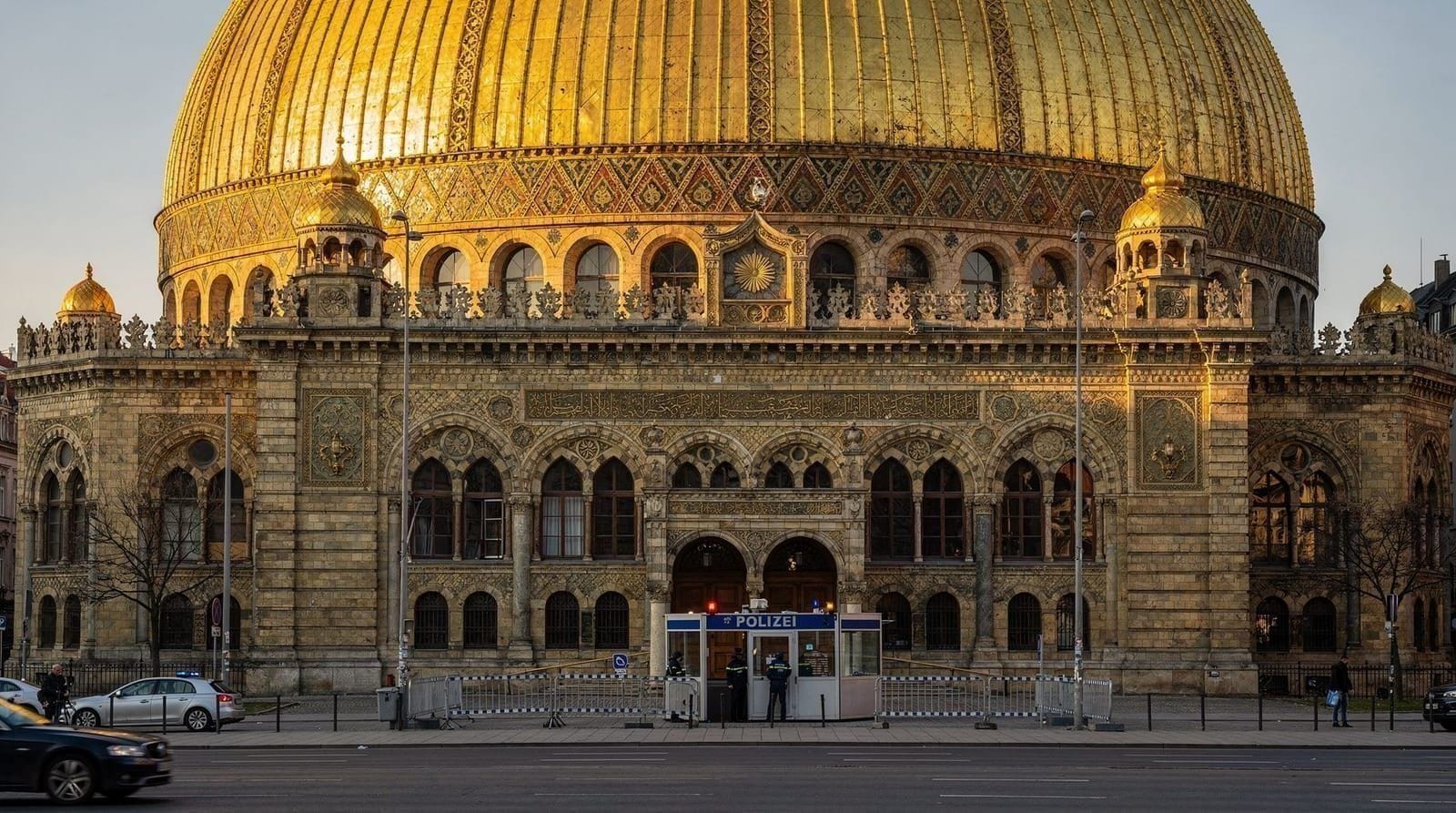
The Rykestrasse Synagogue is an active house of worship for Berlin's Jewish community and is not permanently open to the general public. It can be visited on the annual Tag des offenen Denkmals (Open Heritage Day) in September, during Jewish Kulturtage events, and on occasional organised tours. The exterior is freely viewable from Rykestrasse at any time.
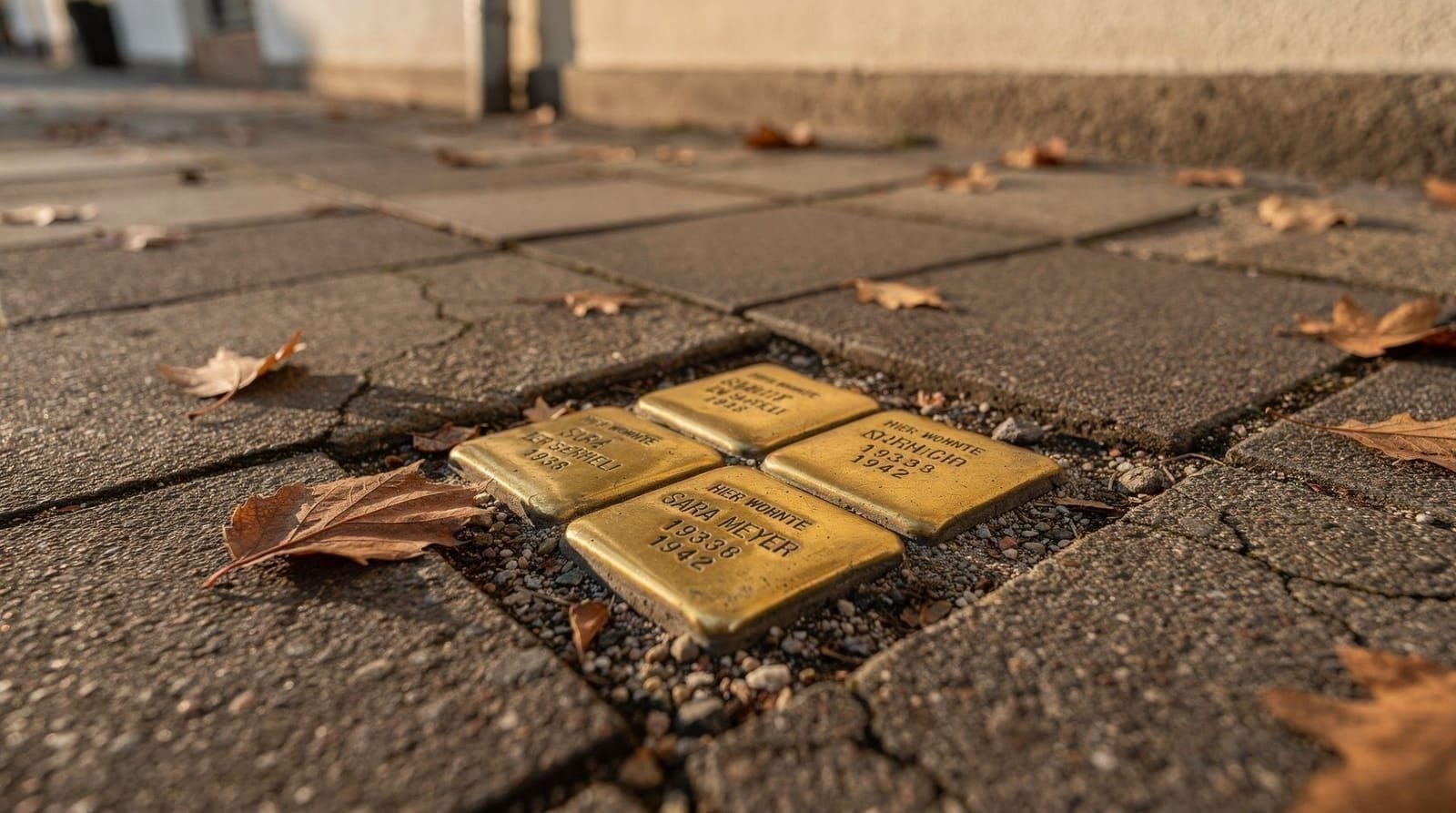
Can you visit the Rykestrasse Synagogue? The Synagoge Rykestrasse in Prenzlauer Berg is an active place of Jewish worship, not a museum, and is not open to the general public year-round. The exterior is visible from the street. Visits inside are possible on Open Heritage Day (September), during Berlin Jewish cultural events, and via some organised tours. The area around it repays a slower walk for its Stolpersteine and its pre-war residential character.
| Where | Rykestrasse 53, Prenzlauer Berg |
| Cost | free to view exterior; interior access limited |
| Time needed | around 30-45 min for the surrounding walk |
| Getting there | U2 Senefelderplatz (10 min walk) or tram M2/M12 |
| Best time | Open Heritage Day (September) for interior access |
The largest surviving synagogue in Germany
The Synagoge Rykestrasse is often cited as the largest Jewish house of worship in Germany that survived the Nazi period. This statistic requires a moment of reflection: by the 1904 standards of German synagogue building, being the largest is a measure of the confidence and prosperity of the Jewish communities that built such structures. Most of those communities, and most of those buildings, are gone.
The Rykestrasse Synagogue’s survival was not because it was protected by any special policy or any notable intervention comparable to Wilhelm Krützfeld’s action at the Neue Synagoge in Mitte. It was saved by practical urban geometry.
Architecture and design
Johann Hoeniger, a Berlin architect who had designed several notable public buildings in the city, was commissioned to design the synagogue in 1903. The resulting structure is Romanesque-Byzantine in its vocabulary — the style frequently favoured for German synagogues in the Wilhelmine period (c.1871–1918) because it referenced early Christian architecture without being specifically Gothic (which was too closely associated with churches). The building combines round arches, blind arcading, and decorative brickwork with a relatively restrained exterior.
The interior is more richly decorated. The main prayer hall is designed on a basilica plan — a wide central nave flanked by two side aisles, with women’s galleries above on three sides. The ceiling is painted in geometric patterns. The bimah (central reader’s platform) and the Aron Hakodesh (ark for the Torah scrolls) face east toward Jerusalem. The colour palette is warm: ochres, deep blues, gold — restored in the 2007 renovation to their closest approximation of the 1904 originals.
The synagogue seats approximately 2,000 people. In the last years before the Nazi rise to power, services at Rykestrasse were full. The High Holidays (Rosh Hashana and Yom Kippur) drew overflow crowds to the courtyard outside.
Prenzlauer Berg’s Jewish community
To understand why a 2,000-seat synagogue was built in Prenzlauer Berg in 1904, you need to understand what the neighbourhood was at the turn of the twentieth century.
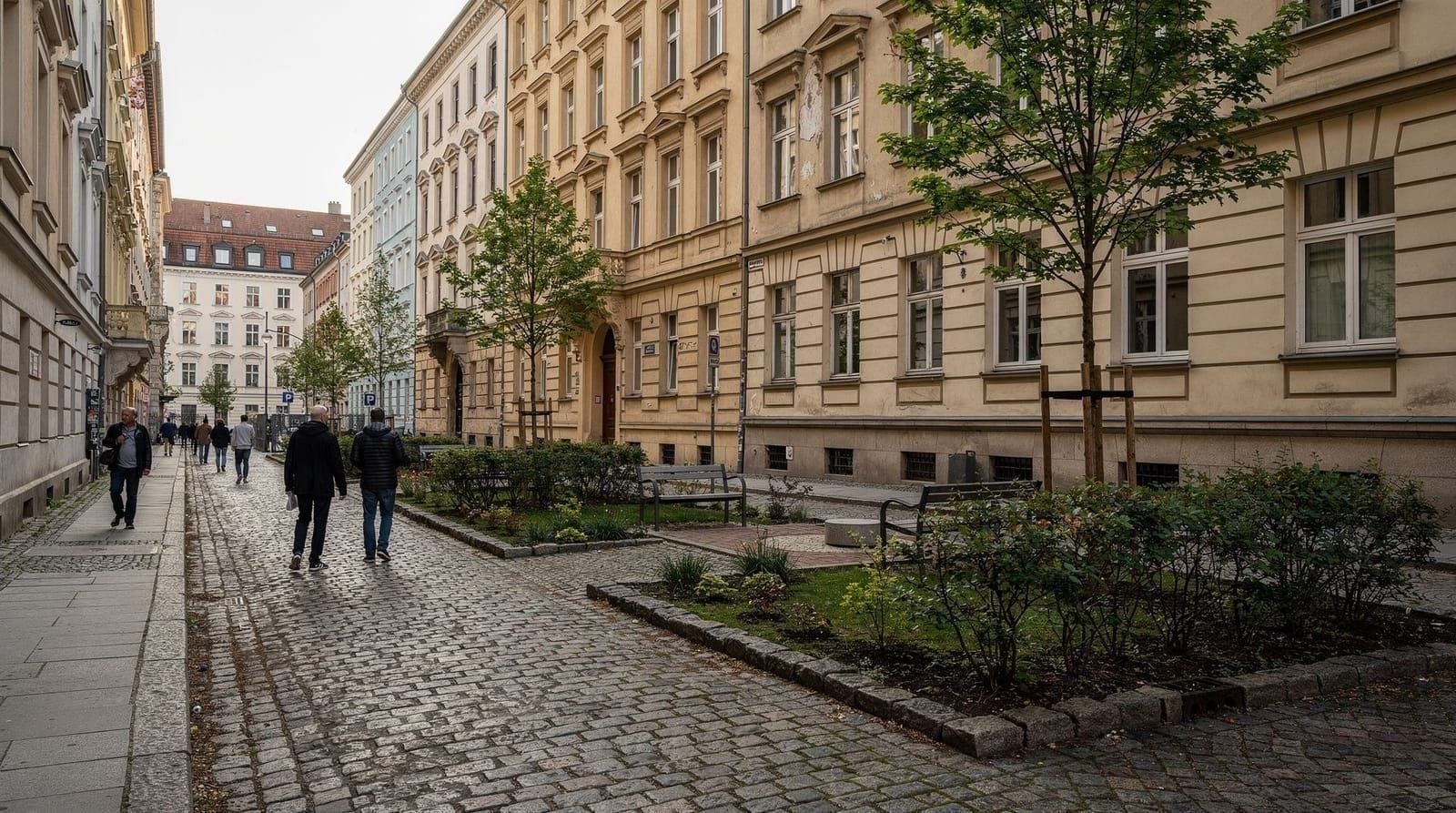
Prenzlauer Berg in 1900 was one of the most densely populated urban districts in the world — a working-class neighbourhood of packed five- and six-storey tenements built in the rapid industrialisation of the late nineteenth century. The streets around Kollwitzplatz, Helmholtzplatz, and Senefelderplatz were home to a mixed working-class population with a significant Jewish component, ranging from established Berlin families to recently arrived Eastern European immigrants.
The Jewish residents of Prenzlauer Berg were not primarily wealthy. They were small tradesmen, craftsmen, workers in the garment trade, peddlers, and, as the generation of the 1880s and 1890s moved into education and professions, teachers, lawyers, and doctors. The synagogue served this community — large, diverse, mostly not wealthy, and Jewish in a range of ways from the strictly observant to the culturally identified.
By the 1920s Weimar period, the neighbourhood had added a layer of radical politics and artistic bohemia to its character. The sculptor Käthe Kollwitz lived on what is now Kollwitzstrasse from 1891 to 1943, drawing her artistic material from the working-class poverty she observed on her street. The area’s mixed Jewish and non-Jewish working-class life is documented in the socialist and communist press of the period.
Why the synagogue survived Kristallnacht
On the night of 9 to 10 November 1938, SA (Sturmabteilung) units were dispatched across Berlin with instructions to destroy synagogues. By morning, most of Berlin’s Jewish houses of worship had been burned or severely damaged.
At the Rykestrasse Synagogue, SA units arrived but did not set fire to the building. The reason, documented in post-war testimony and historical research, was straightforward: the synagogue sits in a deep courtyard, enclosed on all sides by five-storey apartment buildings housing non-Jewish residents. Setting fire to the synagogue would almost certainly have spread to the surrounding residential buildings.
The SA unit commander, faced with this practical problem, withdrew without burning the building. The synagogue was subsequently occupied and used by the Nazis as a stable and a storage facility for confiscated Jewish property, but the structure was not destroyed.
This survival — entirely pragmatic, with no moral dimension on the part of those who left the building standing — left Berlin with its largest synagogue intact.
The building under the GDR
From 1945 to 1990, the Rykestrasse Synagogue served the tiny Jewish community of East Berlin. East Germany’s Jewish population was severely reduced: most surviving Jews who could leave had gone west, and the GDR’s official anti-Zionist stance — which sometimes crossed into antisemitism in its rhetoric — made Jewish community life difficult. By the 1970s, the East Berlin Jewish community numbered in the hundreds.
The GDR government’s relationship with Jewish institutions was contradictory. The state positioned itself as the anti-fascist successor state, the inheritor of Communist and socialist resistance, and did not systematically restore Jewish property or build memorials to Jewish victims in the way the Federal Republic eventually did. Yet the Rykestrasse Synagogue was permitted to function and was given state support for two restorations (1953 and the 1970s).
The November 1988 ceremonies marking the 50th anniversary of Kristallnacht, held in the Rykestrasse Synagogue in East Berlin, were attended by GDR First Secretary Erich Honecker — a notable event that represented one of the GDR’s belated public acknowledgements of Jewish victims of Nazism.
The 2007 restoration
A major restoration, completed in 2007 in time for the synagogue’s centenary celebrations, was funded by the Berlin city government and the German Federal government to the tune of approximately €3 million. The work restored the interior to an approximation of the 1904 original: the painted ceiling patterns were recreated from photographic records and surviving traces of original paint, the galleries were repaired, and the brickwork exterior was cleaned and repointed.
The restoration was significant not only as preservation but as a statement: the public investment in a Jewish religious building in Berlin, 60 years after the Holocaust, was an acknowledgement that the community’s history and its surviving institutions were part of Berlin’s own heritage.
Since the 2007 restoration, the building has functioned as the main synagogue for Berlin’s Jewish Community (Jüdische Gemeinde zu Berlin), hosting regular services and major festival gatherings that draw congregants from across the city, not only from Prenzlauer Berg itself. The scale of the space, largely unnecessary for the size of the postwar congregation in earlier decades, has become genuinely useful again as Berlin’s Jewish population has grown since reunification, including significant immigration from the former Soviet Union in the 1990s.
Visiting the area — a practical walk
Since the synagogue itself is accessible only at specific times, the most practical approach for most visitors is to walk the surrounding streets.
Begin at Senefelderplatz (U2 Senefelderplatz): The square has its own history — note the memorial to Heinrich Zille (1858–1929), the graphic artist who documented working-class Berlin life in drawings that often depicted the Jewish presence in the neighbourhood.
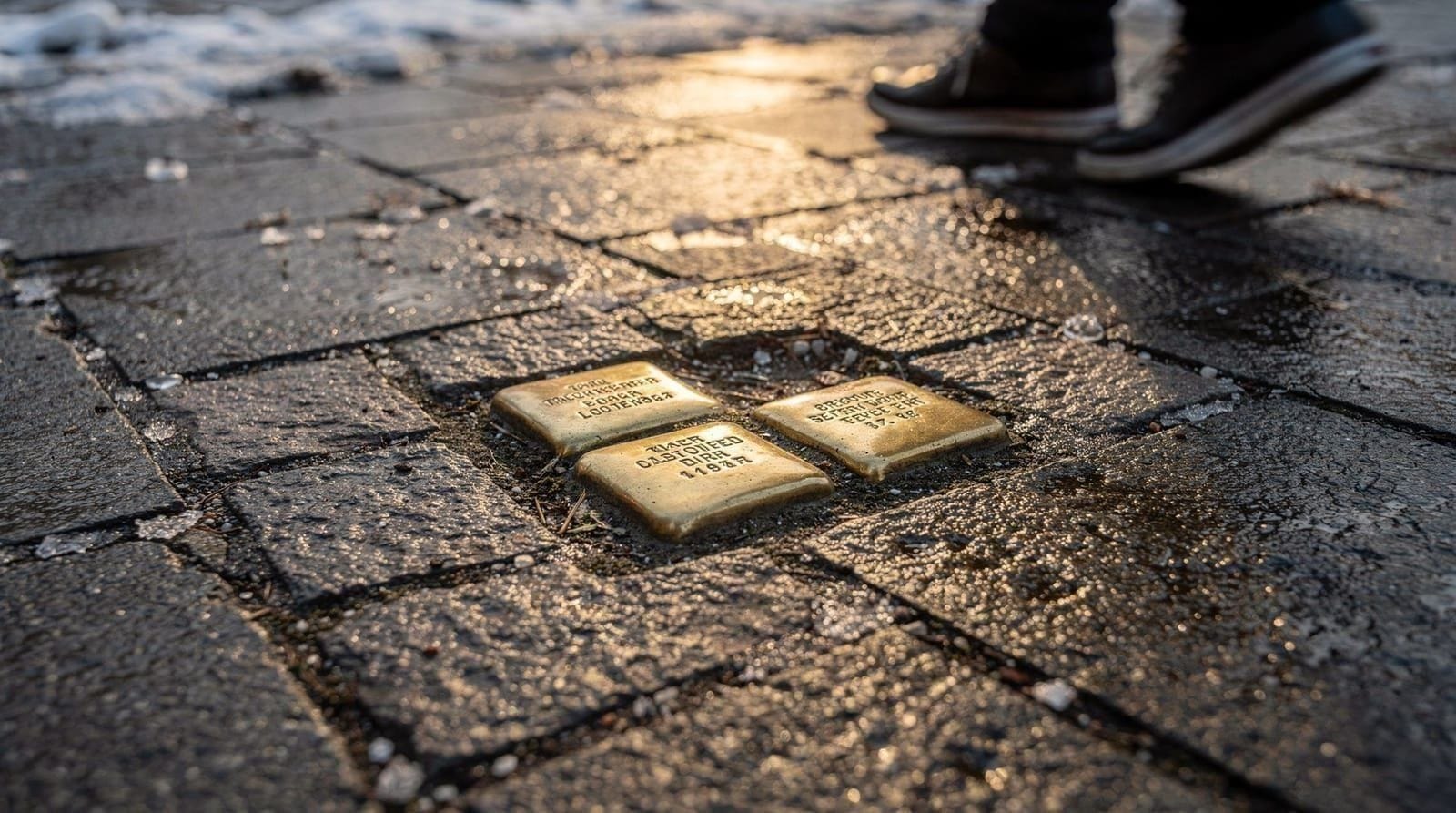
Walk east along Sredzkistrasse to Rykestrasse. The streets here have an unusually high density of Stolpersteine — look at the pavement outside nearly every building entrance. The Stolpersteine guide provides the context for reading them.
The synagogue exterior (Rykestrasse 53): The building sits behind a gate in the street wall. The courtyard and facade are visible through the entrance. The geometry that saved the building from Kristallnacht — surrounded by tenements — is immediately apparent.
Walk south to Kollwitzplatz: The square at the heart of Prenzlauer Berg carries the name of Käthe Kollwitz, who lived nearby. A sculpture of her by Gustav Seitz stands in the square. The surrounding cafés and restaurants are among the better options in the neighbourhood; the area is tourist-friendly but not aggressively tourist-oriented. For more on the wider neighbourhood beyond its Jewish history, see the Prenzlauer Berg guide.
For visitors who want expert context on this walk rather than doing it independently, a guided Jewish quarter tour covers Rykestrasse alongside other sites of Jewish Berlin.
Book a private Jewish quarter walking tour of BerlinComparing Berlin’s surviving synagogues
Rykestrasse is one of several synagogue buildings in Berlin with very different survival stories, and seeing the contrast helps place it in context.
| Synagogue | Survival reason | Current status |
|---|---|---|
| Rykestrasse | Surrounded by tenements, fire risk to neighbours | Active, largest in Germany |
| Neue Synagoge | Partly protected by a police officer on the night | Museum and partial worship space |
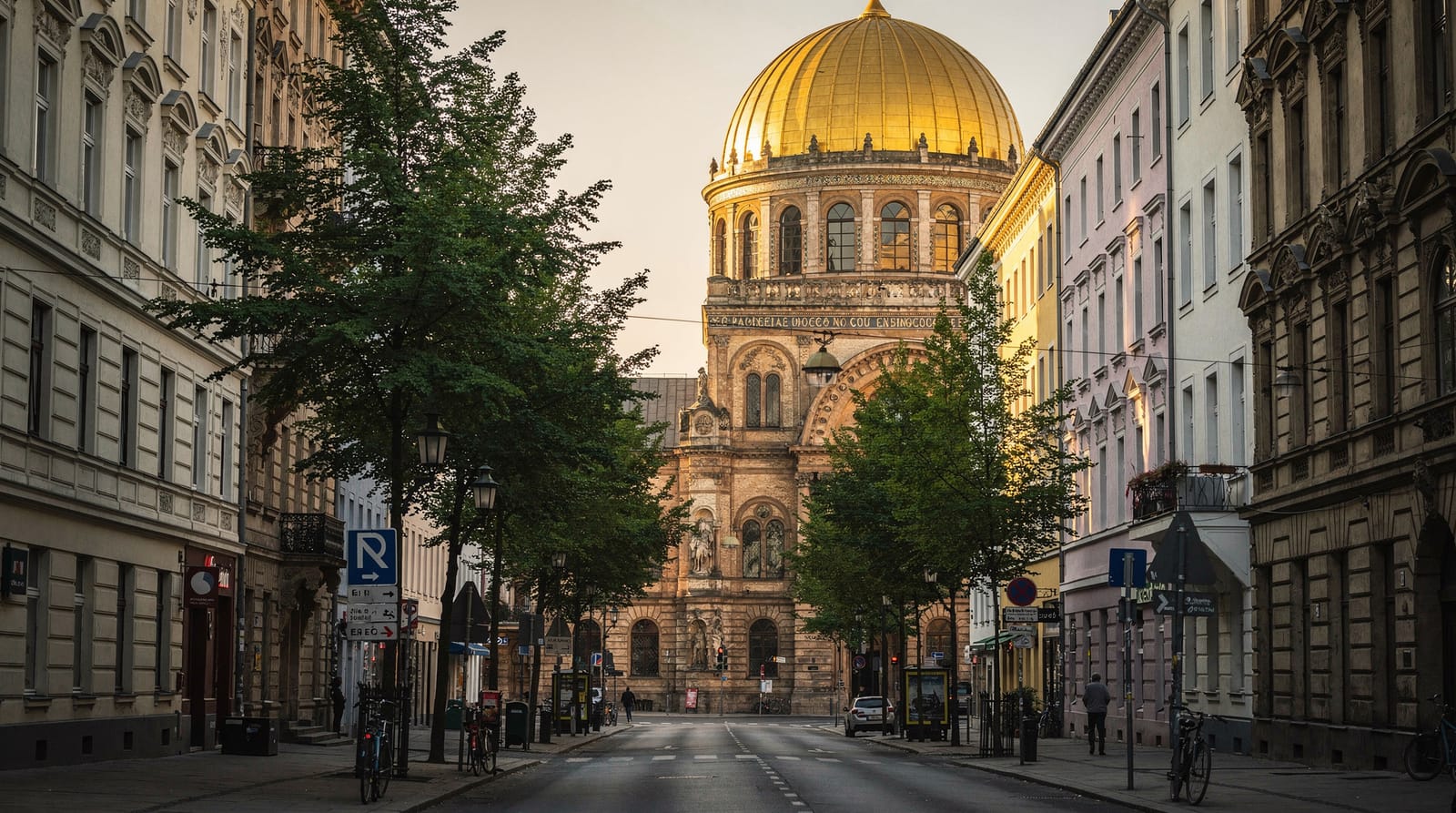
| New Synagogue’s dome | Rebuilt after WWII bomb damage | Landmark, not a full working synagogue |
Together with the Jewish Museum Berlin and the Jewish quarter in Scheunenviertel, Rykestrasse forms part of a wider pattern worth seeing across a single trip: institutions that survived for entirely different, often arbitrary, reasons.
Frequently asked questions about Synagoge Rykestrasse
Why is the Rykestrasse Synagogue significant?
The Synagoge Rykestrasse, built in 1904, is the largest Jewish house of worship in Germany that survived the Nazi period substantially intact. It can seat approximately 2,000 people. Its survival of Kristallnacht in November 1938 was due to its location — the building was surrounded on all sides by inhabited tenement blocks, and the SA feared that a fire would spread to the residential buildings. This practical consideration saved it.Where is the Rykestrasse Synagogue?
The synagogue is at Rykestrasse 53, 10405 Berlin, in the Prenzlauer Berg district, near Kollwitzplatz. The nearest public transport is U-Bahn U2 to Senefelderplatz (10 minutes on foot) or tram M2/M12 to Wörtherstrasse (5 minutes on foot). The synagogue sits in a courtyard behind the street, visible through the entrance gate from Rykestrasse.When was the Rykestrasse Synagogue built?
The synagogue was built between 1903 and 1904, designed by architect Johann Hoeniger in a Romanesque-Byzantine style. It opened on 3 September 1904. It was built to serve the rapidly growing Jewish community of Prenzlauer Berg, which at the turn of the twentieth century was one of the most densely populated districts in Berlin, home to both established Berlin Jewish families and recent Eastern European immigrants.What happened to the Rykestrasse Synagogue during the Nazi period?
During Kristallnacht, 9 to 10 November 1938, SA units were sent to burn the synagogue, as they burned or damaged most of Berlin's Jewish houses of worship. However, the building's location — deep in a courtyard surrounded by residential tenement buildings — meant that setting it on fire would have risked burning down the surrounding apartments. The SA stood down. The building was subsequently used by the Nazis as a stable and as a collection point for confiscated Jewish property, but its structure was not destroyed.Was the Rykestrasse Synagogue used under the GDR?
Yes. The synagogue served the small Jewish community of East Berlin throughout the GDR period. East Germany's Jewish community was tiny — perhaps 200 to 400 people in all of East Berlin by the 1970s — but the Rykestrasse Synagogue remained the community's primary place of worship. It underwent restoration in 1953, again in the 1970s, and a major restoration was completed in 2007. The 2007 restoration, supported by Berlin city funds, restored the interior to something close to its 1904 appearance.Are there Stolpersteine near the Rykestrasse Synagogue?
Yes. The streets of Prenzlauer Berg around the synagogue — Rykestrasse, Sredzkistrasse, Kollwitzstrasse, Wörtherstrasse — have a high density of Stolpersteine marking former Jewish residents of the neighbourhood. The concentration around Kollwitzplatz is among the highest in Berlin. Walking these streets slowly and reading the plaques is part of any meaningful visit to the area.