Jewish history of Berlin — 2,000 years of community, culture, and survival
Berlin: Jewish History Walking Tour
How long have Jewish people lived in Berlin and what is their history?
Jewish settlement in the Berlin area dates to the thirteenth century, though the earliest documented record is 1295. The community grew, was expelled multiple times, and re-established repeatedly. By 1925, Berlin had over 172,000 Jewish residents — the largest Jewish population of any German city. The Holocaust reduced this to a few thousand survivors. A new community has since formed, primarily from Soviet-era Jewish immigration after 1989.
How long have Jewish people lived in Berlin? The documented history begins in 1295. The community grew, was expelled, re-established, flourished, was nearly annihilated, and has formed again. Understanding this full arc — not only the destruction of the Holocaust — is essential to understanding what Berlin’s Jewish sites mean.
| Where | Sites across Mitte, Charlottenburg, Prenzlauer Berg, Grunewald |
| Cost | Mostly free; Jewish Museum entry around €8 |
| Time needed | 1–2 days for a full historical walking route |
| Getting there | S-Bahn/U-Bahn network connects all sites |
| Best time | Weekday mornings, allow unhurried pacing |
Timeline at a glance
| Period | Years | Defining event |
|---|---|---|
| Medieval settlement | 1295–1573 | Two expulsions (1510, 1573) |
| Modern re-founding | 1671 | Great Elector’s charter for 50 families |
| Haskalah / Enlightenment | 1700–1830 | Moses Mendelssohn’s Berlin salon |
| Emancipation | 1812–1871 | Full legal citizenship achieved in 1871 |
| Golden age | 1871–1933 | Peak population ~172,000 (1925) |
| Nazi persecution | 1933–1945 | Kristallnacht (1938), deportations (1941–45) |
| Post-war rebuilding | 1945–1989 | Community shrinks to ~7,000 |
| Contemporary community | 1989–present | Soviet immigration wave, Israeli community grows |
Medieval settlement and the cycles of expulsion (1295–1671)
The earliest documentary evidence of Jewish settlement in the region dates to 1295. A Jewish community existed in medieval Berlin under a legal framework common to medieval European cities: Jews were permitted to reside and trade under a charter granted by the ruler, in exchange for payment of special taxes. They had no political rights and were subject to periodic harassment, accusation, and expulsion.
The pattern that recurred across medieval German Jewish history — settlement, integration into trade and finance, accusation (often of ritual murder or host desecration), expulsion, and eventual re-admission — played out in Berlin twice before the modern period.
In 1510, the Berlin Jewish community was expelled following accusations of stealing and desecrating a communion wafer — the so-called “host desecration” charge, a fabricated offence used to justify persecution across medieval Europe. Some members of the community were executed. The expulsion left no Jewish community in the city for over 60 years.
In 1573, the small community that had gradually re-formed was expelled again. Berlin remained without a significant Jewish community for nearly a century.
The modern community was formally established in 1671, when Brandenburg Elector Friedrich Wilhelm — the “Great Elector” — issued a charter permitting fifty Jewish families from Austria, recently expelled from Vienna, to settle in Berlin and the Brandenburg territories. The Great Elector’s motivation was primarily economic: he wanted skilled merchants and traders. The 1671 charter is the formal foundation of Berlin’s modern Jewish community.
The Enlightenment and the Haskalah (1700–1830)
The eighteenth century brought a fundamental transformation in the relationship between Jewish communities and European states, articulated in France as emancipation after the Revolution of 1789 and in the German states as a slower, contested process.
In Berlin, the crucial figure was Moses Mendelssohn (1729–1786). Born in Dessau, Mendelssohn came to Berlin at age fourteen and rose to become one of the leading philosophers of the German Enlightenment. His importance for Jewish history is twofold.
First, his philosophical argument: Mendelssohn contended, most systematically in his 1783 work Jerusalem, that Jewish religious law and practice were entirely compatible with participation in civil society — that Jews did not need to abandon their religion to become citizens. This argument provided the intellectual foundation for the emancipation movement.
Second, his example: Mendelssohn was personally intimate with the leading figures of the German Enlightenment — Gotthold Ephraim Lessing, Friedrich Nicolai, Immanuel Kant. His salon in Berlin was one of the centres of German intellectual life. His translation of the Torah into German (in Hebrew characters, so that Jewish readers could learn German while reading a text they knew) was both practically transformative and politically significant.
Mendelssohn died in 1786, before the emancipation he argued for was achieved. He is buried in the old Jewish cemetery on Grosse Hamburger Strasse — his grave is marked, though the cemetery was badly damaged in the Nazi period.
The Jewish women’s salons of Berlin in the late eighteenth and early nineteenth centuries — hosted by figures including Rahel Levin Varnhagen and Henriette Herz — were equally significant. These salons were among the first spaces in Berlin where Jews and non-Jews met as social equals, and where German-Jewish intellectual and romantic exchanges of all kinds occurred.
Emancipation and integration (1812–1871)
The 1812 Prussian Emancipation Edict extended significant rights to Jews in Prussia — freedom of residence and occupation, permission to hold academic posts — but fell short of full citizenship. The subsequent decades were marked by a contradiction: Jewish Berliners were increasingly integrated into German cultural and professional life, while the legal framework remained discriminatory and subject to political reversal.
Full legal emancipation came in 1869, when the North German Confederation removed all remaining legal distinctions based on religious confession. With the founding of the German Empire in 1871, this equality became Reich-wide law.
The period from 1871 to 1933 is often called the golden age of German Jewry — a designation that acknowledges both the extraordinary achievement and the tragic truncation. In six decades of full citizenship, Jewish Germans made contributions to science, medicine, law, commerce, philosophy, literature, and the arts far disproportionate to their numbers. Albert Einstein, Sigmund Freud (in Vienna), Heinrich Heine, Felix Mendelssohn, and Franz Kafka are among the names that European culture knows globally; thousands of less famous Jewish German professionals shaped German civic and intellectual life at every level.
The peak and the Weimar era (1918–1933)
By 1925, Berlin had a Jewish population of approximately 172,000 — the largest Jewish community of any German city, representing around 4 percent of Berlin’s total. The community was not homogeneous. It spanned the full range from fully secular and assimilated (many did not identify as Jewish in religious terms) to the Yiddish-speaking Orthodox immigrant community of the Scheunenviertel.
The Weimar Republic’s cultural explosion in Berlin in the 1920s was strikingly Jewish in significant respects: not in the sense that it was exclusively Jewish, but that Jewish artists, writers, journalists, filmmakers, directors, and intellectuals were central to what made Weimar Berlin unique. The list of names is long: Billy Wilder, Fritz Lang, Ernst Lubitsch, Kurt Weill, Ernst Toller, Alfred Döblin, Walter Benjamin, Hannah Arendt.
This visibility — in the press, in cinema, in the theatre, in the arts — was precisely what made antisemitic propaganda in the early 1930s so potent. The Nazi movement’s claim that a Jewish elite controlled German culture had a specific target in Berlin’s cultural life of the 1920s.
For a deeper look at Jewish cultural life in this period, see the Jewish Berlin before 1933 guide.
The Nazi period — persecution, deportation, and the Holocaust (1933–1945)
When the Nazi Party came to power on 30 January 1933, approximately 160,000 Jews lived in Berlin. The first years of Nazi rule brought a cascade of legal exclusions: the April 1933 boycott of Jewish businesses, the 1933 Civil Service law dismissing Jews from government positions, the 1935 Nuremberg Laws stripping Jews of citizenship and prohibiting marriage with non-Jews.
In Berlin, these measures were enforced with particular visibility — the capital’s Jewish professionals were expelled from public life in full view of the press corps of every major nation. The 1936 Berlin Olympics represented a temporary relaxation of overt antisemitic activity for international appearance; the discrimination intensified again immediately after the Games.
Kristallnacht (9 November 1938) was the pivotal public violence before the systematic genocide began. Across Germany and Austria, SS and SA units attacked synagogues, Jewish businesses, and homes. In Berlin, dozens of synagogues were burned or destroyed, Jewish-owned shops along the Kurfürstendamm were smashed, and hundreds of Jewish men were arrested and sent to Sachsenhausen. The sites of the night’s events are covered in detail in the Kristallnacht Berlin sites guide.
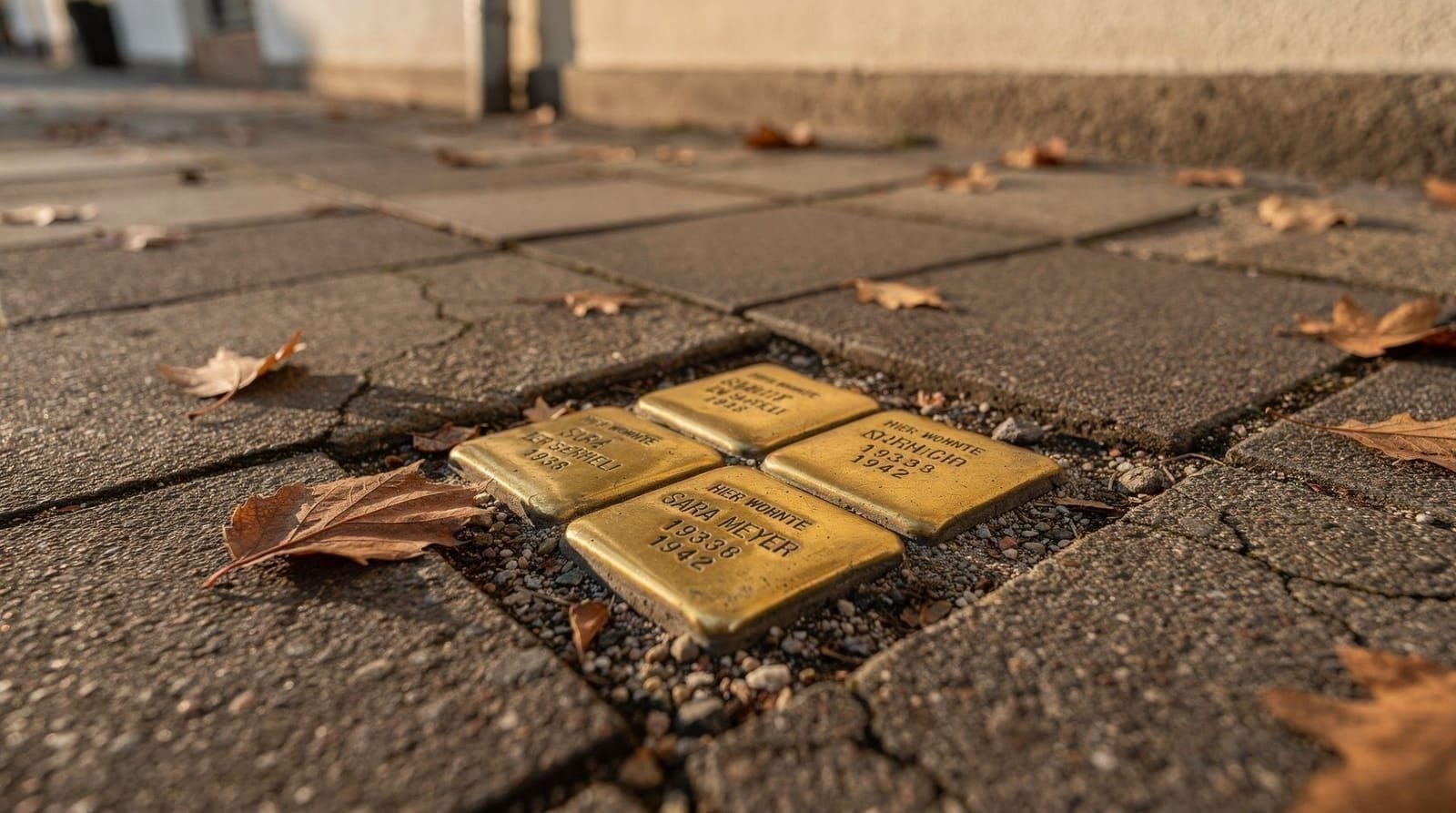
Deportations began in October 1941. The first transport left Berlin’s Grunewald station on 18 October 1941, carrying 1,251 people to Lodz. Over the following three and a half years, over 50,000 Berlin Jews were deported from the same platform — Platform 17 at Grunewald, now a memorial — to the extermination camps of Eastern Europe. The 1942 Wannsee Conference, held in a villa in southwest Berlin, coordinated the inter-agency implementation of what the Nazis called the “Final Solution.”
Of the approximately 160,000 Jews living in Berlin in 1933, an estimated 55,000 were murdered in the Holocaust. The remainder had emigrated, mostly before 1941 when emigration was still possible.
Approximately 1,700 Jews survived the war in Berlin by hiding — assisted by non-Jewish Germans at considerable personal risk. Their story is documented in the Jewish resistance Berlin guide.
Post-war and the new community (1945–present)
In 1945, the Jewish community of Berlin was reduced to a few thousand survivors — those returning from camps, those who had hidden, and those in mixed marriages who had survived. The community organisations were rebuilt slowly. By 1949, the division of Germany meant that Jewish institutions existed separately in East and West Berlin.
In West Berlin, the Jewish community gradually stabilised at around 6,000 to 7,000 registered members — a small fraction of the pre-war population. New community institutions were established: a community centre, schools, the Jüdisches Museum (later superseded by the Libeskind building of 2001), and new synagogues.
The transformation came after 1989. Following German reunification and the collapse of the Soviet Union, large-scale Jewish immigration from the former Soviet states began. From 1991 onward, Germany offered a specific immigration pathway for Jewish citizens of the former USSR. Between 1991 and 2005, approximately 220,000 Jewish immigrants came to Germany from the former Soviet Union. A large proportion settled in Berlin.
The effect was to nearly treble Berlin’s registered Jewish community — from around 7,000 in 1989 to approximately 12,000 to 15,000 by the mid-2000s. This new community has a different demographic profile from the pre-war community: primarily Russian-speaking, secular in religious practice, coming from a Soviet context where Jewish identity had been suppressed for decades.
Simultaneously, Berlin attracted a significant population of Israeli citizens — young Israelis drawn by the city’s cultural scene, relatively low cost of living (compared to Tel Aviv), and openness. Estimates of the Israeli community in Berlin range from 15,000 to 25,000 — making Berlin one of the largest concentrations of Israelis outside Israel.
The result is a Berlin Jewish community in 2026 that is diverse, multilingual, and in many respects quite different from the pre-war community. The institutional structures of the Jüdische Gemeinde zu Berlin continue, alongside Hebrew-speaking businesses and schools, Russian-language community organisations, and a range of cultural organisations.
The community today — where visitors can see it
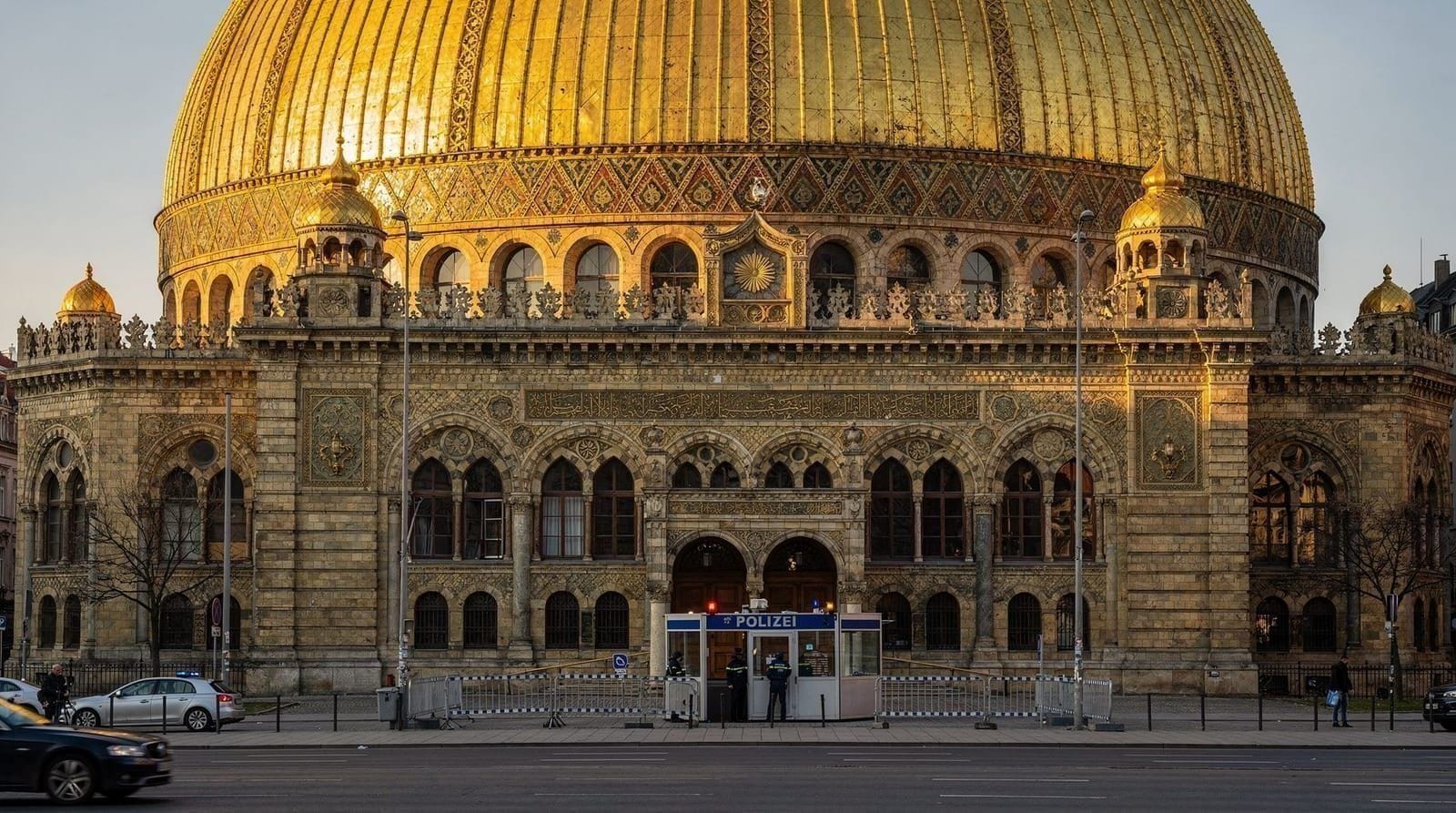
Present-day Jewish Berlin is much less geographically concentrated than the pre-war community, but a few areas give visitors a genuine sense of it. Kosher and Israeli-influenced cafés and restaurants have grown steadily around Prenzlauer Berg and parts of Mitte, alongside the Rykestrasse Synagogue, the largest surviving synagogue in Germany and still an active congregation with regular services. The Jüdische Gemeinde zu Berlin runs community and cultural events, some open to the public, through its centre near Fasanenstrasse. Neukölln and parts of Prenzlauer Berg have also become informal hubs for Berlin’s large Israeli population, with Hebrew visible on café menus and community noticeboards. None of this is set up as a tourist attraction — it’s living community life, and visitors should treat it with the same respect they’d extend to any residential neighbourhood, rather than as a sightseeing stop.
What to expect on the walking route
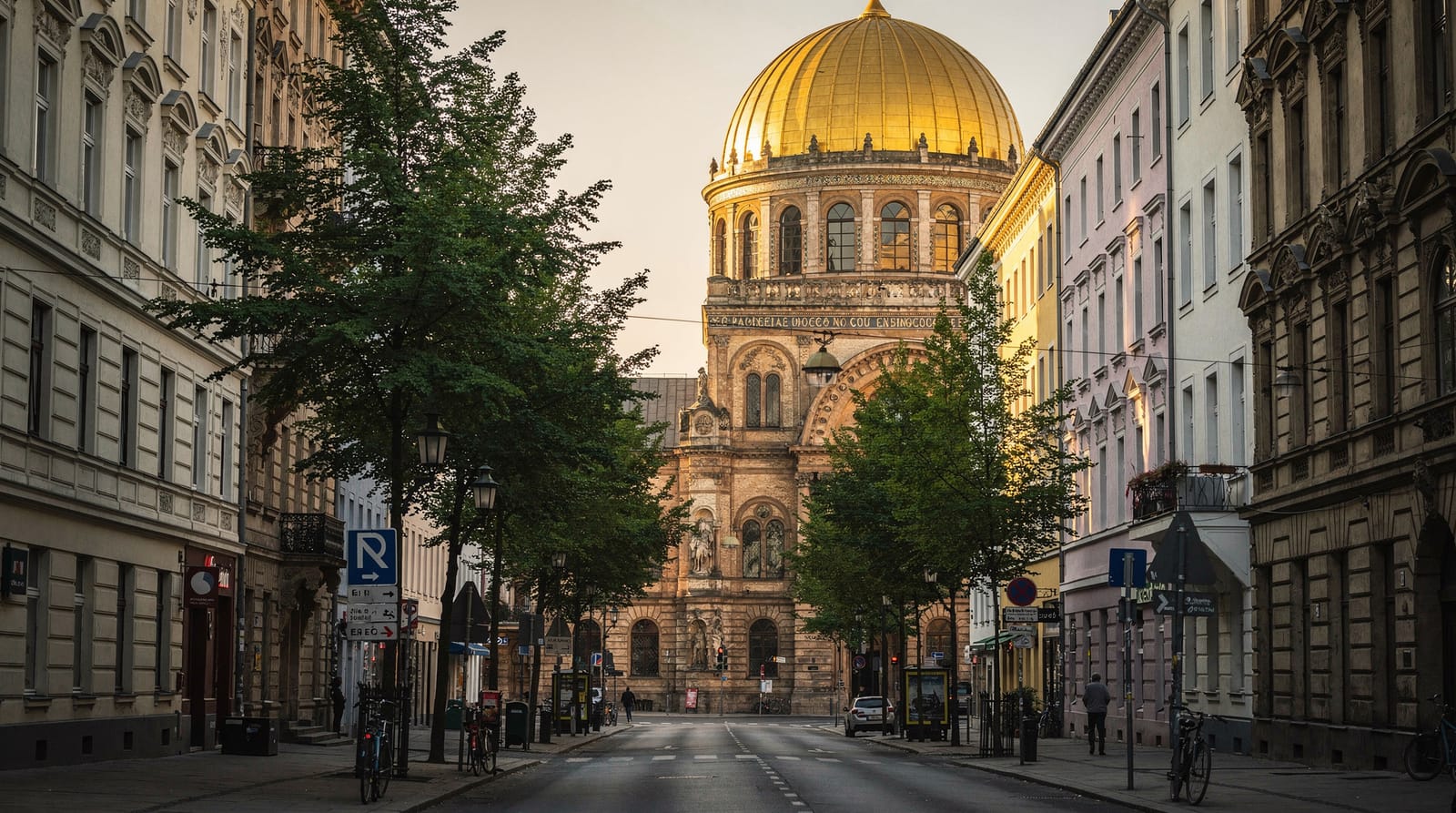
Guides on the Jewish Berlin history walk report a consistent set of questions: whether it’s appropriate to enter the Neue Synagoge or Rykestrasse Synagogue as a non-Jewish visitor (generally yes, respectfully, and often with a small entry fee at the Neue Synagoge/Centrum Judaicum); whether photography is permitted at the Grosse Hamburger Strasse cemetery (yes, but quietly, as it remains a burial ground); and how the pre-war and present-day communities relate to each other (largely they don’t overlap directly — the demographic continuity was broken by the Holocaust, and today’s community is substantially a different population with a different history). Raising these questions with a guide, rather than assuming, tends to produce a richer visit than working through the sites alone.
A walking route through Jewish Berlin history
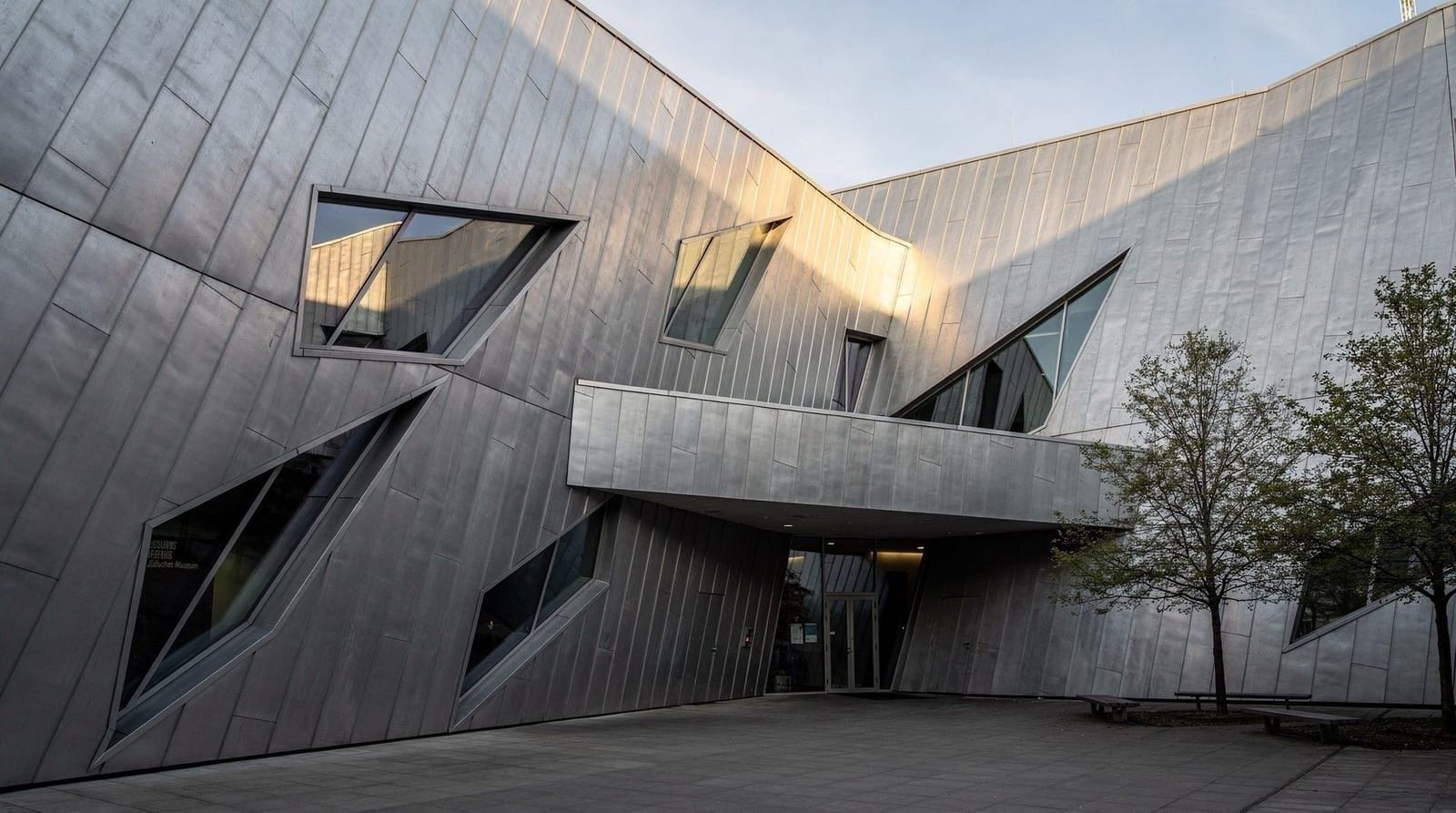
Starting point: U-Bahn to Hallesches Tor, walk to the Jüdisches Museum Berlin (2.5 to 3 hours). The permanent collection gives the chronological framework.
Afternoon: U6 north to Kochstrasse, then walk to the Topography of Terror — the perpetrator organisations are at the heart of the NS Quarter.
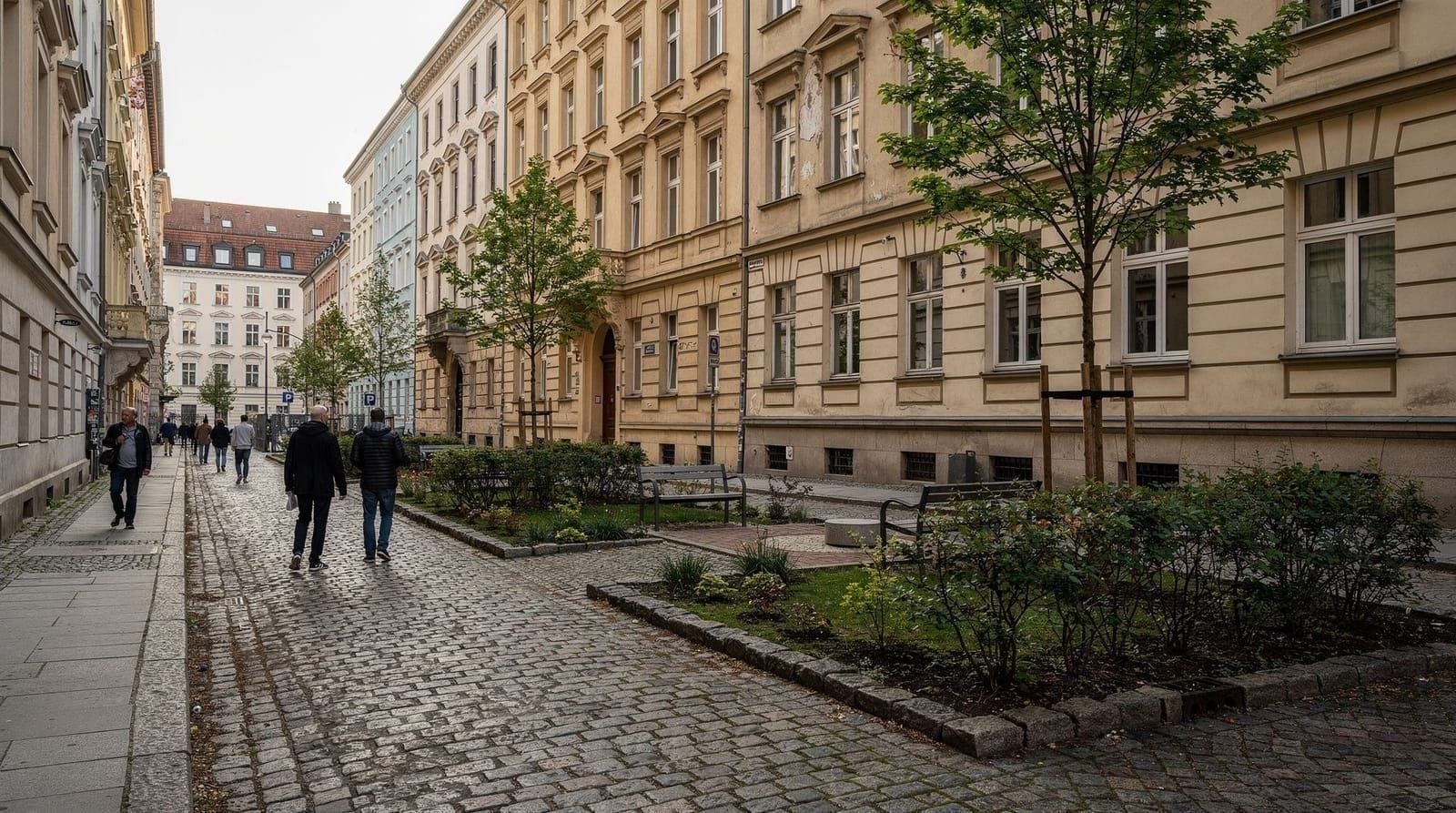
Late afternoon: S-Bahn to Hackescher Markt, walk the Scheunenviertel including Grosse Hamburger Strasse, the old cemetery, and the Neue Synagoge.
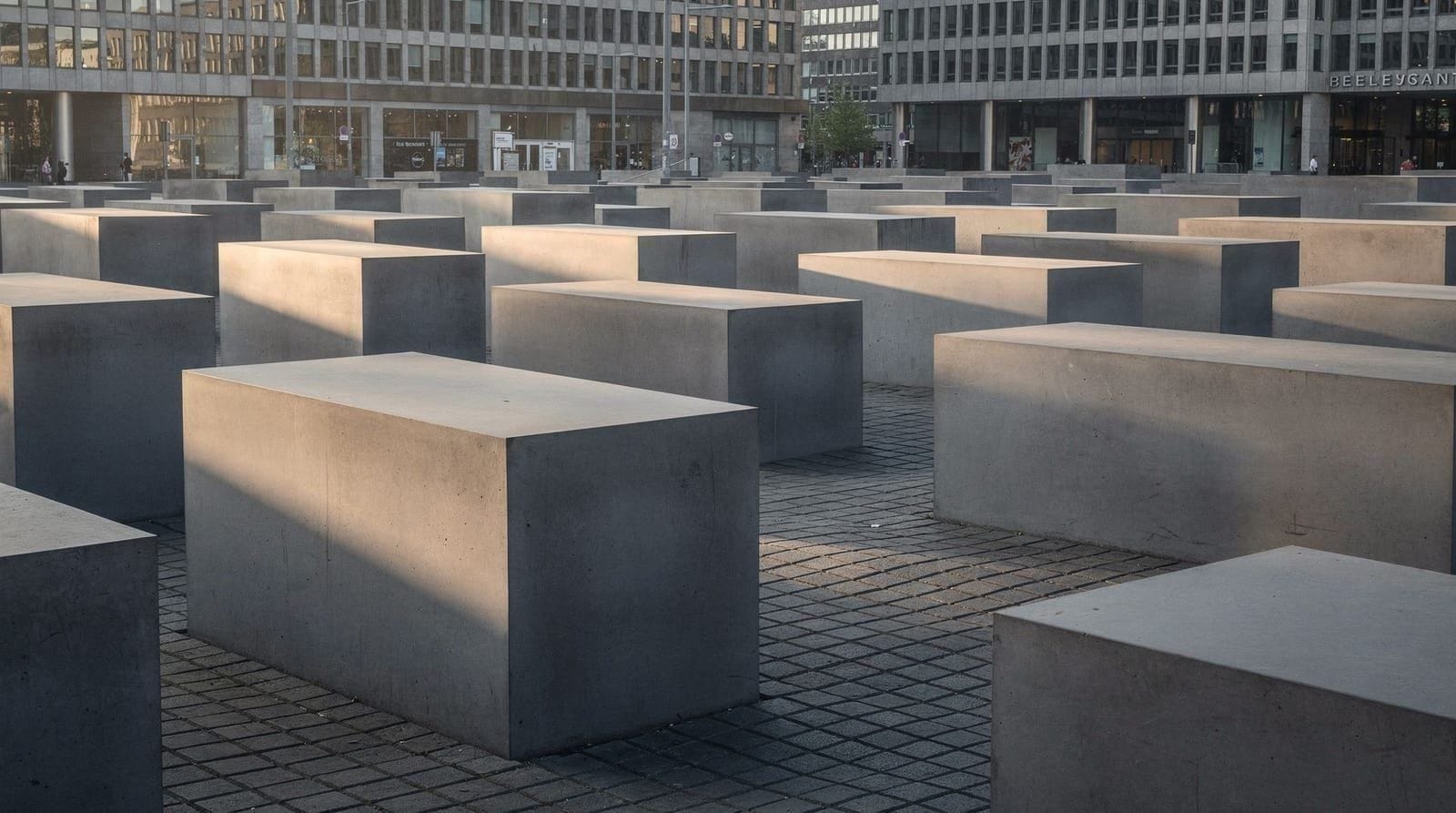
Second day: S7 to Grunewald (Gleis 17), then S-Bahn to the Memorial to the Murdered Jews of Europe.
Complete Jewish Berlin history walking tour — comprehensive guided coverageFrequently asked questions about Jewish history of Berlin
When did Jewish people first settle in Berlin?
The earliest documentary evidence of Jewish settlement in the Berlin area dates to 1295, when a document mentions a Jewish man in Spandau. Jews lived in medieval Berlin under charters that granted limited rights in exchange for taxes and trade permissions. The community was expelled in 1510 after false accusations of host desecration, and again in 1573. A small community was formally re-established by Elector Friedrich Wilhelm in 1671.Who was Moses Mendelssohn and why is he significant for Berlin's Jewish history?
Moses Mendelssohn (1729–1786) was a philosopher from Dessau who became the central figure of the Haskalah — the Jewish Enlightenment. Based in Berlin, he argued that Jews could be both fully Jewish in religious practice and full participants in German civic and intellectual life. His translations of the Torah into German, his philosophical works, and his friendships with figures such as Gotthold Ephraim Lessing shaped a generation of German-Jewish thought. He is buried in the Jewish cemetery on Grosse Hamburger Strasse.When were Jews fully emancipated in Prussia and Germany?
The process was gradual. Jews in Prussia received the right to reside and engage in certain trades from the Emancipation Edict of 1812, though full civil equality was withheld. Complete legal emancipation across the German Empire came in 1871 with the founding of the Reich. From 1871 to 1933 — approximately 60 years — German Jews had full legal citizenship, a period in which their contributions to German culture, science, and commerce were extraordinary.How large was Berlin's Jewish community before the Holocaust?
Berlin's Jewish population reached its peak of approximately 172,000 in 1925, representing about 4 percent of the city's total population. By 1933, when the Nazis took power, approximately 160,000 Jews lived in Berlin. Emigration reduced this to around 75,000 by 1939. The 1941 deportations to extermination camps further reduced the population. By the end of the war, approximately 7,000 to 8,000 Jews remained in Berlin, including those who had survived underground.What is the Jewish community like in Berlin today?
Berlin's Jewish community today numbers approximately 10,000 to 15,000 people affiliated with registered community organisations, with a larger unaffiliated population (including many Israeli citizens living in Berlin) estimated at 25,000 to 40,000. The community is predominantly from the former Soviet Union — following the immigration wave of the 1990s and 2000s — with smaller groups of pre-war survivor families, and a significant Israeli community drawn by Berlin's culture and cost of living.Which Berlin synagogues survived the Nazi period?
Berlin's synagogues were heavily attacked during Kristallnacht (9 November 1938) and in the subsequent years. The Rykestrasse Synagogue in Prenzlauer Berg was one of very few to survive substantially intact, partly because it was surrounded by tenement buildings that the Nazis did not wish to set on fire. The Neue Synagoge facade on Oranienburger Strasse survived Kristallnacht due to the intervention of local police commander Wilhelm Krützfeld, but was later destroyed by Allied bombing.
Top experiences
Bookable activities with verified prices and instant confirmation on GetYourGuide.