Holocaust commemoration in Berlin — the complete guide to memorial sites
Berlin: Holocaust & Nazi Resistance Guided Walking Tour
What are the main Holocaust memorial sites in Berlin?
Berlin's principal Holocaust commemoration sites include the Memorial to the Murdered Jews of Europe (the field of stelae near the Brandenburg Gate), the Topography of Terror, the Jewish Museum Berlin, Gleis 17 at Grunewald station, the Wannsee Conference Villa, and the Sachsenhausen Memorial north of the city. Most are free. Together they address the Holocaust from multiple perspectives — victims, perpetrators, history, and the individual.
What are the main Holocaust memorial sites in Berlin? Berlin has a deliberately dispersed and multi-layered system of Holocaust commemoration — no single site attempts to do everything. The field of 2,711 concrete stelae near the Brandenburg Gate (the Memorial to the Murdered Jews of Europe) is the most visited; Gleis 17 at Grunewald station is among the most affecting; the Wannsee Conference Villa is historically the most specific. Together they require multiple visits spread across the city.
| Where | Sites spread across Mitte, Grunewald, Wannsee, Oranienburg |
| Cost | Free at nearly every site |
| Time needed | Half a day for central sites; a second day for Wannsee/Sachsenhausen |
| Getting there | S-Bahn/U-Bahn network connects all sites |
| Best time | Weekday mornings; allow extra time, don’t rush |
Berlin’s approach to commemoration — why there is no single monument
After the Second World War, the question of how to memorialize the Holocaust was contentious in both German states. The GDR framed the Nazi period primarily through an anti-fascist lens — the perpetrators were capitalists and imperialists, the victims were political resisters, and socialist East Germany was the legitimate successor state to resistance. Jewish victims were acknowledged but not centralised.
West Germany’s approach was slower and more contested. Public debate about monuments, memorials, and the appropriate form of collective memory intensified in the 1970s and 1980s. The Historikerstreit (historians’ dispute) of 1986-87 — a public argument among German intellectuals about the singularity of the Holocaust and Germany’s responsibility for it — ran in parallel with growing calls for a central national memorial.
The result, after German reunification, was a commitment to build the Memorial to the Murdered Jews of Europe in the centre of Berlin — a decision debated for over fifteen years before the memorial opened in 2005. But the broader memorial landscape was deliberately not centralised in that single site. Berlin chose instead to develop multiple sites, each addressing a different dimension: perpetrators at the Topography of Terror, the deportation process at Gleis 17, the planning of the genocide at Wannsee, individual lives at the Jewish Museum and through Stolpersteine, and the wider camp system at Sachsenhausen.
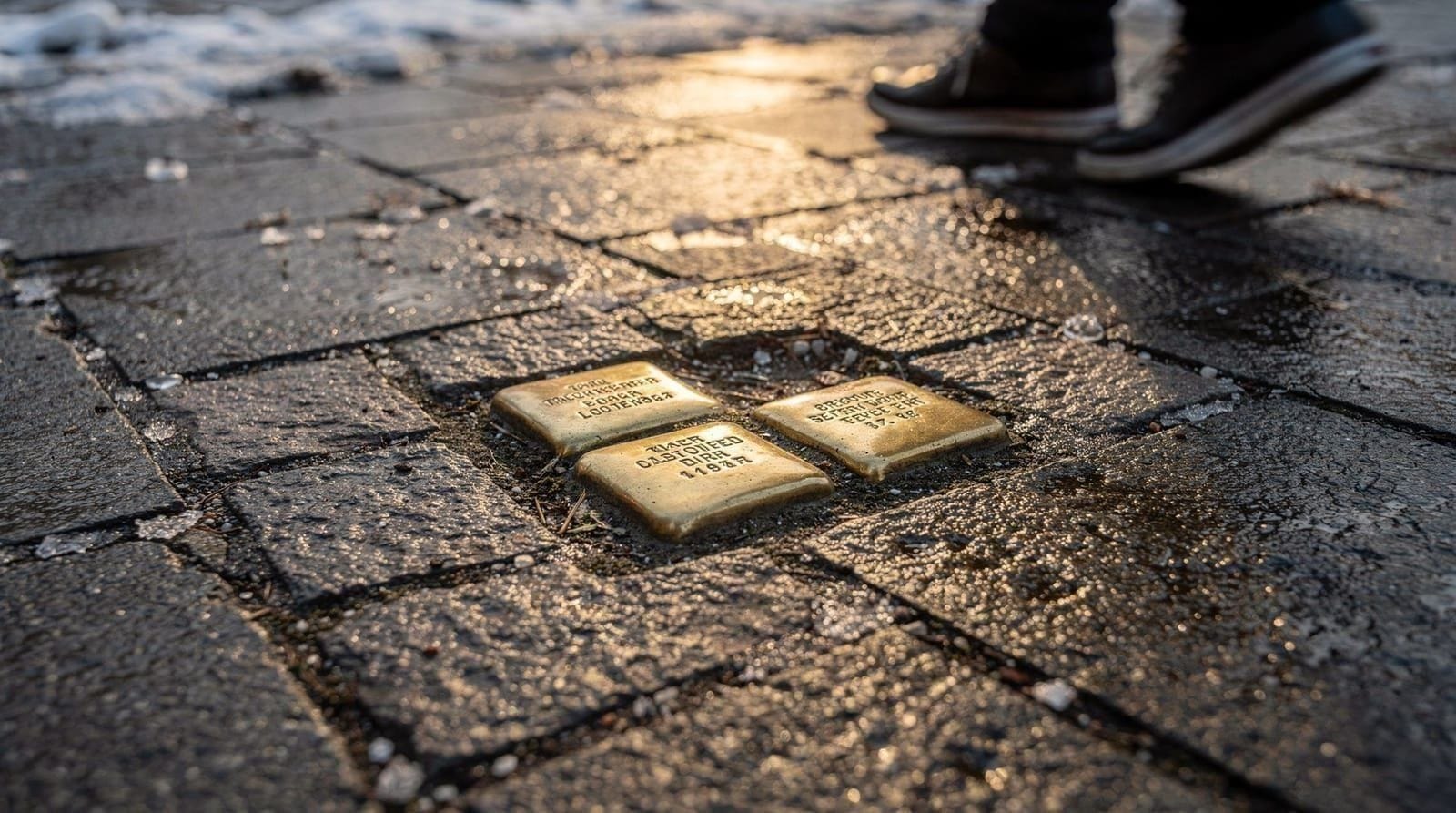
This dispersal is deliberate and arguably more effective than a single monument could be. Individual Stolpersteine — small brass memorial plaques set into the pavement outside the last freely chosen homes of individual victims — extend the same principle down to street level across the whole city, so that commemoration is not confined to a handful of destination sites but woven into everyday walking routes in almost every neighbourhood.
The Memorial to the Murdered Jews of Europe
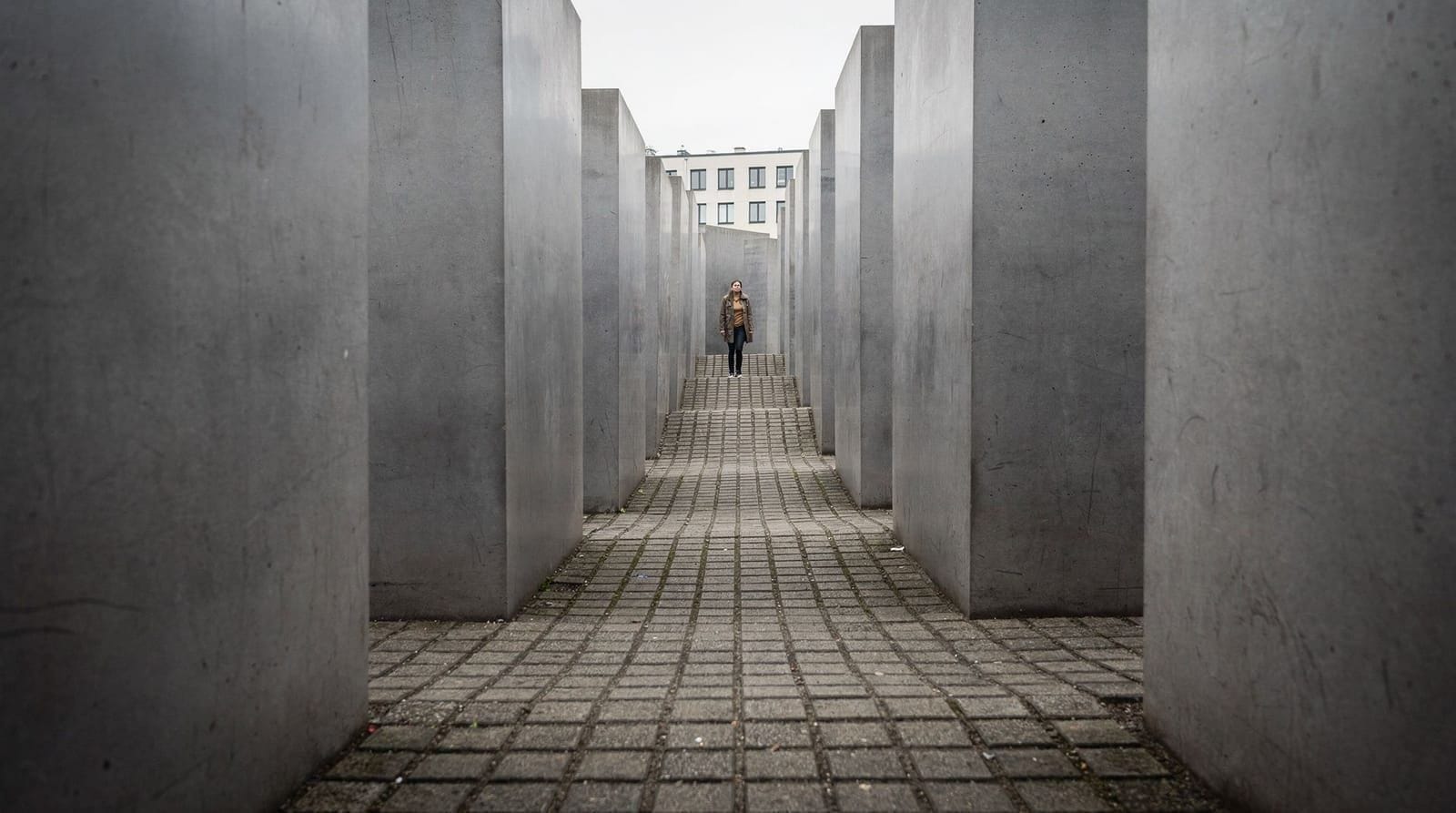
The field of 2,711 concrete stelae on Cora-Berliner-Strasse, one block south of the Brandenburg Gate, was designed by New York architect Peter Eisenman and opened in May 2005. It covers 1.9 hectares of former death strip (the site was in the shadow of the Berlin Wall between 1961 and 1989).
The stelae are rectangular concrete blocks ranging from 20 centimetres to 4.7 metres in height. The ground surface undulates. The intended effect — achieved as you walk into the interior — is of a wave of grey concrete cutting off the surroundings, each path offering changing sightlines and the possibility of becoming briefly lost. There are no names, no dates, no explicit text in the field itself. The memorial is intentionally abstract.
For a full account of the monument, its design debate, and the underground information centre, see the Memorial to the Murdered Jews of Europe guide.
Gleis 17 — Platform 17 at Grunewald station
Of Berlin’s Holocaust sites, Gleis 17 is the one that most directly marks a specific act. Between 18 October 1941 and 26 February 1945, over 50,000 Berlin Jews were loaded onto trains at platform 17 of the Grunewald S-Bahn station and transported east to the concentration and extermination camps.
The platform has been preserved as a memorial since 1998. Along the platform edges, steel plaques are embedded recording each transport in chronological order:
18.10.1941 — 1251 Juden — Berlin — Lódz 14.11.1941 — 1053 Juden — Berlin — Minsk 25.11.1941 — 1030 Juden — Berlin — Kaunas
The sequence continues for four years, the destinations shifting as the extermination infrastructure expanded eastward. The platform is fenced on the track side; the plaques line the full length. Birch trees have grown up on the disused platform surface, their roots pressing between the paving stones.
The site requires no explanation panels, no audio guide, no visitor centre. The plaques are the memorial. The trains that used this platform went to Lodz, Minsk, Riga, Theresienstadt, Sobibor, Auschwitz. The numbers record who was on each train; the destinations record where the trains went.
Grunewald station is reached by S-Bahn S7 (direction Potsdam Hauptbahnhof, approximately 20 minutes from Zoologischer Garten). Platform 17 is a short walk from the main station entrance, signposted. It is freely accessible at all times. Allow at least 30 to 45 minutes to walk the full length and read the plaques.
The Wannsee Conference Villa
On 20 January 1942, fifteen senior Nazi officials met at a lakeside villa in southwest Berlin for a 90-minute meeting chaired by Reinhard Heydrich, head of the Reich Security Main Office. The meeting had one agenda item: the coordination of the “Final Solution to the Jewish Question” — the administrative and logistical organisation of the systematic murder of all European Jews.
The minutes of the meeting (the Wannsee Protocol), drafted by Adolf Eichmann and preserved in only one copy at the German Foreign Ministry archive, document the discussions with bureaucratic detachment. The estimated number of Jews in each European country is listed — 11 million in total. The method of murder is referred to obliquely. The meeting established inter-ministerial coordination between the security services, the SS, the Foreign Ministry, and other state bodies.
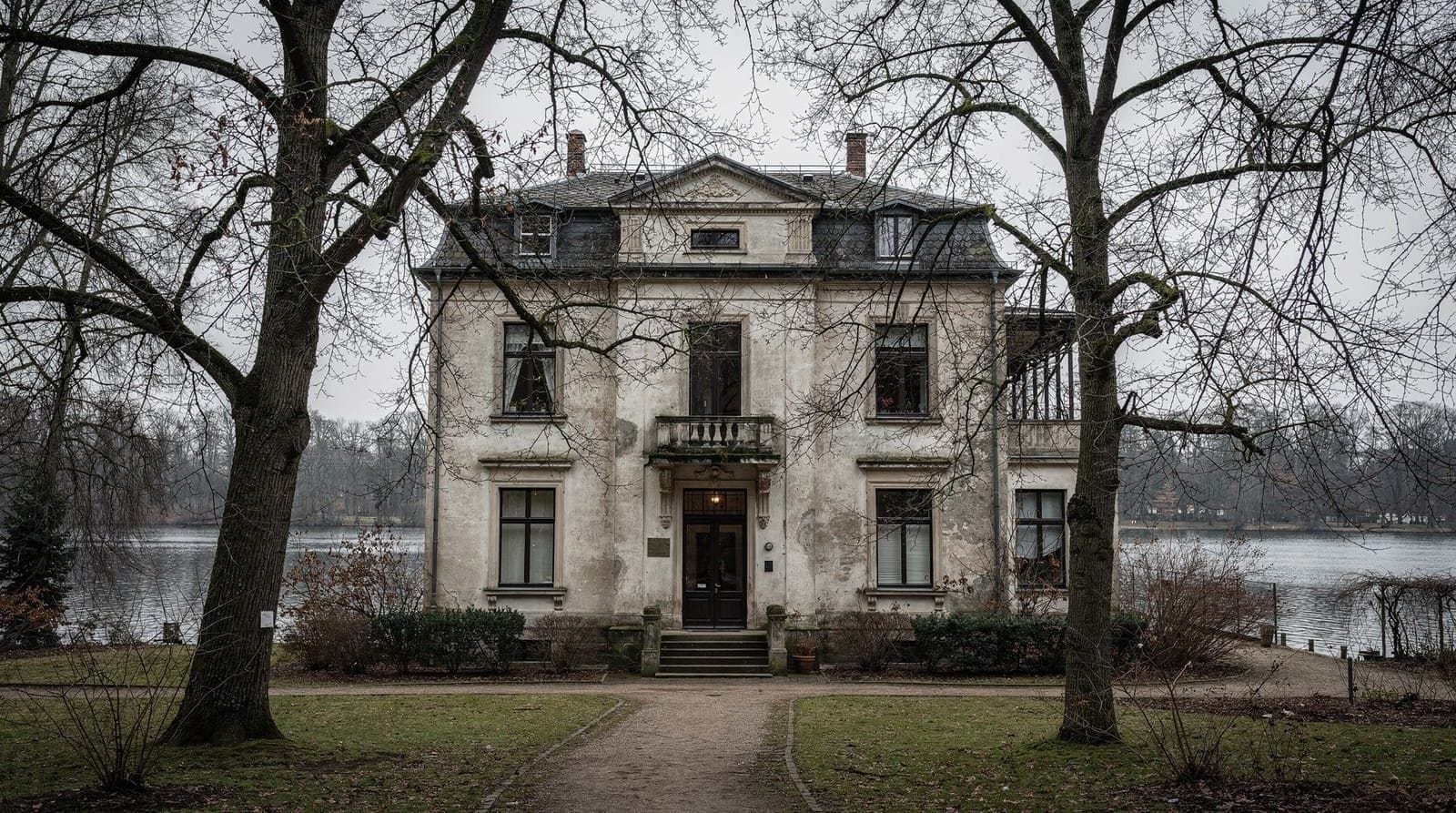
The villa (Am Grossen Wannsee 56-58) is now the Haus der Wannsee-Konferenz — a permanent documentation and education centre. Entry is free. The permanent exhibition is one of the most carefully researched historical exhibitions in Germany, covering the path to the genocide, the fifteen participants and their backgrounds, the implementation that followed, and the postwar fates of the perpetrators. A significant proportion were never tried.
Getting there: S-Bahn S1 from central Berlin to Wannsee station (approximately 40 minutes from Friedrichstrasse), then bus 114 to the villa. Allow at least 90 minutes for the exhibition. The lakeside setting — a prosperous residential area in 2026 — adds its own disturbing quality to the visit.
The Topography of Terror
The Topography of Terror (Topographie des Terrors) on Niederkirchnerstrasse documents the headquarters of the Gestapo and SS, which stood on this site from 1933 to 1945. The perpetrator organisations that implemented the persecution and murder of Jewish Europeans were based here, in Berlin’s government district.
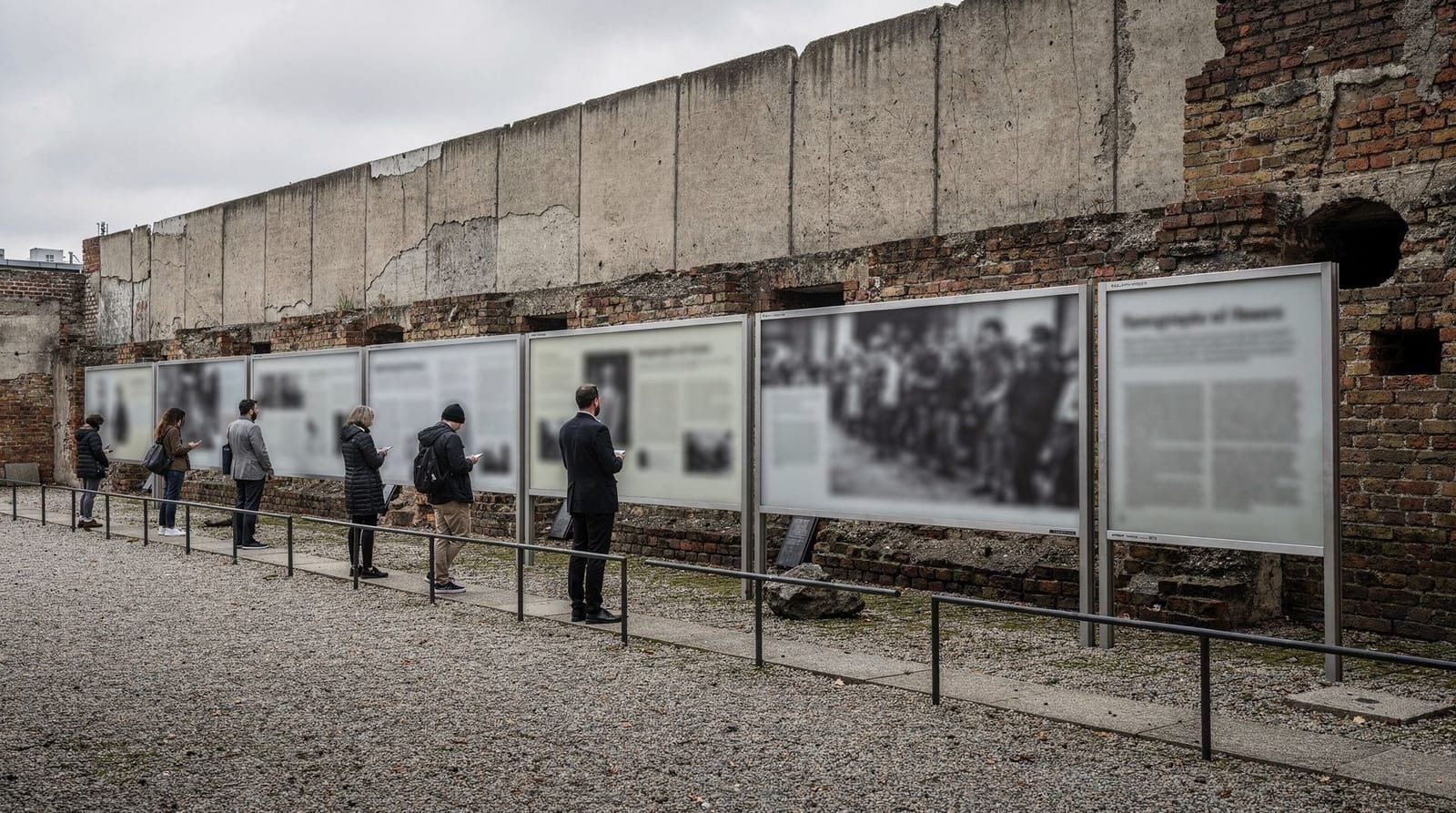
The outdoor exhibition, which runs along a surviving section of the Berlin Wall on the street, is free and always accessible. The indoor documentation centre (also free, open daily) presents the history of the SS and Gestapo, their operations across Europe, and the fates of their victims.
Unlike the Jewish Museum or the Memorial to the Murdered Jews of Europe, the Topography of Terror focuses primarily on the perpetrators. It is an essential complement to the victim-centred memorials. For a full account, see the Topography of Terror guide.
Sachsenhausen Memorial
Sachsenhausen concentration camp at Oranienburg, 35 km north of Berlin, was the first purpose-built concentration camp constructed under the Nazi system, opening in 1936. It served as the administrative model for other camps and as a training ground for SS concentration camp personnel.
Sachsenhausen held political prisoners, Jews, homosexuals, Jehovah’s Witnesses, and Soviet prisoners of war. Tens of thousands died here through forced labour, starvation, execution, and medical experiments. After liberation by Soviet forces in April 1945, the Soviets used the same site as Special Camp No. 7 from 1945 to 1950, in which an estimated 12,000 German prisoners died under Soviet detention.
The memorial is free and open Tuesday to Sunday. The S-Bahn S1 runs to Oranienburg in approximately 50 minutes from central Berlin (zone ABC ticket required — a standard Berlin zone AB ticket does not cover Oranienburg). A guided tour adds significant context to a site whose spatial logic is not self-explanatory. Our day trip guide to Sachsenhausen covers the full logistics if you’re planning it as a standalone excursion rather than combining it with other Holocaust sites.
Sachsenhausen guided memorial tour — full day from Berlin with expert guideNeue Wache — the national memorial to victims of war and tyranny
The Neue Wache on Unter den Linden is Germany’s central national memorial to all victims of war and tyranny. Originally a Prussian royal guardhouse (1818, designed by Karl Friedrich Schinkel), it was used by both the Nazi state and the GDR as their respective central memorials before being designated the German Federal Republic’s central memorial in 1993.
The interior contains a single sculptural work — a 1937 enlargement of Käthe Kollwitz’s small bronze Mutter mit Totem Sohn (Mother with Dead Son) — at the centre of an otherwise bare interior open to the sky. Light and rain fall through the circular oculus in the roof onto the figure below. The simplicity is intentional; the brevity of the visit (it is a small interior) is part of the design.
The Neue Wache addresses all victims of twentieth-century violence — war dead, concentration camp victims, resistance fighters, civilian bombing victims — rather than Jewish victims specifically. Its universalist framing has been criticised for eliding distinctions between perpetrators, bystanders, and victims. It is nonetheless worth the brief stop on Unter den Linden; see the Neue Wache memorial guide for its full history and design context.
The Jewish Museum Berlin
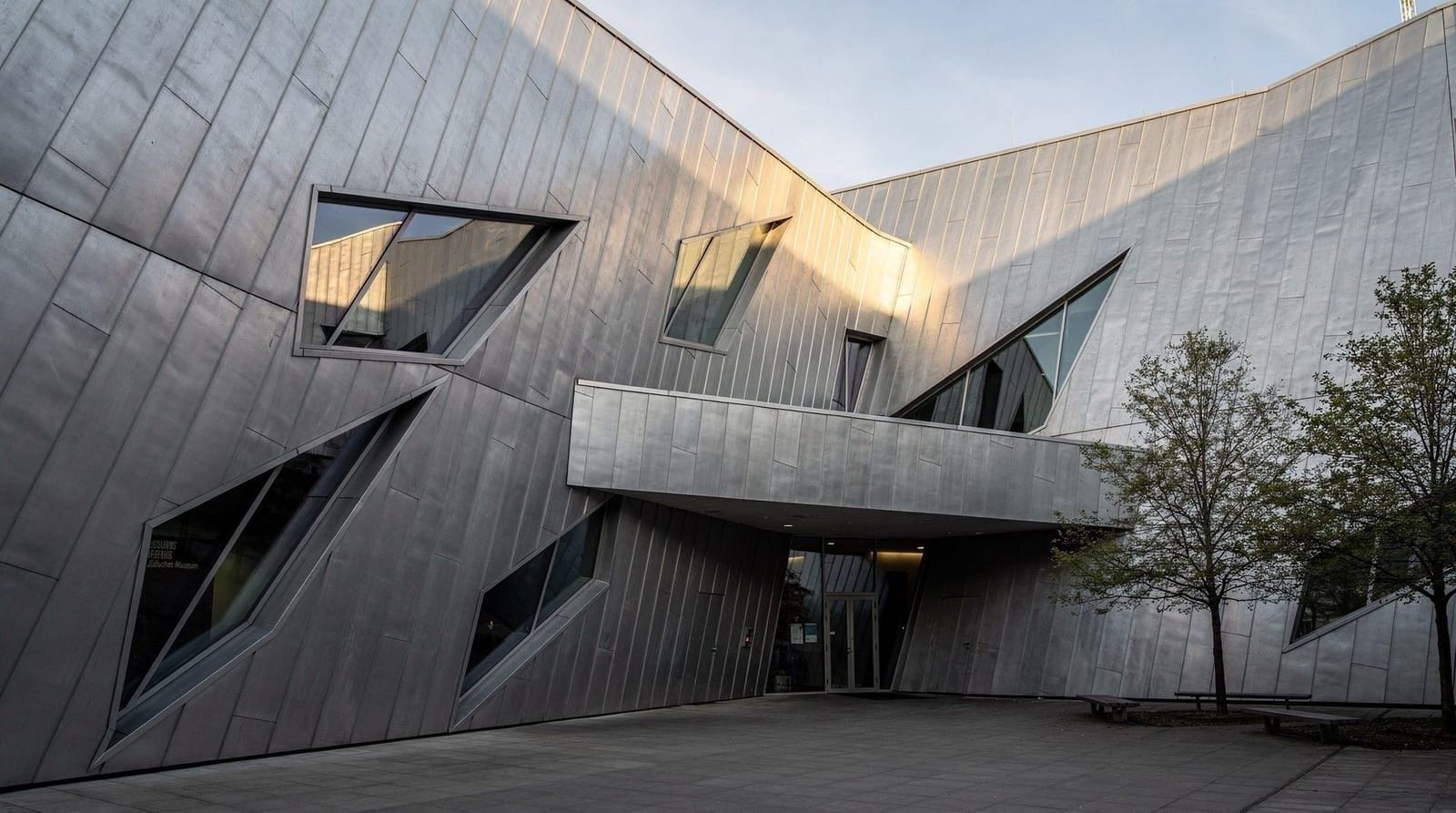
For visitors who want the fuller cultural context around the Holocaust — not only the destruction but the two thousand years of Jewish life in Germany that preceded and survived it — the Jewish Museum Berlin in Kreuzberg is the essential complement to the memorial sites covered above. Daniel Libeskind’s building itself, with its jagged floor plan and disorienting Axis of Exile and Axis of the Holocaust, is as much a part of the experience as the collection. Most visitors need 2–3 hours to do the permanent exhibition justice, longer if a temporary exhibition is running. It pairs naturally with an evening slot after a day spent at the more outdoor, site-specific memorials.
Visiting with children or teenagers
Berlin’s Holocaust sites vary considerably in how appropriate they are for younger visitors. The outdoor field of stelae at the Memorial to the Murdered Jews is open and unstructured enough that children can move through it at their own pace, though the underground information centre’s content (individual victim accounts, photographs) is more suitable from around age 12 upward. Gleis 17 is outdoor and factual — the plaques alone, without extensive text, can prompt a more manageable conversation with younger children than a dense museum exhibition would. Sachsenhausen and the Wannsee Villa’s exhibitions are dense and emotionally demanding; most educators recommend them for secondary-school age and above, ideally with some prior context provided beforehand rather than as a first introduction to the subject. Whichever combination you choose, building in unstructured time afterward — a coffee, a walk, an unrelated activity — helps process what can be a heavy day for visitors of any age.
Planning a day of Holocaust commemoration in Berlin
A practical single-day route:
Morning: Begin at Gleis 17, Grunewald (S7 from Zoologischer Garten, 20 minutes). Spend 30 to 45 minutes at the platform. Return to central Berlin by S7.
Late morning: Walk or take U-Bahn to the Topography of Terror on Niederkirchnerstrasse. Spend 90 minutes in the indoor exhibition. The adjacent Wall section is worth 15 minutes.
Afternoon: Walk north 10 minutes to the Memorial to the Murdered Jews of Europe. Enter the field; allow 30 to 45 minutes. Visit the underground information centre (45 to 60 minutes).
Evening: Consider the Jewish Museum Berlin in Kreuzberg (U6 from Stadtmitte to Hallesches Tor, then walk) for the broader cultural context. Or, if you prefer, end the day with a walk through the Scheunenviertel and Grosse Hamburger Strasse.
A second day would allow Sachsenhausen and/or the Wannsee Villa.
Day one at a glance:
| Time | Stop | Duration |
|---|---|---|
| Morning | Gleis 17, Grunewald | 30–45 min |
| Late morning | Topography of Terror | 90 min |
| Afternoon | Memorial to the Murdered Jews of Europe + information centre | 75–105 min |
| Evening | Jewish Museum Berlin or Scheunenviertel walk | 2–3 hrs / open |
Frequently asked questions about Holocaust commemoration in Berlin
What is the difference between Berlin's Holocaust memorials?
Berlin's memorials approach the Holocaust from different angles. The Memorial to the Murdered Jews of Europe is an abstract, spatial experience of collective loss. The Topography of Terror documents the perpetrator organisations (SS, Gestapo) who implemented it. The Jewish Museum traces 2,000 years of Jewish life with the Shoah as a rupture. Gleis 17 at Grunewald station marks the physical site of deportation departures. Wannsee Villa documents the planning meeting of January 1942. Each requires its own visit.Is the Holocaust Memorial (field of stelae) free?
Yes. The outdoor field of 2,711 concrete stelae near the Brandenburg Gate is free and accessible 24 hours a day. The underground information centre (Ort der Information) beneath it is also free and open Tuesday to Sunday, 10:00 to 20:00 (last entry 19:15). It is closed on Mondays and on 24 December.What is Gleis 17 at Grunewald station?
Gleis 17 (Platform 17) is a disused rail platform at Grunewald S-Bahn station from which over 50,000 Berlin Jews were deported to extermination and concentration camps between 1941 and 1945. The platform edges are lined with steel plaques recording each deportation transport — date, number of people, and destination. It is an outdoor memorial, free and accessible at all times, around 15 minutes from central Berlin by S-Bahn.What is the Wannsee Conference Villa?
The Wannsee Conference Villa (Haus der Wannsee-Konferenz) is the lakeside property in southwest Berlin where on 20 January 1942, fifteen senior Nazi officials and SS officers met to coordinate the implementation of the "Final Solution." The villa is now a museum and educational centre. Entry is free. It takes about 90 minutes to visit and is reached by S-Bahn S1 to Wannsee, then bus 114.How do I behave at Holocaust memorial sites in Berlin?
The field of stelae and Gleis 17 are outdoor public spaces, accessible 24 hours. They attract some visitors who behave inappropriately — running, posing for jumping photos, eating. None of this is forbidden by law, but it is widely considered disrespectful. The information centres attached to major memorials are explicitly reflective spaces — quiet behaviour, no phone calls. Photography is generally permitted but should be thoughtful.Can I visit Sachsenhausen from Berlin in one day?
Yes. Sachsenhausen concentration camp is 35 km north of Berlin, near Oranienburg. The S-Bahn S1 runs to Oranienburg in about 50 minutes (requires zone ABC ticket), from where it is a 20-minute walk to the memorial. Entry is free. Allow a full day — 4 to 5 hours on site is typical for a meaningful visit.Is there an organised tour that covers Holocaust sites in Berlin?
Yes, several tour operators run half-day and full-day tours covering multiple Holocaust and Third Reich sites. A guided tour adds interpretive context that is not available from the sites' own information materials alone. Look for tours that cover at least two or three sites with a knowledgeable guide rather than a single-site hop-on bus tour.
Top experiences
Bookable activities with verified prices and instant confirmation on GetYourGuide.