Memorial to the Murdered Jews of Europe — stele field, information center, and visiting
Berlin: Jewish Walking Tour
What is the Memorial to the Murdered Jews of Europe?
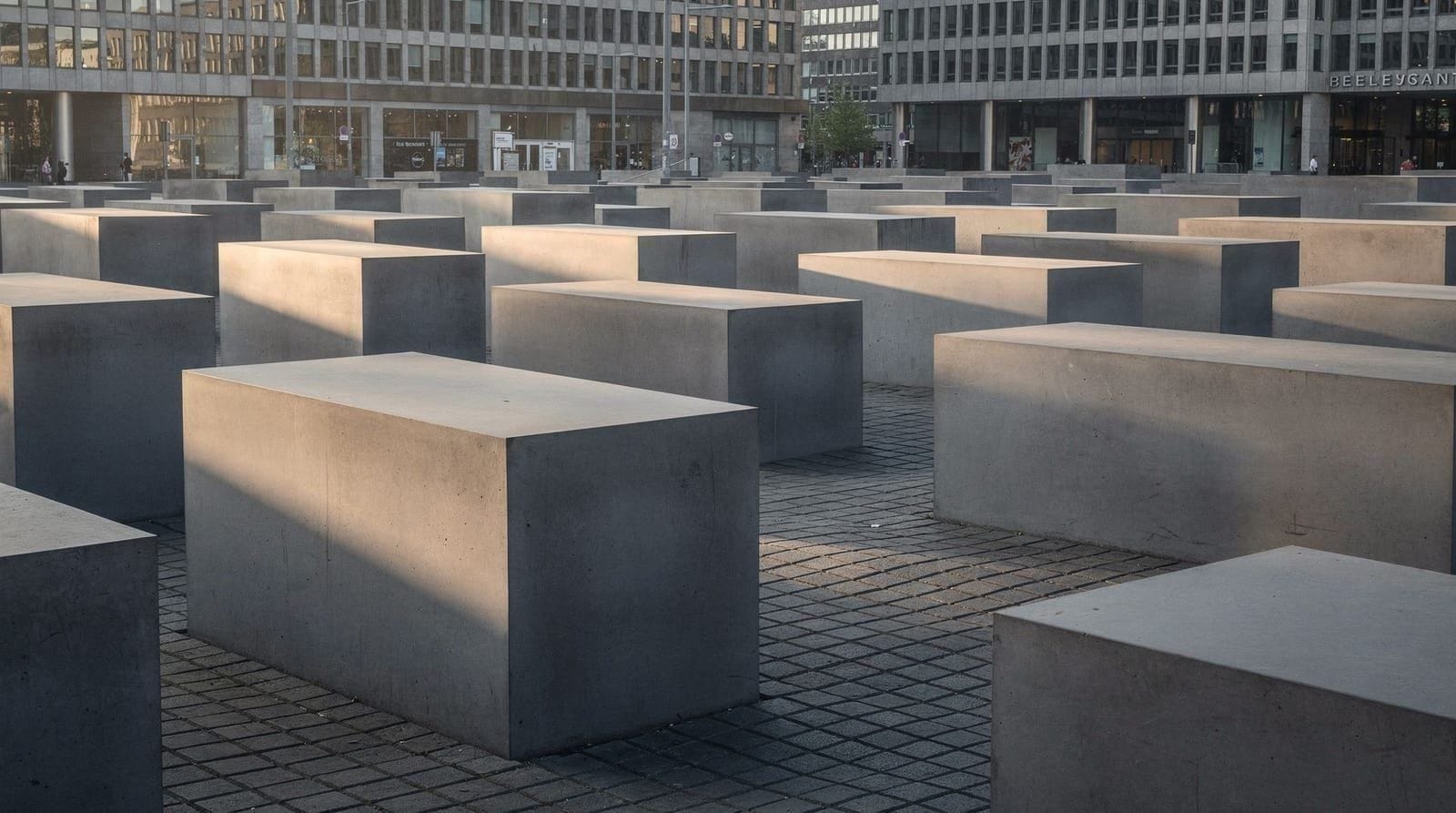
The Memorial to the Murdered Jews of Europe is a 19,000 square metre field of 2,711 concrete stelae near the Brandenburg Gate, designed by Peter Eisenman and opened in 2005. An underground information center documents the fate of individual victims and communities. Entry to both the stele field and the information center is free. For the broader historical context of Jewish life in Berlin before and during the Nazi period, the linked guide on Holocaust memorial history provides detailed background.
The Memorial to the Murdered Jews of Europe is a field of 2,711 concrete stelae covering 19,000 square metres in central Berlin, one block south of the Brandenburg Gate. Entry to both the outdoor stele field and the underground information center is free. It is one of the largest national Holocaust memorials in the world and among the most visited sites in Berlin — approximately 500,000 people visit annually. For the broader context of Jewish history in Berlin and the history of Holocaust remembrance, the Holocaust memorial guide provides detailed background.
| Where | Cora-Berliner-Strasse 1, one block south of Brandenburg Gate |
| Cost | Free — stele field and information center |
| Time needed | 15–30 min for the field; 1–2 hours with the information center |
| Getting there | S-Bahn/U-Bahn Brandenburger Tor, 3 minutes on foot |
| Hours | Stele field 24/7; information center Tue–Sun 10:00–20:00, closed Monday |
The stele field — form, scale, and experience
The stele field occupies a rectangular block on Cora-Berliner-Strasse, between Ebertstrasse and Hannah-Arendt-Strasse, south of Behrenstrasse. From street level, walking toward it from the Brandenburg Gate or Potsdamer Platz, the grey concrete blocks appear first as a low field, then rise dramatically as the ground dips and the stelae increase in height.
The 2,711 rectangular concrete blocks — all identical in plan at 95 cm by 230 cm, but ranging in height from ground level to 4.7 metres — are laid out on a grid with paths approximately 95 cm wide between them. The number 2,711 was not chosen for symbolic significance; it is simply the number of stelae that fit the site according to Eisenman’s design principles.
Walking into the field, the experience changes rapidly. The sounds of the surrounding city diminish. The blocks close in. The slight undulation of the ground creates constantly shifting sight lines — at certain points the blocks are above eye level in all directions. The labyrinthine quality is intentional: Eisenman described wanting to create “an uneasy, confusing atmosphere” that resists easy emotional resolution.
The surface of the stelae is treated with a graffiti-resistant coating (Protectosil, applied in 2003 during construction) and is cleaned regularly. The concrete is slightly different in colour between older and newer sections, but uniformly grey.
Practical note: The field is fully open and unguarded. People sit on the stelae, climb them, use them for photographs. The Foundation Memorial to the Murdered Jews of Europe, which manages the site, has publicly stated it does not wish to police visitor behaviour in the field — only to prohibit commercial photography, eating, cycling, and the use of the field as a shortcut. Parties and games on the stelae have generated controversy but no formal prohibition.
The underground information center (Ort der Information)
The entrance to the Ort der Information (Place of Information) is located in the southeast corner of the stele field, accessed by a staircase descending beneath the stelae. The four permanent exhibition rooms are arranged along a linear path:
Room of Dimensions: Large-format quotations from diaries, letters, and testimonies of victims — from across Europe, from different periods of the persecution, and from diverse communities. The scale of the room and the size of the text convey statistical magnitude without reducing individuals to numbers. Statistical panels alongside document the scope of the murders: approximately 6 million Jews murdered, the largest communities from Poland (approximately 3 million), the Soviet Union, Hungary, Romania, and Germany.
Room of Families: Fifteen families from across Europe are documented in depth — photographs, documents, testimonies from survivors or postwar records. The families were selected to represent the geographic and social breadth of European Jewish life before 1939: a farmer from Ukraine, an industrialist from Germany, a teacher from Greece, a tailor from France. The aim is to restore individuality to people reduced by the perpetrators to categories.
Room of Names: In the centre of the information center, a dark room with text projected onto floor and ceiling reads out the names and brief biographical details of identified Jewish victims — name, year of birth, country of origin, year of death or disappearance. The cycle takes over 6 years to complete. The room documents approximately 3 million victims by name; the remaining 3 million are known only by community records or are not identified in surviving documents. Sitting in this room for a few minutes, listening to the names, is among the more affecting experiences the memorial offers.
Room of Sites: A map room documenting the places where the murders occurred — ghettos, transit camps, concentration camps, shooting sites, deportation routes. The geography of the Holocaust across Europe is presented in spatial terms.
The debate over the memorial — a brief history
The campaign for a central Holocaust memorial in Germany began formally in 1988, led by journalist Lea Rosh and historian Eberhard Jäckel. What followed was one of the longest and most contentious memorial debates in German postwar history.
A first competition in 1994–1995 drew 528 entries. None was selected. A second competition in 1997 produced a shortlist; Eisenman’s concept was selected but then extensively modified after political intervention, including by Bundestag members who objected to the original scale. The project was debated in the Bundestag on four separate occasions. The question of whether the memorial should be specifically for Jewish victims (as ultimately built) or for all Nazi victims was disputed until the final vote in 1999.
Historians, artists, and survivors were divided. Nobel laureate Günter Grass opposed the project. Concentration camp survivor and writer Elie Wiesel supported it. The philosopher Jürgen Habermas argued that Germany required an explicit acknowledgment in stone. The art critic Werner Hoffmann warned against the memorial becoming a ritual substitute for genuine historical reckoning.
The Bundestag voted in June 1999 to proceed with Eisenman’s modified design, specifically for Jewish victims only. Construction began in 2003. The memorial was inaugurated on 10 May 2005.
The debate did not end with the inauguration. Questions about the exclusion of other victim groups — Sinti and Roma, homosexuals, disabled people — led to the construction of separate memorials nearby: the Memorial to the Sinti and Roma of Europe (Tiergarten, 2012) and the Memorial to Homosexuals Persecuted under National Socialism (Tiergarten, 2008).
Related memorials within walking distance
The central Berlin memorial landscape is unusually dense. Within 15 minutes of the stele field:
Memorial to the Sinti and Roma of Europe: In the Tiergarten, north of the Brandenburg Gate. A circular pool with a single flower at its centre, by artist Dani Karavan, opened 2012. It is small, quiet, and easy to miss — far fewer visitors than the main memorial, but of equal historical significance. Sinti and Roma were murdered in parallel with Jews under Nazi racial ideology; approximately 500,000 were killed.
Memorial to Homosexuals Persecuted under National Socialism: Tiergarten, near the Brandenburger Tor. A concrete block with a small window through which a film plays. Opened 2008. Approximately 100,000 gay men were arrested under Paragraph 175 of the German Criminal Code between 1933 and 1945; approximately 10,000–15,000 died in concentration camps.
Neue Wache: On Unter den Linden, 20 minutes east — a converted Schinkel guardhouse serving as the Central Memorial of the Federal Republic of Germany. The interior contains Käthe Kollwitz’s “Mother with Dead Son.” Note: the Neue Wache is sometimes criticised for its universalising dedication language, which obscures distinctions between perpetrators and victims.
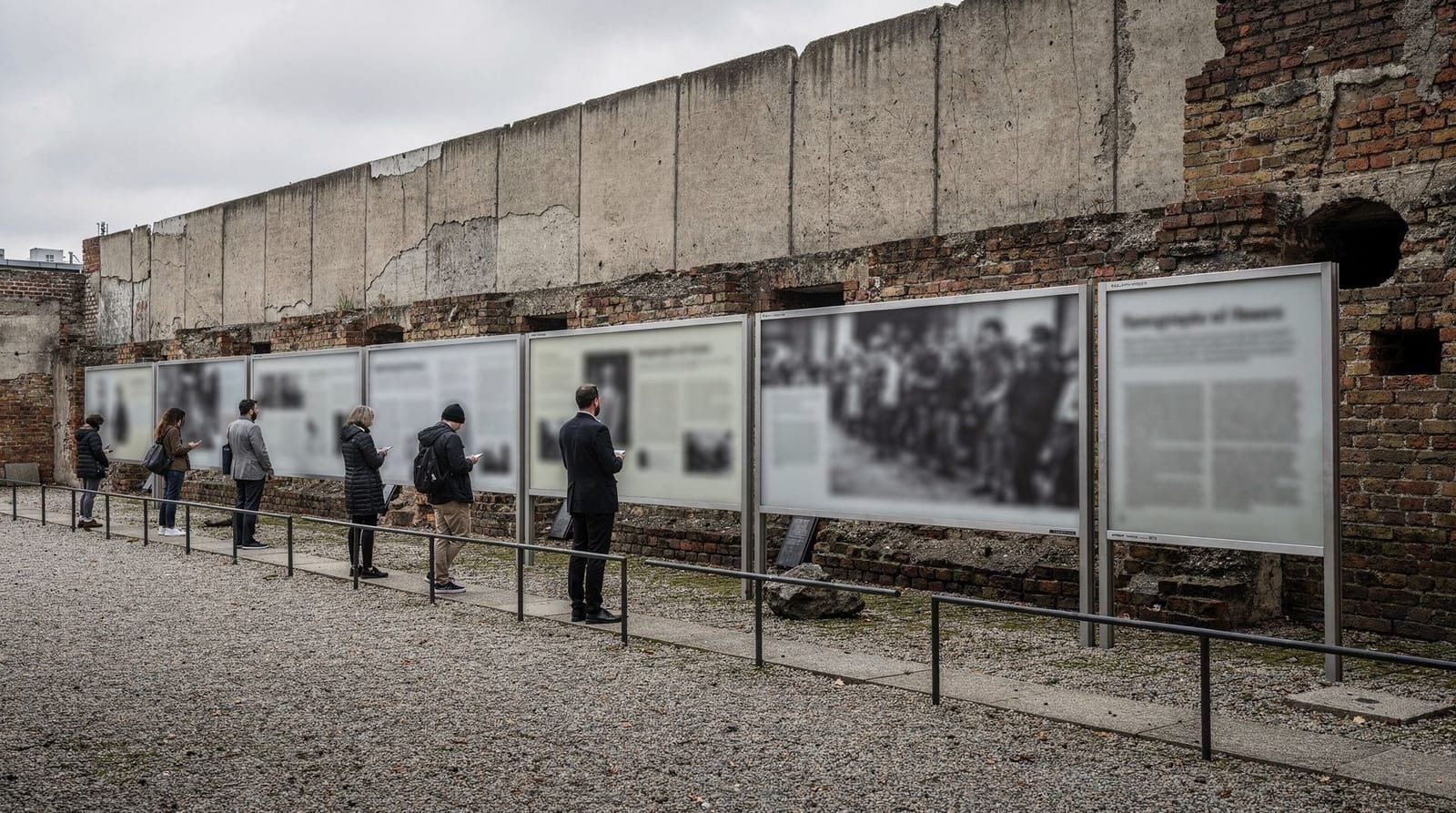
Topography of Terror: 15 minutes south. The former Gestapo and SS headquarters, now a free documentation centre. See the Topography of Terror guide for planning advice.
Guided tours and context
The stele field and information center are fully navigable without a guide. The information center provides English-language maps and interpretive materials at the entrance desk. Audio guides in German, English, French, and other languages are available for a small fee.
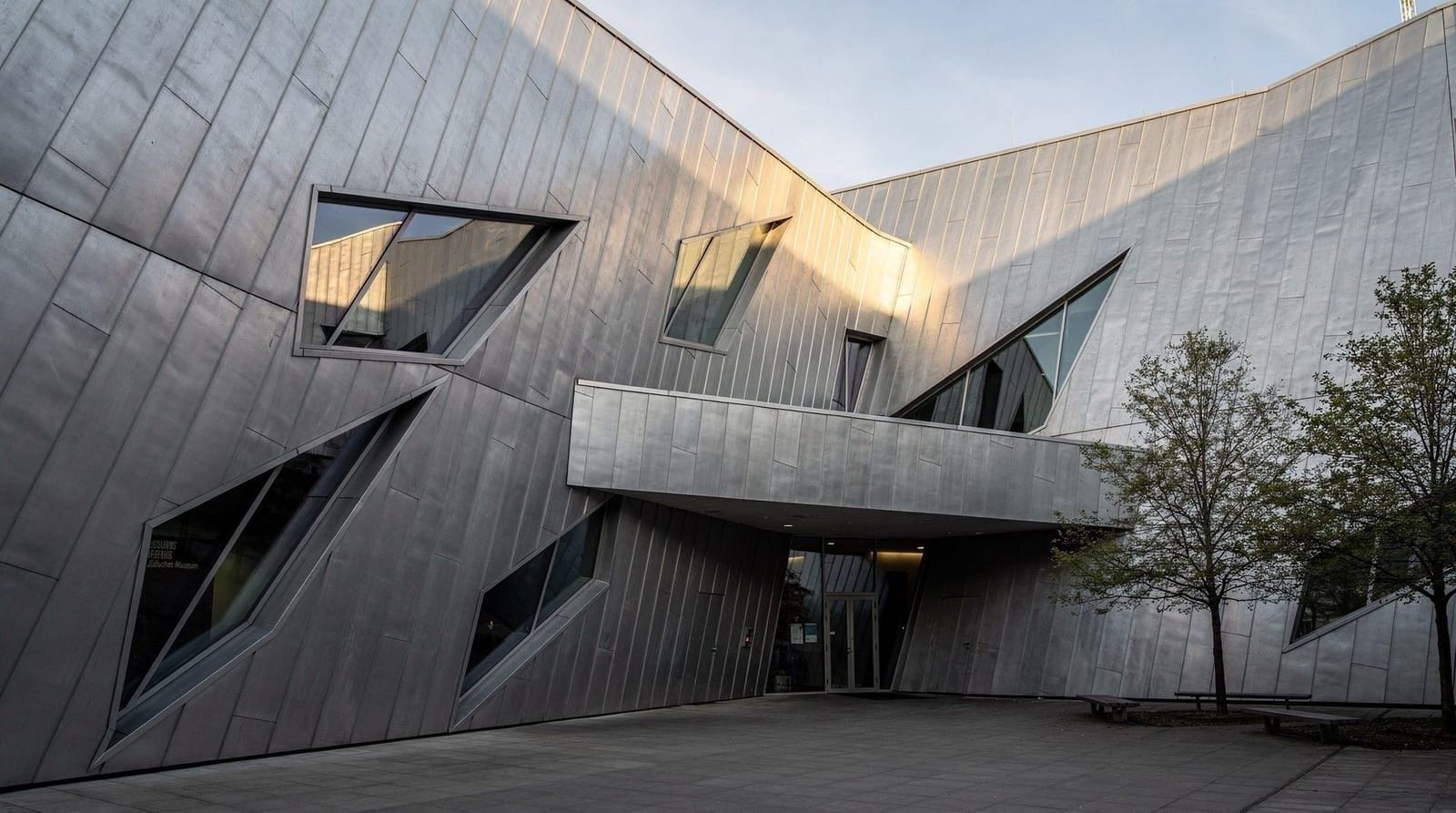
Berlin Jewish walking tour — Holocaust Memorial, Jewish quarter, and Third Reich sites, English guideA guided tour that combines the memorial with the Topography of Terror, the Wannsee Conference site, or the Jewish Museum provides more historical context than the memorial itself offers. The stele field is intentionally non-narrative — it does not explain; it memorialises. The information center provides facts, but the interpretation of what you have seen in the field benefits from guided discussion.
Holocaust, Nazi regime, and resistance walking tour — guided in English, covers memorial and key Third Reich sites, 3 hoursFor a full understanding of Jewish history in Berlin — from the 18th-century Jewish Enlightenment through to the Nazi period and the postwar community — the Jewish history Berlin guide and the Jewish Museum Berlin guide provide the wider context.
Practical planning
Address: Cora-Berliner-Strasse 1, 10117 Berlin (information center entrance in the southeast corner of the stele field)
Getting there:
- S-Bahn: Brandenburger Tor (S1, S2, S25) — 3 minutes on foot south
- U-Bahn: Brandenburger Tor (U55) — 3 minutes on foot
- Bus: 100, 200 (stop Brandenburger Tor)
Stele field: Open 24 hours, every day.
Information center: Tuesday to Sunday, 10:00–20:00 (last entry 19:15). Closed Monday and 24 December. Free entry.
Facilities: Toilets in the information center (accessible). No cloakroom. A bookshop at the information center exit sells relevant literature. No café on site; the nearest cafés are in the adjacent embassy district on Ebertstrasse.
Accessibility: The stele field paths are 95 cm wide — navigable for most wheelchairs but narrow in places. The ground is cobbled; some sections uneven. The information center is fully wheelchair accessible via lift.
Photography: Permitted throughout, personal use. Commercial photography requires permission from the foundation. No drones.
Building a fuller Third Reich memorial circuit
The memorial sits within walking distance of several other essential sites that together tell a more complete story. The Führerbunker site, roughly 80 metres southeast, marks where Hitler spent his final days — a deliberately unmarked car park that is easy to miss without knowing what to look for. For the machinery of persecution rather than its final scale, the Wannsee Conference memorial, a short S-Bahn ride from the centre, is where the “Final Solution” was formally coordinated in January 1942. Back in the city centre, the complete guide to Third Reich sites in Berlin and the structured Third Reich history trail itinerary both sequence these locations into a coherent day or half-day. For the individual, street-level layer of remembrance that complements this centralised memorial, the Stolpersteine guide explains the brass cobblestones marking victims’ last addresses across the city.
Frequently asked questions about Memorial to the Murdered Jews of Europe
How much does it cost to visit the Holocaust Memorial in Berlin?
Entry to both the stele field (outdoor) and the underground information center (Ort der Information) is free. Audio guides for the information center are available at the entrance for a small fee. Guided tours of the memorial can be booked but the site is fully navigable independently.What are the opening hours?
The stele field is open 24 hours, every day of the year. The underground information center (Ort der Information) is open Tuesday to Sunday from 10:00 to 20:00 (last entry 19:15). It is closed on Mondays and on 24 December. Check stiftung-denkmal.de for occasional closures.How long should I spend at the memorial?
Walking through the stele field takes 15–30 minutes. The underground information center takes 1–2 hours if engaged with fully — it contains four rooms covering victims' faces and names, the geography of the murders, the destroyed families, and the post-war acknowledgment of crimes. Allow at least 2 hours for both combined.Who designed the memorial and how was it decided?
The memorial was designed by American architect Peter Eisenman, selected in a competition process that ran from 1994 to 1997 after years of public and political debate that began in 1988. It was inaugurated on 10 May 2005, 60 years after the end of the Second World War. The accompanying information center was designed by Dagmar von Wilcken.Why are the stelae different heights?
The 2,711 stelae range from ground level to 4.7 metres tall. The ground beneath the field is uneven, creating a wave effect as you walk through. Eisenman described the intention as creating an unsettling, disorienting atmosphere — the stelae appear uniform from outside but the interior is labyrinthine. He deliberately avoided explicit symbolism or traditional memorial language.What does the information center contain?
The Ort der Information has four permanent rooms. The Room of Dimensions presents statistical and documentary evidence of the murders. The Room of Families shows the stories of 15 Jewish families across Europe. The Room of Names reads the names and brief biographies of identified victims over a 24-hour cycle. The Room of Sites maps the places where murders occurred across Europe.Is the memorial on the site of anything historically significant?
The site was occupied by the garden of the Reich Chancellery and bordered the death strip of the Berlin Wall after 1961. The Führerbunker, where Hitler spent his final days, was located approximately 80 metres to the southeast of the memorial. The area was a no-man's-land between East and West Berlin for 28 years.
Top experiences
Bookable activities with verified prices and instant confirmation on GetYourGuide.