Führerbunker — history, location, and why there is no monument
Where is the Führerbunker in Berlin, and can you visit it?
The Führerbunker is located beneath a car park on In den Ministergärten in central Berlin-Mitte, approximately 80 metres southeast of the Memorial to the Murdered Jews of Europe. The underground structure, or what remains of it, is inaccessible. A single small information board at street level marks the approximate location. There is no monument; this is a deliberate policy decision by German authorities.
The Führerbunker is an underground concrete structure beneath a car park in central Berlin. It is not publicly accessible. A small information board marks the approximate location on In den Ministergärten, 80 metres from the Memorial to the Murdered Jews of Europe. There is no monument, no entrance, no guided tour of the interior. The deliberate absence of memorialisation is itself one of the more thought-provoking aspects of the site — and one that merits historical explanation.
| Where | In den Ministergärten car park, Berlin-Mitte |
| Cost | Free — outdoor information board only |
| Time needed | 10–15 minutes |
| Getting there | U-Bahn Brandenburger Tor (U55) or Potsdamer Platz (U2, S1/S2/S25), 5–10 min walk |
| Best time | Any daylight hour; pair with nearby sites below |
The bunker complex — structure and construction
The underground complex beneath the former Reich Chancellery garden comprised two principal elements:
The Vorbunker (1936): An earlier shelter beneath the Old Reich Chancellery on Wilhelmstrasse, used primarily by staff. Its construction depth was approximately 2–3 metres below ground level, with relatively modest concrete reinforcement by later wartime standards.
The Führerbunker proper (1943–1944): A deeper, more heavily armoured structure connecting to the Vorbunker below the New Reich Chancellery garden on Vossstrasse. The lower level was approximately 8 metres below ground, with concrete walls up to 4 metres thick and a concrete ceiling approximately 3 metres thick, topped by additional fill and the garden level. The complex contained 30 rooms across both levels: Hitler’s private suite (study, bedroom, sitting room, bathroom), a conference room, rooms for Eva Braun, communications and signals equipment, medical facilities, and accommodation for staff including SS guards.
The construction was undertaken in secrecy by the Todt Organisation. Access from above was via stairwells from the Old Reich Chancellery and via a separate exit tunnel in the Chancellery garden. An emergency exit tunnel connected to the garages on the Vossstrasse side.
Air circulation was provided by independent ventilation systems — essential given the depth and the risk of gas infiltration. Diesel generators provided independent electrical supply. The bunker was designed to withstand direct bomb hits, including the new generation of British and American bunker-busting bombs that were being used against hardened German targets from 1944 onward.
Hitler’s last weeks — February to April 1945
Hitler arrived at the Führerbunker on 16 January 1945, intending to use it as a temporary command post during the Soviet winter offensive. He never left. What follows is a compressed chronology of the final 104 days:
January–February 1945: Military briefings continue; Hitler becomes increasingly divorced from the reality of the military situation on both the Eastern and Western Fronts. His senior generals later testified that his strategic judgments in this period were detached from actual conditions on the ground.
March 1945: Hitler issues the “Nero Decree” (Befehl zum Schutz der Rüstung) on 19 March, ordering the destruction of German infrastructure — bridges, rail lines, factories, food stores — as Allied forces advanced. Albert Speer, his architect turned Armaments Minister, quietly worked to prevent implementation. The order reflected Hitler’s contempt for a German people he now considered to have failed him.
16 April 1945: The Soviet Berlin offensive begins. Soviet forces cross the Oder River. Within days, Berlin is surrounded.
20 April 1945: Hitler’s 56th birthday. Senior Nazi figures — Göring, Himmler, Goebbels, Ribbentrop — visit the bunker for what becomes a final gathering. Most subsequently flee Berlin. Goebbels brings his wife and six children to stay in the bunker.
22 April 1945: Hitler’s last above-ground public appearance, in the Reich Chancellery garden, pinning Iron Crosses on members of the Hitler Youth. In an afternoon military conference, he acknowledges for the first time that the war is lost and announces that he will remain in Berlin and die there.
28–29 April 1945: With Soviet forces 1.5 km from the Chancellery complex, Hitler learns that Himmler has attempted to negotiate surrender with the Allies. He orders Himmler’s arrest. He dictates his political and personal testaments. On the night of 28–29 April, he marries Eva Braun in a brief civil ceremony in the map room.
30 April 1945: Hitler and Braun retire to his private suite at approximately 15:30. Witnesses waiting outside heard a gunshot. When they entered, Hitler had shot himself through the right temple; Braun had taken cyanide. Their bodies were carried to the garden, placed in a shell crater, doused in approximately 200 litres of petrol, and burned. The burning continued for approximately three hours.
1 May 1945: Goebbels and his wife Magda administer cyanide to their six children — Helga, Hildegard, Helmut, Holdine, Hedwig, and Heidrun — before themselves taking cyanide. Their bodies were also burned in the garden, incompletely. Soviet forces liberated the Chancellery complex on 2 May 1945.
What happened to the bunker after 1945
Soviet forces entered the Führerbunker on 2 May 1945 and conducted an immediate forensic investigation. Dental records confirmed the identity of remains attributed to Hitler and Braun. Soviet authorities removed physical evidence including documents, photographs, and personal effects to Moscow, where significant material remains in Russian state archives.
The East German government, which controlled the site from 1949, faced a persistent problem: a bunker complex of reinforced concrete, known location, and enormous symbolic charge, in the centre of their capital city.
1947–1951: Initial Soviet-supervised efforts to demolish the Vorbunker. Limited success due to the thickness of the concrete. Parts of the upper level were collapsed or sealed rather than fully removed.
1959: East German authorities made a second attempt at demolition, focusing on the accessible Vorbunker sections. Again, the reinforced concrete resisted full demolition. The decision was made to fill and seal the site rather than continue costly and unsuccessful attempts at removal.
1961–1989: The Berlin Wall divided the city; the Chancellery site fell within East Berlin. Housing blocks were constructed above parts of the site in the 1970s, further burying and concealing the underground structure.
Post-1990: After German reunification, the site was redeveloped. The housing from the GDR period was cleared; the area above the bunker became a car park and residential development zone. Ground-penetrating radar surveys confirmed the underground structure’s continued existence in at least partial form. No excavation has been undertaken.
The policy of deliberate non-memorialisation
The German federal government and the Berlin Senate have consistently declined to create a prominent monument at the Führerbunker site. This policy has been explicitly debated and repeatedly reaffirmed since 1990.
The arguments for restraint are straightforward and have been publicly articulated by successive German governments:
The pilgrimage risk: A marked, prominent memorial at the site of Hitler’s death risks becoming a focal point for neo-Nazi commemoration. This is not theoretical — groups associated with far-right ideology have periodically gathered at the information board, and any more visible marker would increase this tendency.
The question of what to commemorate: Hitler’s death in the bunker is not an event that merits memorialisation in the manner of a victim’s death. Germany has built extensive memorial infrastructure for the victims of the Nazi regime — the Memorial to the Murdered Jews, the Topography of Terror, Sachsenhausen, and others. Elevating the perpetrator’s final location to similar prominence would distort the memorial landscape’s meaning.
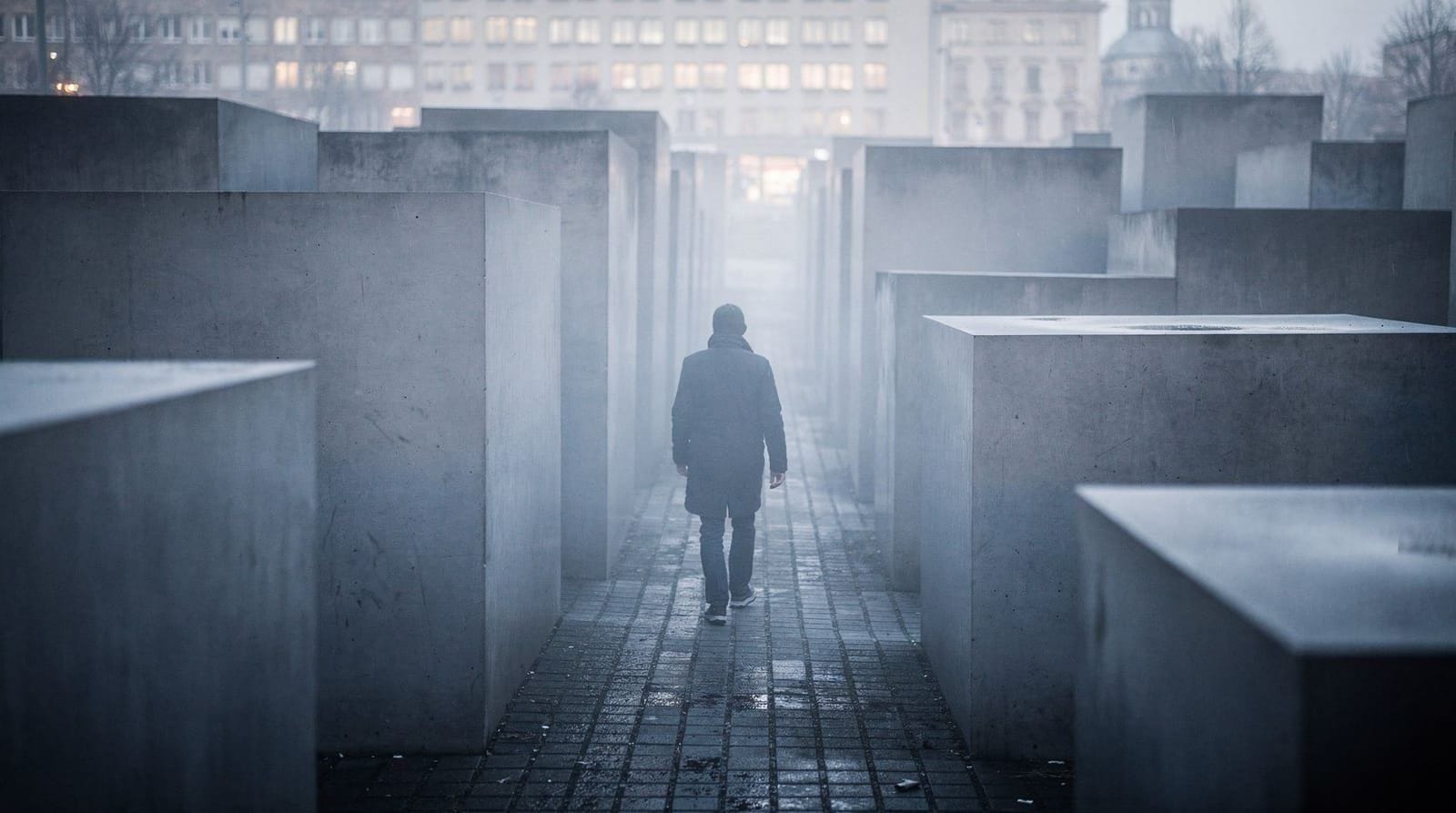
The contrast with victim memorialisation: The proximity of the bunker site to the Memorial to the Murdered Jews of Europe — 80 metres — makes the contrast explicit. Visitors who read the information board and then walk to the stele field are confronted with a deliberate hierarchy: the victims are memorialised; the perpetrator’s location is marked minimally.
The single information board that exists was installed in 2006. It provides a text account of the bunker’s history and a floor plan of the structure. It is intentionally modest.
What you see when you visit
The visit to the Führerbunker site consists of:
- A car park on In den Ministergärten
- A residential development on the north side of the block
- A small brown information board at the corner of In den Ministergärten and Gertrud-Kolmar-Strasse
The information board contains a floor plan of the bunker complex and a factual account of its use and history. It is in German and English. Most visitors spend 10–15 minutes reading it.
There is nothing else to see at street level. The interest of the site is entirely historical and conceptual — what happened here, underground, and what the absence of more prominent marking means.
Photographing the information board is unrestricted, and there’s no crowd to navigate around — unlike the Memorial to the Murdered Jews a short walk away, this corner of Mitte rarely draws more than a handful of visitors at a time. Don’t expect an atmospheric or emotionally charged experience the way you might at Sachsenhausen or the Topography of Terror; the ordinariness of a residential car park is, in fact, the point the German authorities were making when they chose to leave it this way. Some visitors find that anticlimax more thought-provoking than a dramatic memorial would have been. Others feel briefly disappointed and move on within a couple of minutes. Set expectations accordingly and treat it as one stop of several rather than a destination in itself.
In context — nearby sites
The logical sequence for a visit is to combine the Führerbunker information board with the nearby sites that provide the historical framework:
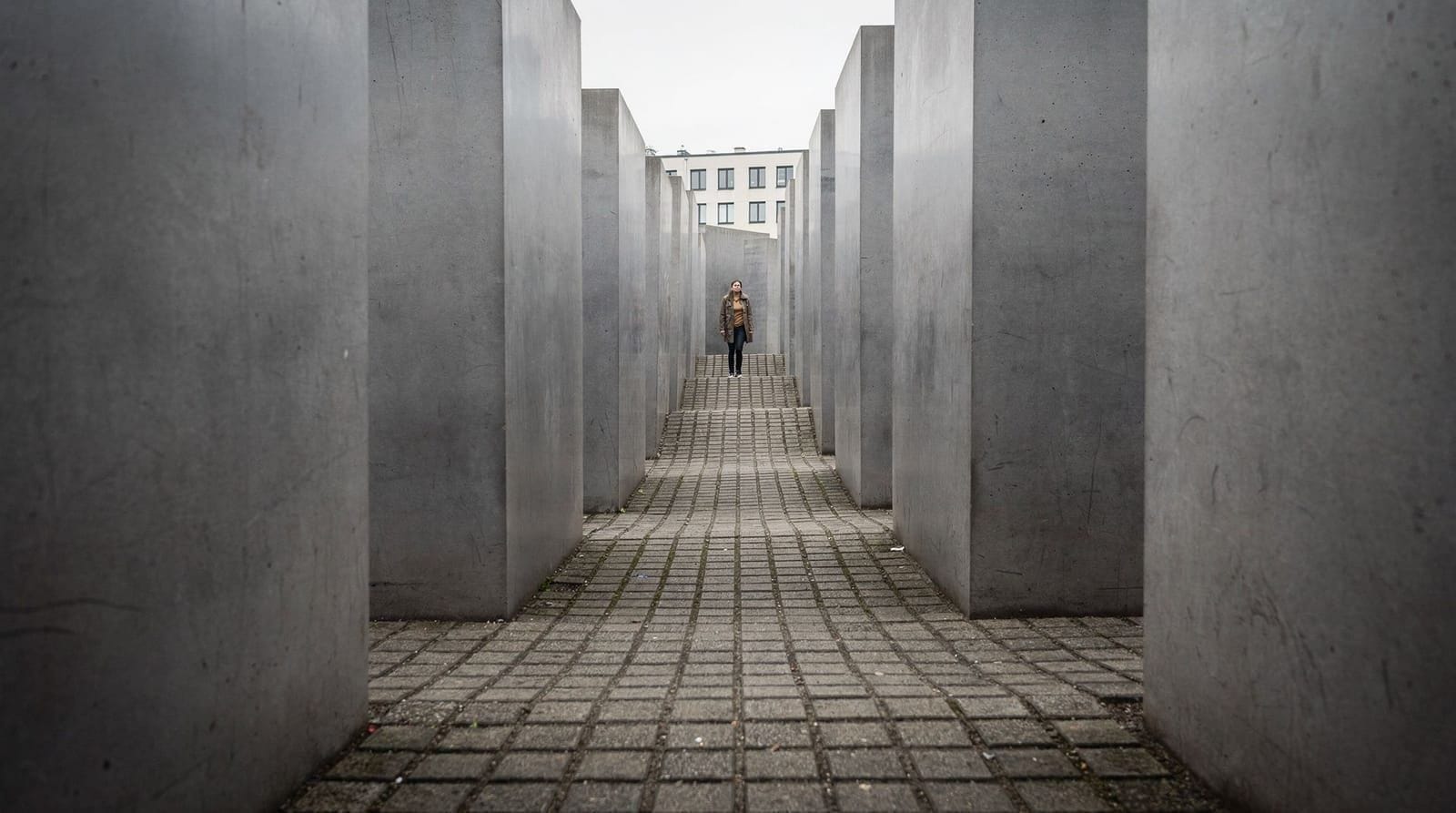
Memorial to the Murdered Jews of Europe (80 metres northwest): The stele field and information center documenting the victims of the regime that operated from this bunker. See the memorial guide.
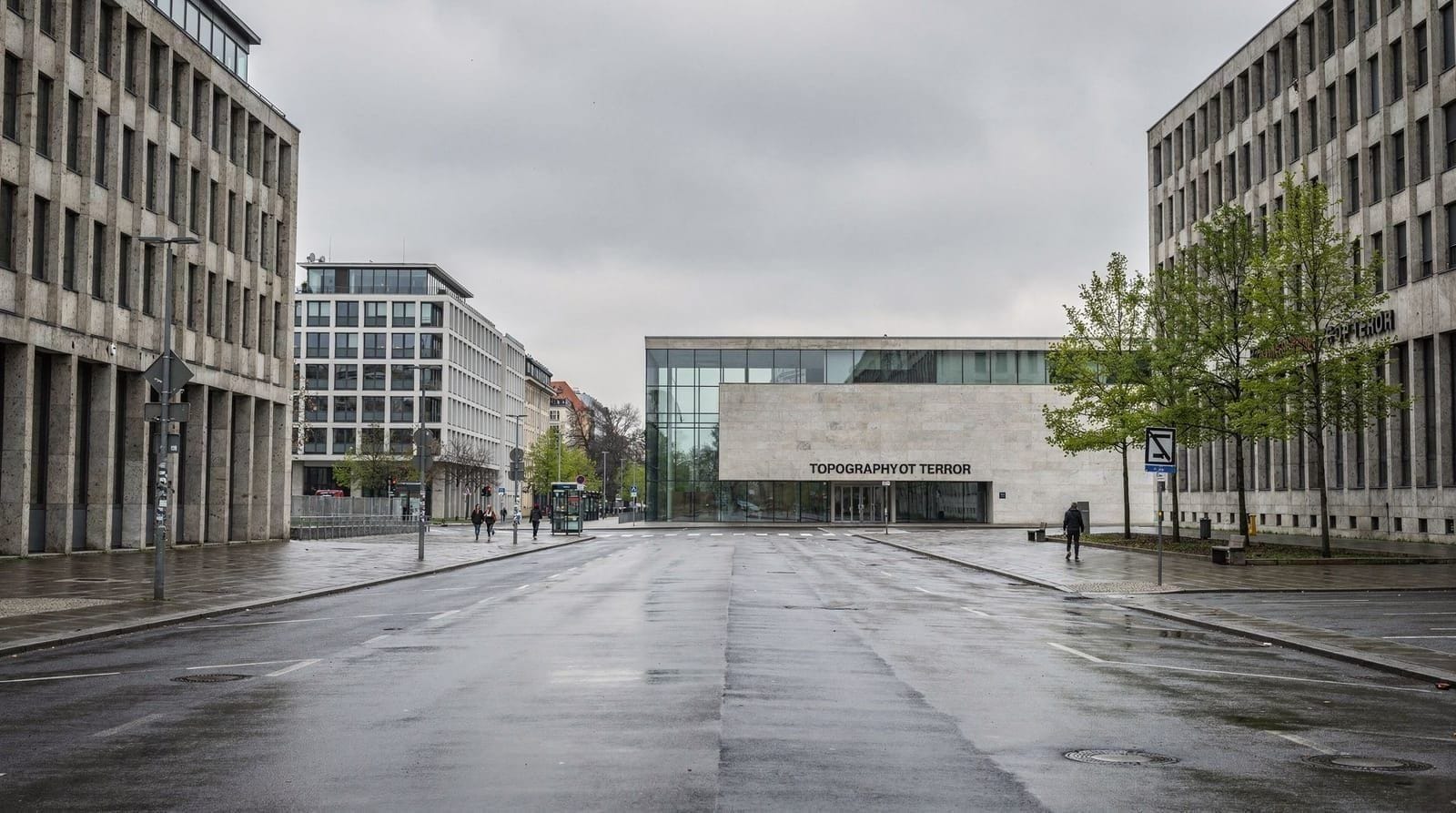
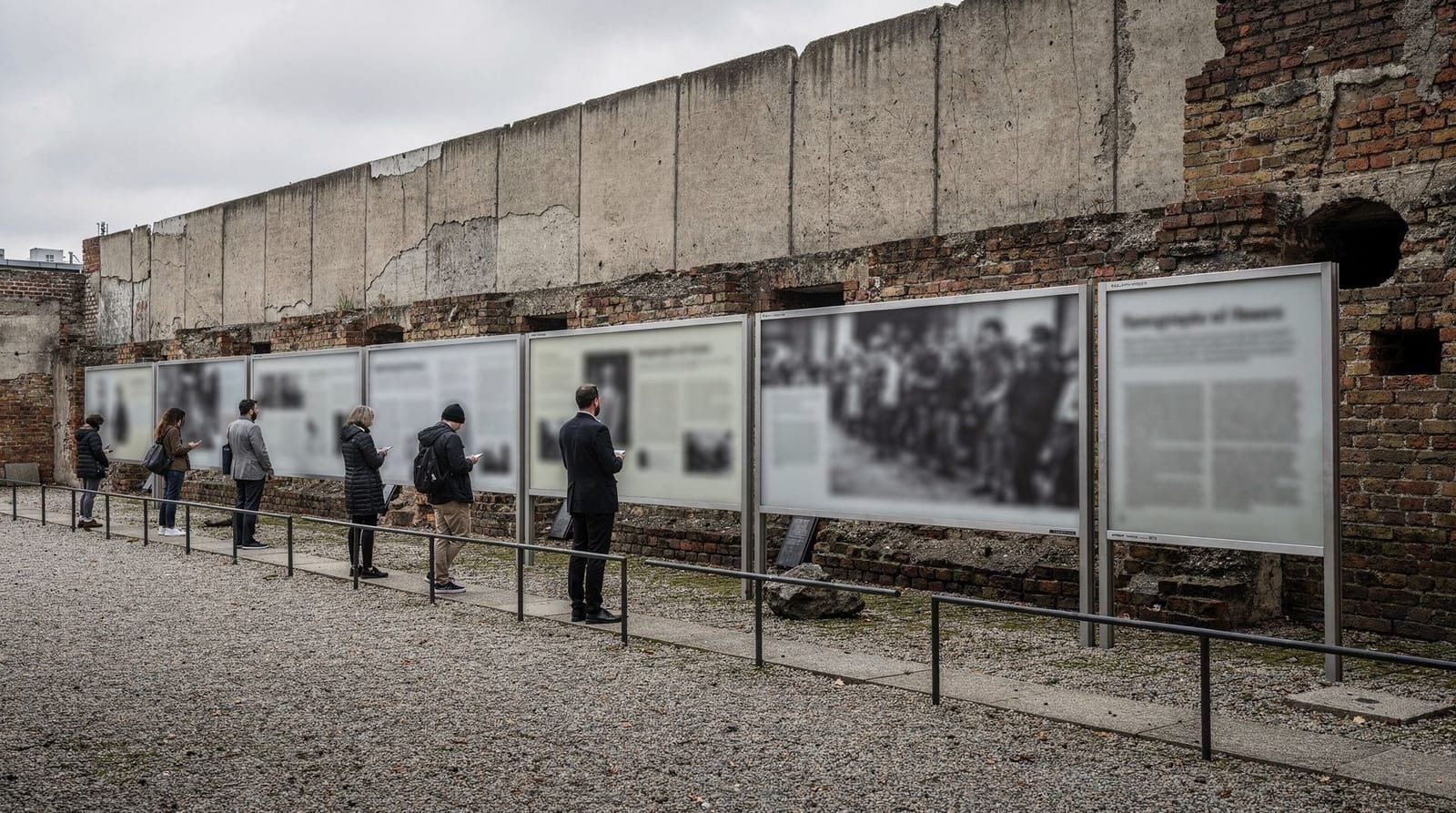
Topography of Terror (15 minutes south): The Gestapo and SS headquarters — the institutions that planned and executed the persecution that the regime in the bunker ordered. See the Topography of Terror guide.
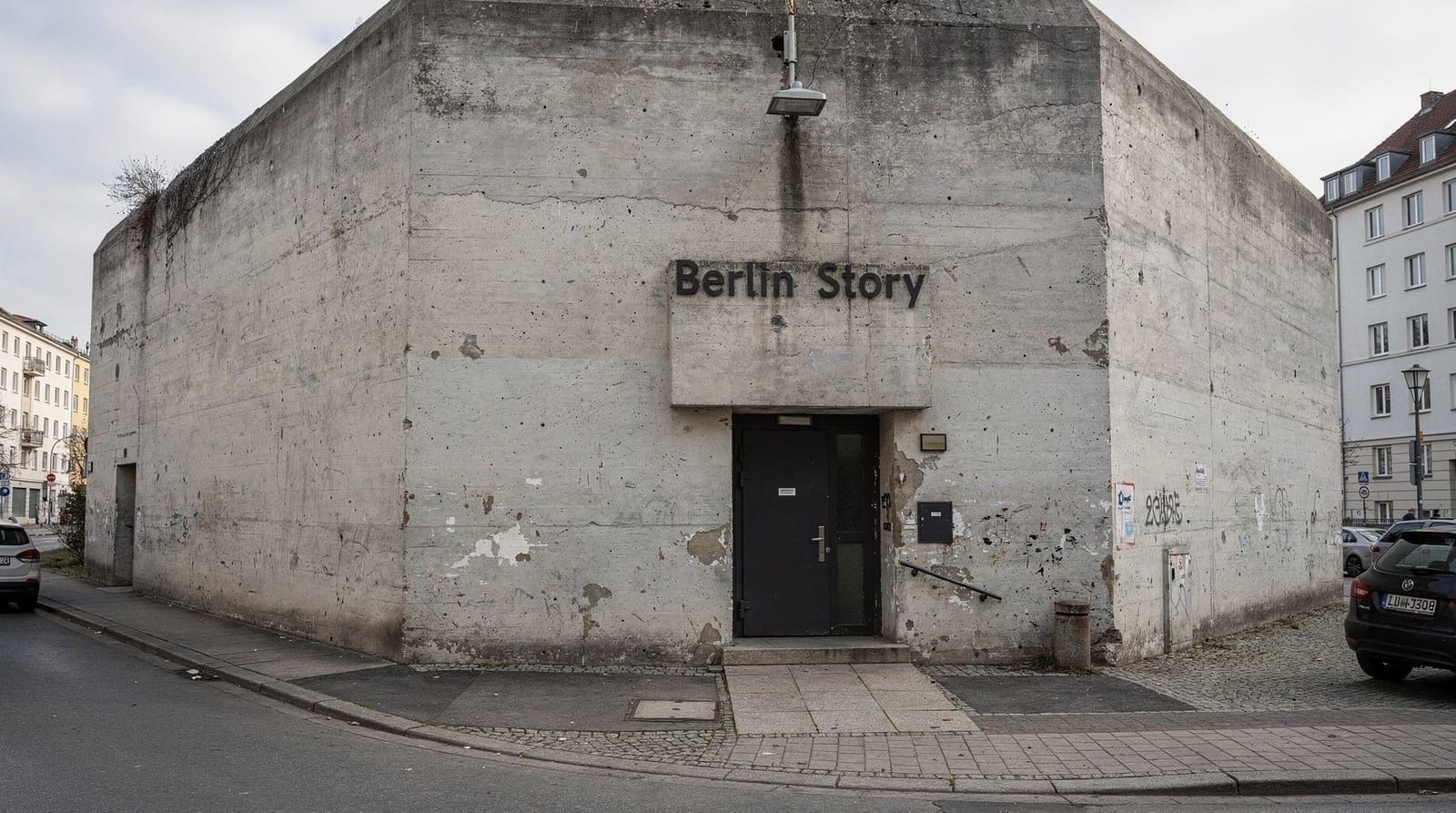
Berlin Story Bunker (20 minutes south): A private museum in an original 1943 civilian air-raid shelter, containing the exhibition “Hitler — how could it happen?” Paid entry. See the Berlin Story Bunker guide.
For a complete walking route connecting all the central Third Reich sites, see the Third Reich sites in Berlin overview. If you’d rather follow a structured route than piece the sites together yourself, the Third Reich history trail itinerary sequences them in a logical order.
Getting there and practicalities
The site sits in central Mitte, roughly midway between the Brandenburg Gate and Potsdamer Platz. The nearest stations are Brandenburger Tor (U55, plus S1/S2/S25/S26 and regional trains) and Potsdamer Platz (U2, S1/S2/S25) — both are a 5–10 minute walk. There is no ticket office, no opening hours, and no staff on site: the information board is accessible around the clock, though reading it after dark is harder since the area is not well lit. There are no toilets, cafés, or shelter at the site itself; the nearest facilities are around Potsdamer Platz or the Memorial to the Murdered Jews visitor centre. Wheelchair users will find the car park and pavement level and step-free.
Because there is genuinely little to see, most visitors fold the Führerbunker into a longer walk through the Third Reich sites rather than making it a dedicated trip — see the Third Reich sites overview for a sensible order to visit them in.
Frequently asked questions about Führerbunker
What was the Führerbunker?
The Führerbunker was an underground reinforced concrete bunker complex beneath the garden of the Old and New Reich Chancelleries in Berlin-Mitte. Hitler moved there permanently in January 1945 and used it as his headquarters during the final months of the war. He married Eva Braun there on 29 April 1945 and committed suicide there on 30 April 1945, one day before Joseph Goebbels and his wife killed their six children and themselves in the bunker garden.Is the Führerbunker still underground?
Partially. After Germany's defeat, Soviet forces explored and partially flooded the bunker complex. East German authorities made several attempts to demolish it between 1947 and 1959, with limited success due to the thickness of the reinforced concrete. The lower level (the actual Führerbunker, approximately 8 metres underground) and parts of the Vorbunker (upper level) are believed to still exist underground in sealed form. The site is not publicly accessible.Why is there no monument at the Führerbunker?
German authorities have consistently resisted creating a prominent monument at the site because of concern that it would attract neo-Nazi pilgrimage and glorification. The deliberate choice to leave the site unremarkable — a car park, a small information board — is itself a policy statement. Marking Hitler's death site with a monument was seen as risking the creation of a shrine. This policy has been upheld since 1990 despite periodic calls for a more significant memorial.Where exactly is the car park?
The car park is on In den Ministergärten, between Gertrud-Kolmar-Strasse to the south and Hannah-Arendt-Strasse to the north, in the block immediately east of the Memorial to the Murdered Jews of Europe. The information board is embedded in the pavement at the corner of In den Ministergärten and Gertrud-Kolmar-Strasse.What was the Vorbunker?
The Führerbunker complex consisted of two levels. The Vorbunker (forward bunker) was an earlier construction from 1936 used primarily by staff, including Goebbels. The Führerbunker proper — deeper, more heavily armoured — was added in 1944 and connected to the Vorbunker. Hitler's suite, the conference room where he received military briefings, and the space where he and Braun were married were all in the lower Führerbunker level.What happened to Hitler's body?
Hitler shot himself on 30 April 1945 in his private rooms in the Führerbunker; Eva Braun took cyanide simultaneously. Their bodies were carried to the Reich Chancellery garden above, doused in petrol, and burned, as Hitler had instructed. Soviet forces subsequently recovered charred remains and took them to the USSR. Soviet authorities confirmed the identity of remains through dental records in 1945, though full Soviet documentation was not made public until after the fall of the USSR. A tooth and skull fragment held in Russian archives were identified as consistent with Hitler's dental records through later forensic analysis.What film was made about the Führerbunker?
The 2004 German film "Der Untergang" (Downfall), directed by Oliver Hirschbiegel and starring Bruno Ganz as Hitler, depicts the final weeks in the bunker and is considered historically reliable in its broad outlines. It was based largely on the account of Hitler's personal secretary Traudl Junge, who survived the war.