Berlin Story Bunker — Hitler exhibition and WWII bunker tour guide
Berlin: Berlin Story Bunker Entry Ticket
What is the Berlin Story Bunker?
The Berlin Story Bunker is a private museum and original WWII air-raid bunker on Schöneberger Strasse in Berlin-Mitte. It contains the permanent exhibition "Hitler — how could it happen?" across multiple floors, plus guided tours of the actual 1943 bunker structure. Entry costs approximately EUR 15 for the standard ticket; combined tickets with the bunker tour cost more. It is not a state institution and takes a commercial approach, though the exhibition covers serious historical material.
The Berlin Story Bunker is a private museum housed in an original 1943 reinforced-concrete air-raid shelter on Schöneberger Strasse, south of Potsdamer Platz. It contains the permanent exhibition “Hitler — how could it happen?” and offers guided tours of the original bunker structure. Entry is paid. It is not a state memorial or academic institution, and takes a more commercial approach than Berlin’s free documentation centres — but covers serious historical material that can be valuable for visitors seeking a narrative introduction to the Third Reich.
| Where | Schöneberger Strasse 23a, Mitte |
| Cost | around €14.50 exhibition, €19.50 combined with bunker tour |
| Time needed | 2-3 hours (3-4 with bunker tour) |
| Recommended age | 14+ |
| Getting there | S-Bahn Anhalter Bahnhof, 5-min walk |
| Booking | recommended, especially bunker tour on weekends |
The building — an original WWII bunker
The physical structure at Schöneberger Strasse 23a is not a reconstruction or replica. It is an original Hochbunker (above-ground reinforced concrete air-raid shelter) built by the Nazi state in 1943 under the programme of civilian air defence construction that accelerated as Allied bombing of Berlin intensified.
The building measures approximately 20 by 30 metres in plan and rises five storeys above ground, with walls ranging from 1.2 to 2.5 metres thick. It was designed to provide shelter for approximately 3,000 people during air raids, with independent ventilation and emergency power. After the war, the building passed through various uses — storage, later sealed — before the Berlin Story company acquired it for conversion to a museum.
The bunker’s survivability is a direct product of its construction quality. Most of the reinforced-concrete bunkers built in Berlin between 1940 and 1944 are still standing; they are too expensive to demolish and too solid to decay. Several others across Berlin have been converted for commercial, cultural, or residential use. The Gesundbrunnen bunker (part of the Berliner Unterwelten tours) and the Humboldthain flak tower ruins are the other most significant survivors.
The exhibition — “Hitler — how could it happen?”
The exhibition spans multiple floors and is arranged as a chronological narrative. It does not attempt the comprehensive documentation approach of the Topography of Terror. Instead, it focuses on a single question — how an individual and a movement seized and used power — and pursues it through the biography of Hitler and the biography of the regime.
Pre-1933 — origins and rise: Hitler’s childhood in Linz and Vienna, the First World War, the Munich putsch of 1923, the Weimar period, and the political crisis that produced the Nazi electoral breakthrough from 1930 onward. The exhibition makes the argument, supported by historical evidence, that the rise was not inevitable — that specific decisions, specific failures of democratic institutions, and specific economic conditions aligned to make it possible.
1933–1939 — consolidation of power: The Machtergreifung (seizure of power), the Enabling Act, the destruction of political parties and independent institutions, the Nuremberg Laws, Kristallnacht, and the remilitarisation of Germany. The exhibition is clear that this period was not simply about Hitler — it shows the complicity of conservative political figures, the judiciary, industry, and significant portions of the population.
1939–1945 — wartime policy and genocide: The invasion of Poland, the decision to murder European Jews, the Wannsee Conference, the concentration camp system, and the escalating Allied bombing of German cities. The final section addresses the collapse of the regime, the April 1945 situation in Berlin, and Hitler’s suicide in the Führerbunker.
Why no monument at the Führerbunker site: The exhibition addresses the deliberate decision not to create a monument at the Führerbunker site (now a car park 1.5 km away in Mitte). For the full history of this decision, see the Führerbunker history guide.
The bunker tour — what it involves
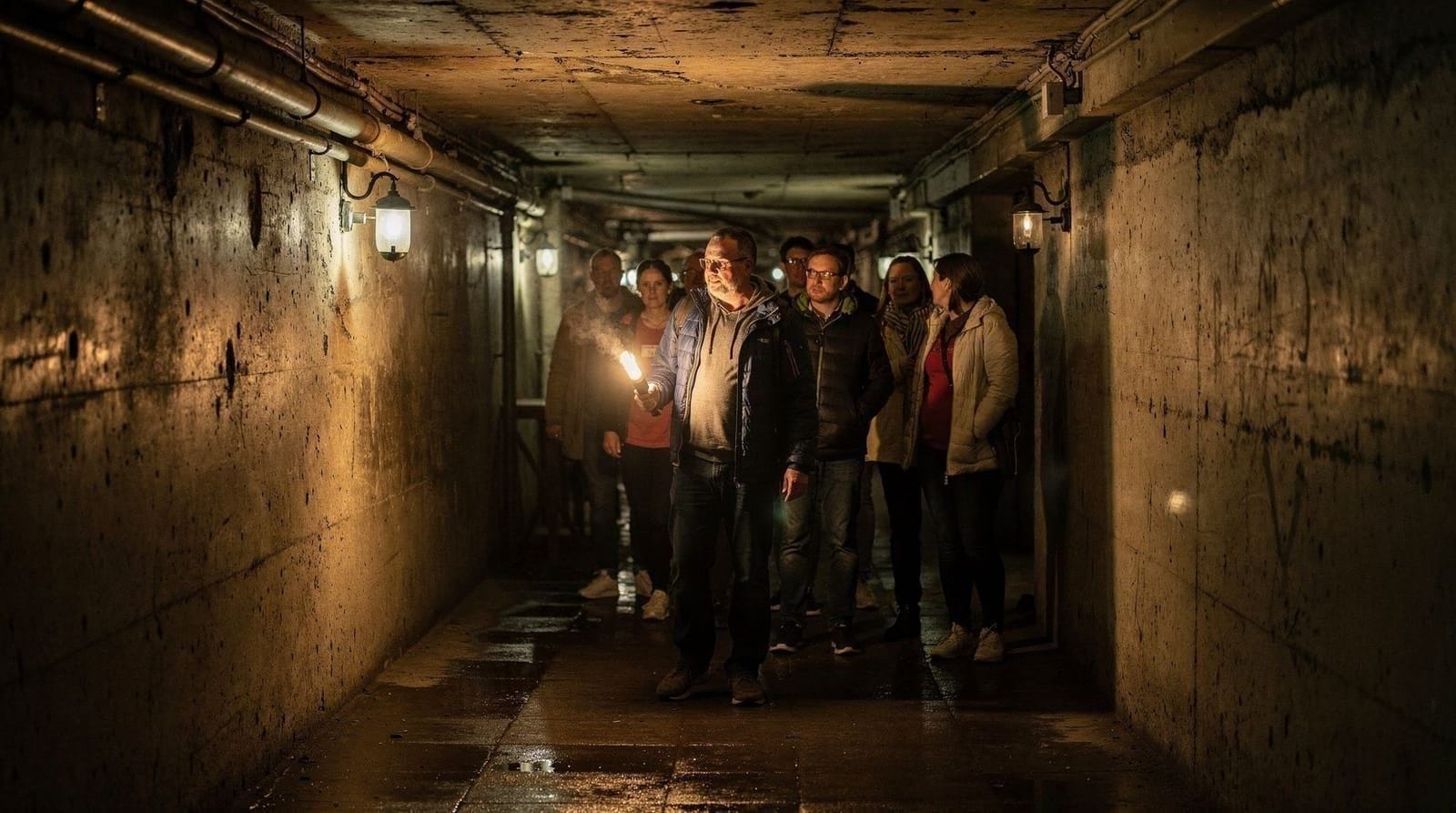
Guided tours of the actual bunker structure run several times daily and must be booked separately. The tour takes approximately 45 minutes and descends into the interior of the structure, visiting the stairwells, shelter areas, and technical spaces that were used in 1943–1945.
The tour content mixes genuine historical material with theatrically staged elements — recorded sound effects, lighting, dramatic narration. This is the most clearly commercial aspect of the experience, and reactions among visitors are mixed. Those who want a sober, scholarly engagement sometimes find the staging excessive. Others find that the combination of real architecture and dramatised context makes the history more immediate than text panels alone.
The bunker interior is cold (typically 14–16°C year-round) and the spaces are tight. Claustrophobic visitors should be aware. The tour involves stairs; there is no lift access to the lower levels.
Honest assessment: The bunker tour is well suited to visitors who engage with history more readily through physical experience than through reading. It is not academically authoritative. If you come wanting the scholarly rigour of the Topography of Terror, you will be disappointed. If you come wanting to understand, viscerally, what it felt like to shelter from Allied bombing in 1943 Berlin, it delivers.
Comparing the Berlin Story Bunker to the free state memorials
Understanding what the Berlin Story Bunker is and is not helps calibrate expectations:
What it offers that free state memorials do not:
- A narrative, person-centred account of Hitler’s rise — more accessible than the institutional focus of the Topography of Terror
- The physical experience of an original bunker structure
- A self-contained visit covering the full arc of the Nazi period in one place
What the free state memorials offer that the Bunker does not:
- Rigorous scholarly framing without commercial pressure
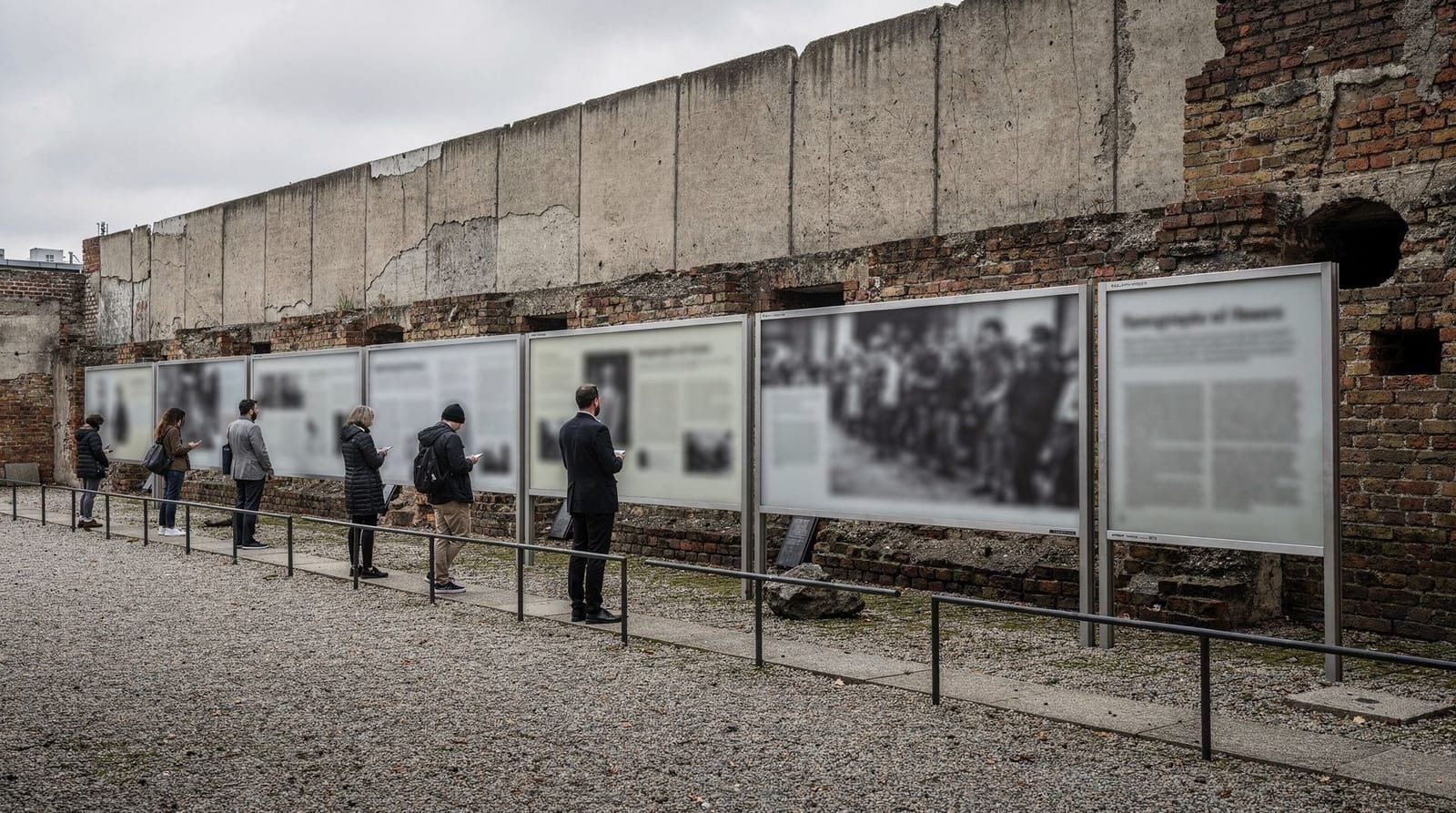
- Documentary depth — original Gestapo files, operational orders, perpetrator records — at the Topography of Terror
- Direct testimony documentation — at the Topography of Terror and the Wannsee House
- Site-specificity: the Topography of Terror sits on the actual Gestapo grounds; the Wannsee House is the actual villa where the conference occurred
For a full third-reich memorial itinerary covering all the key sites, including both this bunker and the Topography of Terror, the Third Reich history trail itinerary provides a two-to-three-day programme.
A side-by-side comparison:
| Berlin Story Bunker | Topography of Terror | Wannsee House | |
|---|---|---|---|
| Cost | around €14.50-19.50 | Free | Free |
| Format | Narrative exhibition + staged bunker tour | Documentary panels, outdoor + indoor | Original villa, room-by-room |
| Tone | Accessible, some theatrical staging | Sober, academic | Sober, site-specific |
| Best for | First-time visitors wanting a clear narrative arc | Visitors wanting documentary depth | Visitors focused on the Holocaust’s planning |
None of these three is a substitute for the others — they cover different angles of the same period, and visitors with a full day available often combine two, most commonly the Story Bunker with the Topography of Terror given their proximity. The Wannsee Conference memorial sits further out (a short train ride to Wannsee), which is why it tends to be planned as its own half-day rather than stacked onto a central Mitte itinerary alongside the Bunker.
Who this visit actually suits
Think of the Berlin Story Bunker as the right choice in three specific situations. First, if this is your only stop covering the Third Reich period and you want a single, self-contained visit that explains the full arc from Hitler’s rise to the regime’s collapse without needing to piece together several sites — the narrative structure does that job efficiently. Second, if you are travelling with teenagers (14+) who respond better to a structured story with physical elements than to dense text panels, the combination of exhibition and bunker tour tends to hold attention better than the more austere state memorials. Third, if claustrophobia and cold are not concerns for you, the bunker tour specifically offers something none of the free sites can: an original, physically intact structure from the period rather than a re-purposed site or a documentation centre built later.
Where it suits you less well: if you are a history specialist, a return visitor to Berlin who has already covered the basics, or someone who finds staged theatrical elements (recorded sound, dramatic lighting) at odds with the seriousness of the subject matter, you will likely get more out of spending that time and money at the free Topography of Terror instead.
Nearby sites and logical combinations
The Berlin Story Bunker is located between Potsdamer Platz and Anhalter Bahnhof, making it convenient to combine with other sites in the same half-day:
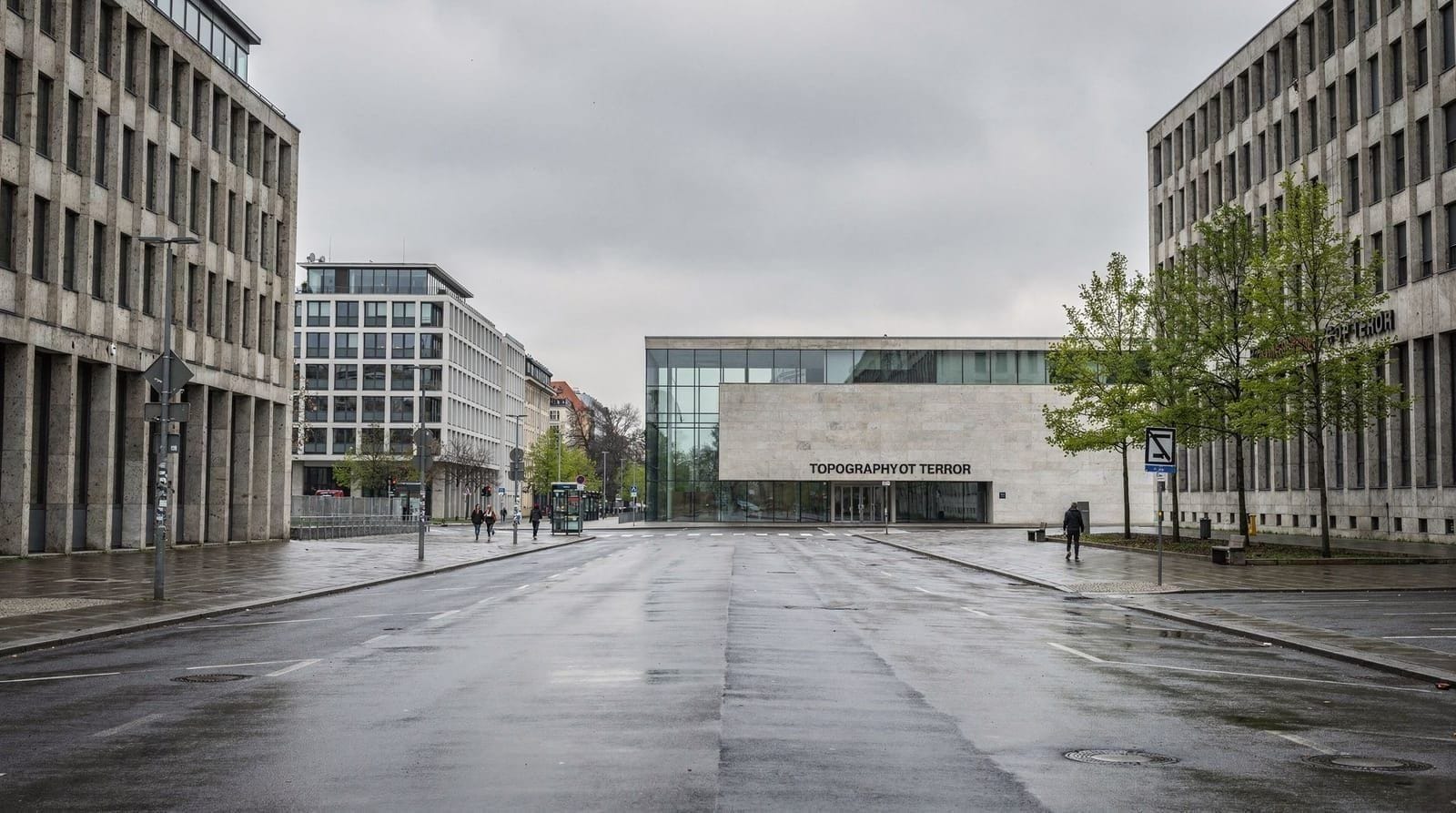
Topography of Terror (15 minutes walk east): The free documentation centre on the former Gestapo headquarters — a more academically rigorous companion to the Bunker’s narrative approach. See the Topography of Terror guide for planning.
Memorial to the Murdered Jews of Europe (20 minutes walk north): The Eisenman stele field near the Brandenburg Gate. See the memorial guide.
Anhalter Bahnhof ruins (5 minutes walk south): The remaining facade of the former Anhalter Bahnhof train station — once one of the largest railway stations in Europe, partially destroyed by Allied bombing in 1943, the ruins left standing after 1945 as an informal memorial. A short stop, entirely free.
Checkpoint Charlie (20 minutes walk east): The Cold War crossing point. The Checkpoint Charlie guide honestly assesses what is and is not worth your time there.
Berlin’s infamous Third Reich sites walking tour — covers Bunker area, Topography of Terror, and key Third Reich locations, English guidePractical planning
Address: Schöneberger Strasse 23a, 10963 Berlin
Opening hours: Daily 10:00–20:00 (last entry 18:00). Check berlinstory.de for seasonal variations and closures.
Tickets: Standard entry approximately EUR 14.50 adults, EUR 9.50 concessions. Bunker tour combined ticket approximately EUR 19.50. Book online in advance, especially for weekend bunker tours which fill early.
Getting there:
- S-Bahn: Anhalter Bahnhof (S1, S2, S25) — 5 minutes walk south on Schöneberger Strasse
- U-Bahn: Möckernbrücke (U7) — 10 minutes walk
- Bus: 200, M29 (stop Stresemannstrasse/Anhalter Strasse)
Facilities: Café, bookshop, toilets. The exhibition floors have good accessibility but the bunker tour itself is stairs-only.
Language: The exhibition panels are in German and English. Audio guides available in additional languages.
Booking: Online prebooking strongly recommended. Walk-in entry to the exhibition is usually possible, but bunker tours are often booked out on busy days.
Frequently asked questions about Berlin Story Bunker
How much do tickets cost for the Berlin Story Bunker?
In 2026, standard entry to the Hitler exhibition is approximately EUR 14.50 for adults, EUR 9.50 for students and concessions. The guided bunker tour (Bunkertour) costs an additional EUR 5–8 and must be booked in advance. A combined ticket covering both is approximately EUR 19.50. Prices are subject to change; check berlinstory.de for current rates. Prebooking is recommended, particularly on weekends and school holidays.How long does a visit take?
The Hitler exhibition on its own takes 2–3 hours if read carefully. Adding a guided bunker tour (approximately 45 minutes) means allowing 3–4 hours in total. The exhibition is dense with text, photographs, and documentary evidence — it is not a walk-through experience.Is the Berlin Story Bunker suitable for children?
The exhibition contains documentary photographs of wartime violence, concentration camps, and Nazi atrocities. The operators recommend it for ages 14 and above. There is no formal age restriction, but the content requires careful preparation for younger visitors.What is the actual WWII bunker at the Berlin Story Bunker?
The bunker is an original German civilian air-raid shelter (Luftschutzbunker) built in 1943 from reinforced concrete on Schöneberger Strasse. It was designed to hold approximately 3,000 people and has walls up to 2.5 metres thick. After the war it was used for storage and later sealed. The Berlin Story company acquired the building and opened the museum in 2012.Is this a reputable historical site or a commercial attraction?
The Berlin Story Bunker is a private, for-profit institution — not a state memorial or academic institution. The Hitler exhibition was developed in consultation with historians and contains serious historical material, but it is presented in a commercial context with more entertainment elements than, say, the Topography of Terror or the Wannsee House. The bunker tours are theatrical in parts. It provides a useful introduction to the period, particularly for visitors who find more austere documentation centres difficult to engage with, but should not be treated as equivalent to the major state memorial sites.How do I get to the Berlin Story Bunker?
The Berlin Story Bunker is at Schöneberger Strasse 23a, 10963 Berlin. The nearest S-Bahn is Anhalter Bahnhof (S1, S2, S25) — 5 minutes walk. Bus 200 stops nearby. U-Bahn Möckernbrücke (U7) is approximately 10 minutes walk.Is the Hitler exhibition suitable for first-time visitors to Berlin's history sites?
Yes, in some ways more so than the Topography of Terror. The exhibition follows a chronological narrative — Hitler's origins, rise, consolidation of power, wartime decisions, and final defeat — which provides a framework that can be useful for visitors new to the subject. However, for a rigorous scholarly engagement, the free state memorials (Topography of Terror, Wannsee House) are more authoritative sources.
Top experiences
Bookable activities with verified prices and instant confirmation on GetYourGuide.