Cold War bunkers in Berlin — what you can visit and what remains
Berlin: Berlin Story Bunker Entry Ticket
Which Cold War bunkers can I visit in Berlin?
The two main visitable bunkers are the Story of Berlin nuclear shelter (beneath the Kurfürstendamm museum, entry included in museum ticket at around 14 euros) and the Berliner Unterwelten guided tours which access WWII and Cold War underground tunnels and shelters in Gesundbrunnen (Wedding). Berliner Unterwelten tickets cost around 15 euros per tour; booking ahead is recommended as tours sell out.
Which Cold War bunkers can I visit in Berlin? The two main visitable bunkers are the Story of Berlin nuclear shelter (beneath the Kurfürstendamm museum, entry included in museum ticket at around 14 euros) and the Berliner Unterwelten guided tours, which access WWII and Cold War underground tunnels and shelters in Gesundbrunnen (Wedding). Berliner Unterwelten tickets cost around 15 euros per tour; booking ahead is recommended as tours sell out.
| Where | Gesundbrunnen (Wedding) or Kurfürstendamm |
| Cost | Around EUR 15 (Berliner Unterwelten) or included in ~EUR 14 museum ticket (Story of Berlin) |
| Time needed | 90 minutes underground (Berliner Unterwelten); 30 minutes for the bunker tour (Story of Berlin) |
| Getting there | S25/S41/S42/U8 to Gesundbrunnen; U1/U9 to Kurfürstendamm |
| Booking | Advance booking strongly recommended for Berliner Unterwelten, especially weekends |
Underground Berlin: why bunkers were built here
Berlin’s underground is not a uniform network. It is a layered palimpsest of construction from different eras and different strategic doctrines — WWII air raid shelters built in haste between 1940 and 1944, Cold War civil defence structures added to and adapted from those earlier tunnels, and the occasional bespoke facility constructed specifically for nuclear-age contingencies. To understand what you are looking at when you descend beneath the city, you need the context first.
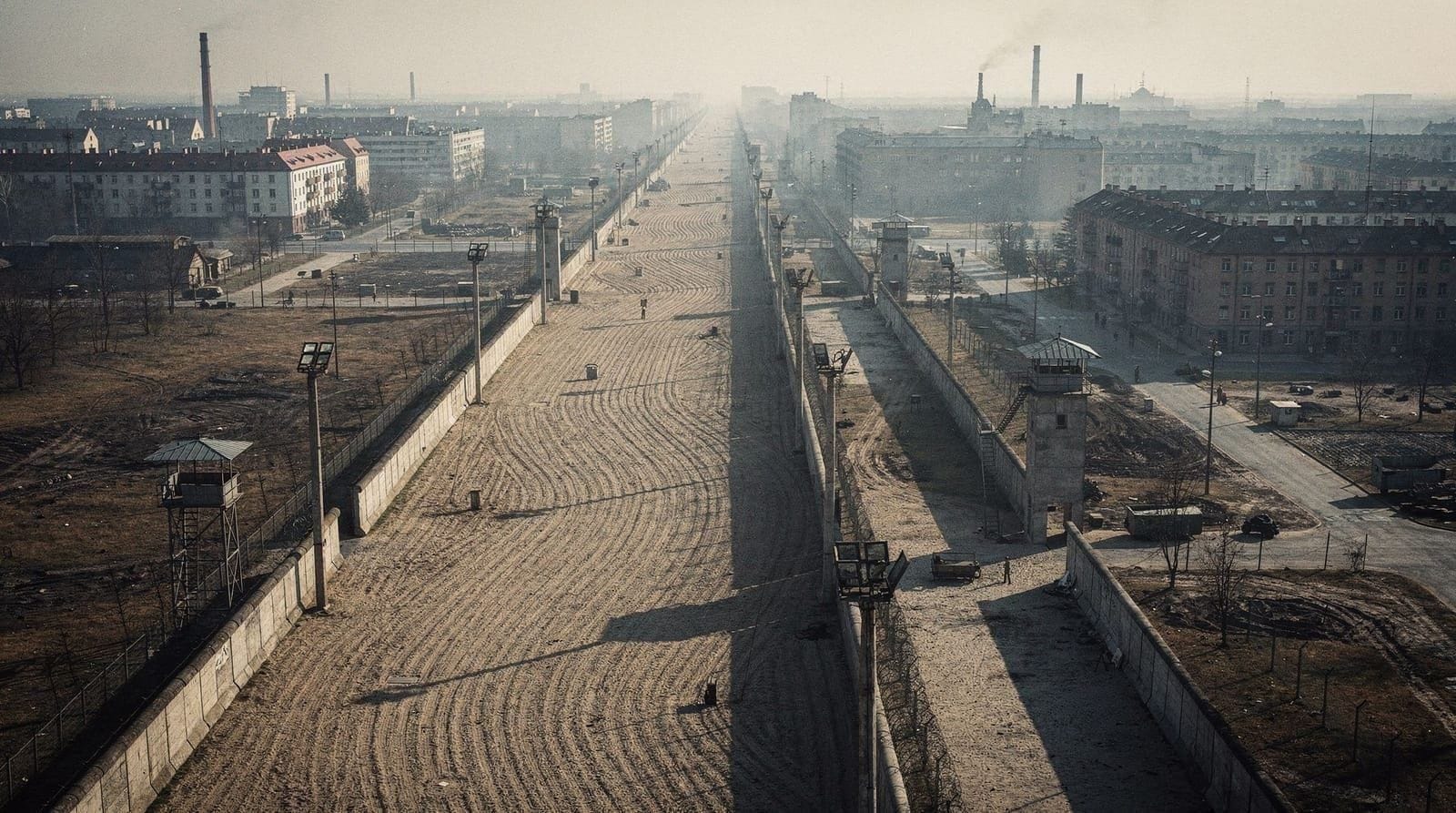
Berlin’s position during the Cold War was unlike that of any other city on earth. Situated 180 kilometres inside the territory of the German Democratic Republic, West Berlin was an island of NATO-aligned territory entirely surrounded by Warsaw Pact forces. If a conventional conflict had escalated to a nuclear exchange — the scenario that planners on both sides spent enormous resources preparing for — West Berlin would have been one of the first targets and would have had no retreat available. Its citizens could not evacuate to safer hinterland. They would need to shelter in place.
That peculiar geography drove West Berlin’s civil defence investment. Throughout the 1960s and 1970s, the West Berlin Senate funded and constructed a network of shelters intended to house a substantial portion of the city’s population. The ambition was significant: the Story of Berlin bunker on Kurfürstendamm, built in the 1970s, was designed to shelter 3,500 people for 14 days — enough time, in theory, for the immediate effects of nuclear blast and radiation to subside to survivable levels. Across the city, a system of designated public shelters was built into or beneath existing structures.
NATO nuclear doctrine during this period operated on the assumption that a Soviet conventional attack into West Germany would likely trigger the use of tactical nuclear weapons, potentially escalating further. Civil defence was part of the political framework that made deterrence credible. If governments could demonstrate that populations could survive a nuclear exchange, the deterrent logic held together more convincingly.
East German civil defence operated on a different philosophy. The GDR’s planning was oriented primarily toward protecting the party leadership and key state functions rather than the civilian population at large. The Zentrales Ausweichführungszentrum at Harnekop in Brandenburg — roughly 60 kilometres from Berlin — was the primary facility for senior GDR leadership, designed to keep the party apparatus functioning through a nuclear scenario. For ordinary East Germans, shelter provision was considerably more limited than in West Berlin.
The physical geology of Berlin complicated all of this. The city sits on glacial sandy soil with a relatively high groundwater table. This made deep bunker construction genuinely expensive and technically demanding. Most civil defence facilities adapted existing structures — primarily the substantial WWII air raid shelters that had been built during the early 1940s — rather than constructing entirely new deep underground facilities. Those WWII shelters were themselves remarkable engineering achievements, and several survive in accessible form today.
For broader context on how the division of the city shaped everything from daily life to strategic planning, see our guide to Cold War Berlin history and Berlin divided city history.
Civil defence as everyday reality
It is easy, from a 2026 vantage point, to treat these bunkers as historical curiosities rather than infrastructure that shaped how ordinary West Berliners understood their own city. Civil defence was not an abstraction confined to planning documents; it had a visible, audible presence in daily life. A network of air-raid sirens was maintained and periodically tested across West Berlin throughout the Cold War, and residents were issued guidance — pamphlets, public information campaigns, school programmes — on what to do in the event of an alert. Designated shelter locations, including basements of public buildings and the purpose-built facilities described in this guide, were marked with civil defence signage that some older buildings in the city still display, faded, above their entrances.
This context matters for how you should read a bunker tour today. What you are seeing is not a museum reconstruction of an abstract threat; it is functioning (or formerly functioning) infrastructure that West Berliners lived alongside for four decades, built on the calculation that the city could be attacked with only minutes of warning. The psychological weight of that reality — permanent, unresolved, and largely undiscussed in day-to-day conversation — is one of the harder things for a modern visitor to appreciate from the tours alone, but it is worth holding in mind as you walk the corridors.
Berliner Unterwelten — the accessible underground
Berliner Unterwelten (Berlin Underworlds) is a non-profit organisation founded in 1997. It employs historians, archaeologists, and trained guides, and has spent nearly three decades documenting and opening to the public the underground spaces beneath the city. It is the primary organisation through which visitors can access Berlin’s underground history, and its work has been genuinely important in preserving structures that might otherwise have deteriorated unseen.
The most visited Berliner Unterwelten tour departs from Gesundbrunnen S-Bahn and U-Bahn station in the Wedding district of northern Berlin. Gesundbrunnen is served by the S25, S41, and S42 S-Bahn lines as well as the U8 underground line — a straightforward connection from most parts of the city. The tour meets at the station exit, and the entrance to the underground facility is directly adjacent.
The Gesundbrunnen shelter was originally built between 1941 and 1943 as one of the largest WWII air raid shelters in Berlin. It could accommodate around 1,200 people in its original configuration. After the war, the facility was expanded and upgraded during the Cold War as part of the West Berlin civil defence programme. The conversion added equipment and systems appropriate to a nuclear-age shelter rather than simply a protection against conventional bombs — ventilation and filtration systems capable of dealing with radioactive fallout, decontamination areas at entry points, and updated communications infrastructure.
What you see on a Berliner Unterwelten tour is this layered history in physical form. The original WWII construction — heavy concrete, narrow corridors, basic steel bunk frames — sits alongside Cold War-era additions and signage. Original equipment has been preserved in many sections: ventilation machinery, pressure doors designed to seal against blast waves, emergency supplies storage areas, and the distinctive Cold War-era warning and information posters that still line some of the corridor walls.
The underground temperature at Gesundbrunnen is a consistent 10 to 12 degrees Celsius year-round, regardless of the season above ground. This is not a detail to ignore: even on warm summer days, the underground feels cold within minutes. A light jacket or layer is essential, and the guides will tell you this when you book. Groups are capped for the tours, which means the experience is never overwhelmed by crowds in the way that some above-ground Berlin attractions can be.
The English-language tour runs several times daily during peak season (roughly April through October) and less frequently in winter. Tours last approximately 90 minutes underground. Booking through berliner-unterwelten.de in advance is strongly recommended — weekend tours in summer reliably sell out several days ahead.
Beyond the Gesundbrunnen tour, Berliner Unterwelten runs several other programmes covering different aspects of Berlin’s underground, including tours of other WWII-era structures. The organisation also maintains an exhibition above ground at the Gesundbrunnen site that provides context for what you are about to see below.
Advance booking matters more than casual visitors expect. Because the tours are capped in group size to protect both the historic fabric and the visitor experience, popular slots — particularly the English-language tour on Saturday and Sunday mornings between May and September — can sell out four to five days ahead. If your Berlin schedule is tight and this tour matters to you, book it as one of the very first things you reserve, before hotels or restaurants.
Which bunker tour matches your interest
| Berliner Unterwelten | Story of Berlin | Berlin Story Bunker | |
|---|---|---|---|
| Best for | Genuine underground atmosphere, WWII-to-Cold War layering | Convenience — combined with a full city history museum | Nazi-to-postwar narrative in one purpose-built exhibition |
| Depth underground | About 10 metres | About 10 metres | Above-ground tower bunker |
| Duration | 90 minutes | 30 minutes (plus museum time) | About 2 hours |
| Booking | Essential in advance | Not required for the bunker itself | Not required |
| Accessibility | Stairs, low ceilings, not step-free | Not wheelchair accessible | Check on arrival |
Story of Berlin — the Kurfürstendamm bunker
The Story of Berlin museum at Kurfürstendamm 207-208 covers eight centuries of Berlin’s history across 23 themed rooms spread through a building that formerly housed a fashion department store. The museum is worth visiting in its own right for the quality and breadth of its Berlin history coverage, but what distinguishes it from comparable city history museums is the access it provides to a genuine, intact Cold War nuclear shelter directly beneath the building.
The shelter was built in the 1970s, at a moment when the possibility of nuclear war still shaped infrastructure investment in West Berlin. It was designed to protect 3,500 people for 14 days — the assumption being that 14 days would be enough for the worst of the immediate fallout and radiation to diminish to levels where survival above ground was again possible. The shelter occupies the basement level of the building and is reached via a tour that runs as part of the museum visit.

What survives in the shelter is largely complete and unaltered. The bunk bed frames remain in position, stacked in the configuration that would have housed 3,500 people in extremely close quarters. The ventilation and air filtration systems — designed to handle nuclear, chemical, and biological contamination — are intact and can be examined closely during the guided tour. Decontamination showers at the entry points are in their original configuration. Food and water storage areas, communication equipment, and the administrative infrastructure that would have managed a 3,500-person community underground for two weeks are all present.
The guided visit to the bunker takes approximately 30 minutes and is included in the museum admission ticket, which costs around 14 euros for adults. Tours depart several times daily; the frequency is higher in peak season. The tour is conducted in the actual shelter, not in a reconstruction, which gives it a different quality from the display bunkers in some military history museums.
To reach the museum: U1 or U9 to Kurfürstendamm, or U7 to Adenauerplatz. The museum is at the western end of the Ku’damm shopping street, approximately a 5-minute walk from either station. Allow 2 to 3 hours for the full museum including the bunker tour.
The Führerbunker site — deliberately unmarked
Any guide to Berlin’s underground spaces needs to address the Führerbunker — Hitler’s final command post and the place where he died on 30 April 1945 — precisely because it is not a place you can visit in any meaningful sense.
The Führerbunker complex was a reinforced concrete structure beneath the garden of the Reich Chancellery in what became the Soviet sector after the war. After the building’s fall, the Soviet authorities partially demolished the structure. What remained was sealed rather than opened to the public. When Germany reunified and the site came under the authority of the Berlin Senate, the deliberate decision was taken not to memorialise, preserve, or mark it in any prominent way. The reasoning was straightforward: a prominent, accessible Führerbunker site would risk becoming a pilgrimage site for neo-Nazis and far-right groups, an outcome that outweighed any historical preservation argument.
The site today is an unremarkable car park in the Mitte district, close to the Memorial to the Murdered Jews of Europe. A small information board was installed in 2006, describing the site’s history without marking its exact location or providing physical access. Most visitors walk past it without knowing it is there.
If you want to understand the Führerbunker in historical terms, our guide to Führerbunker history covers the structure, the events of April 1945, and the reasoning behind the post-war decision not to preserve it. The Memorial to the Murdered Jews of Europe nearby is one of the most significant commemorative sites in the city and an appropriate nearby visit.
GDR leadership bunkers — Harnekop and related sites
The contrast between West Berlin’s civilian-oriented shelter network and the GDR’s provision is instructive. East Germany did build a civil defence system, but its priorities were clear: the party leadership and state apparatus came first, with civilian shelter provision a secondary concern.
The main GDR leadership facility is the Zentrales Ausweichführungszentrum at Harnekop, a village in Brandenburg approximately 60 kilometres north-east of Berlin. The facility was built in the 1970s and designed to allow the senior GDR leadership — party leadership, military command, and key state functions — to continue operating through and after a nuclear attack. It was kept secret during the GDR’s existence; its purpose and location were not publicly acknowledged.
The Harnekop facility is now the Bunkermuseum Harnekop and is open to visitors on guided tours. The facility is partly intact, with command rooms, communication equipment, sleeping quarters for senior leadership, and the support infrastructure required to sustain a self-contained community underground. The contrast between the quality and scale of this leadership facility and the relatively modest provisions made for ordinary East Germans is one of the more telling physical illustrations of how the GDR ordered its priorities.
Getting to Harnekop from Berlin requires planning. The site is not served by direct public transport, and while a combination of S-Bahn and local buses can reach the area, this takes significant time. A car is the practical option for most visitors. Check the Bunkermuseum’s website for tour availability before making the trip — the museum operates on guided-tour scheduling rather than open access.
A separate GDR military facility existed near Strausberg, to the east of Berlin, associated with the National People’s Army command structure. This is less accessible and less consistently open to public visits.
Photography and etiquette underground
Most of Berlin’s accessible bunker sites permit photography, but the rules and the practical conditions differ enough between sites that it is worth checking before you assume you can shoot freely. At Berliner Unterwelten’s Gesundbrunnen tour, photography is generally permitted throughout, but guides sometimes ask visitors to pause photography in specific narrow sections where a group needs to move through quickly, or in areas where flash could disturb fragile original signage. Tripods and elaborate setups are not practical given the group pace and the confined spaces — a phone or a compact camera is the realistic option.
At the Story of Berlin’s nuclear shelter, photography is permitted during the guided bunker tour, though the group moves at a fixed pace set by the guide, which limits how much time you have at any single point. The Berlin Story Bunker, being a static exhibition space rather than a moving tour, is the most relaxed of the three for photography — visitors can generally take as long as they like in each themed room.
A general courtesy across all these sites: they are preserved with real curatorial and conservation effort, often by small non-profit teams. Avoid touching original equipment, follow guide instructions about which areas are open, and treat photography as secondary to actually listening to the guides, who typically convey details — personal stories, engineering specifics, the human texture of civil defence planning — that are not available anywhere else, including in this guide.
The Berlin Story Bunker — near Topography of Terror
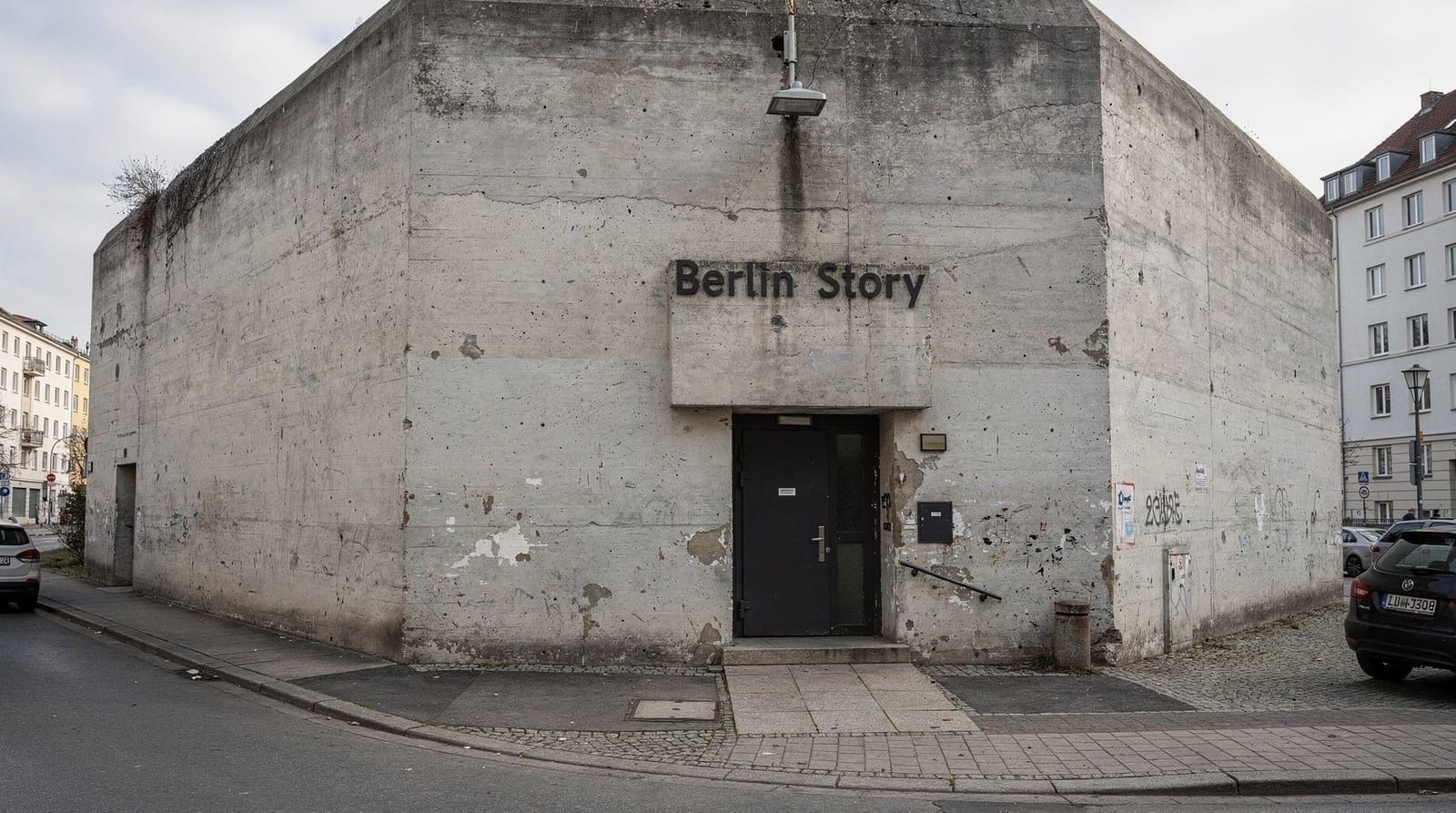
A note on terminology before visiting: there is a naming similarity that can cause confusion. The “Story of Berlin” museum with its nuclear shelter on Kurfürstendamm (described above) is a separate institution from the “Berlin Story Bunker” near Anhalter Bahnhof. They are different sites serving different historical functions.
The Berlin Story Bunker on Schöneberger Strasse is a former WWII-era concrete structure that now houses a permanent exhibition on German history. The bunker building itself — a tower bunker with massively thick reinforced concrete walls, built during the early years of WWII — forms the exhibit space. The building’s industrial scale and the constraints of its original construction give the exhibition an atmosphere that a purpose-built museum space cannot replicate. Low ceilings, narrow passages, and walls more than two metres thick create a physical experience that contextualises the history being presented.
Entry costs around 15 euros. The exhibition covers German history from the late nineteenth century through the Nazi period, WWII, and postwar division, using the bunker’s multiple levels as a sequence of thematic spaces.
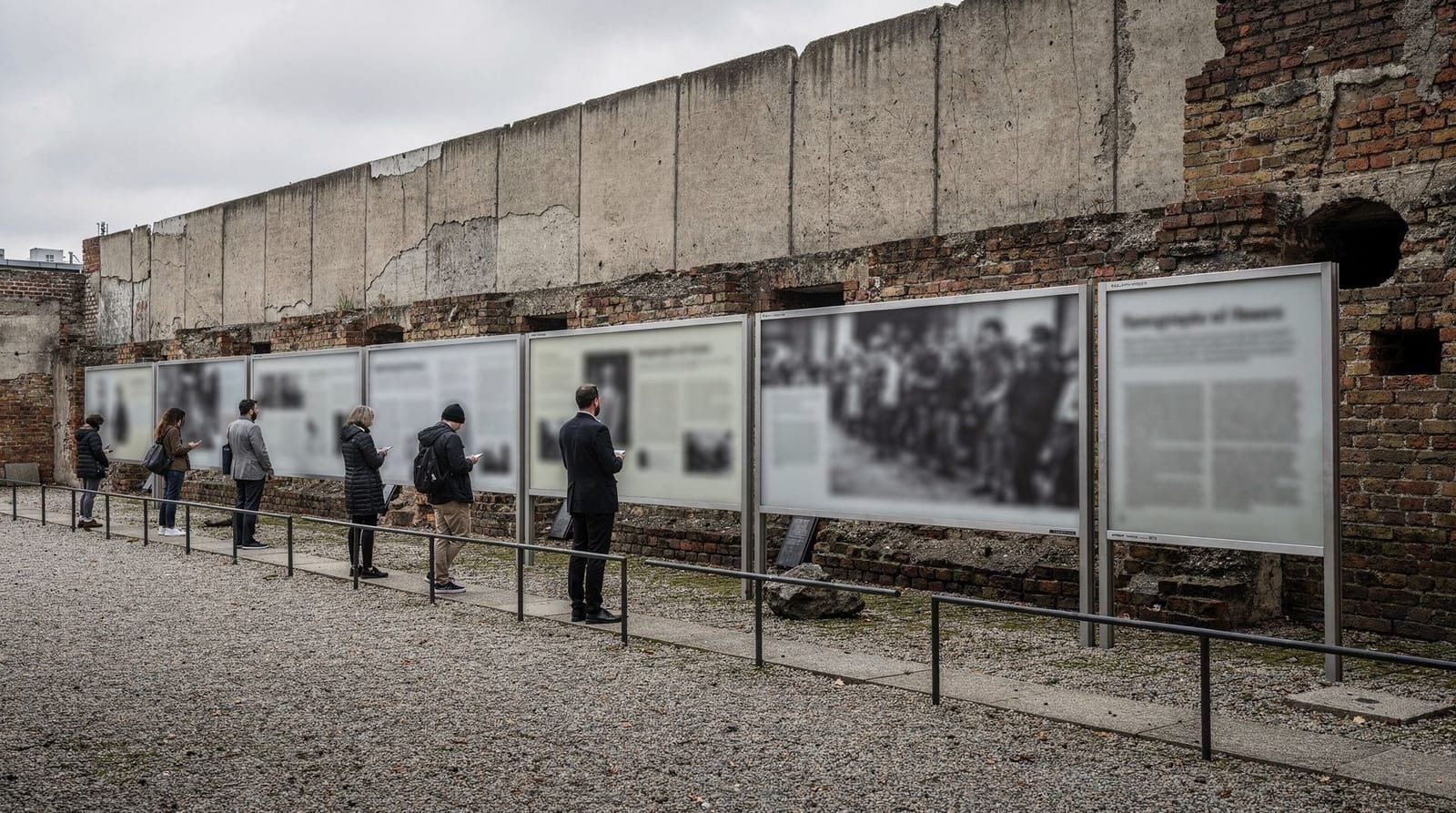
Getting there: S-Bahn to Anhalter Bahnhof (S1/S2/S25/S26) or U-Bahn to Gleisdreieck (U1/U3). The bunker is a 5-minute walk from Anhalter Bahnhof station. Combining a visit here with the nearby Topography of Terror — a 5-minute walk in the opposite direction — makes an efficient half-day covering both Nazi-era and Cold War history. The Topography of Terror is free and does not require advance booking; see our Topography of Terror guide for what to expect.

WWII bunkers that became Cold War infrastructure
The continuity between WWII civil defence and Cold War civil defence is not incidental; it is the defining characteristic of Berlin’s underground heritage. The investment that the Nazi state made in air raid shelter construction during the early 1940s created a physical infrastructure that was simply too substantial to abandon. When West Berlin’s civil defence planners needed shelter capacity in the 1950s and 1960s, they worked with what was already underground.
The Gesundbrunnen shelter — the Berliner Unterwelten site — is the most accessible example of this continuity. Built for conventional bomb protection in 1941-43, it was adapted and upgraded for nuclear-age civil defence in the 1950s. The layering of these two eras of construction is physically visible in the tunnels: original WWII brickwork and steel sits alongside Cold War concrete and filtration equipment.
The Pallasstrasse shelter in the Schöneberg district represents a different type. This is an above-ground tower bunker — a Hochbunker — rather than a subterranean structure. The building’s exterior is visible from the street: a massive rectangular concrete block inserted between residential buildings on Pallasstrasse. After the war and through the Cold War period, the building served various purposes; it is now partially converted to residential use, with some of the original structure still accessible from the exterior. It is a striking example of how these massive wartime structures were simply absorbed into the urban fabric.
The Zoo Flakturm — one of the enormous anti-aircraft towers built around Berlin during WWII — was largely demolished after the war, though fragments of the structure remain visible in the Tiergarten. Flakturme of this type were essentially impossible to destroy efficiently (the concrete is too thick for conventional demolition), and some cities simply built around the remnants. The Zoo tower’s near-complete removal makes Berlin unusual among cities where these towers were constructed; Vienna, for example, retains multiple intact Flakturme that can be visited today.
The history of how Berlin managed its WWII underground infrastructure in the postwar decades connects directly to the Third Reich sites in Berlin more broadly, and to the Berlin Story Bunker guide which covers the Schöneberger Strasse facility in more detail.
Planning a Cold War underground tour day
If you want to combine the major accessible bunker sites in a single day, the geography supports it reasonably well. Here is one practical approach.
Start with a morning Berliner Unterwelten tour at Gesundbrunnen. Book the English-language tour in advance for 9 am or 10 am. The tour runs approximately 90 minutes underground, bringing you back to street level by late morning. Gesundbrunnen has cafes and a bakery near the station for a post-tour coffee and something to eat.
From Gesundbrunnen, take the U8 southbound towards the city centre. The Berliner Unterwelten tour will have covered the WWII-to-Cold War transition in underground terms; the afternoon can add the Cold War surface history. The Berlin Story Bunker near Anhalter Bahnhof (U1/U3 to Gleisdreieck, or S-Bahn to Anhalter Bahnhof) makes a good afternoon stop — the 15-euro entry gives you 2 hours in the concrete building with its German history exhibition.
Alternatively, from the city centre, take the U-Bahn to Kurfürstendamm for the Story of Berlin nuclear shelter tour. The 14-euro museum ticket includes the bunker visit; you can cover the museum’s other rooms as time allows.

In the evening, a guided walking tour covering Cold War surface history connects the underground themes to what was happening above ground at the same period. Several operators run Cold War and Wall-focused evening tours that cover Checkpoint Charlie, Potsdamer Platz, and the former border installations.
For a fuller multi-day Cold War itinerary that incorporates bunker visits alongside the Wall, the Stasi Museum, and the espionage history, see our Cold War Berlin itinerary.
The Third Reich history trail itinerary complements this if you want to extend your stay and cover both historical periods in depth.
Practical summary
Berliner Unterwelten at Gesundbrunnen: Book online at berliner-unterwelten.de before you arrive. English tours run multiple times daily in peak season. Cost approximately 15 euros per adult. Temperature underground is 10-12 degrees — bring a layer. The tour is not fully step-free; there are stairs and some low ceilings. Photography is generally permitted but check with the guide before shooting in specific areas.
Story of Berlin nuclear shelter: The bunker tour is included in the 14-euro museum ticket and runs several times daily. No separate booking required for the bunker itself — purchase your museum ticket and join the next bunker tour. Located at Kurfürstendamm 207-208; U1/U9 to Kurfürstendamm. Not wheelchair accessible for the bunker section due to the original structure.
Berlin Story Bunker (Schöneberger Strasse): Around 15 euros entry. S-Bahn to Anhalter Bahnhof or U-Bahn to Gleisdreieck. Combine with the Topography of Terror (free, 5-minute walk). Photography permitted throughout.
Harnekop: A separate day trip from Berlin by car, approximately 60 km north-east. Pre-book the guided tour at the Bunkermuseum Harnekop website. Not suitable for combining with city-centre bunker visits in the same day.
General notes: Underground environments are not step-free and are generally not wheelchair accessible. The cold temperature underground applies year-round. A small day bag with a layer is the only specialist preparation needed.
Combining costs: A single day covering Berliner Unterwelten (around EUR 15) and the Berlin Story Bunker (around EUR 15) runs roughly EUR 30 per person before transport and food, and fits comfortably into a morning-to-afternoon schedule using the U8 and S-Bahn connections described above. Adding the Story of Berlin museum and its nuclear shelter (around EUR 14, including the bunker tour) pushes the day toward EUR 44 per person and is more realistic split across two days given the travel time between Kurfürstendamm in the west and Gesundbrunnen/Anhalter Bahnhof further east and south.
Seasonal note: Peak season (roughly April through October) offers the most frequent English-language tour departures at all three main sites, but also the highest demand — book Berliner Unterwelten and, if relevant, Harnekop, well ahead. Winter visits mean fewer tour slots but far less competition for the ones that run, and the underground temperature is unaffected either way.
For the Stasi Museum and Cold War espionage history, see the dedicated guide. For the full picture of Cold War espionage in Berlin, including Glienicke Bridge and the CIA tunnel, the espionage guide covers that ground in detail.
Frequently asked questions about Cold War bunkers in Berlin
What is Berliner Unterwelten?
Berliner Unterwelten (Berlin Underworlds) is a non-profit organisation that runs guided tours through underground tunnels, air raid shelters, and Cold War facilities beneath Berlin. Their most popular tour starts at Gesundbrunnen S-Bahn station in Wedding and accesses WWII air raid shelters that were expanded during the Cold War as civil defence structures. Tours run in German and English; the English-language tour departs several times daily in peak season.How much do Berliner Unterwelten tours cost?
Tours cost approximately 15 euros per adult (reduced rates for students and children). The most popular tour at Gesundbrunnen runs approximately 90 minutes underground. Booking online at berliner-unterwelten.de is strongly recommended — weekend tours in summer often sell out days in advance. Tours depart from Gesundbrunnen station (S25/S41/S42/U8 intersection).What is the Story of Berlin bunker?
The Story of Berlin museum on Kurfürstendamm includes access to an authentic 1970s nuclear shelter built beneath the building to protect 3,500 people for 14 days. The museum ticket (around 14 euros) includes a guided visit to the bunker. The shelter retains its original equipment including decontamination showers, ventilation systems, and bunk provisions. Access is by guided tour only (included in ticket price); tours run several times daily.Are there any Cold War bunkers for East Germany's leadership?
Yes. The GDR maintained a leadership bunker complex at Harnekop in Brandenburg (roughly 60 km from Berlin) intended for senior party leadership to survive a nuclear attack. It is now a museum open for guided tours. A separate facility existed near Strausberg. These are day trips from Berlin rather than city-centre sites. Berliner Unterwelten covers some aspects of GDR civil defence in their tours.What were Cold War bunkers built for?
Cold War bunkers in West Berlin were designed as civil defence shelters — places where citizens could survive a nuclear attack for a period of days or weeks. The Story of Berlin bunker was built in the 1970s to shelter 3,500 people for 14 days. In East Germany, the bunker system was oriented more toward protecting the party leadership than the general population; civilian shelter provision was comparatively limited.How deep underground are the Berlin Cold War bunkers?
The depth varies by site. The Gesundbrunnen facility accessed by Berliner Unterwelten is approximately 10 metres underground, within the WWII-era shelter system. The Story of Berlin bunker beneath Kurfürstendamm is similarly shallow at around 10 metres. Genuine nuclear hardened leadership bunkers (like Harnekop) are typically 15-25 metres deep.Can I visit the Führerbunker in Berlin?
No. The Führerbunker (Hitler's final underground command post) was sealed and partially demolished after the war; the site is now an unmarked car park with only a small information board. Deliberate preservation was avoided to prevent it becoming a neo-Nazi pilgrimage site. The site is described in the guide on Führerbunker history. For accessible bunker experiences, the Story of Berlin and Berliner Unterwelten are the practical options.
Top experiences
Bookable activities with verified prices and instant confirmation on GetYourGuide.