Stolpersteine Berlin — how to find and read the memorial cobblestones
Berlin: The Jewish History Tour
What are Stolpersteine and how do you find them in Berlin?
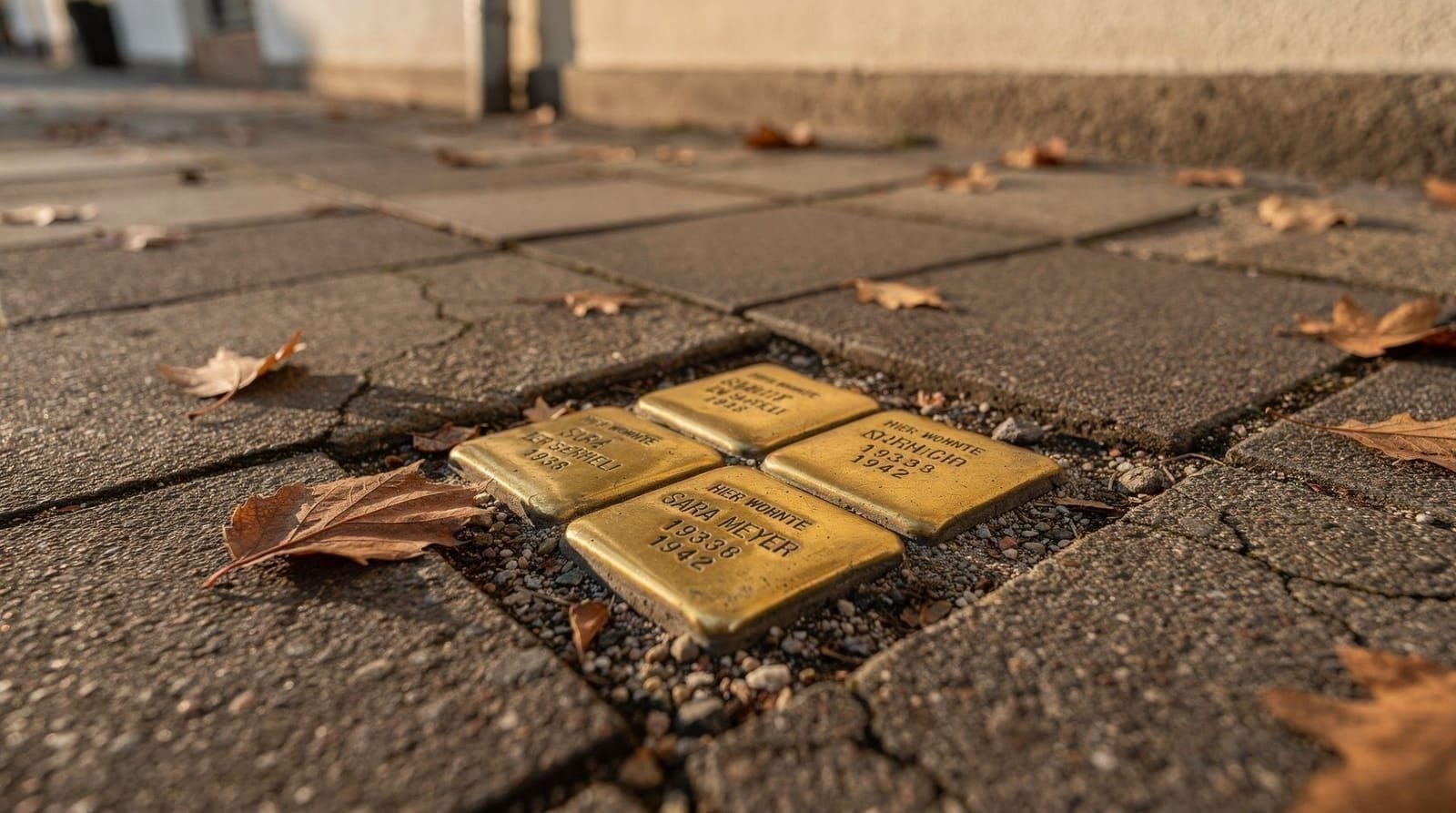
Stolpersteine (literally "stumbling stones") are small brass plaques set into the pavement in front of former homes of Holocaust victims, created by artist Gunter Demnig from 1992 onward. Berlin has the highest concentration of any city — over 8,000 stones. They appear throughout Mitte, Prenzlauer Berg, Charlottenburg, Kreuzberg, and every central district. There is no single map, but stolpersteine.eu lists them by district and street.
What are Stolpersteine? Stolpersteine are small brass plaques set in the pavement outside former homes of people murdered by the Nazi regime, created by German artist Gunter Demnig. Berlin has more than 8,000 — the highest concentration of any city in the world. You encounter them unexpectedly: a glint of polished brass in the pavement outside an apartment building, a cluster of names outside a school or courtyard. Reading them forces a different kind of attention to the city.
| Cost | free to view; around EUR 120 to commission one |
| Where | Mitte, Prenzlauer Berg, Charlottenburg, Kreuzberg |
| Time needed | ongoing — encountered while walking, not a single stop |
| Best approach | pair with a neighbourhood walk or a Jewish history guide |
| Booking | none needed to view; commissioning goes through Koordinierungsstelle Stolpersteine |
The project — origins and scale
In 1992, Gunter Demnig installed what he describes as the first Stolperstein during a Cologne cultural event about the deportation of the city’s Roma community. The stone was installed without official permission — an act of public art that preceded its own legalisation.
Demnig drew on a historical footnote: when Nazi authorities drew up deportation lists and marked addresses, they used a system of chalk marks on pavements to identify houses. The Stolperstein project inverted this bureaucratic violence, marking the same addresses as permanent acts of memory.
The official project began in 1996. By 2004, when the ten thousandth stone was laid in Vienna, it had become the largest decentralised memorial project in the world. By 2026, more than 100,000 stones exist in 30 countries across Europe, in every city where Nazi persecution displaced or killed residents.
Each stone measures 10 by 10 centimetres. The brass surface is polished and engraved by hand. The text is always the same structure: “HIER WOHNTE” — here lived — followed by the name, birth year, deportation date, and death date and place if known.
Demnig has a firm personal practice: he lays every stone himself. Not delegating the physical installation is a deliberate choice. As the project grew to include tens of thousands of stones, this meant a permanent cycle of travel across Europe to installation appointments organised by local committees. Demnig has described the act of bending to the pavement and laying the stone as an act of prostration — a bodily acknowledgement of what happened at that address.
How to read a Stolperstein
The information on each stone follows a fixed formula that rewards careful reading:
HIER WOHNTE — “Here lived.” The past tense is absolute. This person lived here, and no longer does.
Name — In German naming convention: given name followed by family name. Married names are given alongside maiden names (geb., geboren = née).
JG. — Abbreviation of Jahrgang, meaning “year of birth.” This is not the birth date, only the year.
DEPORTIERT — Deported. Followed by the year.
The destination: Often a place name — Auschwitz, Theresienstadt (Terezin in Czech), Sobibor, Treblinka, Riga, Sachsenhausen — which serves as the place of death even when no specific date of death is known.
ERMORDET — Murdered. When a date is known, it follows.
SCHICKSAL UNBEKANNT — “Fate unknown.” When historical records are insufficient to establish what happened after deportation, the stone ends here. This formula is itself significant — it acknowledges the deliberate destruction of records by the Nazi state.
Some stones carry different endings: FLUCHT (flight, followed by destination country) for those who escaped; TOT for those who died of causes not directly attributed to deportation; SUIZID for those who took their own lives to avoid deportation — a documented phenomenon, particularly in Berlin in the weeks before major deportation actions.
Where to find Stolpersteine in Berlin
Scheunenviertel and Mitte
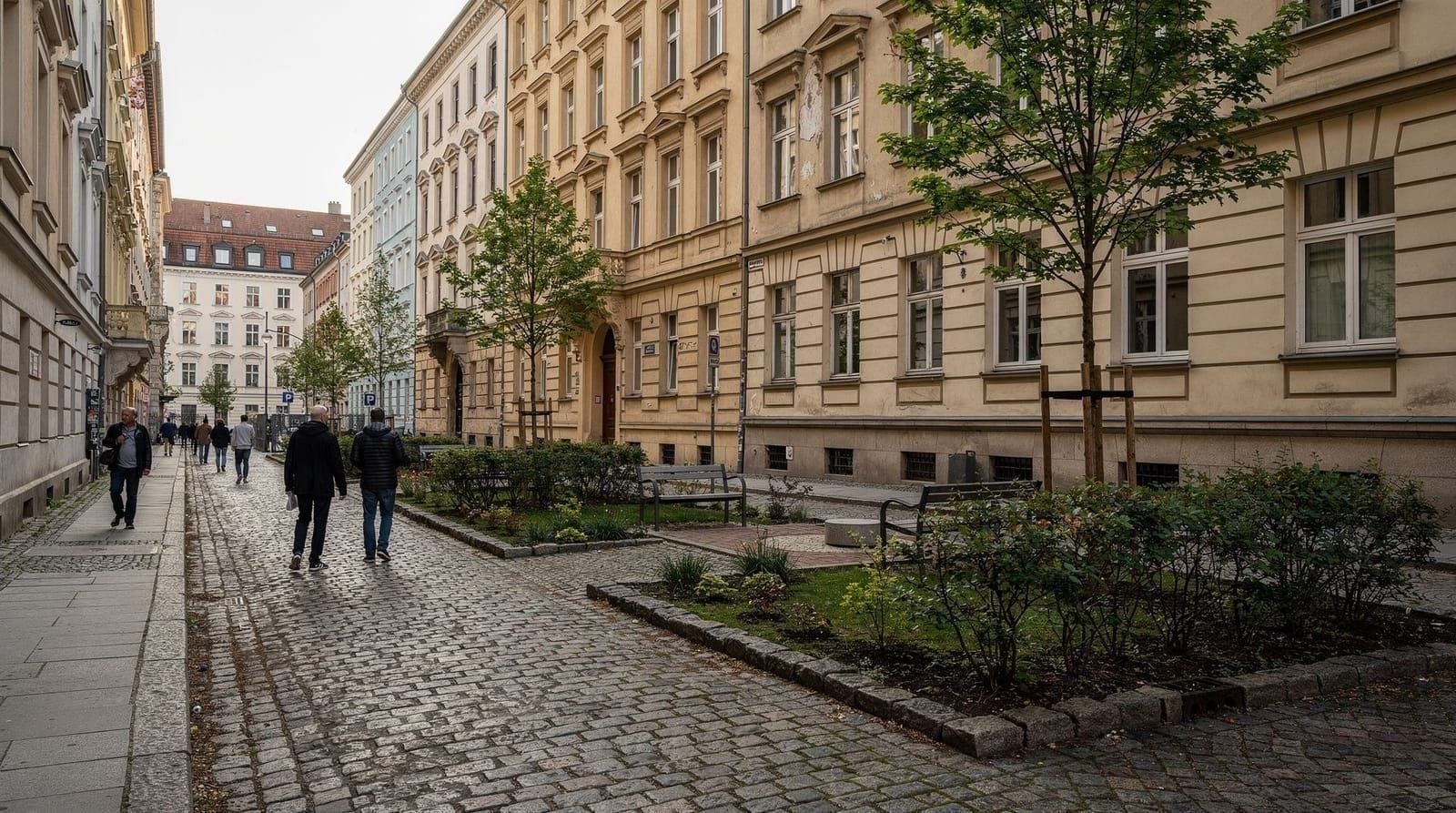
The area around Oranienburger Strasse, Grosse Hamburger Strasse, and Auguststrasse has a high density of stones, reflecting the former concentration of Jewish residents in the Scheunenviertel neighbourhood. Walking south from the Neue Synagoge along Grosse Hamburger Strasse, you pass stones at almost every building entrance.
Prenzlauer Berg
The streets around Kollwitzplatz, Rykestrasse, and Sredzkistrasse in Prenzlauer Berg were home to a significant Jewish population — primarily middle-class, assimilated, and German-speaking. The district has one of the highest concentrations of Stolpersteine in Berlin. The Rykestrasse Synagogue is nearby; stones cluster thickly around it.
Charlottenburg
The streets around the Kurfürstendamm, Fasanenstrasse (where the Charlottenburg Synagogue was destroyed in 1938), and the residential streets of Charlottenburg-Wilmersdorf were home to Berlin’s wealthiest Jewish community. Many stones here commemorate members of professional families — doctors, lawyers, academics.
A particular cluster exists around Fasanenstrasse 79-80, the address of the former main Charlottenburg Synagogue. A memorial sculpture by Bernd Haase (1988) stands at the site; Stolpersteine fill the surrounding pavement.
Kreuzberg
Kreuzberg around Bergmannstrasse and the streets leading south from Mehringplatz has significant concentrations. Many Stolpersteine here mark the former Jewish community of pre-war Kreuzberg, which was a mixed working-class neighbourhood rather than an exclusively Jewish one.
For visitors wanting fuller historical grounding before or after encountering the stones, the Jewish history Berlin complete guide covers the community’s history across all these neighbourhoods, and Jewish Berlin before 1933 documents what daily life looked like before the persecution the stones commemorate. For the specific events of November 1938, see the Kristallnacht Berlin sites guide.
If you prefer a guided introduction that weaves the Stolpersteine into a wider walk through Jewish Berlin, a themed walking tour covers this ground with a historian on hand.
Book a Jewish history walking tour of BerlinWhat Stolpersteine are not
Several comparisons are worth making for clarity:
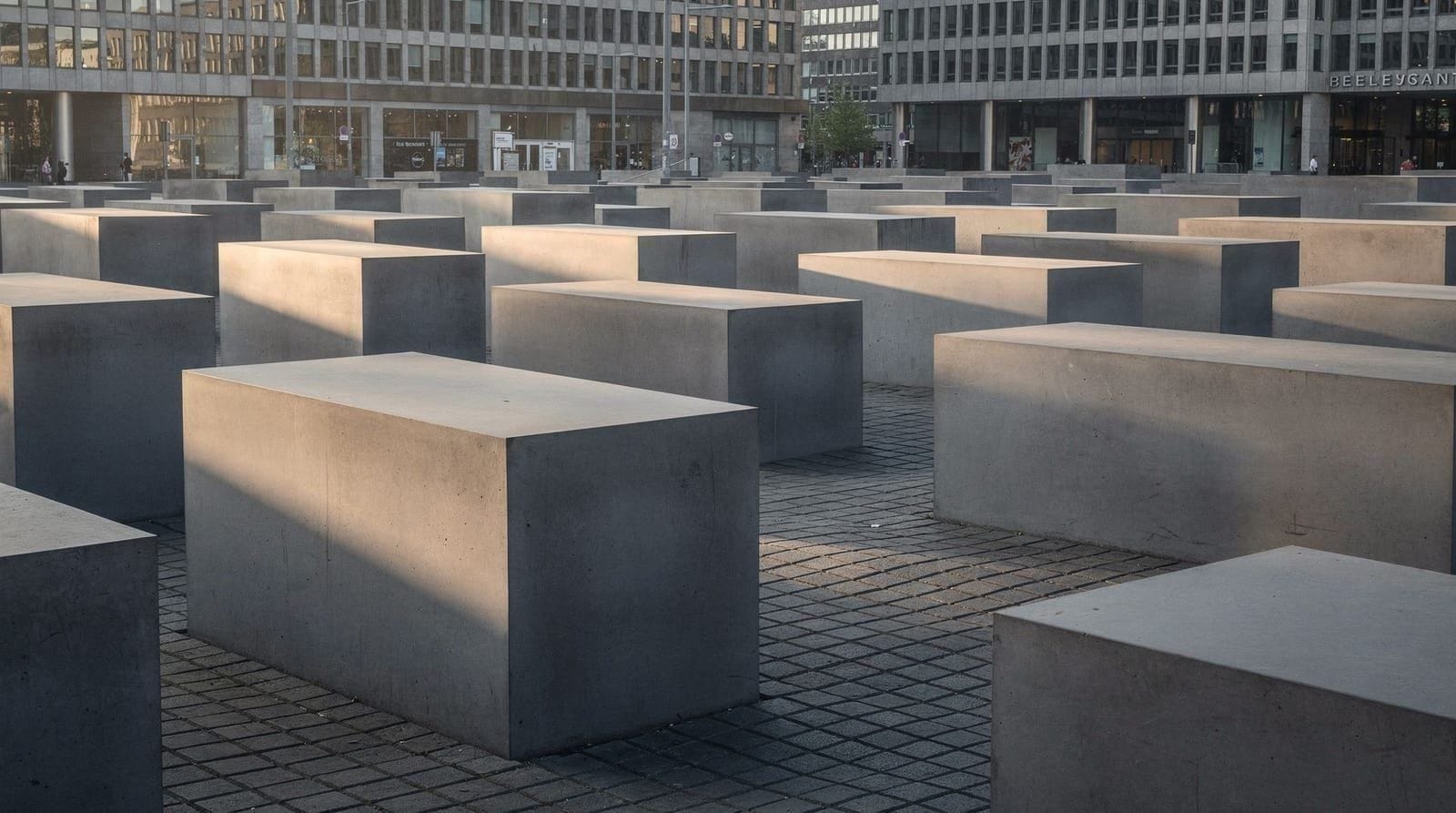
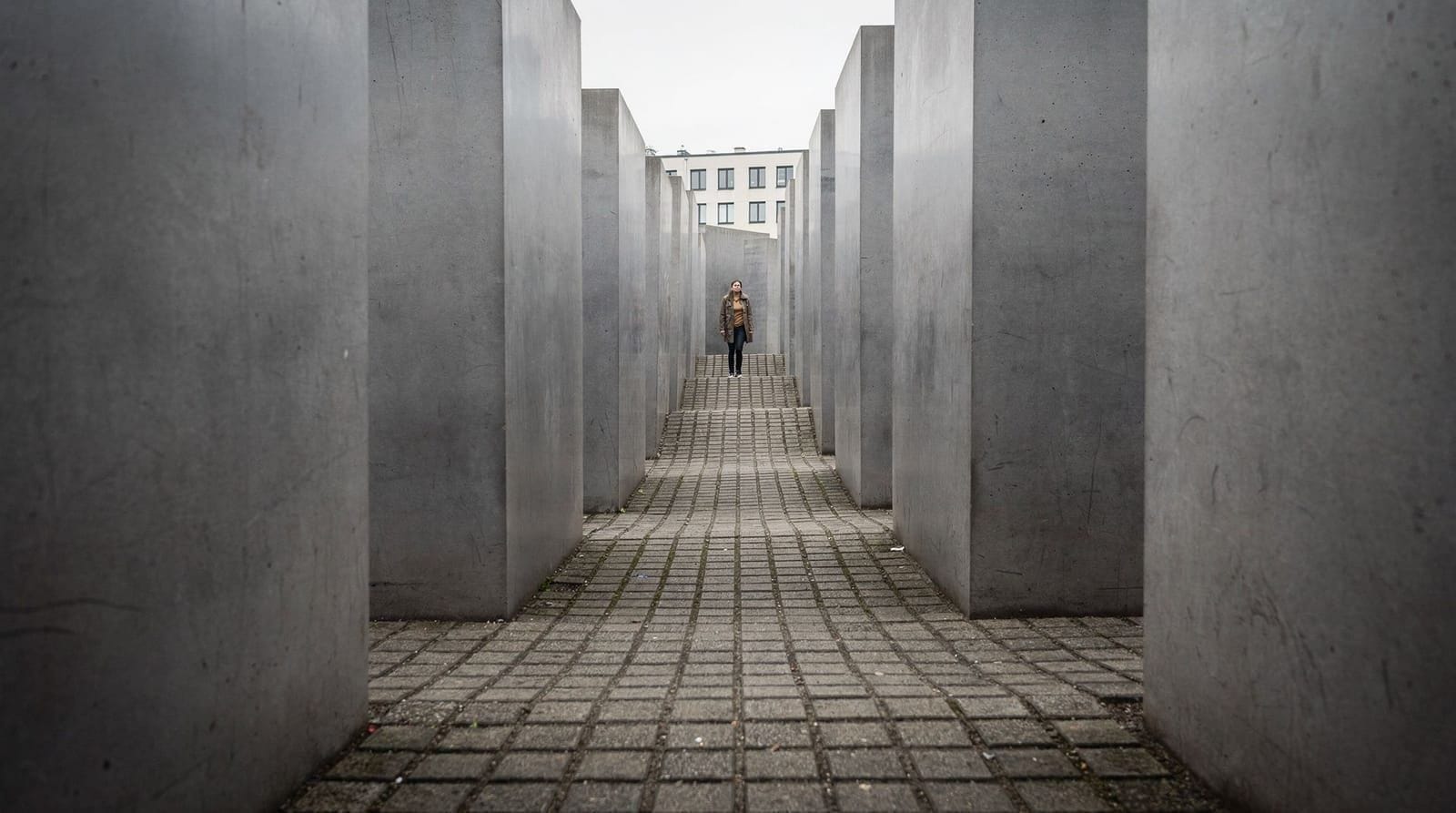
Stolpersteine are not the same as the Memorial to the Murdered Jews of Europe near the Brandenburg Gate. The Memorial uses an abstract landscape of 2,711 concrete stelae to create a collective, anonymous space of contemplation. The Stolpersteine project is the opposite in almost every way: individual, named, located at specific addresses, distributed across the city rather than concentrated in one place.
Stolpersteine are also not the same as the Holocaust Memorial Guide’s broader overview of Berlin’s memorial landscape. The Stolperstein project is one of many memorial forms in the city, distinguished by its decentralisation and its insistence on individual address.
The Munich objection — that placing names in the pavement is undignified because people walk over them — is worth considering seriously. Demnig has responded that the polished brass of the Stolpersteine is cleaned by the feet that pass over it; that the project depends on public presence, not avoidance. The debate is not resolved and different communities have reached different conclusions.
The process of commissioning a stone
If you want to commission a Stolperstein — for an ancestor, for a former resident of an address you know — the process in Berlin goes through the Koordinierungsstelle Stolpersteine Berlin.
The steps:
- Research — establish the name, address, and documented fate of the person.
- Application — submit the information with documentation to the local coordinating office.
- Historical verification — the organisation checks the details against deportation records, Yad Vashem databases, and local archives.
- Funding — the €120 cost is raised privately (though grants are sometimes available for school projects and civic organisations).
- Installation — Demnig or a member of his team comes to install the stone. A small ceremony involving the commissioner, often local residents and officials, accompanies the installation.
Berlin maintains a searchable database of Stolpersteine at stolpersteine-berlin.de, organised by district and street. Yad Vashem’s Central Database of Shoah Victims’ Names is the primary resource for documentary research.
Temporary cleaning ceremonies
In many Berlin neighbourhoods, local residents and schools organise periodic cleaning ceremonies where Stolpersteine are polished with brass cleaner and rags. These events are both practical — the brass tarnishes in urban air — and symbolic, bringing people to specific addresses to stand and read names.
If you pass a tarnished stone, it is considered appropriate to crouch and read it regardless. The patina of tarnish on a stone simply means no ceremony has been held recently at that address. Cleaning one yourself is not inappropriate if you carry brass cleaner, though this is a smaller gesture than the organised ceremonies.
How to make Stolpersteine part of your visit
Because there is no single site or entry queue, Stolpersteine work best woven into walking you are already doing rather than treated as a discrete attraction. If you are exploring the Scheunenviertel, slow down along Grosse Hamburger Strasse specifically to read names rather than walking past. If you are visiting the Topography of Terror or the Memorial to the Murdered Jews of Europe, consider extending the day with a walk through Prenzlauer Berg or Charlottenburg where stones cluster densely — the shift from an institutional memorial to an individual, street-level one changes how the history registers.
Some visitors research a specific address in advance — a family name, a former residence — using the stolpersteine-berlin.de database, and build a short personal pilgrimage around it. Others simply notice stones as they walk and pause when they do. Both are legitimate ways to engage with the project; there is no correct pace or route.
Frequently asked questions about Stolpersteine Berlin
Who created the Stolpersteine?
Gunter Demnig, a Cologne-based artist, created the first Stolperstein in 1992 in Cologne as part of a performance art project about the deportation of Roma and Sinti. The first stones were laid without official permission. By 1996, the project had official status; by 2026, more than 100,000 stones have been laid across 30 European countries. Demnig personally lays each stone — he does not delegate the physical act of installation.What information is engraved on a Stolperstein?
Each stone carries the text "HIER WOHNTE" (here lived), followed by the person's name, birth year, and fate — typically the year of deportation and the place and date of death if known. For example -- HIER WOHNTE / RACHEL GOLDMANN / JG. 1889 / DEPORTIERT 1942 / THERESIENSTADT / ERMORDET 12.3.1944. When the fate is unknown, the stone ends with "SCHICKSAL UNBEKANNT" (fate unknown) or simply "ERMORDET" (murdered) without a location.Who does a Stolperstein commemorate?
Stolpersteine primarily commemorate Jewish victims of the Holocaust, but the project was expanded to include Roma and Sinti, political opponents of the Nazi regime, homosexuals persecuted under Paragraph 175, Jehovah's Witnesses, and people killed under the T4 euthanasia programme. In Berlin, the vast majority mark Jewish residents.How much does a Stolperstein cost and who pays for it?
Each stone costs €120 to produce and install. The cost is typically covered by private individuals — often descendants of the victim, neighbours, local schools, or civic organisations who apply to commission a stone. The process involves historical research to verify the person's details and former address. Applications go through local memorial organisations in each German city.Are there any Stolpersteine I cannot miss in Berlin?
Berlin has over 8,000 stones spread across all central districts. The Scheunenviertel (Mitte), Prenzlauer Berg, and Charlottenburg have particularly high concentrations. A dense cluster on Fasanenstrasse near the former Charlottenburg Synagogue (destroyed in Kristallnacht) marks a neighbourhood that was home to a large assimilated Jewish community. Walking the streets around Kollwitzplatz in Prenzlauer Berg reveals dozens.Why are they called "stumbling stones"?
The name comes from the German idiom "jemandem einen Stein in den Weg legen" (to put a stone in someone's path) — historically an antisemitic expression. Demnig reclaimed the phrase. The stones are deliberately flush with the pavement surface, not raised — visitors must look down, toward the ground, to read them. This posture of bowing the head is part of the intended effect. You do not "stumble" in a physical sense; you pause and look.Has Munich banned Stolpersteine?
Yes. Munich's city council voted in 2004 not to allow Stolpersteine in public pavement, following objections from Charlotte Knobloch, then president of the Munich Jewish community, who argued that placing victims' names underfoot was undignified. Munich uses an alternative system of commemorative plaques on walls instead. Berlin and most other German cities have approved the project; the Munich ban remains a contested decision.