Jewish Berlin before 1933 — the world the Nazis destroyed
Berlin: Jewish Quarter and Holocaust Private Walking Tour
What was Jewish life in Berlin like before the Nazi period?
By the 1920s, Berlin's Jewish community of approximately 170,000 was the largest in any German city and was fully integrated into the city's professional, cultural, and commercial life. Jewish Berliners were prominent in medicine, law, journalism, banking, and the arts to a degree far beyond their 4 percent share of the population. The Weimar period (1918–1933) was the peak of this integration, and its sudden destruction after January 1933 remains one of the defining losses of twentieth-century European culture.
What was Jewish Berlin before 1933? The answer runs deeper than most visitors expect. Berlin’s Jewish community was not a separate world living alongside German Berlin — it was woven through German Berlin at every level, from the most famous scientists and artists to the market traders of the Scheunenviertel. Understanding what existed before 1933 is inseparable from understanding what was destroyed.
| Where | Sites spread across Charlottenburg, Mitte, Schöneberg, Prenzlauer Berg |
| Cost | Free to walk between sites; museum entries vary |
| Time needed | Half a day for a focused walking route |
| Getting there | S-Bahn/U-Bahn connects all districts |
| Best time | Weekday mornings, paired with a guided walk for context |
A community in numbers and geography
In 1925, Berlin’s Jewish population stood at approximately 172,000 — the largest Jewish community of any German city and the third-largest in Europe, after Warsaw and Budapest. Jewish Berliners constituted about 4 percent of the city’s total population.
These numbers, however, do not capture the community’s social weight. In several professions — law, medicine, journalism, banking, academic philosophy — the proportion of Jewish practitioners in Berlin ran to 20 to 30 percent or higher. At the major Berlin daily newspapers, Jewish editors and writers were a majority. In the theatre, in film production, in music publishing, in department store retail (Wertheim, KaDeWe, Tietz — all Jewish-owned), the Jewish presence was defining.
The community was not homogeneous. It spanned the full range from:
- Fully secular, German-identified families whose Jewish ancestry was a private matter of heritage rather than active identity
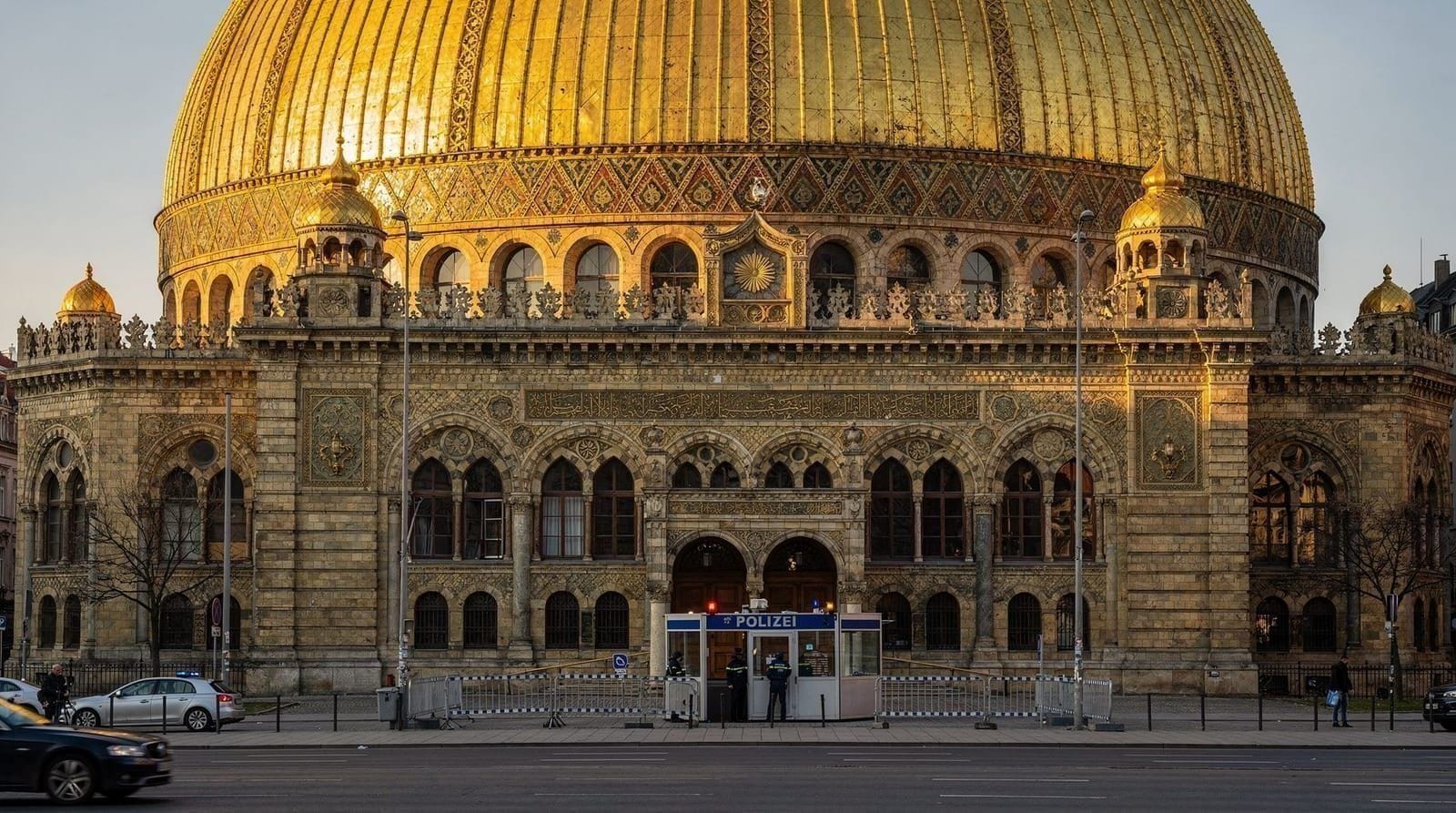
- Liberal Reform Jews attending the Neue Synagoge or similar congregations, Jewish in religious terms but German in culture and language
- Conservative and Orthodox communities, more traditionally observant
- The Yiddish-speaking Eastern European immigrant community of the Scheunenviertel, recently arrived and maintaining a distinct cultural world
These groups coexisted, sometimes uncomfortably. The established German-Jewish community often had ambivalent feelings about the Eastern European immigrants, fearing that their visible difference would provoke antisemitism. The immigrants sometimes viewed the assimilated community as having abandoned Jewish life. The tensions within pre-war Berlin’s Jewish community were as significant as the community’s tensions with its surrounding society.
The Weimar cultural world — Jewish contributions
The Weimar Republic (1918–1933) represents the peak and the truncation of German-Jewish cultural integration. The explosion of artistic innovation, political thought, and popular culture that made Berlin the cultural capital of interwar Europe had Jewish figures at its centre in disproportionate numbers.
Film: The early German film industry was substantially shaped by Jewish directors, producers, and screenwriters. Fritz Lang’s Metropolis (1927) and M (1931) were produced at Ufa studios, where Jewish involvement at every level was extensive. Billy Wilder wrote screenplays in Berlin in the late 1920s before emigrating to Hollywood in 1933; he would later return to Berlin as part of the American occupation forces and was one of the few who came back. Ernst Lubitsch had already left for Hollywood in 1922 but formed his craft entirely in Berlin’s film world.
Theatre: Max Reinhardt ran the Deutsches Theater (Schumannstrasse, Mitte) and the spectacular Grosses Schauspielhaus (a redesigned circus building at Schiffbauerdamm) simultaneously. Reinhardt’s productions defined European theatrical practice in the 1920s. He emigrated in 1933; the Deutsches Theater still operates under the same name today.
Music: Kurt Weill, born in Dessau, collaborated with Bertolt Brecht in Berlin on The Threepenny Opera (1928) and Rise and Fall of the City of Mahagonny (1930) — two of the most significant works produced in Weimar Berlin. Weill emigrated to Paris in 1933, then to New York in 1935. Bruno Walter was the leading conductor of the Berlin Philharmonic from 1925; he was driven out in 1933 when the Philharmonic refused to allow him to conduct. Arnold Schoenberg taught at the Prussian Academy of Arts in Berlin until dismissed under the 1933 Civil Service law.
Literature: Alfred Döblin, a doctor in a working-class area of Mitte, published Berlin Alexanderplatz in 1929 — the definitive novel of Weimar Berlin, with its Jewish street life and Scheunenviertel scenes. Döblin emigrated in 1933 and converted to Catholicism in 1941. Walter Benjamin, Berlin-born essayist and philosopher, wrote his Berlin Childhood Around 1900 in exile in Paris, reconstructing the world of his Charlottenburg childhood. He died at the French-Spanish border in 1940, after a failed attempt to flee the Nazis.
Science: Albert Einstein was appointed to the newly created post of director of the Kaiser Wilhelm Institute for Physics in 1914, and lived in Berlin until January 1933, when he emigrated to the United States. He never returned to Germany. His Berlin apartment was on Haberlandstrasse in Schöneberg. Einstein was awarded the Nobel Prize in Physics while based in Berlin in 1921.
Journalism: The Berliner Tageblatt, edited by Theodor Wolff, was one of the most influential newspapers in Germany — liberal, cosmopolitan, and widely read by the educated middle class. The Vossische Zeitung (nicknamed “Auntie Voss” by Berliners) was another major liberal paper with extensive Jewish editorial contribution. Both were forced to close after 1933.
The press and publishing world
The Ullstein Verlag — founded by Leopold Ullstein and run by his sons — was by the 1920s one of the largest publishing houses in the world, producing books, illustrated magazines (Berliner Illustrirte Zeitung, Die Dame, Uhu), and four daily newspapers simultaneously. The Ullstein building on Kochstrasse in what is now Kreuzberg was a major Berlin landmark.
The Nazi regime forced the Ullstein family to sell the company under threat in 1934, for a fraction of its value. After the war, the Ullstein heirs partially reclaimed assets in a postwar restitution settlement. The Ullstein Verlag continues to exist as a publisher to this day, now owned by Axel Springer.
Rudolf Mosse, another major Jewish publishing house, was similarly forced to sell under duress in 1933. The Mosse Foundation today funds journalism prizes and media ethics work.
Social and communal life
The Jewish community of Weimar Berlin had its own dense communal infrastructure. The Jüdische Gemeinde zu Berlin (Jewish Community of Berlin), the umbrella communal organisation, provided schools, welfare services, hospitals, and old people’s homes. The largest Jewish hospital in Europe operated on Iranische Strasse in Wedding (the Jewish Hospital Berlin still operates today, now serving the general population as well as the Jewish community).
Jewish sports clubs, cultural associations, youth organisations, and political parties — ranging from Zionist to Bundist to Social Democrat — each had their own Berlin organisations and venues. The social life of an involved Berliner Jew could be conducted almost entirely within Jewish communal frameworks, or could be entirely integrated with non-Jewish Berlin society. Both patterns existed simultaneously.
The Zionist movement had a significant presence in Berlin through the Zionistische Vereinigung für Deutschland, headquartered in the city. Following the Balfour Declaration of 1917, the possibility of Jewish settlement in Palestine was a live political question in Berlin’s Jewish community, though in 1933 the Zionists were a minority position — most Berlin Jews had no intention of emigrating.
The salons and intellectual life
The tradition of Jewish salons — informal gatherings in private homes where intellectual discussion, music, and social exchange crossed confessional lines — that had characterised Berlin Jewish intellectual life since the era of Rahel Levin Varnhagen (1771–1833) continued into the Weimar period.
By the 1920s, the salon form had diffused into the cabarets, the newspaper editorial rooms, and the café culture of the city. The Romanisches Café on the Kurfürstendamm (demolished in the 1960s; the Europa-Center now occupies the site) was the gathering point for artists, writers, and journalists, Jewish and non-Jewish. The café functioned as an intellectual exchange — arguments, card games, manuscript readings, and political arguments conducted in a permanent haze of cigarette smoke.
The Kurfürstendamm — the symbolic centre
The Kurfürstendamm, Berlin’s main west-end boulevard, was the symbolic centre of the prosperous Jewish middle-class community in Charlottenburg and Wilmersdorf. The large department stores (KaDeWe at the eastern end, Wertheim’s other branches, Tietz) were Jewish-owned. The cinemas, theatres, and cafés were Jewish-patronised. The apartment buildings on the side streets — Fasanenstrasse, Konstanzerstrasse, Leibnizstrasse — were home to Jewish families.
This is why the violence of Kristallnacht on 9 November 1938 concentrated so heavily on the Kurfürstendamm: smashing the shop windows, burning the Fasanenstrasse Synagogue, arresting Jewish men in their homes. The street was targeted precisely because it was so visibly, prosperously Jewish.
For the specific sites of the 1938 violence, see the Kristallnacht Berlin sites guide.
What happened to the community after January 1933
The January 1933 Nazi seizure of power ended the integration of Jewish Berliners into German civic life with extraordinary speed.
By April 1933, a one-day boycott of Jewish businesses was implemented — the first organised economic attack. The 1933 Civil Service Law expelled Jews from government positions, academic posts, and public employment. Subsequent legislation removed Jews from the legal, medical, and journalistic professions.
The Nuremberg Laws of September 1935 stripped Jewish Germans of citizenship and prohibited marriage or sexual relations between Jews and non-Jews. Each escalation narrowed the space in which Jewish Berliners could live and work.
Kristallnacht in November 1938 represented a shift to public physical violence. The deportations to extermination camps began in October 1941.
The world described in this guide — the cafés, the newspapers, the film studios, the community organisations, the intellectual life, the 172,000 people — was dismantled in twelve years.
Sites connected to pre-1933 Jewish Berlin
Fasanenstrasse 79-80: Site of the former Charlottenburg Synagogue, destroyed in Kristallnacht. A memorial sculpture stands at the site.
Haberlandstrasse 5, Schöneberg: Former address of Albert Einstein’s Berlin apartment, marked with a plaque.
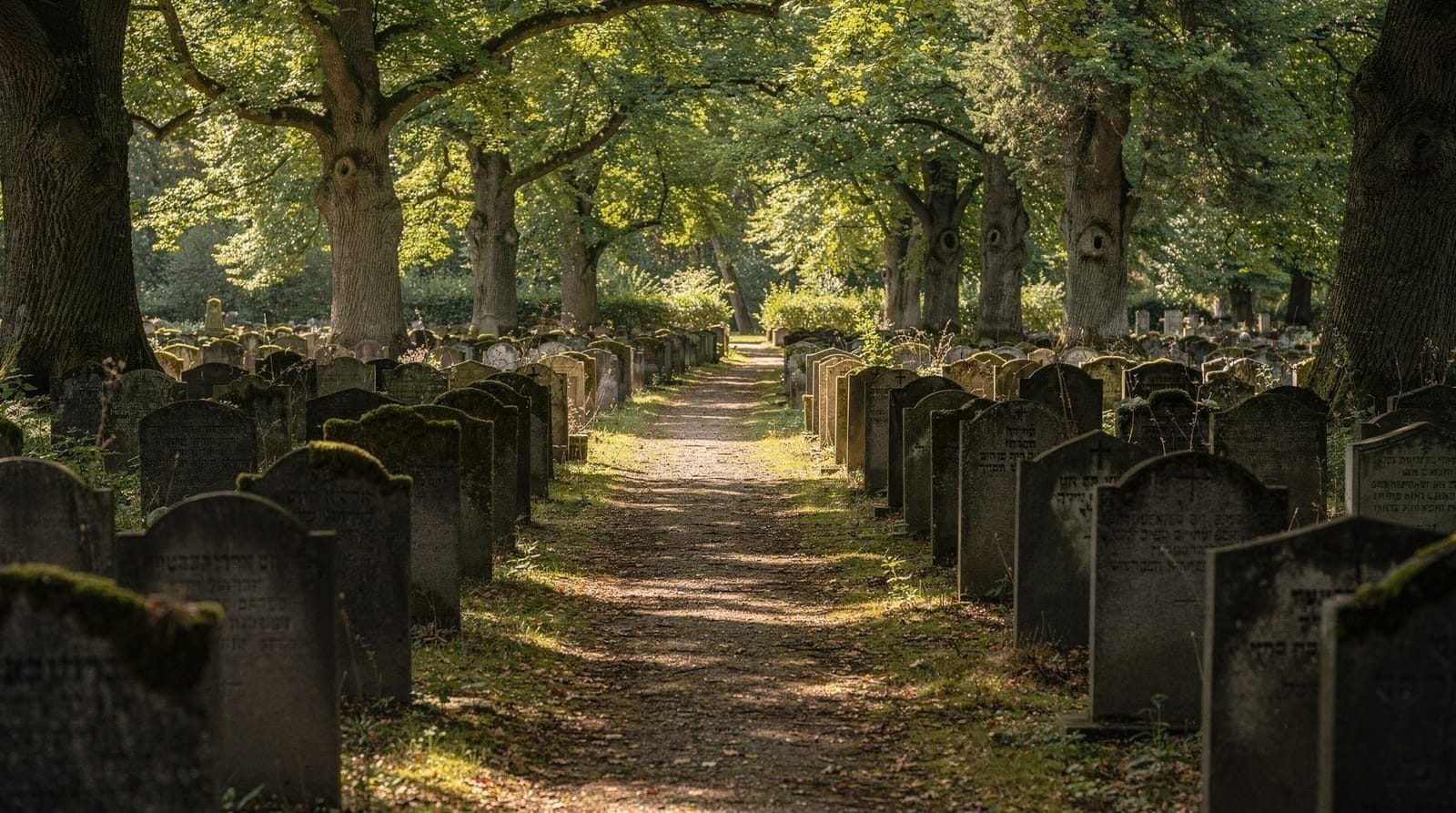
Grosse Hamburger Strasse, Mitte: The old Jewish cemetery where Moses Mendelssohn is buried; the former Jewish old people’s home later used as a deportation collection point.
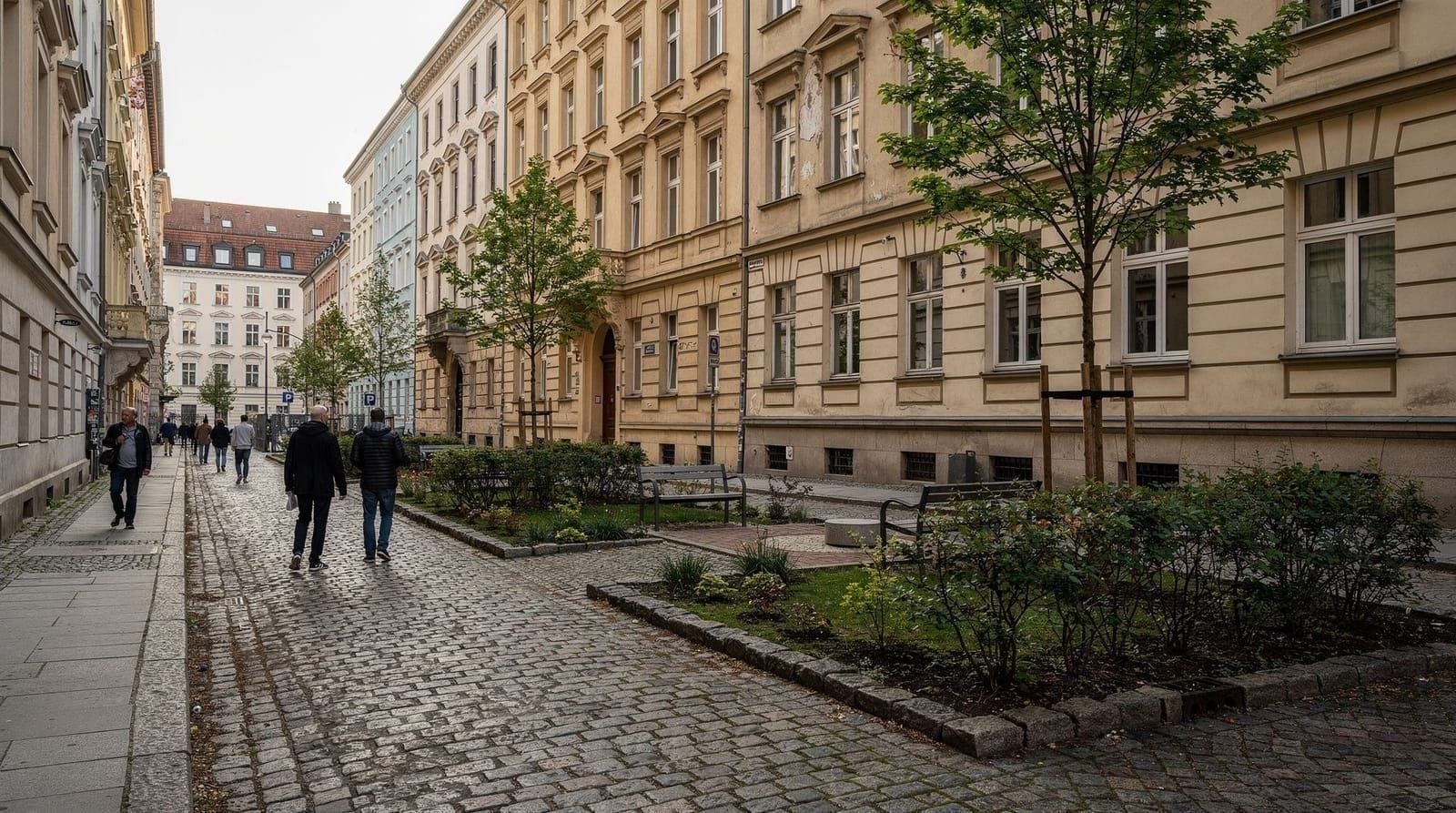
The Scheunenviertel: The surviving streets of the Eastern European Jewish immigrant quarter. See the Scheunenviertel guide for detail.
The Neue Synagoge and Centrum Judaicum: The main synagogue of the assimilated Berlin community. See the Neue Synagoge guide.
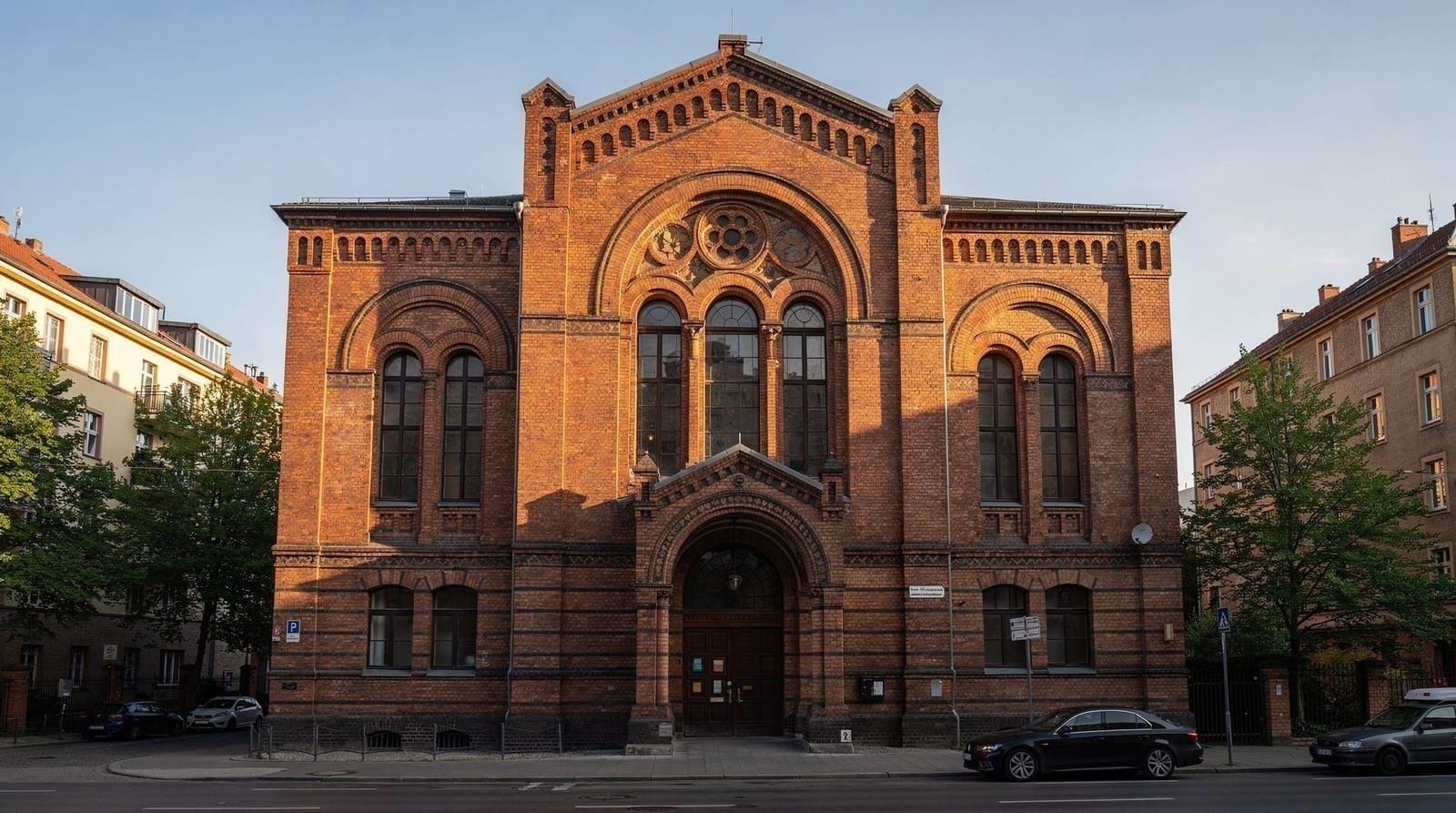
Rykestrasse Synagogue, Prenzlauer Berg: The largest surviving synagogue in Germany, still in active use. See the Rykestrasse Synagogue guide.
A suggested walking route through pre-1933 Jewish Berlin
The sites above span several districts, so most visitors sequence them into a single half-day route rather than visiting piecemeal. A practical order:
| Stop | Area | Time |
|---|---|---|
| Grosse Hamburger Strasse (old cemetery, former Jewish home) | Mitte | 30 min |
| Neue Synagoge and Centrum Judaicum | Mitte | 45–60 min |
| Scheunenviertel streets | Mitte | 30–45 min |
| Fasanenstrasse memorial site | Charlottenburg | 20 min |
| Haberlandstrasse (Einstein’s apartment plaque) | Schöneberg | 15 min |
Mitte’s cluster of sites works well as a self-guided walk since the distances are short and the streets are well-signposted; Charlottenburg and Schöneberg require a short S-Bahn or U-Bahn hop and are worth combining with a Kurfürstendamm walk. Those who prefer context from a guide rather than working it out alone can join a dedicated Jewish history walking tour that covers several of these stops in sequence.
Private guided walking tour of Berlin’s Jewish quarter and historyRestitution and how this history is marked today
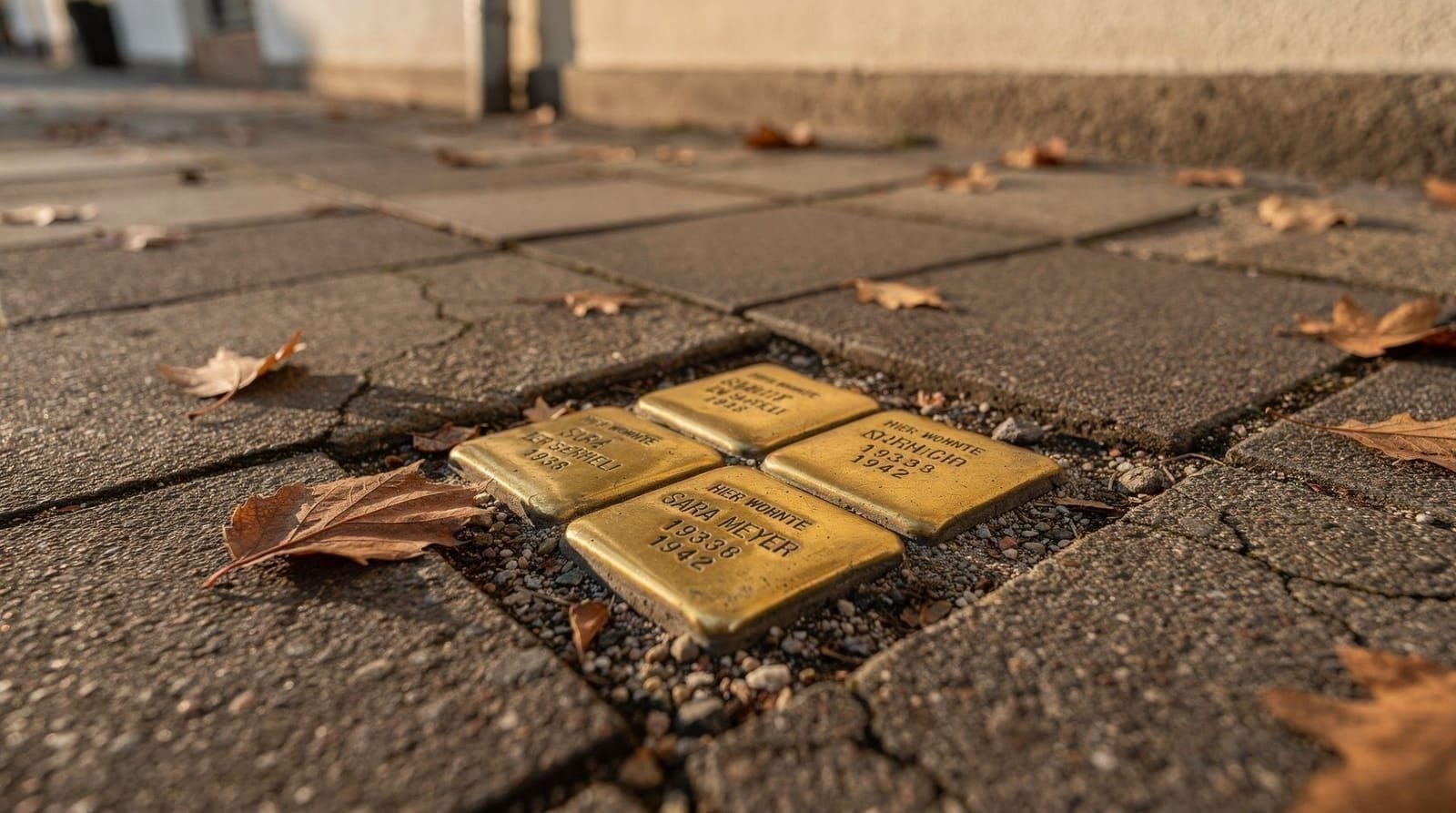
Much of the physical record of pre-1933 Jewish Berlin survives only as absence — a plaque where a synagogue stood, a name on a restitution settlement, a company that still exists under different ownership. Stolpersteine (brass “stumbling stones” set into the pavement outside the last freely chosen home of an individual victim) are the most visible, distributed everyday memorial: small enough to walk past without noticing, deliberately placed so that remembrance happens in the ordinary rhythm of a city street rather than only at a destination memorial. Restitution of Jewish-owned property and businesses — the Ullstein and Mosse publishing houses among the most prominent cases — has proceeded unevenly since the war, with some families reclaiming assets decades later and others never fully compensated. For the fuller story of the community’s destruction and the memorial landscape that resulted, the Jewish history in Berlin complete guide and the Holocaust memorial sites guide both extend directly from where this guide ends.
Frequently asked questions about Jewish Berlin before 1933
How many Jewish people lived in Berlin before the Nazis came to power?
Berlin's Jewish population reached approximately 172,000 in 1925, its historical peak. By 1933, the figure had declined slightly to around 160,000 due to emigration. Jewish Berliners represented about 4 percent of the city's total population — a minority, but one whose visibility and influence in professional and cultural life was far larger than this proportion suggests.What were the main Jewish newspapers and cultural institutions in pre-Nazi Berlin?
The Berliner Tageblatt was one of the most influential newspapers in Germany, edited from 1906 by Theodor Wolff, who was Jewish. The Vossische Zeitung was another major liberal paper with Jewish contributors. The Ullstein publishing house, one of the largest in Germany, was Jewish-owned and published books, magazines, and newspapers across the political spectrum. Cultural institutions included the Berlin Philharmonic (whose programming was significantly shaped by Jewish conductors and patrons), major theatre companies, and the nascent German film industry.Which famous Jewish figures were associated with Berlin before 1933?
The list is long and spans many fields. In science -- Albert Einstein (at the Kaiser Wilhelm Institute in Berlin from 1914 to 1933). In philosophy -- Walter Benjamin and Hannah Arendt (both Berliners, both fled in 1933). In film -- Billy Wilder, Ernst Lubitsch, and Fritz Lang all worked in Berlin before emigrating. In theatre -- director Max Reinhardt ran the Deutsches Theater and the Grosses Schauspielhaus. In literature -- Alfred Döblin, author of Berlin Alexanderplatz (1929). In music -- composer Kurt Weill and conductor Bruno Walter. In cabaret -- Claire Waldoff, Friedrich Hollaender.Where did Berlin's Jewish community live before 1933?
The community was geographically dispersed across the city, reflecting its integration. Wealthier families lived in Charlottenburg (around the Kurfürstendamm and Fasanenstrasse), Wilmersdorf, and Tiergarten. Middle-class families were spread through Mitte, Prenzlauer Berg, and Schöneberg. The working-class and immigrant community concentrated in the Scheunenviertel in Mitte. There was no single Jewish neighbourhood, no ghetto, no enclosed district — Jewish Berlin was distributed throughout a city of 4 million.How integrated were Jewish Berliners before 1933?
Very. Jews who had been German citizens since 1871 were, in the vast majority, fully integrated into German civic life — speaking German as their primary language, serving in the German military in the First World War (over 12,000 German Jews died serving Germany in WWI), attending German universities, and in many cases holding no particular sense of separate Jewish identity beyond religious affiliation or ancestry. The antisemitic claim that Jews were foreign or unassimilable was the opposite of the lived reality.When did Jewish Berliners begin to emigrate after 1933?
Emigration began immediately after the Nazi takeover in January 1933, initially slowly and primarily among those with the clearest reasons to fear persecution — politically active figures, those in public positions that were immediately affected by the 1933 Civil Service law. Emigration accelerated with each escalation: the Nuremberg Laws in 1935, the aftermath of Kristallnacht in 1938. Between 1933 and 1941, approximately 80,000 Jews emigrated from Berlin. Emigration was banned from October 1941 as the deportations to extermination camps began.