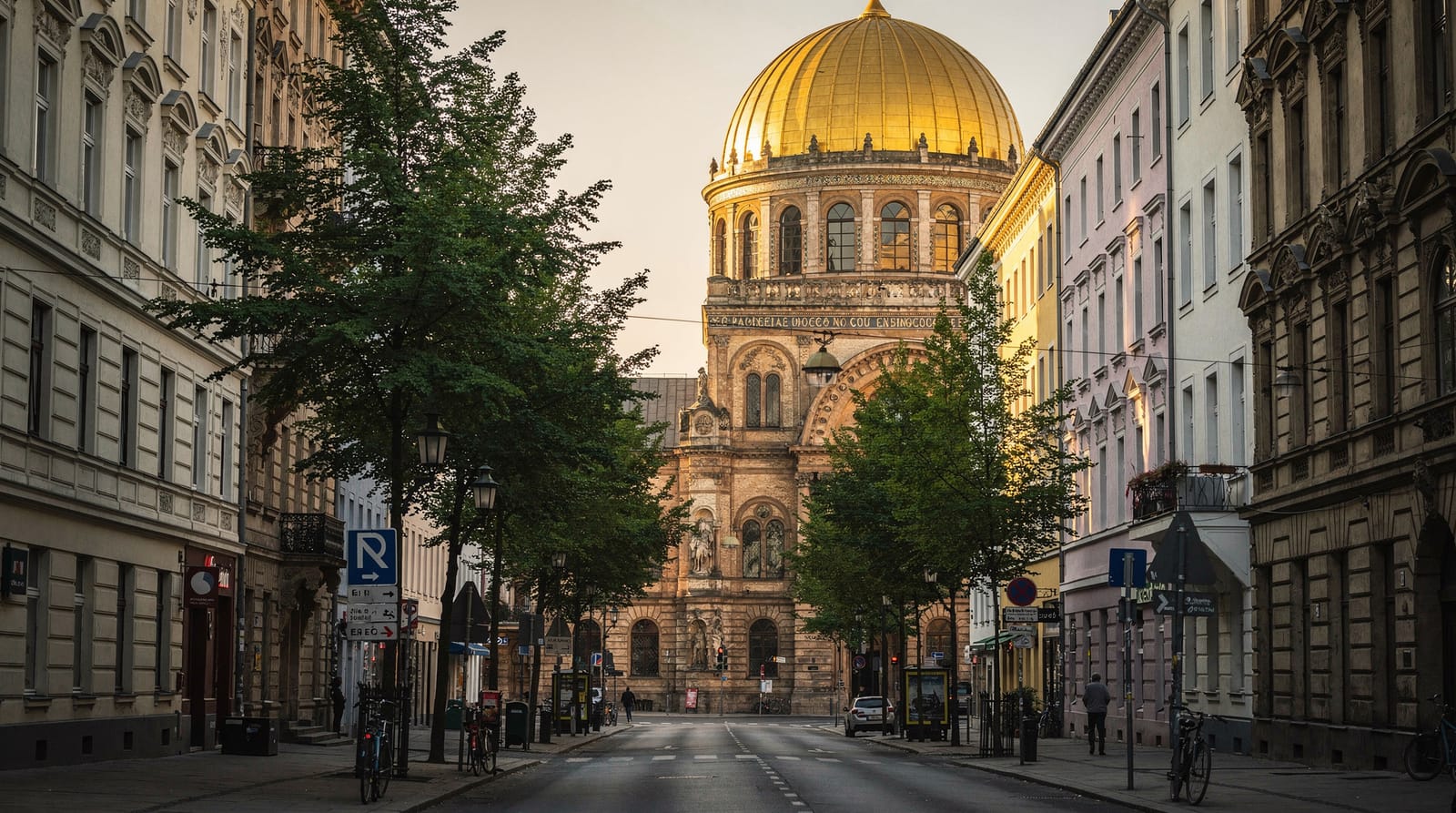
Neue Synagoge Berlin — the golden dome on Oranienburger Strasse
Berlin: Jewish Museum Berlin Entrance Ticket
Can you visit the Neue Synagoge Berlin, and what does it cost?
The Neue Synagoge is open to visitors through its Centrum Judaicum cultural centre and museum. Entry to the permanent exhibition costs €7 (reduced €4.50). The main prayer hall is not used for public worship and is partly closed for restoration; the dome and facade are the primary draw. Opening hours vary by season — check before visiting.
Can you visit the Neue Synagoge? Yes, through the Centrum Judaicum museum housed in its restored front section. Entry costs €7 for adults. The iconic golden dome on Oranienburger Strasse is the most recognisable Jewish landmark in Berlin. The main prayer hall is a preserved ruin, deliberately not rebuilt, which makes the site as much a memorial as a museum.
| Where | Oranienburger Strasse 28–30, Mitte |
| Cost | Around €7 adult, €4.50 reduced |
| Time needed | 45–60 minutes |
| Getting there | S-Bahn Oranienburger Strasse, 2 min walk |
| Closed | Mondays and Saturdays |
A building designed to announce Jewish presence
When the Neue Synagoge opened on 5 September 1866, it was the largest synagogue in the German-speaking world and one of the most ambitious buildings in Berlin. The opening ceremony was attended by Prussian Minister-President Otto von Bismarck. This was not coincidence. The synagogue was built as a statement: that Berlin’s Jewish community was a permanent, prosperous, and legitimate part of the city.
The architect Eduard Knoblauch (with Friedrich August Stüler completing the project after Knoblauch’s death) chose a Moorish Revival style that drew on the architecture of Moorish Andalusia — particularly the Alhambra in Granada. This was a deliberate choice across nineteenth-century European synagogue architecture: Moorish ornament was seen as both historically connected to Jewish heritage (via Sephardic communities in Al-Andalus) and as a style clearly distinct from the Christian Gothic and Romanesque forms used for churches.
The result was extraordinary. The facade on Oranienburger Strasse was covered in blue, white, and gold tilework and topped by a central gilded dome 50 metres high, flanked by two smaller towers. The prayer hall inside could accommodate 3,200 worshippers. Natural light entered through coloured glass windows. The acoustics were designed for the liturgical singing of Cantor Louis Lewandowski, who worked here for decades and whose choral arrangements of Hebrew prayers became standards across the Jewish world.
The building’s history through four regimes
The Neue Synagoge was completed in 1866 under Prussian rule, when Berlin’s Jewish community was in the middle of a long process of legal emancipation. Jews in Prussia had received full citizenship rights only in 1869, and the synagogue’s construction had been permitted specifically by royal decree from Frederick William IV. The building’s size and visibility was permitted in a way that would have been impossible a generation earlier.
Imperial Germany (1871–1918): The synagogue functioned as the main place of worship for the liberal Reform branch of Berlin Jewry. By 1900, Berlin had the largest Jewish population in the German-speaking world — approximately 144,000 people, about 4 percent of the city’s total. The Neue Synagoge was its most public landmark.
Weimar Republic (1918–1933): The period of the Weimar Republic brought unprecedented integration for Jewish Berliners in public life, alongside a simultaneous rise in political antisemitism. The synagogue continued to function. The cultural life in the surrounding Scheunenviertel neighbourhood — the subject of a separate guide — was at its peak in the 1920s.
Nazi period (1933–1945): After 1933, the progressive elimination of Jewish civil rights reached the Neue Synagoge on the night of 9 to 10 November 1938. SA and SS units attacked the building, setting fires and vandalising the interior. Local police commander Wilhelm Krützfeld, acting on his own initiative and invoking a historic landmark protection law, expelled the attackers and called the fire brigade. The structure survived that night — Krützfeld’s action being one of the very few documented cases of a German official protecting a Jewish institution during Kristallnacht.
However, the building did not survive the war intact. Allied bombing raids in November 1943 severely damaged the interior, destroying the prayer hall roof and much of the interior fittings. The ruins were left standing through the end of the war.
GDR period (1945–1990): The East German government demolished the main body of the synagogue in 1958, citing structural danger. Only the front section — the facade, towers, and vestibule — was left standing. It fell into neglect and decay for three decades. Restoration did not begin until after German reunification.
The Centrum Judaicum and what visitors see today
The Centrum Judaicum opened in 1995 in the restored front section of the Neue Synagoge. It occupies the vestibule, staircase halls, and gallery spaces that survived — roughly the first third of the original building.
The permanent exhibition, Open Ye the Gates, covers the history of the Neue Synagoge and the Berlin Jewish community from the synagogue’s founding to the present. It is compact but well-documented, with original objects, photographs, and archival materials. Highlights include:
- The original plans and elevation drawings from the Knoblauch/Stüler construction
- Documentation of the 1866 opening ceremony and Bismarck’s attendance
- Photographs of the interior before its destruction — the only way to comprehend the scale of what was lost
- A section on Wilhelm Krützfeld and the events of Kristallnacht 1938
- Documentation of the GDR-era demolition and the post-reunification restoration
Behind the Centrum Judaicum, accessible from inside, the visitor can look into the main body of what was the synagogue — a roofless space that now contains only fragments of wall and a garden of remembrance. This ruin is maintained as a memorial rather than rebuilt. The decision not to reconstruct carries meaning: the building as it stands shows what was destroyed, not what was replaced.
The golden dome is accessible via a staircase that gives views over the rooftops of Mitte and the Scheunenviertel. On a clear day, the television tower at Alexanderplatz and the dome of the Berlin Cathedral are both visible. The climb involves steep stairs with no lift access.
The surrounding area — Oranienburger Strasse and Scheunenviertel
The Neue Synagoge sits at the edge of what was the Scheunenviertel (literally “barn quarter”), Berlin’s historic Jewish immigrant neighbourhood, which from the late nineteenth century into the 1920s was a dense, Yiddish-speaking working-class district extending northeast of the synagogue. The full Scheunenviertel guide covers this neighbourhood in detail.
Oranienburger Strasse itself, immediately outside the synagogue, is a mixed street in 2026 — upscale cafés, tourist restaurants, and art galleries alongside the Kunsthaus Tacheles cultural centre (a former squat turned arts space). The street is notably lively at night and has a different character from the quiet of the synagogue entrance.
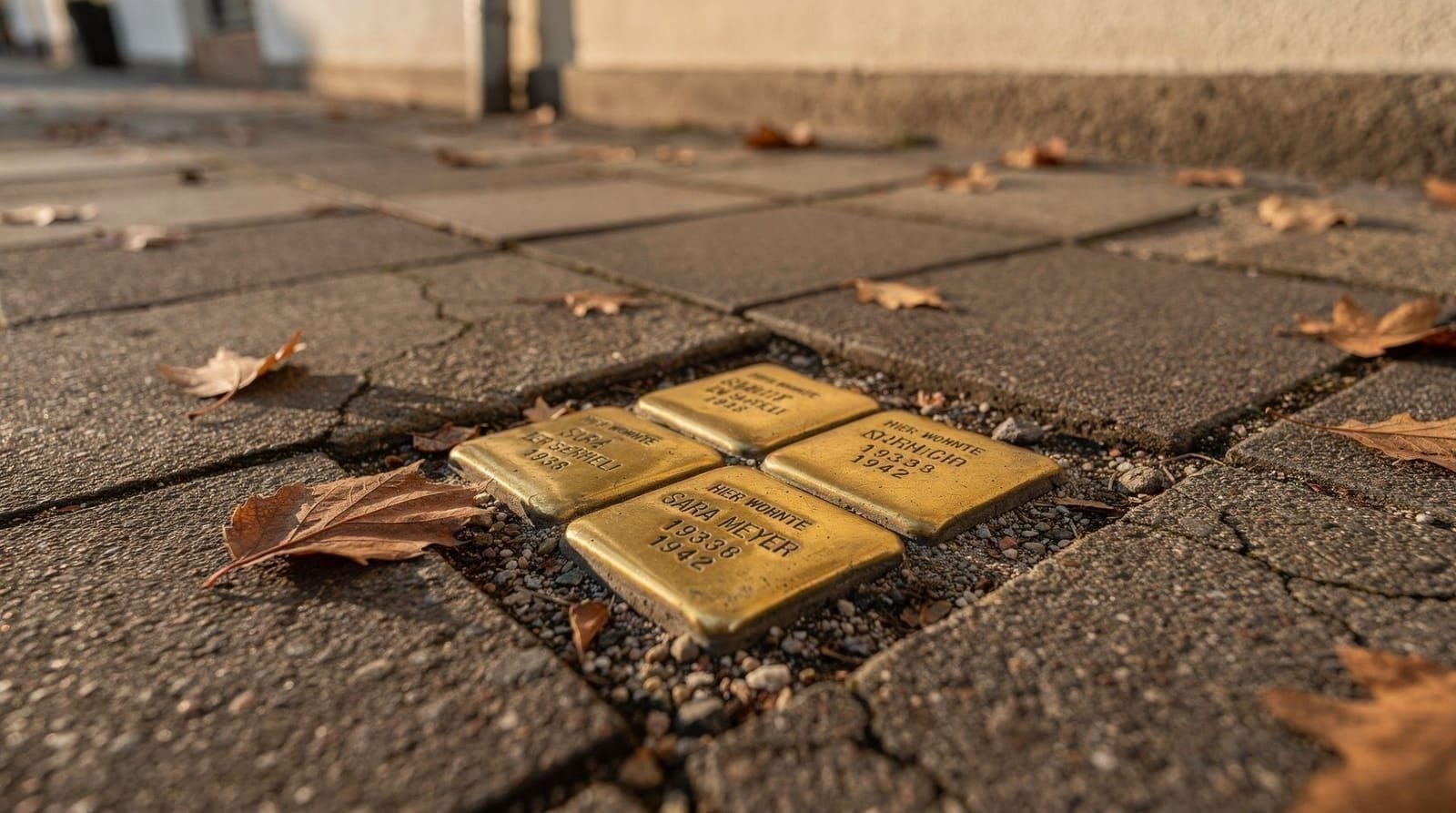
Several Stolpersteine — the small brass memorial cobblestones marking former Jewish residents — are embedded in the pavement on Oranienburger Strasse and surrounding streets.
Practical information
Address: Oranienburger Strasse 28-30, 10117 Berlin (Mitte)
Getting there: S-Bahn Oranienburger Strasse (S1, S2, S25) — two minutes on foot. From Hackescher Markt (S5, S7, S9), walk 10 minutes west through the Scheunenviertel.
Entry: €7 adults, €4.50 reduced. Combined tickets with temporary exhibitions available. No free entry days.
Opening hours: Vary by season and Jewish holidays. Generally Tuesday to Thursday 10:00–18:00, Friday 10:00–17:00, Sunday 10:00–18:00. Closed Monday and Saturday. Confirm at centrumjudaicum.de before visiting.
Accessibility: The ground floor permanent exhibition and the ruin garden behind the building are wheelchair-accessible. The dome staircase is not — it requires climbing steep original stone stairs.
Security: As with all Jewish institutions in Berlin, security checks are in place at the entrance. Allow a few minutes extra.
Connections to other Jewish Berlin sites
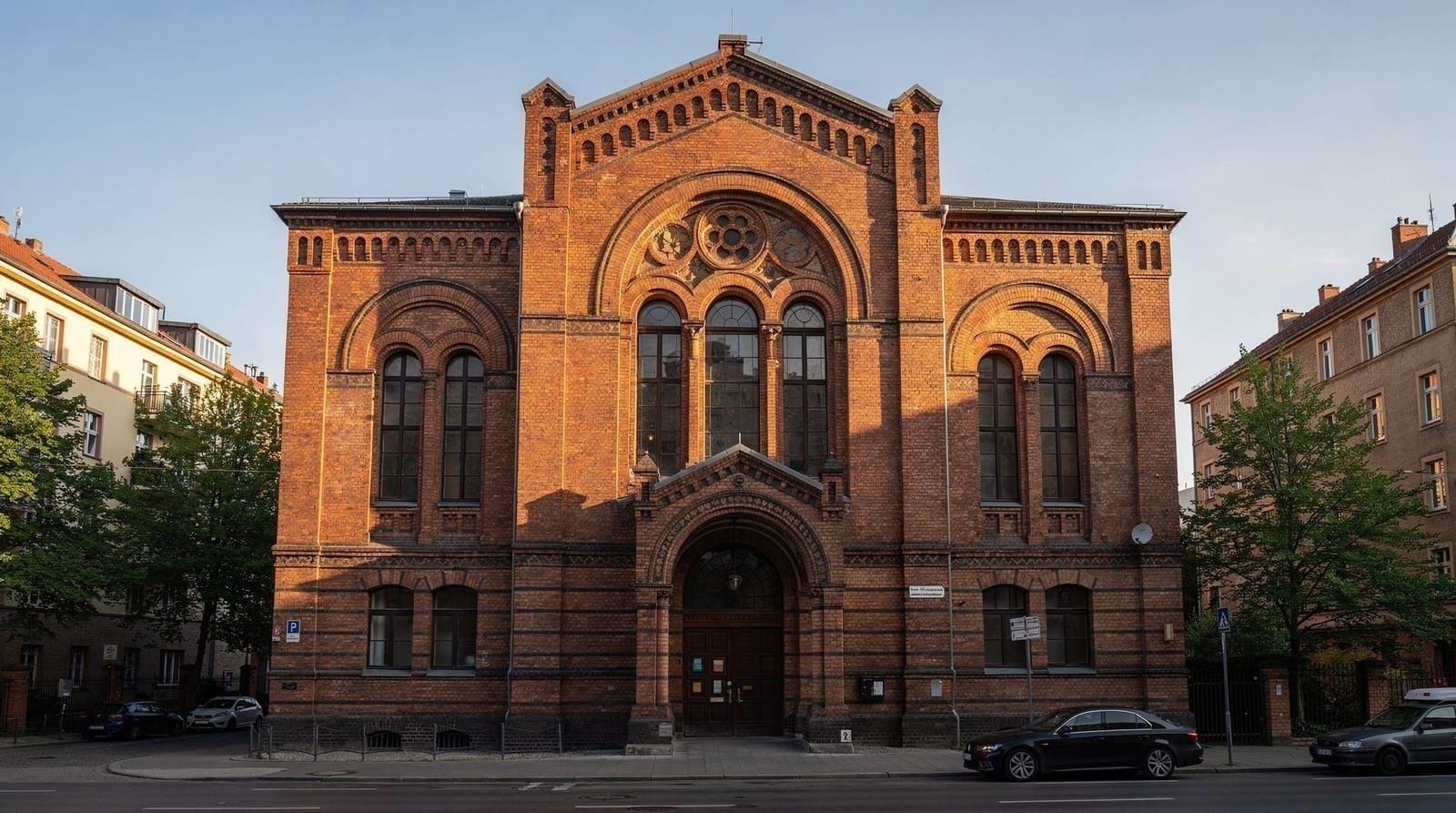
The Neue Synagoge is most naturally visited as part of a wider exploration of Jewish Berlin, beginning in the Scheunenviertel neighbourhood directly around it. A logical route from here would walk north to the Rykestrasse Synagogue in Prenzlauer Berg (25 minutes on foot or two stops on tram M1), which is the largest surviving synagogue in Germany and remains an active place of worship.
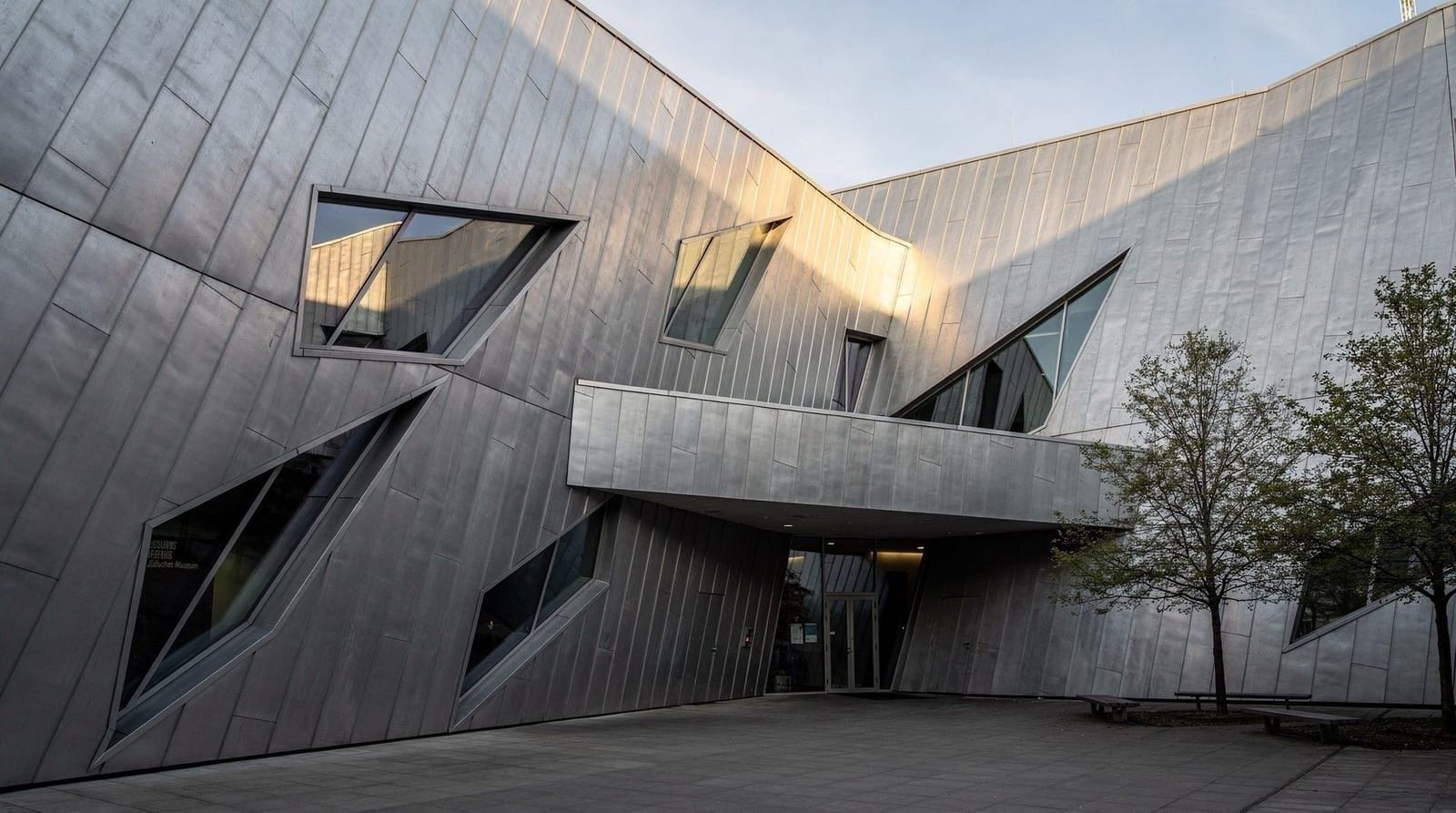
For the broader sweep of Jewish Berlin history — from the medieval period through the present — the complete Jewish history guide provides essential context. The Jewish Museum Berlin in Kreuzberg takes a different approach to the same material, with Daniel Libeskind’s architecture doing much of the interpretive work.
Book Jewish Museum Berlin entrance ticket to pair with your Neue Synagoge visitIs it worth the entry fee, and how does it compare to the Jewish Museum?
At around €7, the Centrum Judaicum is inexpensive relative to most Berlin museum entries, but the exhibition itself is compact — realistically 30–40 minutes of content plus the dome climb. Visitors expecting a large-scale museum experience comparable to the Jewish Museum Berlin should recalibrate: the Neue Synagoge’s value is as much in the building itself, the ruin garden, and the dome view as in the exhibition content. The Jewish Museum, by contrast, is a much larger institution requiring 2–3 hours and covering the full sweep of German-Jewish history through Daniel Libeskind’s deliberately disorienting architecture. Neither replaces the other — they cover different scales of the same story, and visitors with a serious interest in Jewish Berlin should budget for both rather than choosing one.
Frequently asked questions about Neue Synagoge Berlin
What is the Neue Synagoge Berlin?
The Neue Synagoge (New Synagogue) was built between 1859 and 1866 on Oranienburger Strasse in Mitte as the main synagogue of Berlin's Jewish community. Its Moorish-Revival architecture and golden dome made it one of the most distinctive buildings in nineteenth-century Berlin. It could seat 3,200 worshippers. It was badly damaged during Kristallnacht in 1938 and further destroyed by Allied bombing in 1943. The partially restored facade and dome reopened in 1995 as the Centrum Judaicum.What is the Centrum Judaicum?
The Centrum Judaicum is a Jewish cultural centre and museum housed in the restored front section of the Neue Synagoge. It runs permanent and temporary exhibitions on Berlin Jewish history, community life, and the history of the building itself. It also hosts events, lectures, and a library. The main body of the synagogue behind the restored facade remains a roofless ruin, deliberately preserved as a memorial.Was the Neue Synagoge destroyed in Kristallnacht?
The synagogue was attacked during Kristallnacht on 9 November 1938, but was saved from total destruction at that point by the intervention of local police commander Wilhelm Krützfeld, who ordered the attackers out and called the fire brigade. Krützfeld invoked a historic landmark protection law. The building survived 1938 but was severely damaged by Allied bombing in November 1943 and subsequently demolished by the GDR in 1958, leaving only the facade and dome section standing.How do I get to the Neue Synagoge Berlin?
The Neue Synagoge is at Oranienburger Strasse 28-30, 10117 Berlin, in the Mitte district. The nearest S-Bahn station is Oranienburger Strasse (S1, S2, S25), a two-minute walk. It is also reachable from Hackescher Markt (S-Bahn, 10 minutes on foot), which is the more useful starting point if you plan to explore the surrounding Scheunenviertel area.Is the Neue Synagoge Berlin still an active synagogue?
The Centrum Judaicum is not primarily a functioning synagogue — the main prayer hall is in a ruined state. There is a small, reconstructed prayer room in the building that is used for some religious services. The active synagogue of the Berlin Jewish community is elsewhere. The Oranienburger Strasse building serves primarily as a cultural institution and memorial.When is the Neue Synagoge Berlin open?
Opening hours vary by season. Generally Tuesday to Thursday 10:00 to 18:00, Friday 10:00 to 17:00, Sunday 10:00 to 18:00. Closed on Mondays and Saturdays (the Jewish Sabbath). Hours change around Jewish holidays. Always check the current schedule at centrumjudaicum.de before visiting.Should I visit the Neue Synagoge or the Jewish Museum Berlin if I only have time for one?
If depth and scale matter most, choose the Jewish Museum Berlin — it covers the full sweep of German-Jewish history over 2–3 hours in Daniel Libeskind's purpose-built architecture. If you want a shorter, more atmospheric stop centred on a single preserved landmark, the Neue Synagoge's 45–60 minute visit and dome view are more efficient. Visitors with a full day for Jewish Berlin history should try to fit in both rather than choosing.