Kristallnacht Berlin — the sites of the November 1938 pogrom
Berlin: Third Reich and the Holocaust Private Guided Tour
What happened during Kristallnacht in Berlin and which sites can you visit?
On the night of 9 to 10 November 1938, SA and SS units attacked Berlin's synagogues, Jewish businesses, and homes in a coordinated pogrom. Dozens of synagogues were burned, thousands of Jewish-owned shops were smashed, and hundreds of Jewish men were arrested and sent to Sachsenhausen. Key Berlin sites include the former Fasanenstrasse Synagogue, the Neue Synagoge (whose survival is documented), and the deportation records at Sachsenhausen. Most sites are marked by memorials or plaques and freely accessible.
What happened during Kristallnacht in Berlin? On the night of 9 to 10 November 1938, coordinated attacks by SA and SS units destroyed or severely damaged dozens of Berlin synagogues, smashed thousands of Jewish-owned businesses, and resulted in the arrest and deportation to Sachsenhausen of approximately 1,200 Jewish men. The event was a turning point — the first mass public violence against Jews in Germany’s cities, conducted in the open and without intervention by police or the fire service.
| Where | Charlottenburg, Mitte, Tiergarten (sites scattered across the city) |
| Cost | Free — all sites are outdoor memorials or free-entry |
| Time needed | Around half a day to see the main sites by U-Bahn |
| Key sites | Fasanenstrasse Gemeindehaus, Neue Synagoge, Levetzowstrasse memorial |
| Best paired with | Sachsenhausen day trip or Topography of Terror |
The pretext and the planning
The official pretext for Kristallnacht was the assassination of Ernst vom Rath, a German diplomatic attaché in Paris, by Herschel Grynszpan on 7 November 1938. Grynszpan was a 17-year-old Jewish refugee from Poland whose family had been among approximately 17,000 Polish Jews forcibly expelled from Germany to the Polish border in October 1938 — including his parents, who were trapped in no-man’s land when Poland refused them entry.
Grynszpan shot vom Rath with the explicitly stated intention of drawing attention to his family’s situation. Vom Rath died on 9 November — the anniversary of both the 1918 German revolution and the 1923 Munich Beer Hall Putsch, dates freighted with Nazi symbolism.
That evening, Propaganda Minister Joseph Goebbels gave a speech to Nazi Party leadership in Munich’s Alte Rathaussaal, referring to antisemitic violence already underway in some cities and indicating that it should not be suppressed. The signal was understood as an order. By midnight, SA and SS commanders across Germany had issued instructions to their units.
Evidence from Gestapo and SS records gathered after the war shows that the attacks were not entirely spontaneous. Target lists existed, arsonists had materials prepared, and units were organised before Goebbels’s speech. The assassination provided a usable pretext for violence that had been contemplated and partially prepared.
The night in Berlin — what happened
In Berlin, the attacks began in the late evening of 9 November and continued through the night and into the morning of 10 November. The main targets were:
Synagogues: SA units set fire to Berlin’s largest synagogues. The fires were set deliberately and in multiple locations within each building to ensure thorough destruction. The fire brigade was ordered not to intervene in fires affecting Jewish property — they were only to prevent flames spreading to adjacent non-Jewish buildings. The resulting logic was grotesque: firemen stood at the perimeter of burning synagogues to protect surrounding buildings, but not to save the synagogues themselves.
Jewish-owned businesses: The Kurfürstendamm and surrounding streets in Charlottenburg, the city’s main commercial boulevard, was the centre of the business attacks in Berlin. Shop windows were systematically smashed. Goods were thrown into the street and looted. The Jewish-owned department stores (Wertheim branches, KaDeWe — which was partially Jewish-owned) were attacked.
Jewish homes and individuals: Jewish residents in many Berlin neighbourhoods were attacked in their homes. Men were beaten; apartments were ransacked. Some Jewish men attempted to flee into the streets and were attacked there.
Arrests: From the early hours of 10 November, Gestapo and SS teams systematically arrested Jewish men — primarily those who were prominent in business, the professions, or community leadership. Approximately 1,200 men in Berlin were taken to Sachsenhausen.
The attacks concluded through the morning of 10 November as the coordinated units dispersed. By daybreak, much of Berlin’s Jewish institutional and commercial life had been physically destroyed.
Key Berlin sites connected to Kristallnacht
Fasanenstrasse 79-80, Charlottenburg — Jüdisches Gemeindehaus
The synagogue that stood here was one of the most architecturally distinguished in Berlin. Built in 1912 by architect Ehrenfried Hessel in a combination of Romanesque and Jugendstil styles, the Fasanenstrasse Synagogue served the wealthy Charlottenburg Jewish community. It could seat 2,000 people.
On the night of 9 November 1938, the synagogue was set on fire by SA units. The fire brigade stood by the perimeter to protect adjacent buildings. By morning the interior was gutted; the outer shell survived partially and was demolished in the postwar period.
The site today (Fasanenstrasse 79-80) houses the Jüdisches Gemeindehaus — the Berlin Jewish community centre, built in 1959. The new building’s entrance portico deliberately incorporates carved stone fragments salvaged from the original synagogue: sections of the ark surround, capital fragments, and decorative stonework. This use of ruins as foundation material is an architectural acknowledgement that the new building stands on a destroyed predecessor.
In front of the Gemeindehaus, a memorial sculpture by Bernd Haase (installed 1988, the 50th anniversary of Kristallnacht) depicts three bronze figures. The Gemeindehaus itself is an active community centre, not a museum; a security check is in place at the entrance. The exterior memorial is freely viewable at all times.
Getting there: U-Bahn U15 to Uhlandstrasse, then 3 minutes on foot. The entrance is on Fasanenstrasse between Kurfürstendamm and Kantstrasse.
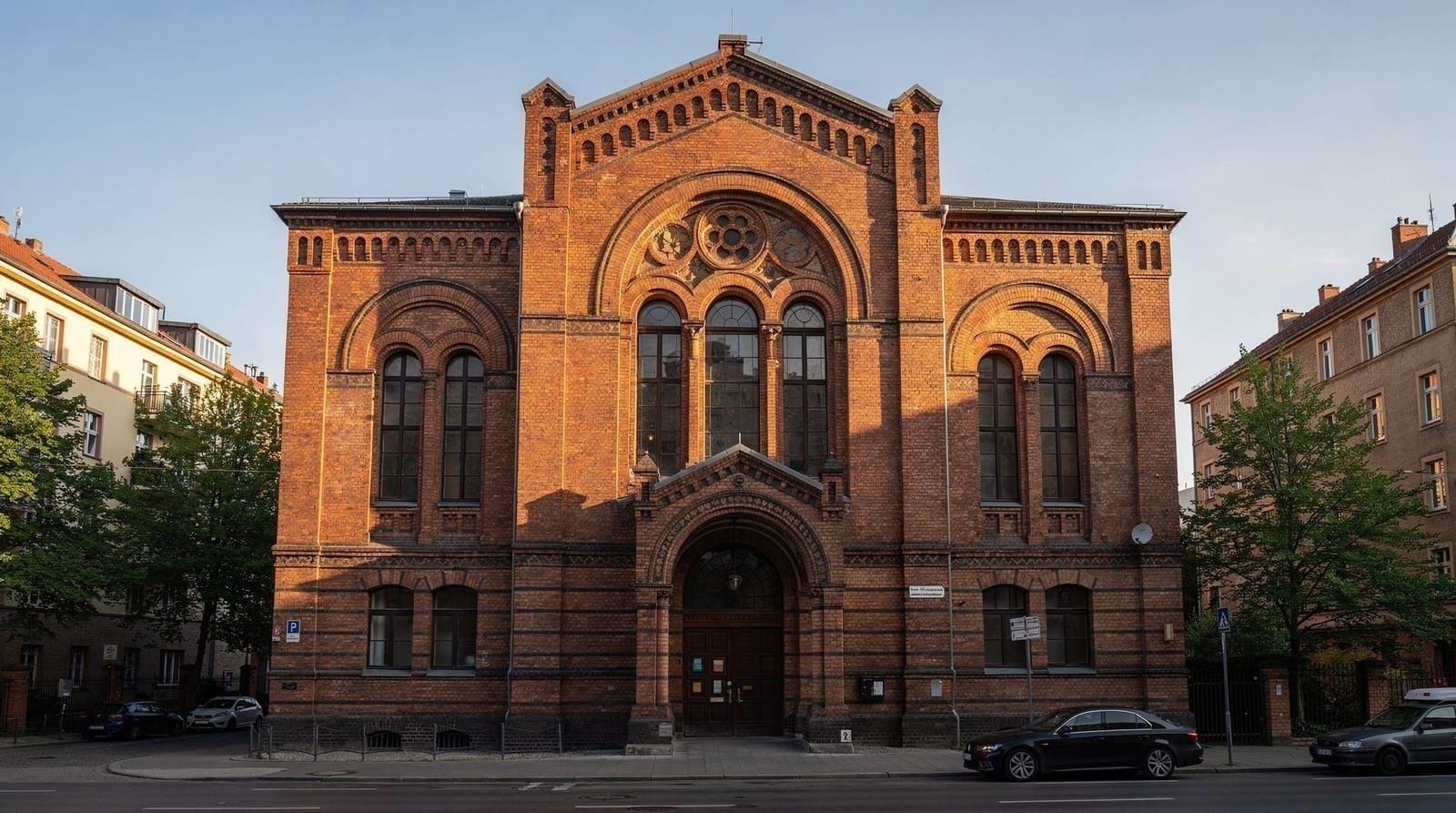
Oranienburger Strasse 28-30, Mitte — the Neue Synagoge
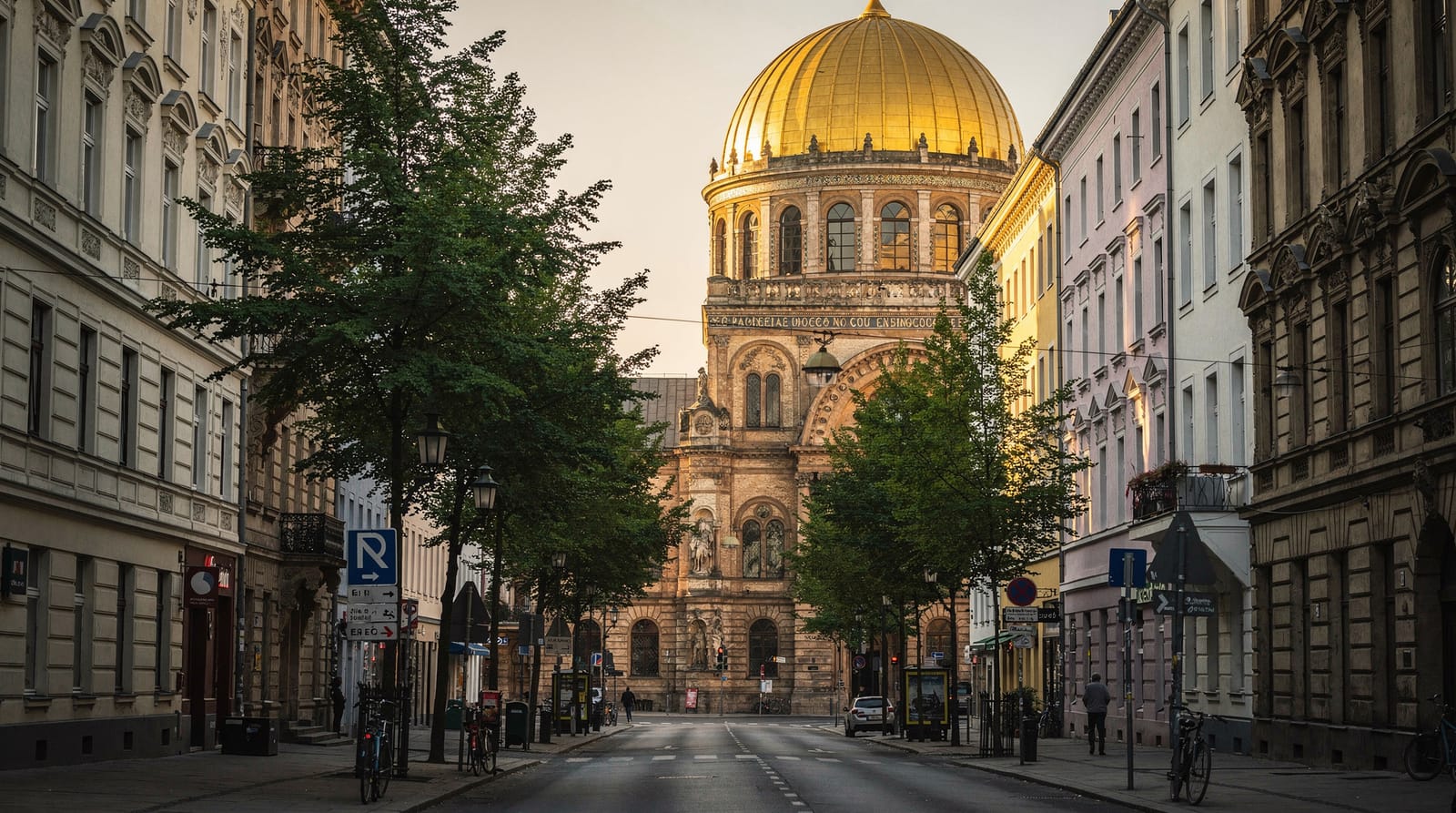
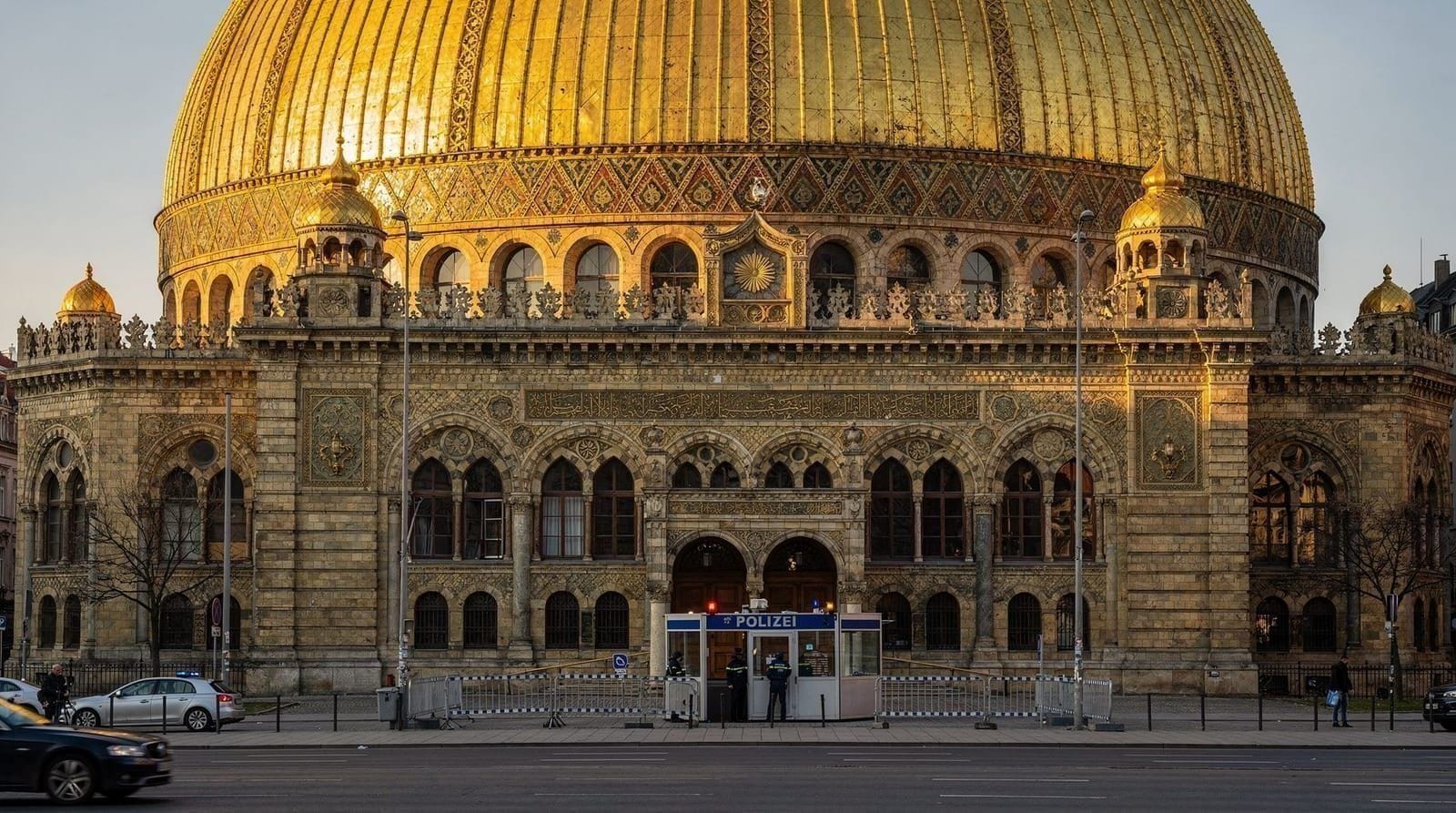
The Neue Synagoge’s survival of Kristallnacht is documented in the Neue Synagoge guide. Local police commander Wilhelm Krützfeld intervened to halt the attack, citing a historic landmark protection law. His intervention is one of very few documented cases of a German official actively protecting a Jewish institution on the night of 9 November.
The building subsequently survived Kristallnacht but was destroyed by Allied bombing in 1943. The restored facade and dome — now the Centrum Judaicum — can be visited.
Levetzowstrasse, Tiergarten — deportation memorial
The synagogue that stood at Levetzowstrasse 7-8 in Tiergarten was not destroyed in Kristallnacht — it was damaged but not burned. Its more significant history came in 1941, when the Gestapo converted it into the primary collection point for the Berlin deportations. From October 1941 to February 1943, approximately 36,000 Jewish Berliners were brought here to await transport to the camps.
The synagogue building was demolished in 1955. A memorial now marks the site: a life-sized bronze model of a freight wagon on a section of track, surrounded by information panels documenting the deportations. The memorial was designed by Peter Herbrich and Winfried Baumann, installed in 1988.
Getting there: Bus 106 to Levetzowstrasse, or walk 15 minutes from Hansaplatz U-Bahn (U9).
Sachsenhausen, Oranienburg — site of Kristallnacht detentions
The approximately 1,200 Jewish men arrested in Berlin during Kristallnacht were transported to Sachsenhausen concentration camp. The camp’s facilities were not prepared for such a large sudden influx. The men were held in overcrowded, harsh conditions, subjected to forced standing roll-calls lasting many hours, and systematically humiliated and beaten. Several died; others sustained permanent injuries.
The Kristallnacht detentions at Sachsenhausen were designed specifically to extract a signature on a document promising to leave Germany and transfer assets to the state. Men were released conditionally on agreement to these terms. The combined objectives — forced emigration plus forced asset transfer — were achieved with high effectiveness. Emigration from Berlin accelerated sharply in 1939.
For visiting Sachsenhausen, see the Sachsenhausen day trip guide.
The Kurfürstendamm and surrounding streets
The stretch of the Kurfürstendamm between Joachimsthaler Strasse and Olivaer Platz was the centre of the Berlin business attacks. Dozens of Jewish-owned shops, restaurants, and professional offices were attacked. The broken glass across the Ku’damm on the morning of 10 November was what gave the event the name that stuck.
No single memorial marks this stretch today; the commercial boulevard has been continuously rebuilt and modernised. Several Stolpersteine mark the street and immediate side streets — the Stolpersteine guide provides context for finding and reading them.
The Europa-Center at the eastern end of the Kurfürstendamm (built 1965) stands on the site of the Romanisches Café, the intellectual gathering place that was the social heart of Weimar Berlin’s Jewish cultural life.
The aftermath — immediate consequences in Berlin
In the weeks following Kristallnacht:
Financial decrees: On 12 November 1938, the Nazi government issued a series of economic decrees. Jewish business owners were required to repair the damage done to their own properties — at their own expense. Jewish owners of apartment buildings were required to fund the repair of windows smashed by the SA. A collective fine of one billion Reichsmarks was levied on the Jewish community of Germany for “provoking” the violence. The fine was collected through confiscation of assets.
Business liquidation: The November decrees also required the complete “Aryanisation” of remaining Jewish businesses — forced sale to non-Jewish buyers at drastically below market value by January 1939. This completed the economic dispossession that had been proceeding since 1933.
Accelerated emigration: The combination of the violence and the economic destruction sharply accelerated Jewish emigration from Berlin. In 1939, the emigration rate was substantially higher than in any previous year. Those who could leave did. Those who could not — including the elderly, the poor, those without foreign connections — remained and faced deportation from 1941.
Remembrance and commemoration
The Federal Republic of Germany has formally commemorated Kristallnacht on 9 November each year since the 1960s. The date carries additional weight in German history: 9 November is also the date of the 1918 German revolution, the 1923 Munich Beer Hall Putsch, and the 1989 fall of the Berlin Wall — making it what historians call the “fateful date” of modern German history.
Annual memorial services in Berlin take place at the Jüdisches Gemeindehaus on Fasanenstrasse, at the Neue Synagoge, at the Levetzowstrasse memorial, and at the various community organisations connected to the Berlin Jewish community. The events are open to the public; contact the Jüdische Gemeinde zu Berlin for details of specific annual commemorations.
Planning a Kristallnacht history route
The Fasanenstrasse Gemeindehaus, the Neue Synagoge, and the Levetzowstrasse memorial are spread across three different districts, so seeing all three in one visit means planning transport rather than walking a single corridor. A practical order is Fasanenstrasse (Charlottenburg) in the morning, then U-Bahn or bus to Levetzowstrasse (Tiergarten), then on to the Neue Synagoge and Scheunenviertel (Mitte) in the afternoon — roughly half a day including travel time. A guided Holocaust and Nazi-history walking tour covers some of this ground with context that standalone plaques don’t provide.
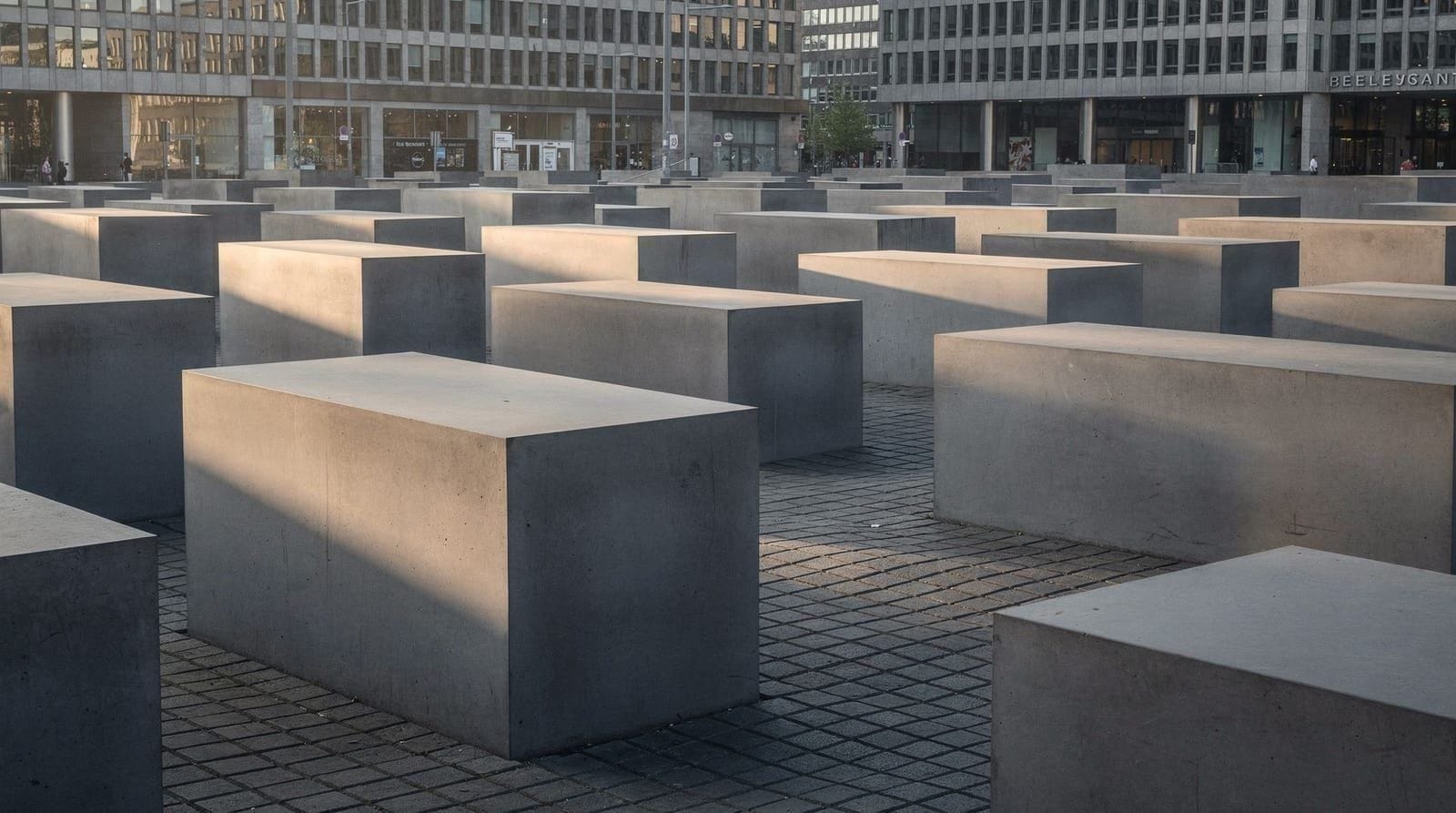
Private guided tour of Third Reich and Holocaust history sites in BerlinFor the fuller arc of what preceded and followed the pogrom, the Jewish Berlin before 1933 guide shows the community life that Kristallnacht shattered, and the complete history of Jewish Berlin carries the story through deportation and after. The Holocaust Memorial near the Brandenburg Gate is the city’s central site of remembrance and pairs naturally with a visit to these more specific, scattered locations. For the administrative machinery behind the persecution that followed, the Topography of Terror — on the former Gestapo and SS headquarters site — is the logical next stop. The synagogue on Rykestrasse in Prenzlauer Berg, one of the few Berlin synagogues to survive both Kristallnacht and the war largely intact, offers a rare counterpoint to the destruction documented here.
Frequently asked questions about Kristallnacht Berlin
What does Kristallnacht mean?
Kristallnacht — "Night of Crystal" or "Night of Broken Glass" — refers to the broken glass from thousands of smashed Jewish shop windows that covered the streets of German and Austrian cities after the pogrom of 9 to 10 November 1938. The name was coined by Berliners in the aftermath, partly as bitter irony. Historians increasingly prefer the terms "November Pogrom" (Novemberpogrom) or "Reichspogromnacht" (Reich Pogrom Night) as more accurate and less aestheticising than Kristallnacht.How many synagogues were destroyed in Berlin during Kristallnacht?
Estimates vary depending on what is counted. Historians document the destruction of at least 12 major synagogues in Berlin proper, along with numerous smaller prayer houses (Betsäle and shtiblekh), particularly in the Scheunenviertel. The Fasanenstrasse Synagogue, the Levetzowstrasse Synagogue, the synagogues on Prinzregentenstrasse, Lützowstrasse, and Lindenstrasse were among the major structures destroyed or severely damaged.Who carried out the Kristallnacht attacks?
The attacks were organised by the SS and SA (the Nazi paramilitary organisations) under instructions from Propaganda Minister Joseph Goebbels, following a speech to party leadership on the night of 9 November. The official pretext was the assassination of German diplomat Ernst vom Rath in Paris by a young Jewish man, Herschel Grynszpan, two days earlier. In practice, the pogrom had been prepared in advance and required only a signal to begin. Police were ordered not to intervene in attacks on Jewish property, though they were instructed to prevent deaths of German citizens.Were ordinary Berliners involved in the Kristallnacht attacks?
The primary perpetrators were SA and SS members in civilian clothes, often brought into districts from other areas to reduce identification. Some non-organised Berliners participated in the looting of Jewish shops. Most Berlin civilians were bystanders. The reaction of the non-Jewish Berlin population to Kristallnacht was mixed -- some expressed disgust, others indifference, very few active sympathy or assistance. The event was not secret -- it happened in the streets of the city centre in view of thousands.What happened to Jewish men arrested during Kristallnacht in Berlin?
During and immediately after Kristallnacht, approximately 1,200 Jewish men were arrested in Berlin and sent to Sachsenhausen concentration camp north of the city. They were held for several weeks in increasingly brutal conditions. Most were released conditionally, on the promise of immediate emigration from Germany and transfer of their assets to the state. The arrests were designed to coerce emigration and asset forfeiture simultaneously.Where is the memorial for the Fasanenstrasse Synagogue?
The former Fasanenstrasse Synagogue site at Fasanenstrasse 79-80 in Charlottenburg is now the Jüdisches Gemeindehaus Berlin — the Berlin Jewish community centre, built in 1959. The entrance portico incorporates fragments of the original 1912 synagogue building. A memorial sculpture by Bernd Haase (1988) stands in front. The community centre is operational; the memorial is freely viewable from the street at any time.