Neue Wache memorial guide: Germany's central memorial to victims of war and tyranny
What is the Neue Wache and why is it significant?
The Neue Wache (New Guardhouse) on Unter den Linden is Germany's official central memorial to the victims of war and tyranny. Built by Karl Friedrich Schinkel in 1818, it was redesignated as the national memorial by Chancellor Helmut Kohl in 1993. At its centre is an enlarged bronze cast of Käthe Kollwitz's 1937 Pietà sculpture — a mother holding her dead son — beneath an oculus open to the sky.
What is the Neue Wache? Germany’s official central memorial to the victims of war and tyranny, housed in a Schinkel neoclassical building of 1818 on Unter den Linden in the Mitte district. Its single chamber contains an enlarged bronze cast of Käthe Kollwitz’s Pietà, lit from an oculus open to the sky. It is free, small, and consistently one of the most quietly affecting memorial spaces in Berlin.
| Where | Unter den Linden 4, Mitte |
| Cost | Free, no booking |
| Time needed | 10–20 minutes |
| Getting there | S-Bahn to Hackescher Markt or Unter den Linden |
| Best time | Weekday mornings, for quiet reflection |
The building’s history before 1993
Karl Friedrich Schinkel designed the Neue Wache in 1816–1818 as a Prussian Royal Guard House. The design draws on the Greek temple form — a Doric portico with six columns fronting a windowless rectangular hall, surmounted by a metope-and-triglyph frieze. The cast-iron casting of the frieze decoration, the iron railings, and the overall restraint of the exterior are characteristic of Schinkel’s approach.
For the century after its completion, the Neue Wache served its literal purpose: soldiers of the Prussian Royal Guard changed watch here. It was a functional building, not initially a memorial.
The first transformation came in 1931. In the final years of the Weimar Republic, architect Heinrich Tessenow was commissioned to convert the interior into a WWI memorial. Tessenow removed the interior furnishings, lowered the floor, added the central oculus that now defines the space, and installed a black granite stone at the centre beneath the opening. The oak wreath of gold over the stone, an eternal candle, and the plaque “Dem Opfern des Krieges” (To the victims of war) created a minimalist interior whose tone was dignified mourning.
Under the Nazi regime from 1933, the Neue Wache continued as a war memorial with the same formal structure but with ideological ceremonies attached — the Volkstrauertag (People’s Day of Mourning) became a major state occasion held here. The building’s function as a focus for national grief was maintained but given Nazi content.
During WWII the building was damaged but survived structurally. After the war, it fell within the Soviet sector of Berlin.
The GDR version — Mahnmal für Antifaschismus
The East German government redesignated the Neue Wache in 1960 as the “Mahnmal für die Opfer des Faschismus und Militarismus” (Memorial for the Victims of Fascism and Militarism). The redesign, by Lothar Kwasnitza, replaced Tessenow’s minimalist interior with an eternal flame flanked by a large black granite block. Beneath the granite block were interred the remains of an unknown soldier who fell in WWII and an unknown concentration camp victim.
The GDR’s framing was specific: victims of fascism and militarism, not “war and tyranny” in the West German formulation that came later. This language reflected the East German historical narrative in which the GDR presented itself as the legitimate inheritor of anti-fascist resistance, distinct from what it characterised as the fascist continuities of West Germany (a claim that served political purposes and obscured complexities on both sides).
The Neue Wache under the GDR was the site of the Changing of the Guard ceremony (Wachablösung) — a choreographed military ceremony performed hourly from 1969, drawing tourists from across East Germany and Eastern Europe. The ceremony was discontinued in 1990 following reunification.
The 1993 redesignation and the Kollwitz Pietà
After German reunification, Chancellor Helmut Kohl designated the Neue Wache as the official German central memorial in 1993. The GDR interior was removed and replaced with the current installation.
At the centre of the chamber, beneath the oculus, stands the enlarged bronze cast of Käthe Kollwitz’s Pietà. The original was a small clay sculpture (approximately 38 centimetres high) made in 1937. The Neue Wache version is 155 centimetres tall — an enlargement authorised and overseen by Kollwitz’s grandson Arne Kollwitz.
The subject is a mother holding her dead adult son across her lap. The pose is derived from the Christian tradition of the Pietà — Mary mourning the body of Christ — but Kollwitz’s version contains no religious symbolism. It is a secular image of grief. The mother’s head is bowed; her body envelops the son’s. The physical relationship communicates both tenderness and devastation.
Käthe Kollwitz lost her son Peter to the First World War on October 22, 1914, at Diksmuide in Belgium, ten days after the war began. He was 18 years old. She spent years creating a sculptural response to his death — first the figures of The Grieving Parents (Die Trauernden Eltern), installed at his grave at the German War Cemetery in Vladslo, Belgium. The small Pietà came decades later, near the end of her life.
Her grandson Peter, named for the lost son, was killed on the Eastern Front in 1942. She died in April 1945, days before the end of the war, at Moritzburg near Dresden.
The personal dimension of the Kollwitz Pietà — the artist’s own losses embodied in the sculpture — is essential to understanding the choice of this image for Germany’s national memorial. It is not a monument to heroism, military sacrifice, or national glory. It is a sculpture of a mother holding a dead child.
The inscription and its critics
The inscription beneath the entrance to the Neue Wache reads: “Den Opfern von Krieg und Gewaltherrschaft” — “To the victims of war and tyranny” (Gewaltherrschaft literally means “rule by violence” or “violent domination,” typically translated as “tyranny”).
The formulation was criticised at the time and has continued to be contested. The central objection: by addressing all victims of war and tyranny without distinction, the inscription potentially places German soldiers who died fighting in the service of the Nazi state in the same memorial space as the Holocaust’s victims, and as the victims of Nazi concentration camps.
Elie Wiesel, the Holocaust survivor and Nobel Peace Prize laureate, stated publicly that he would not visit the memorial in this form. The Central Council of Jews in Germany expressed similar reservations.
The counterargument is that all deaths are mourned, that German military deaths and the Holocaust are not morally equivalent but can coexist in a single act of mourning, and that the specific history is provided by other memorials and documentation centres while the Neue Wache is specifically a space for grief rather than historical narration.
The debate has never been satisfactorily resolved. German society’s relationship to this memorial reflects the ongoing, unfinished process of coming to terms with the Nazi period. Visiting the Neue Wache with this debate in mind — rather than simply as an architectural or tourist experience — is more honest. For the specific memorial to the Holocaust’s victims, distinct from the Neue Wache’s broader formulation, see the Memorial to the Murdered Jews of Europe guide a short walk south near the Brandenburg Gate.
Experiencing the space
The Neue Wache is easy to visit quickly and easy to miss. It is a small building on a busy boulevard, flanked by the German Historical Museum’s monumental baroque Zeughaus to the east and Humboldt University to the west. Many visitors pass it without stopping.
Inside, the chamber is roughly 12 by 12 metres. The walls are of roughly textured stone. The floor is stone. There are no seats, no audio guide, no shop. The only element is the Pietà, centred under the oculus. Natural light — and, in poor weather, rain and snow — enters from above.
The exposure to the elements is not an oversight. The decision to leave the oculus open was deliberate, and the Pietà is made from bronze specifically because it weathers rather than deteriorates. In rain, water runs over the sculpture. In winter, snow accumulates on the mother’s bowed head. In the Berlin cold, this takes on a particular quality.
The silence inside is protected by convention — visitors speak quietly or not at all. There is no formal request for silence; people simply observe it.
Most visitors underestimate how quickly the visit passes and how much it lingers afterward. There is genuinely nothing to “do” inside — no interpretive panels, no interactive elements, no gift shop — and that absence is itself part of the design. Compared with the information-dense experience of the nearby German Historical Museum or the physically vast Memorial to the Murdered Jews, the Neue Wache asks for stillness rather than reading or walking. Visitors who arrive expecting a conventional museum experience sometimes leave within thirty seconds; those who pause tend to stay considerably longer than they planned.
Unter den Linden — the broader context
The Neue Wache sits in a sequence of buildings along Unter den Linden that, taken together, constitute one of the most historically layered streets in Europe:
- The Zeughaus (now the German Historical Museum), Berlin’s oldest surviving baroque building, built 1695–1706, houses a permanent exhibition on German history that is among the most comprehensive and honest national historical narratives in any European capital.
- Humboldt University, founded in 1810 under Wilhelm von Humboldt, attended at various points by Marx, Engels, Einstein, Hegel, Fichte, and Heine — the university whose students burned books at the adjacent Bebelplatz in 1933.
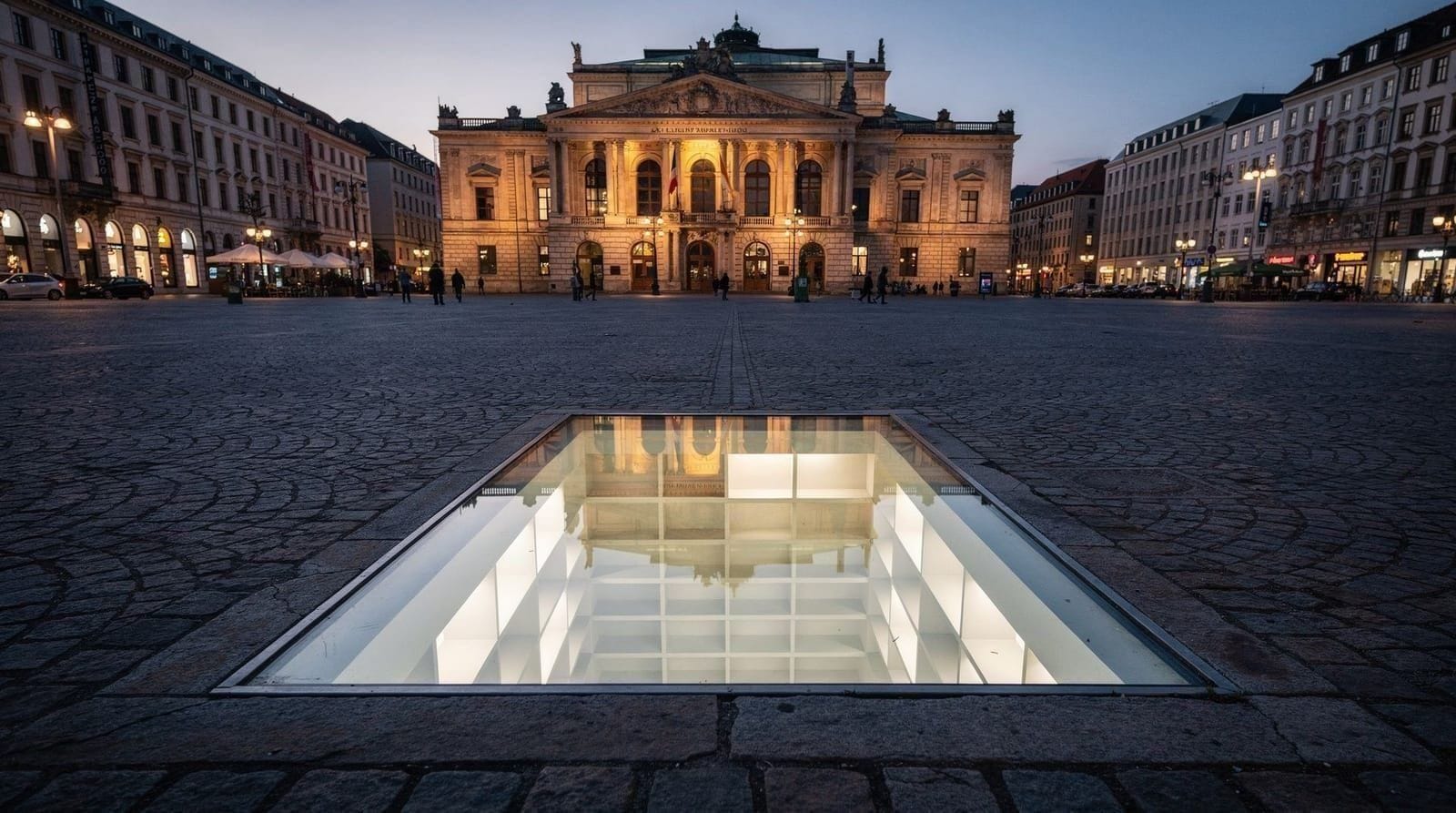
- The Bebelplatz itself, 200 metres east, with Ullman’s empty bookshelf memorial set into the paving (see the Bebelplatz book burning guide for history and context).
- The Staatsoper Unter den Linden, originally built 1741–1743 by Frederick the Great, twice bombed and rebuilt, now fully restored and in operation.
- Museum Island, 500 metres east, at the end of Unter den Linden where it becomes Karl-Liebknecht-Strasse — see the Museum Island guide.
A walk along the full length of Unter den Linden from Brandenburg Gate to Museum Island, with the Neue Wache, Bebelplatz, and German Historical Museum as primary stops, is one of the most historically dense walks in the city. Allow 3–4 hours with interior visits.
The Neue Wache also fits naturally into a wider circuit of Third Reich memorial sites across Berlin, and the structured Third Reich history trail itinerary sequences it alongside Bebelplatz, the Memorial to the Murdered Jews, and other Mitte sites for visitors who want the fuller historical arc in a single day.
Visiting information
Address: Unter den Linden 4, 10117 Berlin
Getting there: S-Bahn S1/S2/S5/S7/S9 to Hackescher Markt (10 min walk west), or S1/S2 to Unter den Linden (8 min walk east). Tram M1 to Am Kupfergraben. U6 to Französische Strasse (10 min walk north).
Hours: Daily 10:00–18:00. Free entry. No booking required.
Accessibility: Step-free access from the street through the central entrance. The interior is at ground level.
Time needed: 10–20 minutes for the space itself. More if you sit with it.
The Pietà compared to other Kollwitz works in Berlin
Käthe Kollwitz is exceptionally well represented in Berlin. The Käthe Kollwitz Museum in Charlottenburg (Fasanenstrasse 24, near the Kurfürstendamm) holds the largest collection of her prints, drawings, and sculptures, including works not available elsewhere. The museum occupies a Gründerzeit villa and has a permanent exhibition across multiple floors.
In Prenzlauer Berg, Kollwitzplatz — the square named for her — is a pleasant neighbourhood square in the area where she lived and worked for much of her adult life (Weißenburger Strasse, now Kollwitzstrasse). A bronze figure of Kollwitz herself by Gustav Seitz (1958) stands in the square.
Her grave is at the Zentralfriedhof Friedrichsfelde in Lichtenberg, in the same cemetery as Rosa Luxemburg, Karl Liebknecht, and other left-wing figures of the Weimar period.
Understanding that the sculpture in the Neue Wache is not a generic public commission but the personal work of a specific artist who lost her son and grandson to the two wars the memorial commemorates changes how you stand in front of it.
How the Neue Wache compares to Berlin’s other central memorials
Berlin has several major memorial spaces addressing overlapping but distinct histories, and it helps to know how the Neue Wache differs before you visit.
| Memorial | Focus | Character |
|---|---|---|
| Neue Wache | All victims of war and tyranny (contested framing) | Single room, one sculpture, silence |
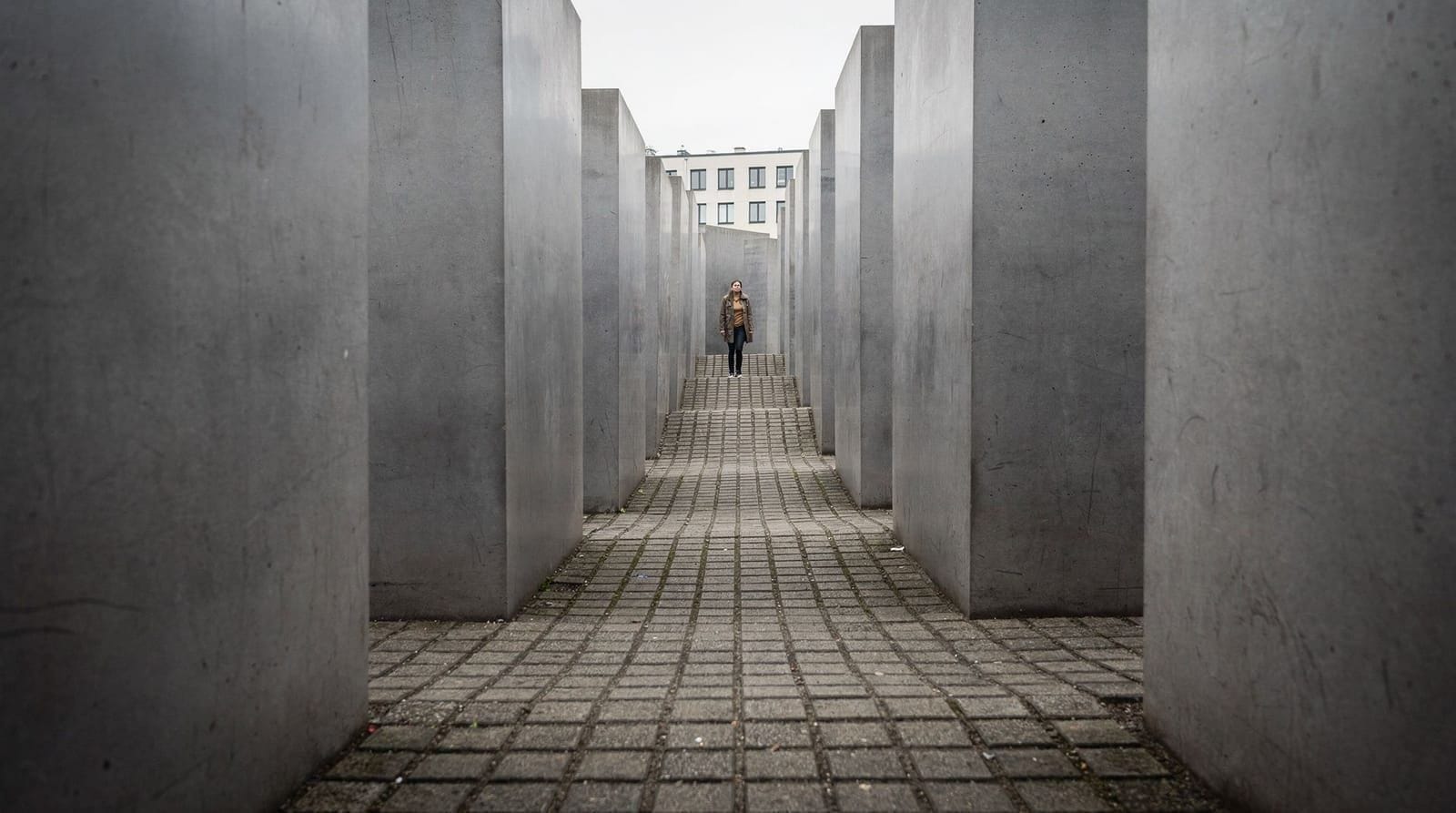
| Memorial to the Murdered Jews of Europe | Holocaust victims specifically | 2,711 concrete stelae, outdoor field |
| Bebelplatz | 1933 Nazi book burning | Small in-ground glass memorial |
The Neue Wache is deliberately the least explicit of the three — it names no specific group of victims and offers no historical text. That ambiguity is precisely what generates the ongoing debate about its inscription, and precisely why many visitors find the nearby, more specific memorials easier to process emotionally. Visiting the Neue Wache after, rather than before, the Memorial to the Murdered Jews often gives it more weight — the specific history informs how you read the deliberately general inscription.
Frequently asked questions about Neue Wache memorial guide
What does "Neue Wache" mean and why was it built?
Neue Wache" means "New Guardhouse." Schinkel designed it in 1818 as a Prussian Royal Guard House on Unter den Linden, adjacent to the Zeughaus (arsenal). It is a small neoclassical Greek Revival structure with Doric columns. Its military purpose was as a ceremonial guard post for the Berlin City Palace — the soldiers it housed guarded the royal route along Unter den Linden.Who was Käthe Kollwitz and what is the Pietà?
Käthe Kollwitz (1867–1945) was a German artist whose work consistently engaged with poverty, loss, and mourning. She was known for printmaking and sculpture depicting working-class suffering. The original Pietà — a small clay sculpture of a mother cradling her dead adult son — was made in 1937. Kollwitz lost her son Peter in WWI in 1914, and her grandson Peter in WWII in 1942. The sculpture is widely understood as a personal expression of grief. The Neue Wache version is an enlarged bronze cast authorised by Kollwitz's surviving estate, installed in 1993.Is the Neue Wache free to visit?
Yes. The Neue Wache is free to enter and has no booking requirement. It is open daily 10:00–18:00 (last entry 17:45). The building is small — a single chamber — and visits typically last 10–20 minutes. It is one of the most quietly powerful memorial spaces in Berlin despite its modest size.What is the debate about the Neue Wache's inscription?
The inscription reads "Den Opfern von Krieg und Gewaltherrschaft" — "To the victims of war and tyranny." Critics argue this formulation is too broad and potentially conflates perpetrators with victims — it could include German soldiers who died fighting for the Nazi state alongside Holocaust victims and political prisoners. Holocaust survivors and scholars including Elie Wiesel objected to the 1993 redesignation for this reason. The debate about whether a single memorial can encompass all categories of victim is unresolved.How has the Neue Wache been used throughout its history?
After 1818 it was a Prussian guardhouse. After WWI it was redesigned as a memorial to the fallen (1931, by Heinrich Tessenow). Under the Nazi regime it remained a memorial but with altered ideological framing. Under East Germany's GDR it was renamed "Mahnmal für die Opfer des Faschismus und Militarismus" (Memorial for the Victims of Fascism and Militarism) with an eternal flame and the remains of an unknown soldier and an unknown concentration camp prisoner. After reunification, Helmut Kohl redesignated it as the all-German national memorial in its current form.How does the architecture of the building work as a memorial?
The Neue Wache is a single room, roughly 12 by 12 metres, with a circular oculus (opening) in the ceiling approximately 5 metres in diameter. Rain, snow, and daylight enter through the oculus — the sculpture below is exposed to the elements. The exposure is deliberate. In wet weather, water runs over the sculpture. In winter, snow accumulates. The openness to the sky gives the interior a meditative quality distinct from enclosed memorial spaces.What else is on Unter den Linden near the Neue Wache?
The Neue Wache sits between the Zeughaus (the German Historical Museum's main building, Berlin's oldest surviving baroque structure) and Humboldt University. To the east along Unter den Linden are the Bebelplatz (book burning memorial), the State Opera, and the Museum Island. The entire stretch of Unter den Linden from Brandenburg Gate to Museum Island can be walked in 30–40 minutes with stops.How is the Neue Wache different from the Memorial to the Murdered Jews of Europe?
The Neue Wache is Germany's general central memorial to all victims of war and tyranny, a deliberately broad and contested framing, housed in a single small room. The Memorial to the Murdered Jews of Europe is specifically dedicated to the Holocaust's Jewish victims and consists of 2,711 concrete stelae across a large outdoor field. They are a short walk apart near Unter den Linden and the Brandenburg Gate, and many visitors find it useful to see both to understand how Berlin handles general versus specific memorialisation.