Bebelplatz and the 1933 book burning — Berlin's silent underground library
Berlin: Third Reich, Hitler, and WWII Walking Tour
What happened at Bebelplatz in 1933?
On the night of 10 May 1933, Nazi students and members of the SA burned approximately 20,000 books by Jewish, Communist, pacifist, and politically undesirable authors at Bebelplatz, the square on Unter den Linden in front of the Humboldt University. Joseph Goebbels addressed the crowd. The event was one of 34 simultaneous book burnings across Germany that night. The underground memorial "Bibliothek" by Micha Ullman (1995) marks the site with a glass window revealing an empty white library.
Bebelplatz, the square on Unter den Linden opposite the Staatsoper, is one of Berlin’s most elegant 18th-century public spaces. On the night of 10 May 1933, Nazi students and SA members burned approximately 20,000 books here while Joseph Goebbels addressed a crowd of 40,000. In the cobblestones of the square, barely visible unless you know where to look, Israeli sculptor Micha Ullman’s “Bibliothek” memorial — a glass window into an underground empty library — marks the site. Entry is free. The square is open at all times.
| Where | Bebelplatz, Unter den Linden, Mitte |
| Cost | free, no ticket needed |
| Time needed | 10–15 minutes for the memorial itself |
| Getting there | U6 Französische Strasse or U55 Brandenburger Tor |
| Best time | After dark, when the underground room is lit and glows through the glass |
The night of 10 May 1933
The book burnings of 10 May 1933 were not a spontaneous mob action. They were organised by the Deutsche Studentenschaft (German Student Union) as part of a coordinated national campaign called “Aktion wider den undeutschen Geist” (Action against the un-German spirit), announced six weeks earlier in a manifesto distributed to universities across Germany.
The campaign identified 12 categories of “un-German” thought — Marxism, pacifism, Jewish intellectual influence, sexual research, cosmopolitanism — and assigned each category an “action thesis” calling for the burning of books representing it. Lists of targeted authors were prepared in advance and distributed to university student organisations, who collected books from university libraries and bookshops in the days before the burnings.
On the night of 10 May 1933, simultaneous book burnings were held at 34 cities across Germany. Bebelplatz in Berlin was chosen as the central venue, given its symbolic location in the university and cultural district. The square in front of the Humboldt University — which had educated Marx, Hegel, and Heine among many others — was the appropriate stage.
The burning in Berlin began at approximately 23:00. Goebbels, newly appointed Reich Minister of Public Enlightenment and Propaganda, arrived at midnight to deliver a speech. His words were broadcast by radio across Germany: “The age of exaggerated Jewish intellectualism is now ended, and the German revolution has again opened the way to the true essence of the German spirit.”
The crowd numbered approximately 40,000. The burning continued for several hours. Among those watching from the crowd was Erich Kästner, who witnessed his own books — including “Emil and the Detectives” and the satirical novel “Fabian” — thrown into the fire.
The books that were burned
The list of targeted authors runs to hundreds of names. Among those whose works were burned at Bebelplatz:
German Jewish authors: Heinrich Heine (poetry, essays), Ludwig Börne (political journalism), Felix Salten (fiction, including “Bambi”), Arthur Schnitzler (drama, prose), Stefan Zweig (fiction and essays).
Political and social critics: Karl Marx and Friedrich Engels (political philosophy), Rosa Luxemburg (political theory), Ernst Toller (drama), Kurt Tucholsky (satire), Carl von Ossietzky (political journalism).
Psychoanalysts and sexologists: Sigmund Freud (psychoanalysis), Magnus Hirschfeld (sexual research — Hirschfeld’s Institut für Sexualwissenschaft had been ransacked by the same student groups four days earlier, on 6 May 1933).
Pacifists: Erich Maria Remarque (“Im Westen nichts Neues” — “All Quiet on the Western Front”), a book that had been a worldwide bestseller since 1929 and was particularly targeted for its unsparing depiction of the First World War.
Foreign authors: Jack London, Upton Sinclair, Helen Keller — whose works were included for their political content. Helen Keller responded in an open letter: “You can burn my books and the books of the best minds in Europe, but the ideas in them have seeped through a million channels and will continue to quicken other minds.”
The Deutsche Studentenschaft had created index cards for each targeted book with citations of specific passages considered objectionable. The burning was prepared, catalogued, and documented in advance.
The Heinrich Heine connection
The most quoted text associated with Bebelplatz is a line from Heinrich Heine’s 1820 play “Almansor”: “Das war ein Vorspiel nur, dort wo man Bücher verbrennt, verbrennt man auch am Ende Menschen” — “That was only a prelude; where they burn books, they will ultimately burn people also.”
Heine, born in Düsseldorf in 1797 into a Jewish family, converted to Lutheranism in 1825 as, in his own words, “an admission ticket to European culture.” He spent much of his adult life in Paris after German authorities prohibited his writing. He died in Paris in 1856. The line from “Almansor” was written in reference to the burning of the Koran by the Spanish Inquisition in 1499 — yet its application to the burning of his own books at Bebelplatz in 1933, and then to the Holocaust that followed, has made it one of the most cited predictions of political barbarism in modern history.
Heine’s works were among those burned at Bebelplatz. The plaque near Ullman’s memorial carries the line in German.
Micha Ullman’s “Bibliothek” memorial
The memorial was commissioned through a public competition in the early 1990s and installed in 1995. Micha Ullman (born 1939 in Tel Aviv) is an Israeli sculptor whose work frequently addresses memory, absence, and the trace of what is no longer present.
“Bibliothek” consists of a reinforced glass panel, approximately 1.2 metres square, set flush into the original cobblestones of Bebelplatz. The glass is clear. Looking down through it, you see a white underground room approximately 7 metres below, with white empty bookshelves capable of holding approximately 20,000 volumes. The room is lit by internal lights. No books are present; the shelves are bare.
The memorial is intentionally understated to the point of near-invisibility. First-time visitors who have not been told to look for it often walk past it without noticing. Even when pointed to the glass panel, some visitors struggle to orient themselves to what they are seeing — the scale of the underground room and the angle of vision through the small glass square require a moment of adjustment.
This understatedness is a deliberate choice. A large monument would impose a fixed emotional register. The small glass panel requires the visitor to seek it out, to adjust their perspective, and to supply the missing books imaginatively. The empty shelves do what a catalogue of burned titles cannot: they convey absence.
The memorial is accessible at all times and is lit at night, when it is arguably most affecting — a glowing window into whiteness in the dark cobblestones.
The square’s historical setting
Bebelplatz (known as Opernplatz until 1947, when it was renamed for the SPD leader August Bebel) is one of Berlin’s finest 18th-century civic spaces. Its surrounding buildings define it:
Humboldt University (west side): Originally the Palace of Prince Heinrich (designed by Georg von Knobelsdorff, 1748–1766), converted to a university in 1810 at the initiative of Wilhelm von Humboldt. Among its students and faculty: Marx, Engels, Hegel, Schopenhauer, Fichte, and Heinrich Heine. The university remains one of Germany’s most prominent research institutions.
Staatsoper Unter den Linden (east side): The State Opera House (designed by Knobelsdorff, 1741–1743, originally called the Royal Court Opera). Heavily damaged in wartime bombing and rebuilt twice — in 1955 by the GDR and again in a comprehensive renovation completed in 2017. Still a functioning opera venue with a major programme; see staatsoper-berlin.de for performances.
Alte Bibliothek / Old Library (west side, south of the University): The curved Baroque building known colloquially as the “Kommode” (wardrobe) due to its convex facade. Built 1775–1780 as the Royal Library; now part of Humboldt University Law Faculty. The irony of a building whose function was storing books standing on the square where books were burned has not gone unremarked.
St. Hedwig’s Cathedral (south side): The round-domed Catholic cathedral of Berlin, begun in 1747 under Frederick the Great. It was heavily damaged in 1943 and reconstructed twice — most recently in a controversial interior redesign completed in 2021 that removed the original postwar fittings.
Other historical layers — this was the old Opernplatz
The square’s history before 1933 is also worth understanding. The Kaiser and the Hohenzollern court used it for military parades. The famous 1806 performance of Beethoven’s “Fidelio” — an opera about political imprisonment and liberation — took place in the opera house on this square. The square was also the site of celebrations during the Wars of Liberation against Napoleon.
Naming the square after August Bebel (1840–1913), one of the founders of the German Social Democratic Party (SPD) and a consistent opponent of German militarism and anti-Semitism, was a deliberate act of historical reclamation by the postwar Berlin authorities.
Visiting Bebelplatz in combination with other sites
Bebelplatz sits within an easy 30-minute walk of several other significant Third Reich and Berlin history sites:
Neue Wache (Unter den Linden, 5 minutes west): The Central Memorial of the Federal Republic of Germany, with Käthe Kollwitz’s “Mother with Dead Son.”
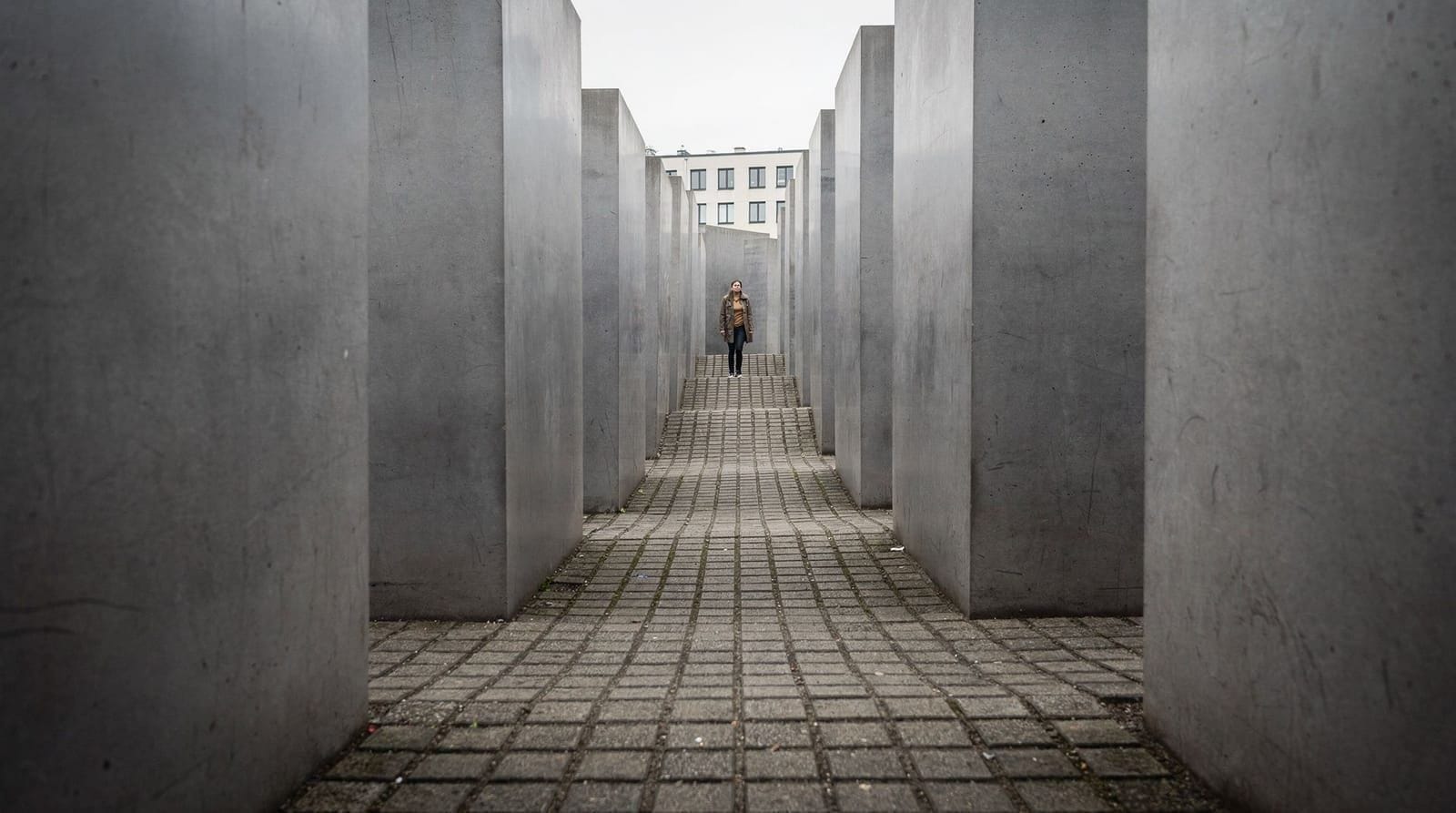
Memorial to the Murdered Jews of Europe (15 minutes west): The Eisenman stele field near the Brandenburg Gate. See the memorial guide.
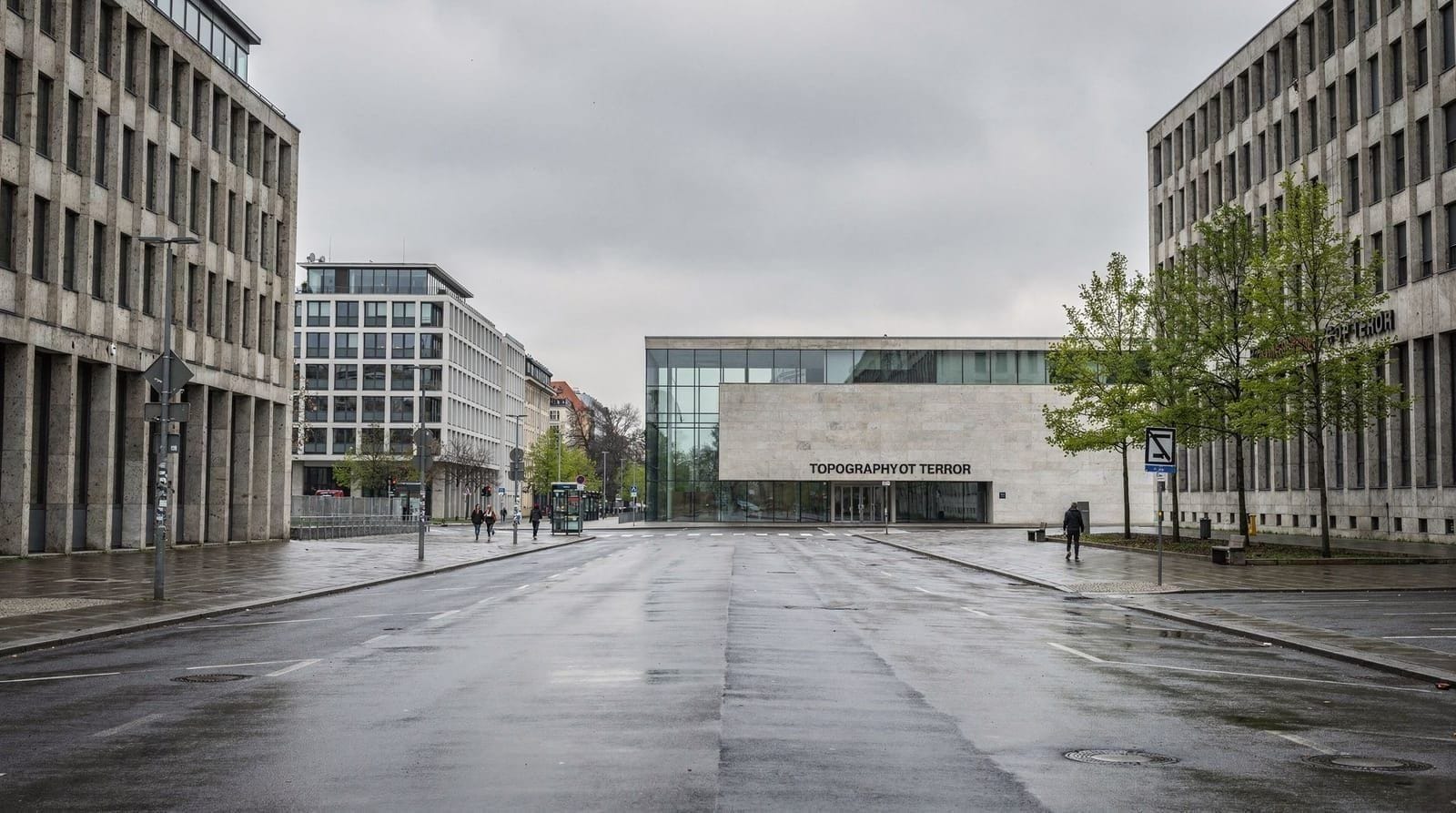
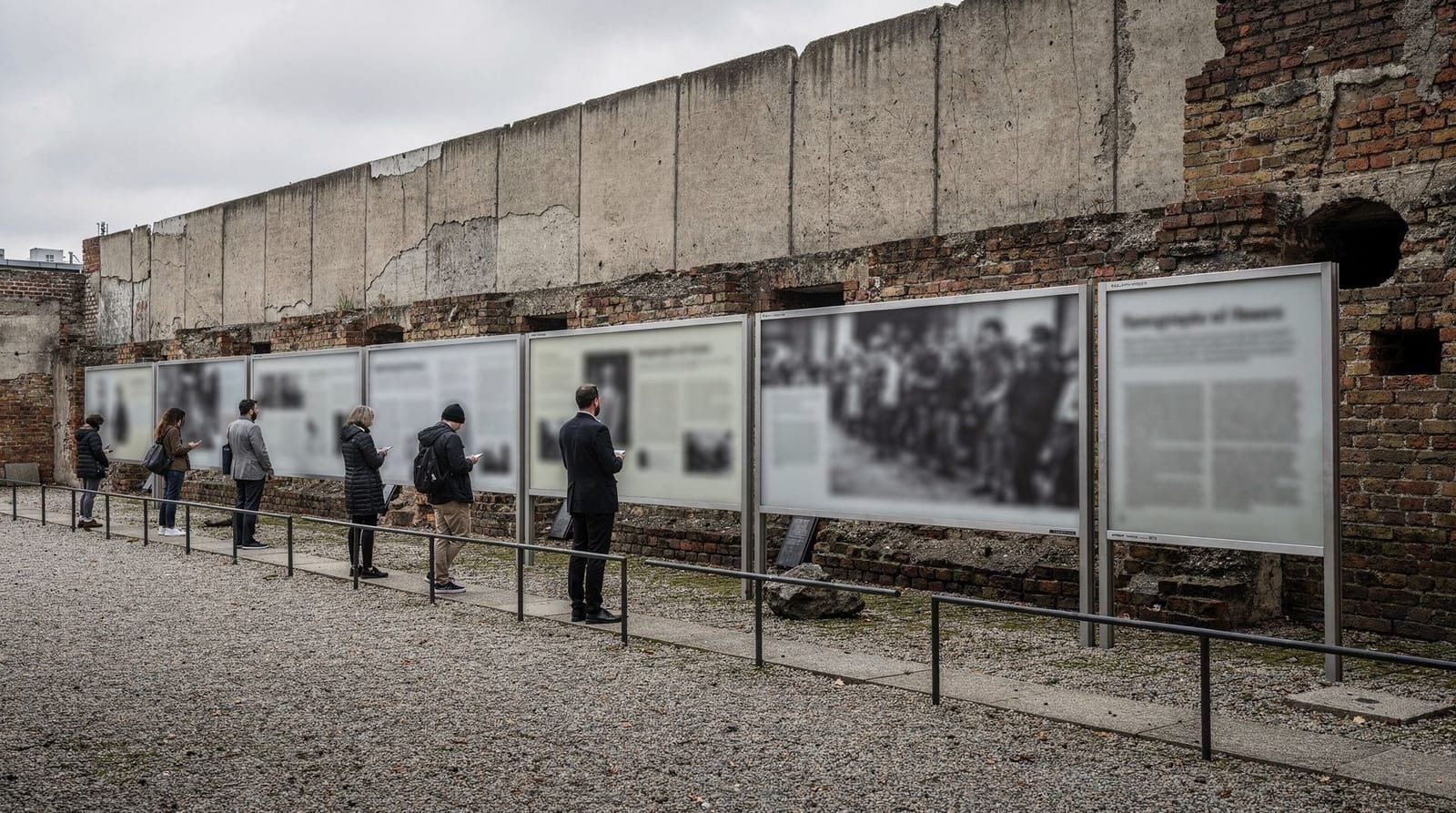
Topography of Terror (25 minutes southwest): The former Gestapo and SS headquarters, free documentation centre. See the Topography of Terror guide.
New Synagogue, Oranienburger Strasse (15 minutes northeast): The restored 1866 synagogue in the former Jewish quarter. See the New Synagogue guide.
For a logical walking route connecting all the central Third Reich memorial sites, see the Third Reich sites in Berlin overview and the Third Reich history trail itinerary.
If you’d rather have context explained on the spot than piece it together from plaques, a guided walking tour of the Third Reich sites covers Bebelplatz alongside the Reichstag area and the Memorial to the Murdered Jews of Europe with a licensed guide.
Book a guided Third Reich history walking tour of central BerlinWhy the memorial is easy to miss — and why that matters
Visitors who arrive expecting a conventional monument sometimes walk across the entire square without noticing anything at all, because “Bibliothek” has no vertical presence — no plinth, no statue, nothing at eye level. This is not a design failure; it is the point. Ullman’s memorial withholds the comfort of a fixed object to look at and instead asks visitors to actively search the ground, crouch, and adjust their eyes to what is essentially a hole filled with absence. Guides who bring groups to Bebelplatz often report that this searching process — the few seconds of not finding it, then finding it — produces a stronger reaction than a more conventional monument would. If you visit on your own, resist the urge to photograph it immediately; give yourself a minute of just looking down before reaching for a camera.
Bebelplatz today — a working square, not a museum
It is worth remembering that Bebelplatz functions as a normal, busy Berlin square, not a preserved historical site. The Staatsoper still stages performances most nights, students from Humboldt University cross the cobblestones constantly, and tourists sit on the steps of St. Hedwig’s Cathedral. This ordinary daily life continuing directly on top of the memorial is, for many visitors, part of what makes it affecting — the past and present share the same few square metres without separation. It also means the square can be genuinely crowded around opera performance times (evenings, especially weekends); if you want a quiet moment at the glass panel, avoid arriving right before a Staatsoper curtain time.
Practical notes
Address: Bebelplatz, 10117 Berlin (the memorial glass panel is in the cobblestones, approximately in the centre of the open square, slightly east of centre)
Access: The square is open 24 hours. The memorial is always visible. No entry fee.
Getting there:
- U6 to Französische Strasse (3 minutes walk west)
- Bus 100 or 200 (stop Staatsoper)
- S-Bahn to Hackescher Markt, then 15 minutes walk west along Unter den Linden
Finding the memorial: Walk to the centre of the cobbled square, east of the Humboldt University main entrance. The glass panel is approximately 20 metres in from the east side of the square. Look for a small square of glass in the cobblestones. Kneel or crouch to see the underground room clearly.
Best time to visit: The memorial is powerful at any time, but after dark it is most visible — the internal lighting makes the white underground room glow through the glass. The square is quieter in the early morning and evening; midday can be crowded with tourist groups.
Photography: No restrictions.
Frequently asked questions about Bebelplatz and the 1933 book burning
Where is Bebelplatz?
Bebelplatz is a large square on Unter den Linden, immediately east of the Humboldt University and directly opposite the State Opera (Staatsoper Unter den Linden). It is in Berlin-Mitte, approximately 700 metres east of the Brandenburg Gate. The square is surrounded by significant 18th-century buildings including St. Hedwig's Cathedral and the Old Library (Alte Bibliothek, now part of Humboldt University).What is Micha Ullman's "Bibliothek" memorial?
"Bibliothek" (Library) is a square glass panel set flush into the cobblestones of Bebelplatz, designed by Israeli sculptor Micha Ullman and installed in 1995. Looking through the glass, you see an underground white room approximately 7 metres below, with white empty bookshelves capable of holding approximately 20,000 volumes — the number of books burned on the same spot in 1933. The memorial is lit internally at night. Entry to the underground room is not possible; it is visible only through the glass.Is the Bebelplatz memorial always visible?
Yes. The glass panel is set into the cobblestones and illuminated from below, making it visible day and night. It is small — approximately 1.2 metres square — and easy to miss in a crowded square if you do not know where to look. Find it approximately 20 metres in from the east side of the square, roughly in the centre of the open cobbled area.What does the Heinrich Heine quote mean?
A plaque near the memorial is engraved with a line from Heinrich Heine's 1820 play "Almansor" — "Where they burn books, they will ultimately burn people also." Heine, a German Jewish poet, wrote this more than a century before the Nazis came to power, but the accuracy of the prophecy in the context of the Holocaust has made it one of the most quoted warnings about political violence against knowledge and culture.Who were the authors whose books were burned at Bebelplatz?
The burned books included works by Heinrich Heine, Karl Marx, Sigmund Freud, Heinrich Mann, Kurt Tucholsky, Erich Kästner, Ernst Toller, Bertolt Brecht, Magnus Hirschfeld, Jack London, Upton Sinclair, Helen Keller, and many others. The list of targeted authors was drawn up by the Deutsche Studentenschaft (German Student Union) under 12 "action theses" identifying categories of "un-German" thought.Was Erich Kästner present at the burning of his own books?
Yes. The author Erich Kästner — whose "Emil and the Detectives" was among the burned books — was present in the crowd at Bebelplatz and watched his own books burned. He wrote about the experience afterward. Unlike many of his contemporaries, Kästner remained in Germany during the Nazi period, working pseudonymously. He survived the war.How do I reach Bebelplatz by public transport?
U-Bahn U6 to Französische Strasse, or U55 to Brandenburger Tor, then a 10-minute walk east along Unter den Linden. Alternatively, S-Bahn S3/S5/S7/S9/S1 to Hackescher Markt, then 15 minutes west along Unter den Linden. Bus 100 and 200 both have stops on Unter den Linden directly adjacent to the square.How long should I spend at Bebelplatz?
The square and memorial itself take only 10–15 minutes to see properly, since there is a single small glass panel and a few informational elements rather than an exhibition. Most visitors combine it with a longer walk covering nearby Unter den Linden sights, so budget the 10–15 minutes at Bebelplatz within a wider hour or two exploring the surrounding area.Is Bebelplatz worth visiting if I have limited time in Berlin?
Yes, if you are already walking Unter den Linden, since it costs only a short detour and no entry fee. It is less essential than the Memorial to the Murdered Jews of Europe or Topography of Terror for a first-time visitor with very limited time, but it adds meaningful context with almost no time cost given how central it sits.