Gestapo headquarters on Prinz-Albrecht-Strasse: history of the site and the Topography of Terror
Berlin: Hitler's Germany — Berlin During the Third Reich & WWII
Where was Gestapo headquarters in Berlin and what is there today?
The Gestapo's headquarters occupied the former Hotel Prinz Albrecht at Prinz-Albrecht-Strasse 8 in what is now Kreuzberg. The building was destroyed in the war and demolished in 1956. Today the site hosts the Topography of Terror — a free, open-air and indoor documentation centre built on the excavated foundations, including preserved basement cells where prisoners were held.
Where was Gestapo headquarters in Berlin? Prinz-Albrecht-Strasse 8, in what is now the Kreuzberg district. The former luxury hotel that housed the Gestapo’s central operations was destroyed by Allied bombing and subsequently demolished. Today, the Topography of Terror stands on the excavated foundations — a free documentation centre that is one of the most substantive sites in Berlin for understanding how the Nazi terror apparatus was organised and how it functioned.
| Where | Niederkirchnerstrasse 8, Kreuzberg/Mitte border |
| Cost | Free, both indoor and outdoor exhibitions |
| Time needed | 1.5–2 hrs indoor, 30–45 min outdoor |
| Getting there | U6 Kochstrasse or S1/S2 Anhalter Bahnhof, 5 min walk |
| Best time | Weekday mornings for a quieter, unhurried visit |
The Prinz-Albrecht block before 1933
The block bounded by Prinz-Albrecht-Strasse, Wilhelmstrasse, Anhalter Strasse, and Niederkirchnerstrasse was, in the Weimar Republic, a cultural and governmental district. The Hotel Prinz Albrecht at number 8 was a well-regarded establishment. The Prinz-Albrecht-Palais at Wilhelmstrasse 102, built in 1737, was one of Berlin’s finest neoclassical palaces. The Kunstgewerbemuseum (Museum of Decorative Arts) occupied a building at Prinz-Albrecht-Strasse 7.
The adjacency to the Reich ministries along Wilhelmstrasse — the Chancellery, the Foreign Office, the Air Ministry — made the block a logical choice for the new regime’s security apparatus when it needed central Berlin addresses.
The transformation of the block, 1933–1934
Hermann Göring, appointed Prussian Interior Minister in January 1933 and Prime Minister of Prussia in April, established the Geheime Staatspolizeiamt (Secret State Police Office) in April 1933. He initially housed it in a police building at Prinz-Albrecht-Strasse 8 — the former hotel had already been converted for government use by the Weimar authorities.
In April 1934, Heinrich Himmler, Reichsführer-SS, was appointed Inspector of the Gestapo and took effective control of it from Göring. Himmler combined the SS’s central offices with the Gestapo on the same block. Reinhard Heydrich, head of the SD (Sicherheitsdienst, the SS intelligence service), moved into the Prinz-Albrecht-Palais.
By late 1934, the complex housed:
- Prinz-Albrecht-Strasse 8: Gestapo central headquarters, with detention cells in the basement
- Wilhelmstrasse 102 (Prinz-Albrecht-Palais): SS-Hauptamt and SD headquarters under Heydrich
- Prinz-Albrecht-Strasse 7: SS officer school and later additional SS offices
This concentration of terror authority in adjacent buildings was not accidental. Himmler’s consolidation of police and SS power under a single command required physical proximity to function.
What happened in the basement cells
The most direct evidence of what took place at Prinz-Albrecht-Strasse 8 comes from the building’s own basement. After the foundations were excavated in the 1980s, archaeologists found the preserved cells — small rooms, roughly 2 by 3 metres, where prisoners were held during interrogation.
The Gestapo used the cells as temporary detention and interrogation facilities, not as long-term imprisonment. The intent was to break prisoners during questioning, extract confessions and names, and then transfer them to prisons such as Plötzensee or to concentration camps. Methods included beatings, sleep deprivation, stress positions, and systematic psychological pressure.
Among those held and interrogated here:
- Carl von Ossietzky — journalist and pacifist, Nobel Peace Prize winner in 1935, who died in 1938 from tuberculosis contracted during his concentration camp imprisonment, after interrogation here in 1933
- Georg Elser — the carpenter who independently planned and nearly succeeded in killing Hitler with a bomb at the Bürgerbräukeller in Munich in November 1939; he was held here for years before being killed at Dachau in April 1945
- Dietrich Bonhoeffer — Protestant theologian and resistance member, held here after his arrest in 1943 before being transferred to concentration camps and executed at Flossenbürg in April 1945
- Members of the Stauffenberg plot — after the failed assassination attempt of July 20, 1944, hundreds of suspects were interrogated in these cells
The documentation centre’s permanent exhibition reproduces interrogation protocols, prisoner correspondence, and post-war testimony. These are primary sources, not reconstructions.
The Gestapo’s operational structure
The Gestapo’s headquarters on Prinz-Albrecht-Strasse coordinated operations across the Reich through regional offices (Staatspolizeileitstellen) in every major city. The misconception that the Gestapo had operatives everywhere was partly a deliberate propaganda construction — the regime wanted citizens to believe they were watched at all times.
In reality, the Gestapo was severely understaffed relative to the population it controlled. Research by historian Robert Gellately has shown that the Gestapo in Düsseldorf, for instance, had approximately one officer per 10,000 citizens. The system functioned largely through denunciations — citizens reporting on their neighbours, colleagues, and family members. Approximately 70 percent of Gestapo case files were opened based on denunciations rather than police-initiated surveillance.
This finding is one of the most disturbing aspects of Gestapo history: the terror apparatus depended on civilian cooperation. The documentation centre’s exhibition addresses this directly, examining who denounced whom and why — romantic jealousy, business rivalry, ideological conviction, fear — and what happened to those denounced.
The RSHA and the Final Solution
In September 1939, Himmler consolidated the SS security apparatus into a single organisation: the Reichssicherheitshauptamt (RSHA, Reich Main Security Office). The RSHA comprised seven offices (Ämter), with the Gestapo becoming Amt IV under Heinrich Müller and the SD becoming Amt III and VI. Adolf Eichmann’s Section IV B4 — responsible for the logistics of Jewish deportation — was a subdivision of Amt IV.
The administrative decisions that implemented the Holocaust were partly planned and coordinated from this block. The January 1942 Wannsee Conference, which coordinated the logistics of the “Final Solution” among government departments, was preceded by years of planning that passed through these offices. Heydrich chaired the conference; his authority derived from his position as head of the RSHA.
Understanding Prinz-Albrecht-Strasse as an administrative address — a place where bureaucrats sat at desks, wrote memoranda, and coordinated railway schedules — is essential to understanding how industrialised genocide functioned. The Wannsee Conference memorial and museum addresses the specific conference; the Topography of Terror addresses the broader apparatus.
Destruction, demolition, and deliberate forgetting
Allied bombing struck the block repeatedly from 1943 to 1945. The Gestapo headquarters building was damaged in the 1943 attacks; by the end of the war, it was partially ruined. American forces briefly occupied some of the remaining structures after Germany’s surrender in May 1945.
The Prinz-Albrecht-Palais was demolished in 1949. The Gestapo headquarters building was demolished in 1956, officially because it was structurally dangerous. The site became a vacant lot — known colloquially as the “terrain of terror” (Gelände des Terrors) — in the heart of West Berlin.
For three decades after the war, there was no memorial, no marker, no public acknowledgement of what had happened at this address. The lot was used at various points for garbage disposal and temporary facilities. West Berlin authorities showed no interest in commemoration. It was a deliberate, structural forgetting.
The 1960 Eichmann trial in Jerusalem and the 1963–1965 Frankfurt Auschwitz trials brought Nazi crimes back into German public consciousness. But it was not until the 1970s and especially the 1980s that civic pressure and academic research began to transform attitudes toward the Prinz-Albrecht site.
The emergence of the Topography of Terror
In 1987, as part of Berlin’s 750th anniversary celebrations, a temporary exhibition was mounted in and around the excavated foundations. The Aktives Museum (Active Museum), a citizens’ initiative, had pushed for acknowledgement of the site since 1983. Excavations revealed the basement cells and the foundations of the complex.
The 1987 temporary exhibition attracted over 500,000 visitors — a figure that demonstrated demand for honest historical reckoning that the city’s authorities had not anticipated. A competition for a permanent structure was held, but design disputes and funding difficulties delayed construction for over two decades.
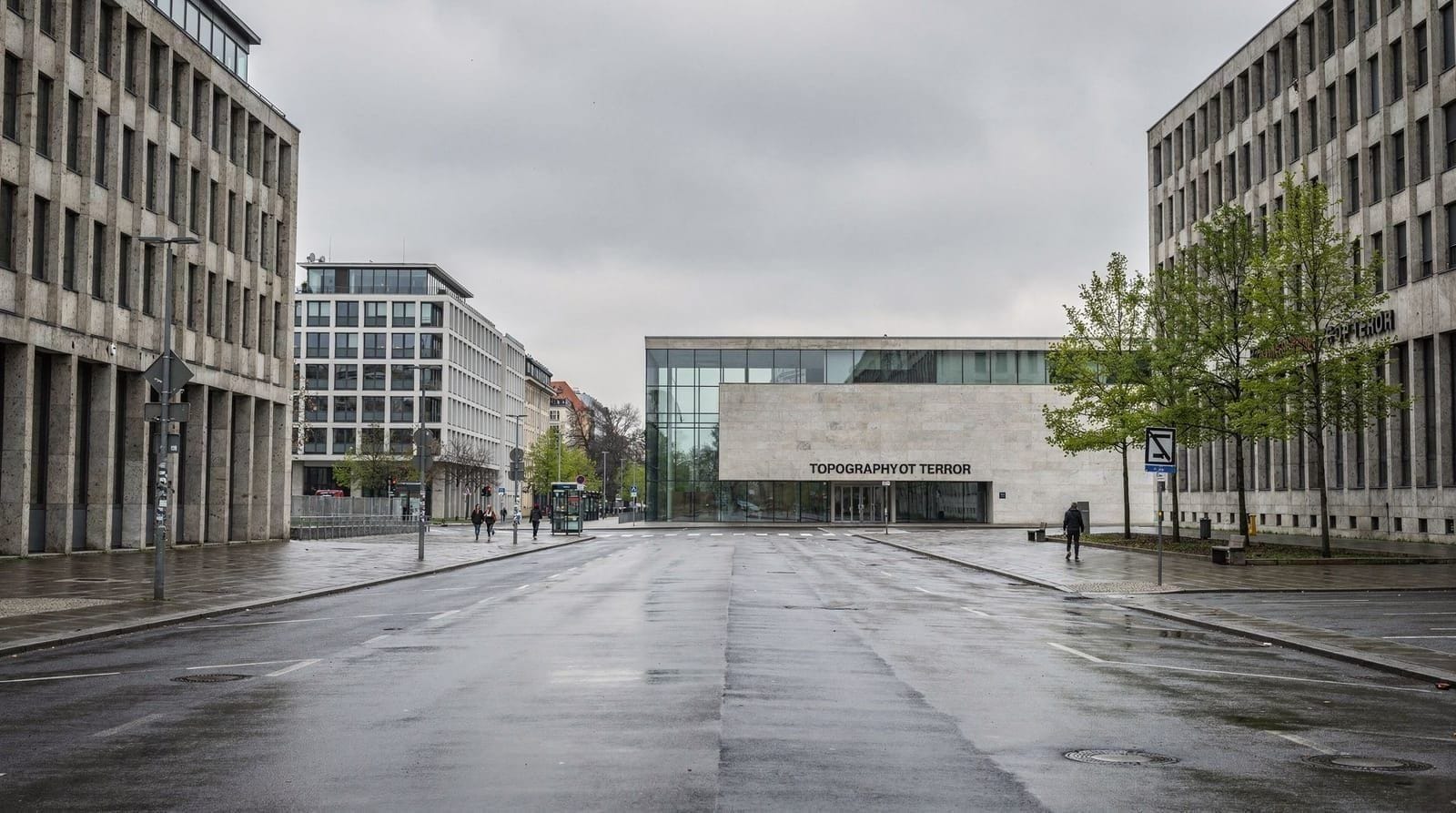
In the interim, an outdoor exhibition on the excavated foundations became the de facto memorial, visited by millions. The permanent indoor documentation centre finally opened in May 2010, designed by architect Ursula Wilms in a deliberately understated style — a long glass and concrete building running parallel to Niederkirchnerstrasse, designed not to compete with the open-air site.
Tour of Berlin’s most significant Third Reich sites — Gestapo, SS headquarters, and key locationsThe Berlin Wall on Niederkirchnerstrasse
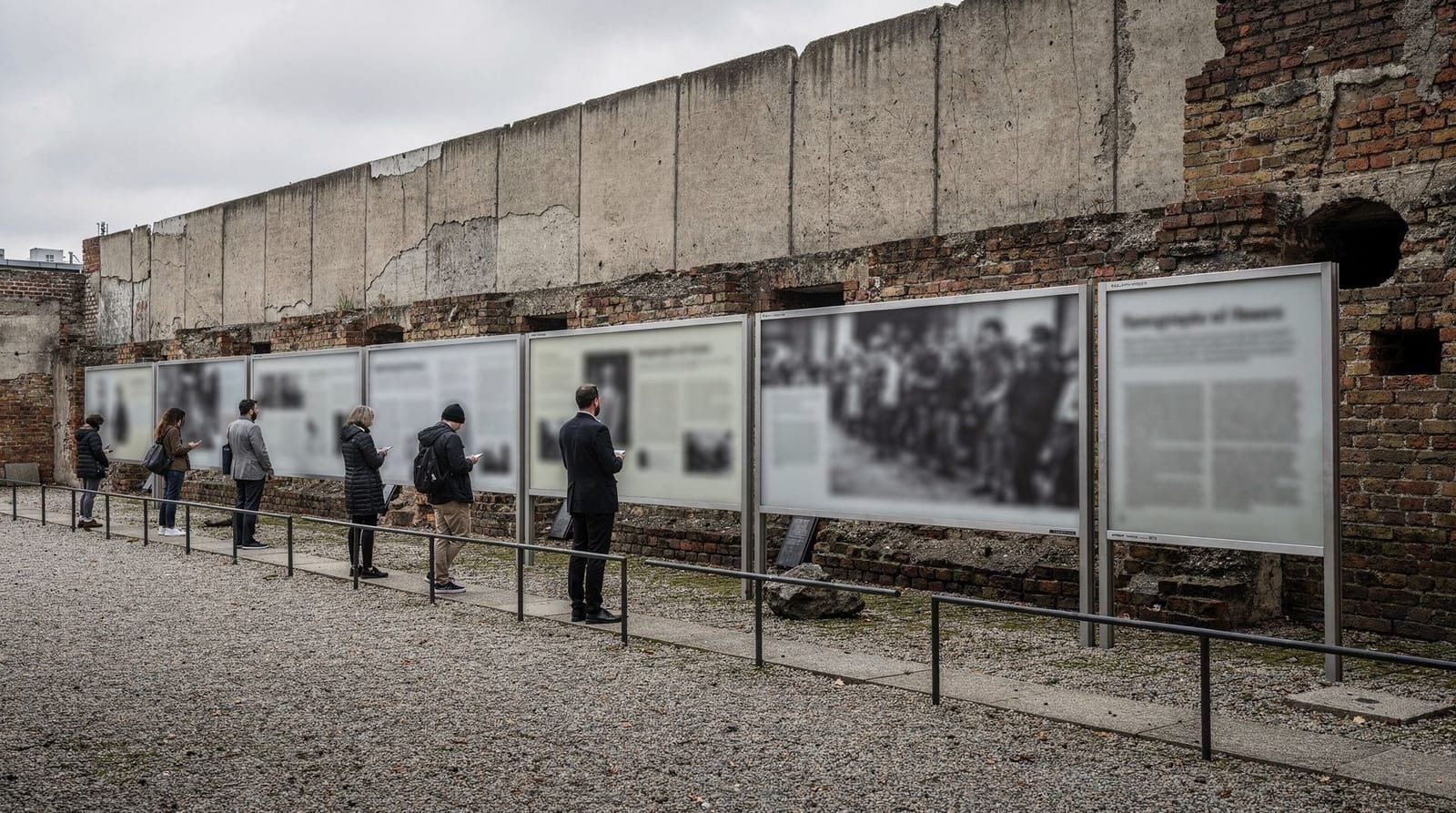
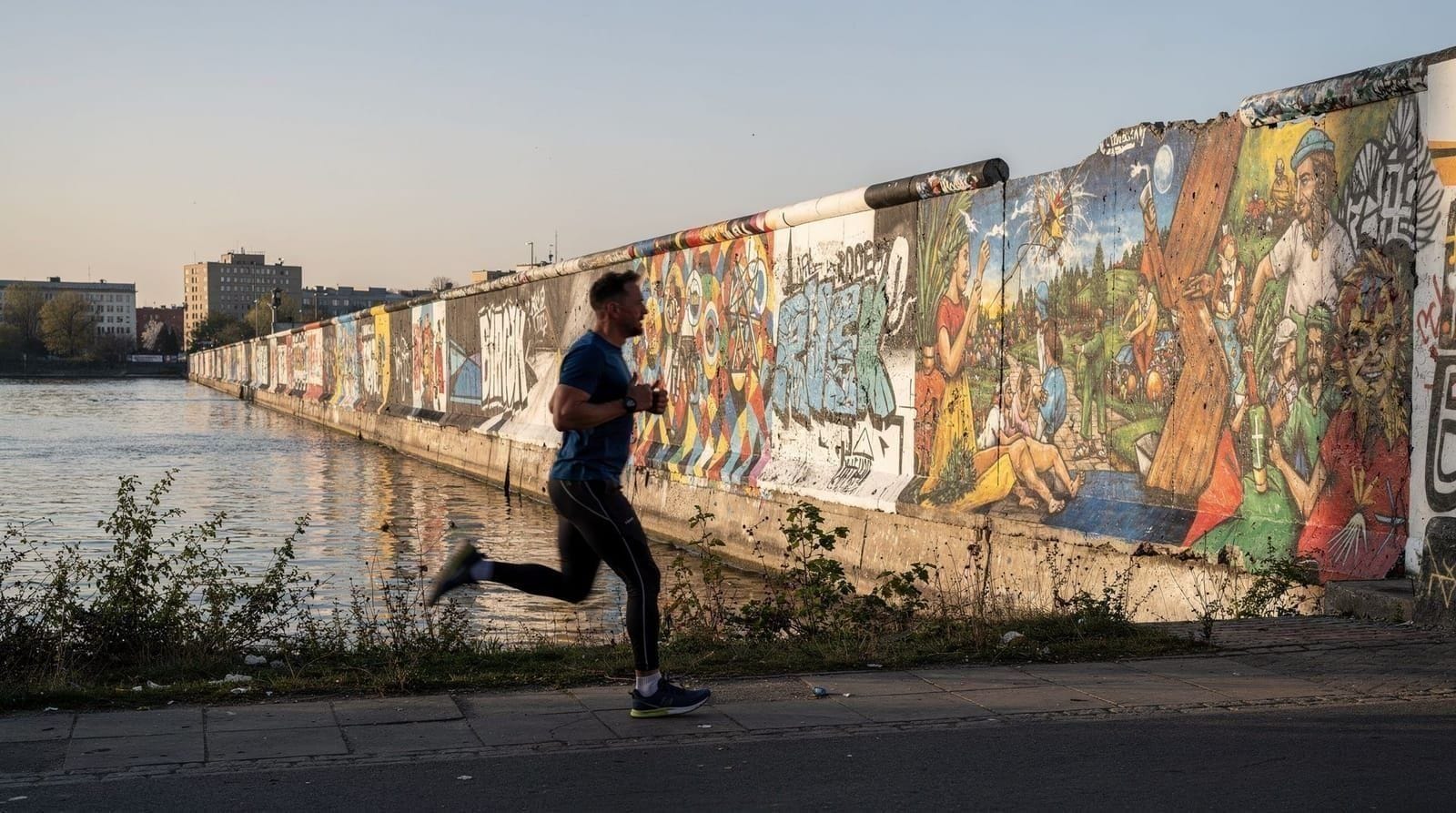
One of the most historically resonant details of the Topography of Terror site is the section of Berlin Wall that runs along its eastern edge on what was formerly Wilhelmstrasse (renamed Niederkirchnerstrasse in the GDR). The Wall was constructed here in 1961, directly over the ruins of the Nazi administrative block.
The section is one of the few remaining original stretches in central Berlin. It can be seen alongside the Topography of Terror’s outdoor exhibition. The visual layering — Nazi foundations below, Cold War Wall above, unified Berlin beyond — concentrates the city’s twentieth-century history in a single view.
For the broader context of the Berlin Wall, see the Berlin Wall complete guide.
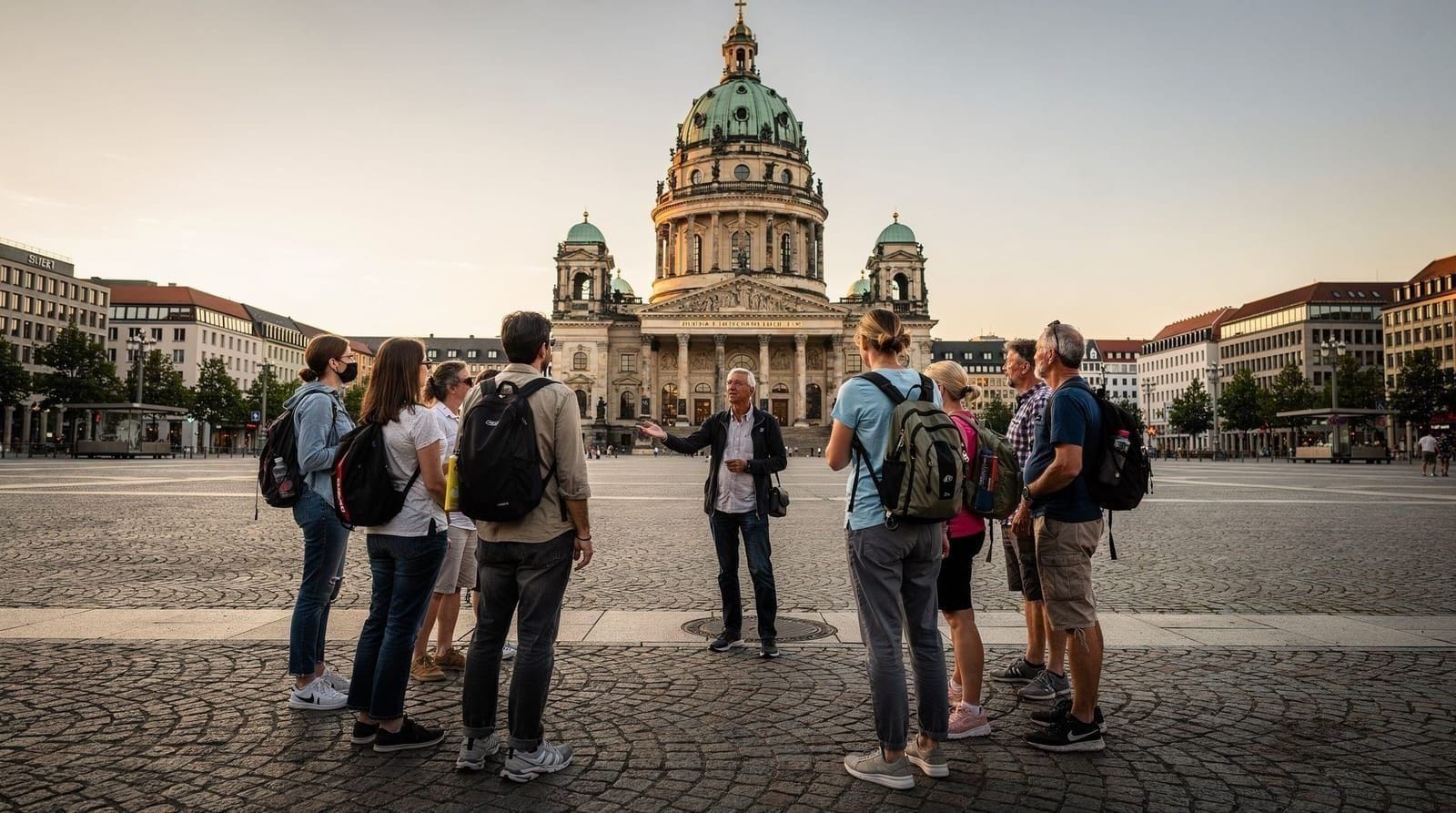
Third Reich and WWII walking tour covering the Gestapo site and surrounding historyVisiting the Topography of Terror
Address: Niederkirchnerstrasse 8, 10963 Berlin (the former Prinz-Albrecht-Strasse; the street was renamed by East Germany)
Getting there: U6 to Kochstrasse (Checkpoint Charlie is 200 metres east). S1/S2 to Anhalter Bahnhof (5 minutes’ walk north). Bus M29, M41.
Hours: Daily 10:00–20:00 (last entry 19:30). Open 365 days a year. Free entry.
Time needed: 1.5–2 hours for the indoor exhibition; 30–45 minutes for the outdoor site; more if you read everything.
Tone: The site handles very dark material. The documentation is factual and restrained — deliberately not sensationalised. Photographs of victims and perpetrators are reproduced from original sources. The exhibition does not shy from naming the perpetrators and describing what was done.
For a broader overview of Third Reich sites across Berlin, the third-Reich sites guide provides a systematic map. To visit the Gestapo site alongside other key memorial locations in a planned sequence, the third-Reich history trail itinerary covers the optimal routing. Nearby, the Führerbunker site and the Memorial to the Murdered Jews are both within a 15-minute walk, and pair naturally with a Topography of Terror visit to form a full morning of Third Reich history in central Berlin.
Practical tips for a first visit
Because the material here is dense and emotionally demanding, pacing matters more than at most Berlin museums. Read the outdoor panels along Niederkirchnerstrasse first — they’re shorter and set context — before moving indoors, where the exhibition rewards a slower pace than most visitors initially budget for. There are no lockers, so plan for carrying bags through; the building is step-free and wheelchair accessible throughout, including the outdoor gravel path, which has a firm accessible route alongside it. Toilets are available inside the documentation centre; there is no café on site, so eat beforehand or plan a break afterward — Checkpoint Charlie, 200 metres east, has cafés nearby.
Photography is permitted throughout both the indoor and outdoor exhibitions, though many visitors choose not to photograph the more graphic panels out of respect. Groups and school parties are common on weekday mornings during term time; if you prefer a quieter visit, aim for a weekday afternoon or an early weekend morning instead.
Why this site matters beyond the Gestapo story specifically
What makes Prinz-Albrecht-Strasse historically significant isn’t only what happened in the basement cells — it’s what the site’s decades of silence, followed by its eventual excavation, reveal about how postwar Germany confronted its own history. The 40-year gap between demolition in 1956 and the site’s emergence as a serious memorial mirrors a broader pattern across German memorial culture: places associated with perpetration were, for a generation, left unmarked while victim memorials slowly took shape elsewhere. Visiting with that context in mind changes how you read the outdoor foundations — not just as archaeology, but as evidence of a long argument about memory that Germany is still having.
Frequently asked questions about Gestapo headquarters on Prinz-Albrecht-Strasse
What was the Gestapo?
The Gestapo (Geheime Staatspolizei, or Secret State Police) was the official secret police of Nazi Germany, established in 1933 by Hermann Göring in Prussia and expanded by Heinrich Himmler from 1934. Unlike regular police, it operated largely outside legal constraints — it could detain, torture, and transfer prisoners to concentration camps without judicial oversight. At its peak it employed approximately 32,000 officers across the Reich, supplemented by a vast network of informants.What happened at Prinz-Albrecht-Strasse 8?
The former Hotel Prinz Albrecht became the Gestapo's central headquarters from 1933. The basement was converted into an interrogation and detention facility. Thousands of political prisoners, Jews, resistance members, and others were processed here. Many were tortured during interrogation. The adjacent Prinz-Albrecht-Palais housed the SS main office and Reinhard Heydrich's SD (security service) headquarters.Who were the key figures based at the Prinz-Albrecht complex?
Heinrich Himmler (Reichsführer-SS), Reinhard Heydrich (head of the SD and later the RSHA), and Heinrich Müller (head of the Gestapo from 1939) all operated from this complex. Adolf Eichmann, who coordinated the logistics of the Holocaust, worked nearby. The site was the administrative nerve centre of the SS-Gestapo apparatus that implemented the regime's terror.Is the Topography of Terror free to visit?
Yes. Both the outdoor excavation site and the indoor documentation centre are permanently free to enter. The indoor centre is open daily 10:00–20:00. The outdoor site is accessible year-round during daylight hours. No booking is required. The documentation is in German and English.What can you see at the Topography of Terror today?
The outdoor exhibition runs along the excavated foundations of the Gestapo/SS complex along Niederkirchnerstrasse, with a surviving section of the Berlin Wall running adjacent. The indoor Topography of Terror documentation centre (opened 2010) contains a permanent exhibition on the SS and Gestapo apparatus, illustrated with extensive original documents and photographs. The basement cells are partially preserved and visible.How was the site used after the war?
The bomb-damaged buildings were used by US forces briefly after the war, then fell derelict. The main buildings were demolished in 1949 and 1956. The site became a vacant lot — notorious in West Berlin as an unaddressed Nazi site. In 1987, for Berlin's 750th anniversary, temporary exhibitions were mounted on the foundations, revealing the basement cells. A permanent structure was eventually built, opening fully in 2010.How long should I plan for the Topography of Terror?
The indoor exhibition alone takes 1.5–2 hours if read carefully. Combined with the outdoor installation and the Berlin Wall section on Niederkirchnerstrasse, plan for at least 2.5–3 hours. The documentation is dense and emotionally demanding — visitors who rush through miss the specificity that makes the site meaningful.
Top experiences
Bookable activities with verified prices and instant confirmation on GetYourGuide.