Grunewald forest guide — Teufelsberg, lakes, and 3,000 hectares of Berlin wilderness
What is Grunewald forest in Berlin?
Grunewald is a 3,000-hectare (30 km²) forest in southwest Berlin, mostly Scots pine with mixed deciduous areas. It contains two swimming lakes (Grunewaldsee and Krumme Lanke), the ruins of a Cold War NSA listening station on Teufelsberg hill, and Jagdschloss Grunewald, Berlin's oldest surviving castle. Entry to the forest is free. It is easily reached by S-Bahn or U-Bahn from central Berlin.
Quick answer: Grunewald is 3,000 hectares of pine forest in southwest Berlin — free to enter, reachable by S-Bahn in under 30 minutes from the centre, with two swimming lakes, the Teufelsberg Cold War ruins, and Berlin’s oldest castle. No booking required for the forest; Teufelsberg entry €8–10 on open days.
| Where | Southwest Berlin, S-Bahn Grunewald/Nikolassee or U3 Krumme Lanke |
| Cost | Free forest; Teufelsberg around €8–10, Jagdschloss around €4 |
| Time needed | 2–3 hrs focused, full day for forest + lake + castle |
| Getting there | S1/S7 to Grunewald, S1 to Nikolassee, or U3 to Krumme Lanke |
| Best time | Weekday mornings; summer for swimming, October for colour |
Berlin’s largest urban forest
Grunewald does not announce itself. There is no entrance gate, no ticket booth, no queue. One moment you are at a suburban S-Bahn station; a short walk later the pines close in, the city noise drops away, and you are in what feels like genuine wilderness — 3,000 hectares (30 square kilometres) of forest running along the western edge of the city, bordered by the Havel river and the Wannsee lakes to the south and west.
The name means “green forest,” which is straightforward enough, and the forest is indeed predominantly green: Scots pine forms the canopy across most of the area, with mixed deciduous sections of birch, oak, and beech appearing particularly in the southern and eastern reaches. The composition reflects a history of deliberate planting and management dating to the 15th century, when the Hohenzollern electors of Brandenburg maintained it as a royal hunting ground. That history left its most visible trace in Jagdschloss Grunewald, the hunting lodge beside the forest’s central pond, which has stood since 1542 and is now Berlin’s oldest surviving castle.
What the name does not explain is the particular quality of the place — the silence inside the forest on a Tuesday morning, the way the light comes through the pines in long, raking shafts in October, the slight disorientation that comes from realising you are deep in woodland within a city of 3.7 million people. Grunewald is large enough that you can genuinely get lost in it, especially in the parts where mobile signal drops out entirely. Downloading an offline map before you go is practical advice, not a precaution.
For visitors to Berlin spending more than two or three days, Grunewald tends to emerge as the day that sticks in memory — not the Brandenburg Gate or Museum Island, but the afternoon in the pines with a swimming lake at the end of it.
Getting there
The forest is accessible from several points, and the right entry depends on what you want to do.
S1 or S7 to Grunewald station drops you at the northeastern edge of the forest, close to Jagdschloss Grunewald, the forest trails leading south to Teufelsberg, and the cycling network. From central Berlin (Friedrichstrasse), the S7 takes about 25 minutes. The station has a small commercial area with a café and a bike rental.
S1 to Nikolassee takes you to the southern end of the forest, within 15 minutes’ walk of Grunewaldsee. This is the right choice if swimming is the main agenda.
U3 to Krumme Lanke is the simplest access to the smaller, quieter lake of the same name — a 5-minute walk from the U-Bahn exit. The U3 runs from Nollendorfplatz and Wittenbergplatz.
Wannsee connections: The southern edge of the forest touches Wannsee, making it possible to combine Grunewald with the Wannsee villa area and the Havel beaches on a longer day. The S1 to Wannsee continues south from Nikolassee.
No car is needed, and parking around the forest entrances is limited and fills early on summer weekends. The public transport connections are straightforward enough that driving makes the day more complicated, not less.
Teufelsberg — the listening station on the hill of rubble
Teufelsberg (Devil’s Mountain) is, by an uncomfortable margin, the most historically layered place in the forest. The 115-metre hill was built between the early 1950s and mid-1960s from approximately 25 million cubic metres of rubble — the physical remains of a bombed and demolished city. The Allied forces had levelled the ruins of a never-completed Nazi military technical college on this site first, then buried it under millions of tonnes of rubble cleared from central Berlin’s ruins. The hill that resulted was entirely artificial, the largest of several “rubble mountains” (Trümmerberge) raised in Berlin during the postwar clearance.
On top of this buried history, the United States and British intelligence services built Field Station Berlin — a joint NSA and GCHQ signals intelligence listening post operational from 1961 to 1991. The five distinctive radar domes (radomes) that covered the antennas were designed to look innocuous from the East; the hill’s elevation put the equipment above the surrounding canopy and much of the city, useful for intercepting signals traffic from East Germany and the Soviet bloc. The station was decommissioned after the fall of the Wall, the equipment removed, and the structures left to decay.
What remains today is a genuinely strange place: rusting industrial buildings, peeling corridors, collapsed staircases, and graffiti covering almost every flat surface — a combination of deliberate street art commissioned from internationally known artists and accumulated layers of tags and sprays from three decades of unsanctioned access. The views from the domes, on days when the structure is accessible, cover the entire western half of the city.
Practical access: A private operator manages the site and charges €8–10 for self-guided access, €15 for guided weekend tours. The gates are not always open. Hours vary considerably by season and the site can be closed without notice. Check teufelsberggberlin.de before visiting or call ahead. Do not make the uphill walk (30 minutes from Grunewald S-Bahn station) without confirming the site is open.
Getting there: S7 to Grunewald station, then either walk south through the forest on the marked trail (approximately 30 minutes) or take bus 115 toward Spanische Allee and alight at Teufelsseechaussee. There is no direct public transport to the hilltop itself.
A note on online bookings: Several third-party platforms sell “drone photography tours” and similar packages at inflated prices with vague access promises. The honest approach is to go directly through the site operator. Walking up independently on an open day is cheaper and gives you the same access as any packaged experience.
The Teufelsberg experience is not for everyone — the buildings are ruined and conditions inside can be rough. But as an encounter with the physical debris of 20th-century Berlin history, there is nothing else quite like it in the city.
Grunewaldsee — the main swimming lake
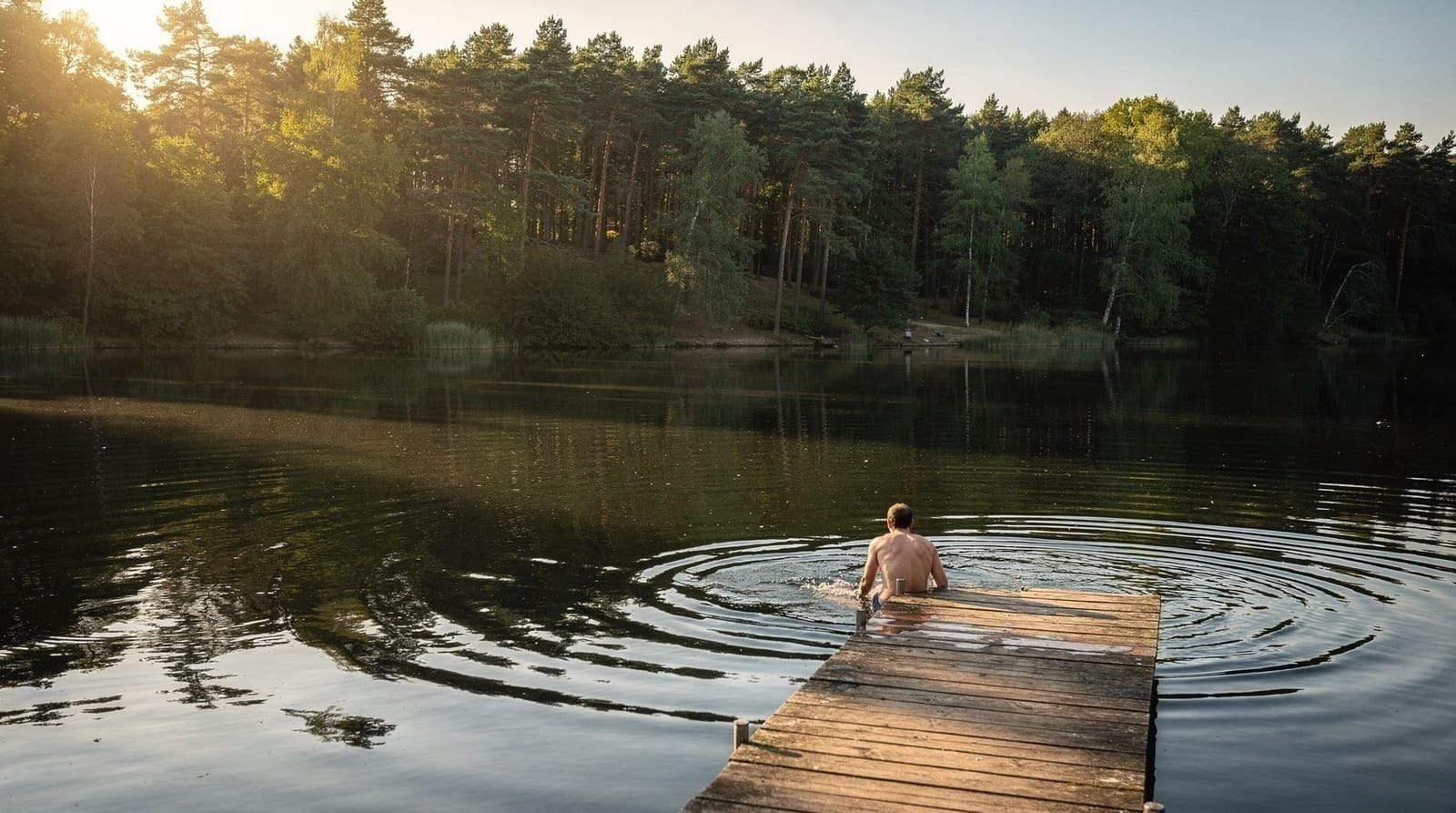
Grunewaldsee is the larger and more developed of the two principal swimming lakes in the forest, and the one most Berliners think of when they think of swimming in Grunewald. It is roughly 1.5 kilometres long, dark in colour from organic matter in the water, and surrounded by mixed pinewoods on three sides.
Access: S1 to Nikolassee, then a 15-minute walk through the forest following the signs. Alternatively from Grunewald station, a 25-minute walk south on the main forest tracks.
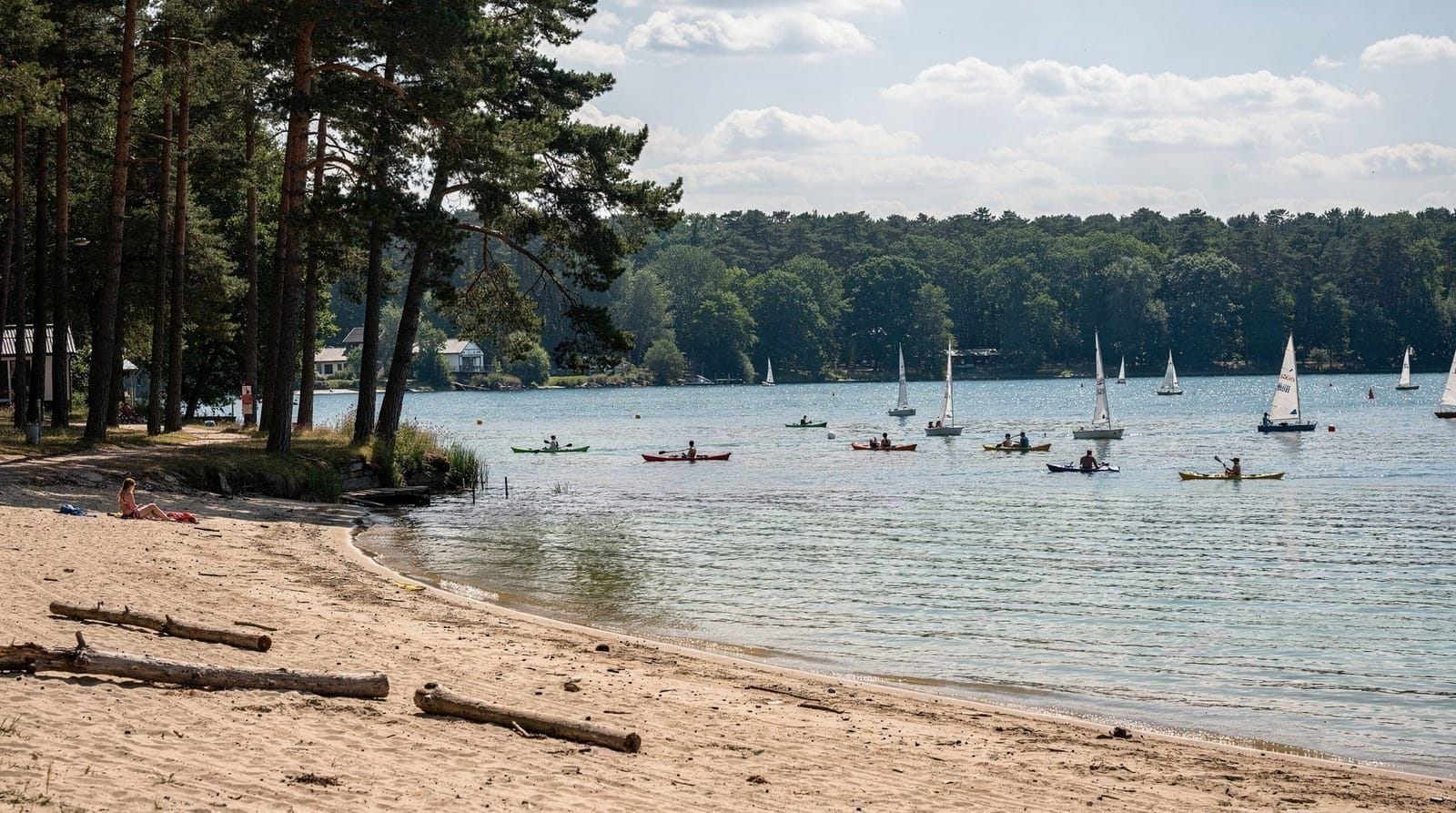
What’s there: Designated swimming areas with gentle beaches, pedalos for hire in summer, and a café that operates from late May through early September. One section of the lakeshore is designated FKK (Freikörperkultur — naturist), a German tradition that is entirely unremarkable in context; just be aware that the designation exists if it affects where you choose to set up.
Entry: Free. No tickets, no barriers.
Water quality: Berlin’s authorities (Senatsverwaltung für Umwelt) test the bathing lakes regularly through the summer and publish results online. Grunewaldsee is generally rated satisfactory, though it can develop algae in very hot, still spells. Current readings are worth checking in July and August before making a dedicated trip.
Crowds: On a hot weekend afternoon in July, Grunewaldsee is very busy. Arriving before noon on summer weekends significantly improves the experience. Weekday mornings are quiet even in peak season.
For a full overview of Berlin’s swimming lakes, including water quality comparisons and how to combine multiple lakes in one day, see the Berlin lakes swimming guide.
Krumme Lanke — the quieter alternative
Krumme Lanke (“Crooked Pond”) sits at the southern tip of the forest, smaller and less visited than Grunewaldsee and generally considered to have cleaner water. It is one of several small lakes that formed in ancient glacier channels running through this part of the Berlin landscape.
Access: U3 to Krumme Lanke — the U-Bahn station is named after the lake and the exit deposits you within 5 minutes’ walk of the water. This is a straightforward journey from central Berlin, the U3 running from Nollendorfplatz and Wittenbergplatz.
What’s there: Minimal facilities — a small beach area, no café, no pedalos. The appeal is the contrast with Grunewaldsee: quieter, shadier, and less visited even in summer. Families with young children often prefer it for the lower crowds and gentler atmosphere.
Krumme Lanke is included in the broader Berlin lakes swimming guide alongside Tegeler See and other less-central options.
Jagdschloss Grunewald — Berlin’s oldest castle
The Jagdschloss (hunting lodge) sits beside the Grunewaldsee in a clearing that has changed surprisingly little since the Electors of Brandenburg used it for autumn hunting parties five centuries ago. The original building was commissioned in 1542 by Elector Joachim II and makes it the oldest surviving castle in Berlin — a designation that surprises many visitors, who associate Berlin’s architecture primarily with 19th-century Prussian grandeur or 20th-century catastrophe.
The building is compact by castle standards — a white Renaissance structure two storeys high, reflected in the dark water of the adjacent pond. A Dutch-influence baroque wing was added in the 17th century, and the whole complex was restored in the late 19th century for use as a summer residence.
The museum: The interior holds a collection of Baroque and Renaissance paintings, many connected to the Brandenburg and Prussian electoral households — hunting scenes, court portraits, landscapes. The collection is specialist in orientation and will appeal mainly to visitors with an existing interest in this period of German history. Others may find the building and its setting more compelling than the contents.
Entry: €4 adults. Check opening hours before visiting — the Jagdschloss is typically open Tuesday to Sunday in summer, with shorter winter hours, but days and times vary.
Getting there: S1 or S7 to Grunewald station, then a 20-minute walk south through the forest on clearly marked paths.
Cycling through Grunewald
The forest is threaded with a well-marked cycling network, and bikes are permitted on most tracks. Grunewald is one of the better urban cycling environments in Berlin — traffic-free, shaded, and with enough variety in routing to make a half-day circuit worthwhile.
Routes: A popular circuit runs from Grunewald station south through the forest to the Havel shore, continuing along the water to Wannsee and returning via the forest’s eastern tracks. The full loop is roughly 20–25 kilometres and can be ridden comfortably in two to three hours at a relaxed pace.
Connections south: The forest connects seamlessly to the Wannsee area and the Havel lakes, making it possible to chain Grunewald with a Wannsee swim or lunch break in one day by bike.
Bike rental: Bikes can be hired in Grunewald village, near the S-Bahn station. The Berlin bike rental guide covers rental options across the city, including what to expect on pricing and deposit requirements. If you prefer a guided cycling introduction to the forest, the Berlin bike tours guide covers organised options that include Grunewald in their routes.
The forest is also a natural waypoint on the Berlin self-guided walk highlights route for anyone doing a longer walking day.
Seasonal highlights
Spring (April–May): The transition from brown to green through the pine forest is gradual, but the bluebell flowering in the deciduous sections — particularly in the mixed woodland south of Jagdschloss Grunewald — is genuinely impressive in a good year. Late April and early May are the peak window. The forest is much less visited than in summer. See the Berlin in summer guide for what changes from June onwards.
Summer (June–August): Peak swimming season. Grunewaldsee and Krumme Lanke are at their warmest. The café at Grunewaldsee is open. This is also the busiest period — arrive early on weekends or plan for crowds at the main lake. The interior of the forest stays relatively cool even in heatwaves, making it useful as a respite from the city in July.
Autumn (October): The deciduous sections — birch, oak, beech mixed through the pine — turn in October, and the forest is at its most visually varied. The Grunewaldsee is usually too cold for swimming by mid-October but the lake is worth seeing in autumn light. Weekday visits in October are among the least crowded of any season.
Winter (December–February): In hard winters, some of the smaller ponds within the forest freeze over, and improvised ice skating happens without much organisation. The pines keep their colour and the forest has a particular silent quality in snow. Teufelsberg can be atmospheric in fog. Jagdschloss and the Grunewaldsee café have reduced or no winter hours.
Season at a glance:
| Season | Weather | Crowds | Best for |
|---|---|---|---|
| Spring (Apr–May) | Mild, occasional rain | Low | Bluebells, quiet trails |
| Summer (Jun–Aug) | Warm, 20–28°C | High on weekends | Swimming, cycling, café |
| Autumn (Oct) | Cool, crisp | Low, especially weekdays | Foliage colour, photography |
| Winter (Dec–Feb) | Cold, occasional frost | Very low | Silence, fog at Teufelsberg |
Wild boar — what to know
Grunewald has a substantial wild boar population. They are not unusual to see, particularly at dusk near the forest edges, around the lake shores, and in the clearings east of Teufelsberg. The information boards at all main forest entrances give current guidance.
The rules are consistent: do not feed them, keep dogs on a leash, give animals space. Sows with young piglets (most visible in spring and early summer) can be aggressive if approached. In practice, boar encounters in the forest are rarely dramatic — the animal usually retreats when it detects humans. Problems tend to arise from people approaching for photographs.
Dogs off-leash in Grunewald are a recurring local debate. The forest is a designated leash-required area in most sections, partly for wildlife protection and partly for this reason.
Practical planning
Mobile signal: Parts of the forest — particularly the central sections away from the main tracks — have weak or no mobile signal. Download an offline map of Grunewald before you go. OpenStreetMap via OsmAnd or Maps.me covers the forest paths well.
Navigation: The main tracks are signposted, but the forest is large enough that casual wandering can result in unexpected detours. The signs at major junctions indicate Grunewald station, Nikolassee, Teufelsberg, and Jagdschloss, which is usually enough to stay oriented.
Facilities: Grunewaldsee has toilets and a summer café. Krumme Lanke has minimal facilities. Elsewhere in the forest there are no services — bring water and snacks for longer walks.
Time needed: A focused visit to Teufelsberg and a walk from Grunewald station takes 2–3 hours. A lake swim day from Nikolassee is comfortable in 3–4 hours including travel. A full forest circuit by foot or bike, including Jagdschloss and one of the lakes, takes a full day. The Berlin 3-day itinerary places Grunewald on day three; the Berlin 5-day itinerary can extend it with the Wannsee and Havel shore.
With children: Grunewaldsee’s pedalo hire and beach area work well for families. The forest tracks are pushchair-accessible on the main paths. The walk to Teufelsberg involves an uphill section that is manageable for children over 8. See the Berlin with kids guide for broader family planning across the city.
Free walking tours: Some of Berlin’s free walking tours extend into Grunewald and the Wannsee area, though these tend to be scheduled rather than standard daily departures. Worth checking if you want context on the Cold War history at Teufelsberg specifically.
Running, dog walking, and everyday use
Grunewald is as much a working local amenity as a tourist destination — plenty of Berliners use it for a daily run or dog walk rather than a special outing, and visitors are welcome to slot into the same rhythm. The main forest tracks around Grunewaldsee and out toward the Havel are flat, well-surfaced, and popular with runners year-round; a loop from Grunewald station down to the lake and back is roughly 6–7 km. Dogs are welcome throughout the forest but must be kept on a leash in most zones, both for wildlife protection (the boar population in particular) and because it is simply the local rule, enforced periodically. If you’re staying nearby for more than a couple of days, an early-morning run or walk through the pines before the day’s sightseeing is one of the more distinctive ways to experience the forest away from any crowds.
Photography and drone rules at Teufelsberg
The domes and derelict buildings at Teufelsberg are among the most photographed Cold War ruins in Berlin, and the site operator is generally relaxed about photography as part of the entry fee — bring a wide lens for the interior of the radomes, where the acoustics and light are part of the appeal. Drone flights are a different matter: Teufelsberg sits within Berlin’s controlled airspace near several restricted zones, and flying a drone without the site operator’s explicit permission and the correct German aviation authorisation is both against site rules and against German air law. If aerial photography matters to your visit, contact the operator in advance rather than assuming you can fly on the day; unauthorised drone use is one of the more common reasons for on-site confrontations with staff.
Where to eat and drink nearby
Options inside the forest itself are limited to the seasonal café at Grunewaldsee (open roughly late May to early September) and, on Teufelsberg open days, occasional pop-up refreshment stalls near the entrance — neither should be relied on outside their operating windows. Grunewald village, immediately around the S-Bahn station, has a small cluster of cafés and bakeries suitable for a pre-walk coffee or a post-swim snack, and is the most convenient option if you’re starting or ending your visit there. For a fuller meal, most visitors head back toward central Berlin or combine the day with Wannsee, which has considerably more restaurant choice along the lakefront. Bringing a packed lunch is the simplest option for a full day exploring the forest itself, since carrying food in is easier than relying on finding it.
Comparing Grunewald with other Berlin green spaces
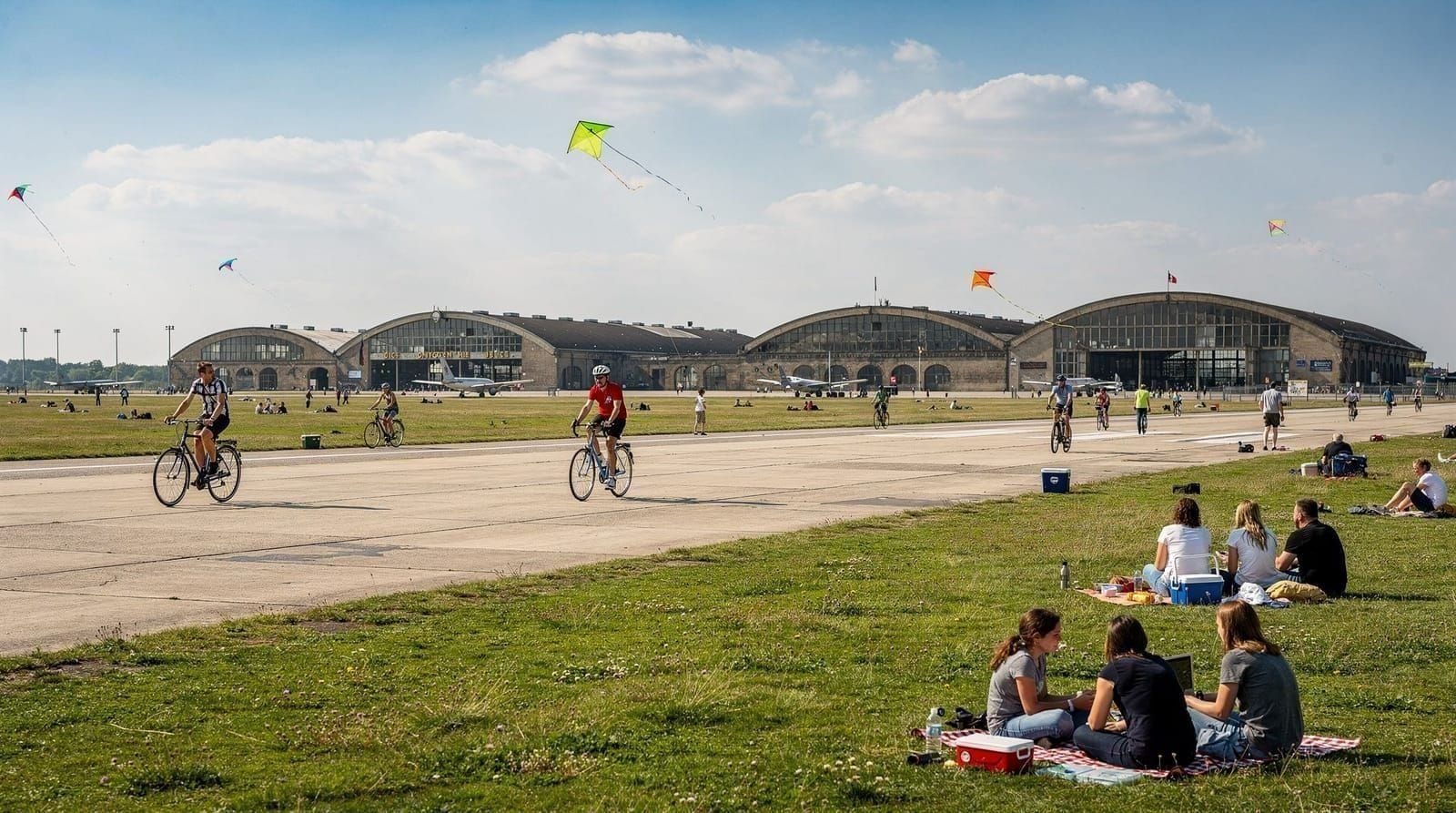
Grunewald is the right choice when you want genuine forest, distance from the city, and the option of a natural swimming lake. Tiergarten is better for a quick urban park visit in the centre — it is smaller, more manicured, and surrounded by major sights. Tempelhof Field offers a completely different experience: open, flat, and urban, where Grunewald is enclosed, hilly, and sylvan.
For lake swimming specifically, the choice between Grunewald’s lakes and Tegeler See or the lakes to the east comes down to geography and crowd tolerance. Grunewald’s lakes are busier in summer but easier to pair with the forest itself.
Frequently asked questions about Grunewald forest guide
How do I get to Grunewald forest from central Berlin?
Take the S1 or S7 to Grunewald station (about 25 minutes from Friedrichstrasse). From there you can walk directly into the forest. For the southern lakes, S1 to Nikolassee (15-minute walk to Grunewaldsee) or U3 to Krumme Lanke (5-minute walk). For Teufelsberg, S7 to Grunewald station then a 30-minute walk, or bus 115 to Teufelsseechaussee.Is Grunewald forest free to visit?
Yes. The forest itself is free and open at all times. Grunewaldsee and Krumme Lanke beaches have no entry charge. The Teufelsberg listening station charges €8–10 for self-guided access on days when it is open. Jagdschloss Grunewald museum costs €4 for adults.Can you swim in Grunewald's lakes?
Yes. Grunewaldsee has designated swimming areas, pedalos for hire, a café open in summer, and a designated FKK (nudist) section. Krumme Lanke is smaller and quieter with cleaner water and no facilities. Both are free to use. Water quality at both lakes is monitored regularly by Berlin's authorities and rated good in normal summers.What is Teufelsberg and how do I visit?
Teufelsberg (Devil's Mountain) is a 115-metre hill built from approximately 25 million cubic metres of WWII rubble, topped by the ruins of a former NSA and GCHQ listening station (Field Station Berlin, operational 1961–1991). The ruins are now covered in street art and accessible through a private operator. Entry is €8–10 self-guided, €15 for guided tours on weekends. Hours vary and the gates are not always open — check teufelsberggberlin.de or call ahead before making the trip.Are there wild boars in Grunewald?
Yes. Wild boar are common throughout the forest, particularly near the edges and around the lakes at dusk. Do not feed them and keep dogs on a leash. Boars with piglets can be aggressive. Information boards at forest entrances give current advice. Encounters are common on evening walks; most are uneventful if you give animals space.What is Jagdschloss Grunewald?
Jagdschloss Grunewald is the oldest surviving castle in Berlin, built in 1542 as a hunting lodge for Elector Joachim II of Brandenburg. The small Renaissance building sits beside a dark, reed-fringed pond and houses a museum with Baroque and Renaissance paintings. Admission is €4 for adults. Reach it by S1 or S7 to Grunewald station, then a 20-minute walk through the forest.When is the best time to visit Grunewald?
Each season has a strong argument. April and May bring bluebells flowering under the pines. Summer (June–August) is peak swimming season at Grunewaldsee and Krumme Lanke. October offers outstanding autumn colours across the mixed deciduous sections. In hard winters, some of the smaller ponds freeze and attract ice skaters. The forest is much quieter on weekday mornings year-round than on summer weekends.Can I cycle in Grunewald?
Yes. The forest has an extensive network of marked cycle paths and most forest tracks allow bikes. It connects south towards Wannsee and the Havel waterways, making it a popular route for longer day rides. Bikes can be rented in Grunewald village near the S-Bahn station.