Müggelsee guide — Berlin's largest lake in Köpenick
Is Müggelsee worth the trip from central Berlin?
Yes, if you budget the time honestly. Müggelsee is Berlin's largest and arguably most rewarding lake — 7.4 km², clean water, a sandy beach, a forest tower with views, and good hiking in the Müggelberge hills. The catch is distance. It sits in Köpenick, far southeast Berlin, and the journey from Alexanderplatz takes 45–55 minutes each way by S-Bahn and tram. Plan a full day, not an afternoon detour.
Quick answer: Müggelsee is Berlin’s largest lake — 7.4 km², clean for swimming, backed by pine-forested hills with a 30-metre tower, and ringed by sailing clubs and quiet trails. The honest catch: it is in Köpenick, far southeast Berlin, and the journey from the city centre takes 45–55 minutes each way. Plan a full day and you will not regret it.
| Where | Köpenick, far southeast Berlin |
| Getting there | S3 to Friedrichshagen or Köpenick + tram, 45–55 min from Alexanderplatz |
| Cost | Free lake access; Strandbad around €3–4; Müggelturm around €2.50 |
| Time needed | A full day, ideally 5–7 hours including Köpenick |
| Best time | June–August for swimming, September–October for forest walks |
What Müggelsee actually is — and why many Berliners still haven’t been
Großer Müggelsee is the largest body of water within Berlin’s city limits: 7.4 km² of surface area, roughly 8 km long and 2.5 km wide, with a maximum depth of 8 metres. It sits in the Köpenick district in the far southeast of the city, connected to the Spree river and surrounded by the Müggelberge hills and Berliner Forsten forest. By any measure, it is a serious natural asset — larger and wilder in character than the Wannsee, better water quality than many of the central lakes, and genuinely quiet on weekdays even at the height of summer.
And yet a surprising proportion of Berliners have never been. The reason is simple: distance. From Alexanderplatz, you are looking at 45 to 55 minutes each way on the S3 S-Bahn plus a tram connection. That is not an enormous journey by any international standard, but in a city full of more accessible green spaces, the extra travel time is enough to tip the calculation. Many Berliners default to Tiergarten for a quick park fix, or to Tegeler See for a closer lake experience.
If you are visiting Berlin and have a full day free — particularly in summer — Müggelsee is worth prioritising. The combination of lakeside swimming, forest hiking, a functioning observation tower, and the historic Köpenick old town makes it one of the more complete half-day destinations in the greater Berlin area. But plan accordingly. This is not a place to visit on a tight schedule.
Getting there: the honest transport breakdown
The route from central Berlin is well-served but unhurried.
From Alexanderplatz, take the S3 S-Bahn eastward. The journey to Friedrichshagen takes around 30 minutes. This is the main gateway to the north shore of the lake. From Friedrichshagen station, take tram 60 or 61 — a short two-stop ride brings you to Müggelseedamm, where the north shore and the ferry landing are within walking distance.
For the south shore and Strandbad Müggelsee (the main official beach), the route is slightly different. Travel on the S3 to Köpenick station and then switch to tram 68 toward Rahnsdorf, alighting at Strandbad Müggelsee. This adds a few minutes compared to the Friedrichshagen route but puts you directly at the beach entrance.
Allow 45–55 minutes from Alexanderplatz under normal conditions. The entire journey is valid on a standard BVG day ticket or the Berlin Welcome Card, so there are no surcharges.
Cycling is an option if you have a rental bike and a morning to spare: the route through Treptow and along the Spree is pleasant, though it takes 60–80 minutes from the city centre. A summer day in Berlin that starts early enough can reasonably fit both the cycle out and a swim before heading back.
The lake in numbers and landscape
Müggelsee is sometimes called just “der Müggel” by Berliners who know it well. Its full official name is Großer Müggelsee — the Big Müggelsee — to distinguish it from Kleiner Müggelsee, a smaller and murkier lake immediately to the south that is not used for swimming and tends to be skipped entirely.
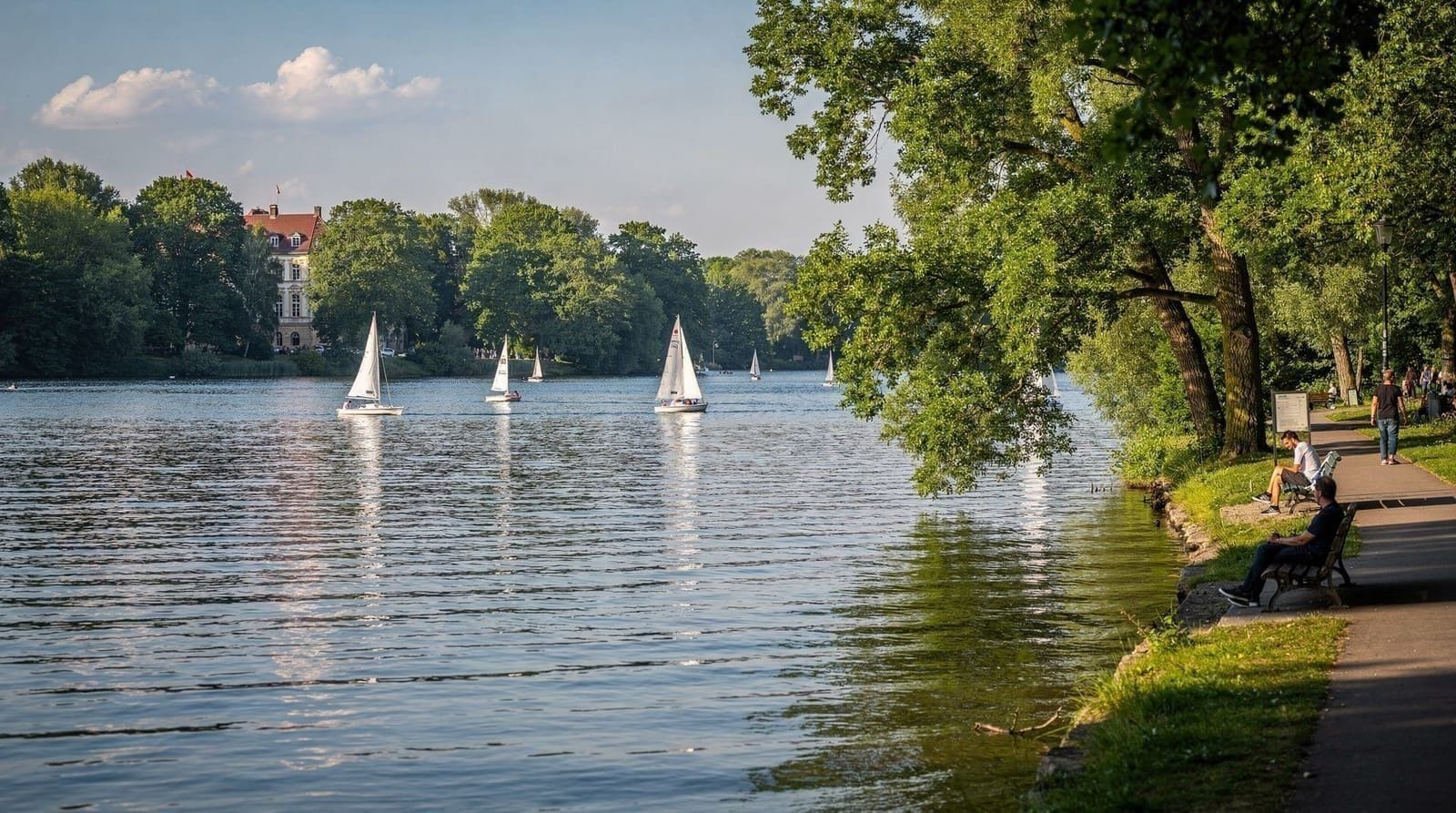
The water connects to the Spree via the Müggelspree channel, which enters the lake from the northwest and exits toward the southeast toward the town of Erkner. This connection matters practically: the lake is not stagnant, and the gentle flow-through is one reason water quality remains consistently good. Sailing and stand-up paddleboarding are the dominant water sports. Motorboats are not permitted, which keeps noise levels low and the surface unruffled.
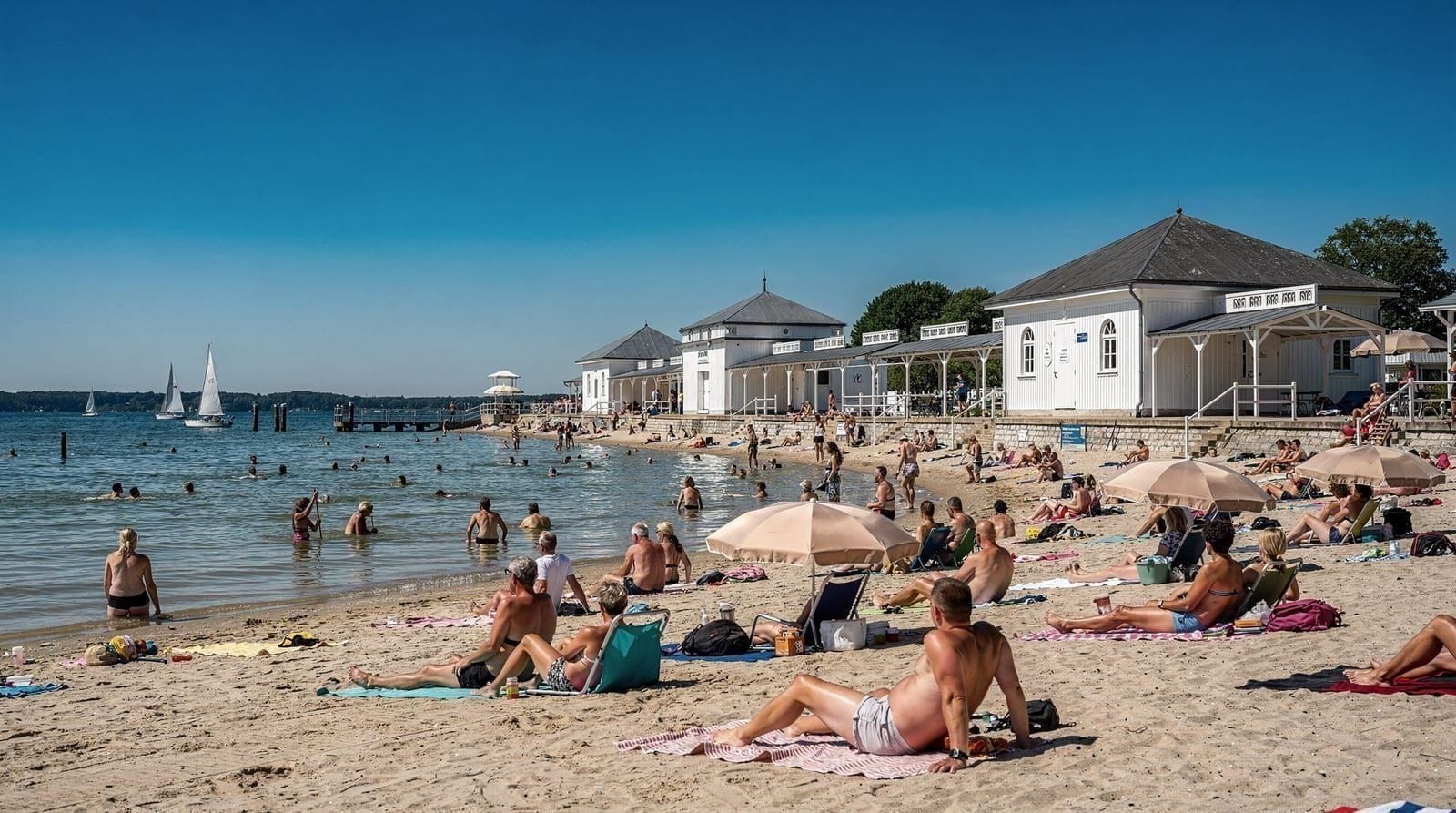
The surrounding landscape shifts noticeably from shore to shore. The north shore, along the Friedrichshagen side, is partly wooded and has informal access points and quieter bathing spots with no facilities. The south shore is where Strandbad Müggelsee sits — a proper organised beach with changing rooms, showers, and lifeguards in peak season. Behind the south shore, the Müggelberge hills begin almost immediately, rising to 115 metres — modest by most European standards, but genuinely elevated by the criteria of flat Berlin, where any hill is noteworthy.
Strandbad Müggelsee: the main beach
Strandbad Müggelsee has been operating as a public bathing beach since the early 20th century and is the most visited access point to the lake in summer. Entry costs around €3–4 in peak season and covers use of the changing facilities, showers, and lockers. The beach itself is sandy, reasonably wide, and gently shelving into the water — it works well for families with young children.
On a hot July Saturday, expect it to be full by midday. Arrival before 11 am is sensible if you want a comfortable spot. Weekday visits are considerably more relaxed.
The water quality is tested and monitored throughout the season. Results are published publicly at berlin.de/badeseen, and Müggelsee has maintained a consistently clean record. The lake carries a formal designation as a supervised bathing water under EU standards.
Food at the beach is available from kiosks and the nearby Rübezahl restaurant, a long-established traditional German restaurant on the lake shore. Rübezahl is solid rather than remarkable — the menu is conventional German fare, the terrace faces the water, and it becomes genuinely crowded on summer weekends. If you go on a busy day, booking ahead or arriving at opening time avoids the wait.
For family day trips from Berlin, Strandbad Müggelsee is one of the most complete options: a proper beach, a park behind it, food options, and the Müggelberge trails accessible on foot. Children who are capable walkers can combine a swim with the hike up to the Müggelturm.
The north shore: free bathing and local atmosphere
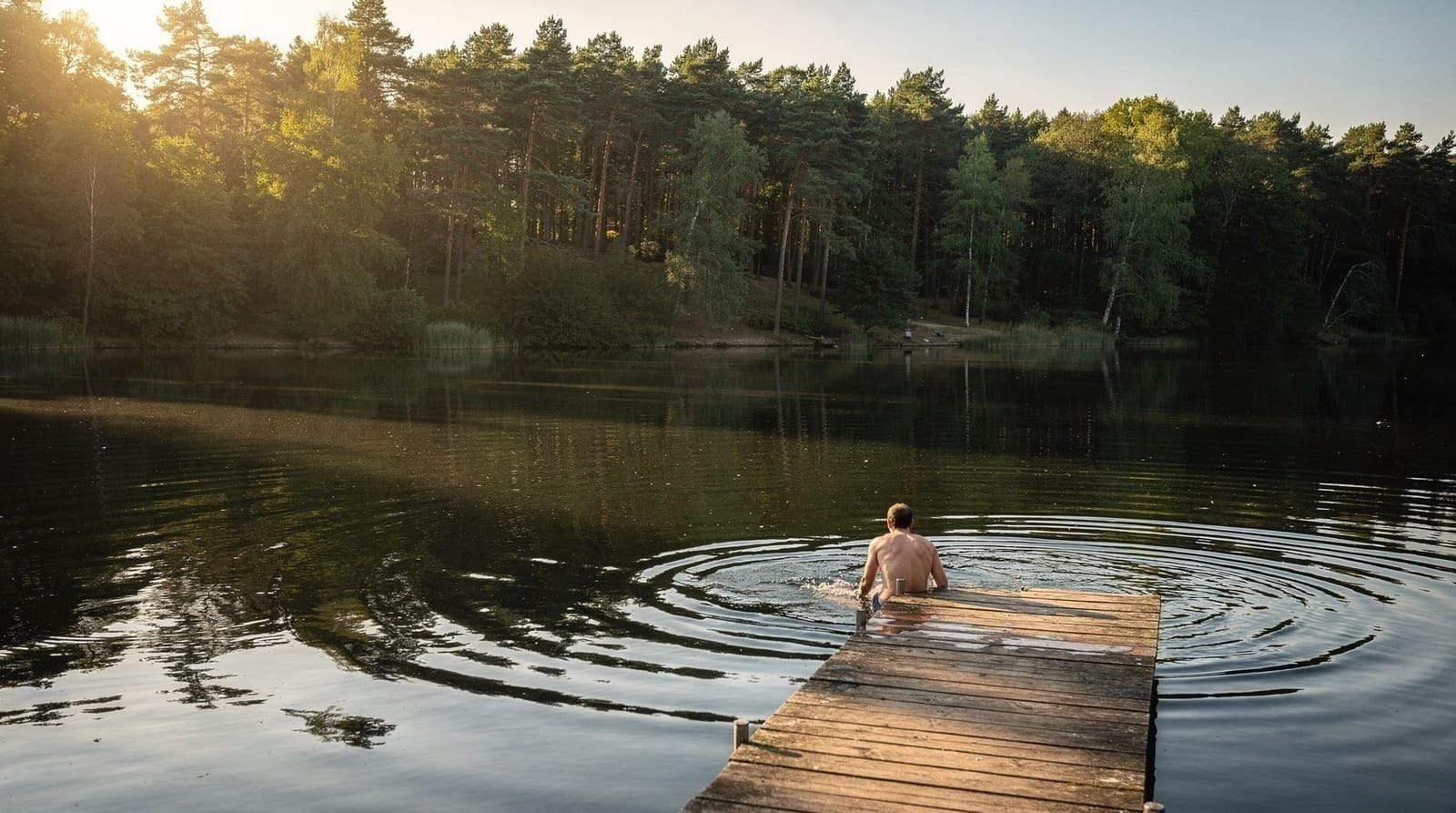
The north shore between Friedrichshagen and the lake is less organised and, for that reason, more popular with regular visitors who know the area. There are no entry fees, no lifeguards, and no changing rooms. What you get instead is direct access to the water from grassy banks and forest clearings, with a much lower density of visitors on most days.
The Friedrichshagen neighbourhood that backs onto this shore is one of the more charming corners of outer Berlin — a late 19th-century workers’ settlement with a main street (Bölschestraße) full of small cafés, independent shops, and a markedly un-touristy atmosphere. Spending an hour on Bölschestraße before or after the lake is worth building into the day.
From the north shore, you can also catch the seasonal ferry operated by Stern und Kreisschiffahrt, which crosses the lake from Friedrichshagen to Rahnsdorf on the south shore. This is useful if you want to visit the Müggelturm from the north side without walking all the way around the lake. Standard BVG transport tickets are accepted on this service.
Müggelberge and the Müggelturm
The Müggelberge — the hills southwest of the lake — are the natural highpoint of any Müggelsee visit beyond the beach itself. At 115 metres above sea level, they represent the highest terrain accessible within Berlin city limits, and the pine forest covering them is dense enough to feel genuinely removed from the city even though you are still technically inside it.
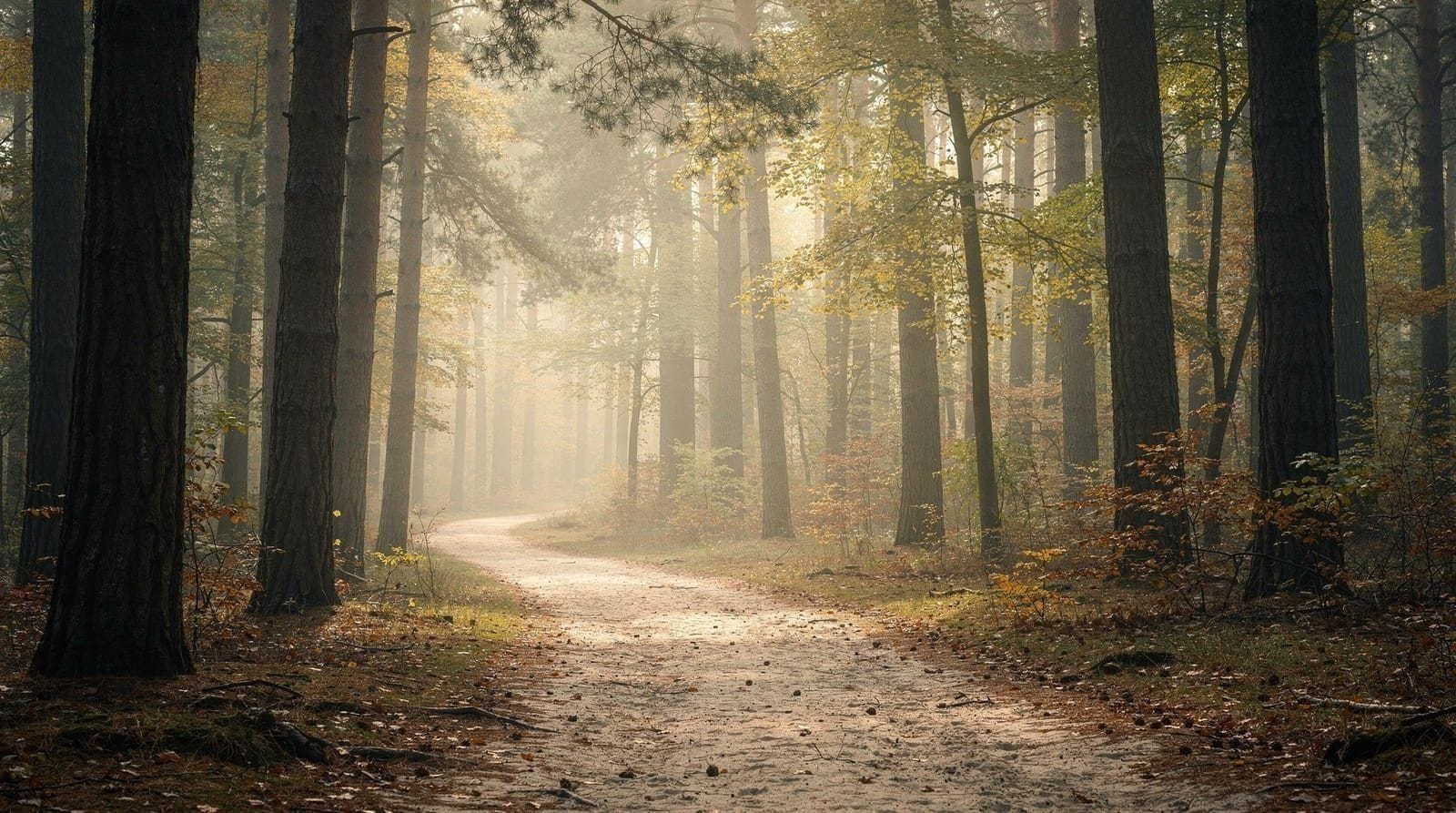
Walking trails criss-cross the Müggelberge in all directions. The most direct approach from Strandbad Müggelsee is a 30-minute walk through the forest, climbing steadily on well-marked paths. The trails are unpaved and can be muddy after rain; decent shoes rather than sandals make the difference between a pleasant walk and an annoying one.
The Müggelturm observation tower stands near the summit of the Müggelberge and is the obvious goal of any walk up here. The current structure is a 30-metre concrete tower rebuilt in 1961 to replace an earlier version destroyed in World War Two. Entry costs approximately €2.50, and the upper platform offers a panoramic view over the forested hills, the lake below, and — on clear days — the distant outlines of central Berlin to the northwest. The view is not dramatic in the way of alpine viewpoints, but it offers a useful perspective on the sheer scale of the forested green belt surrounding the city.
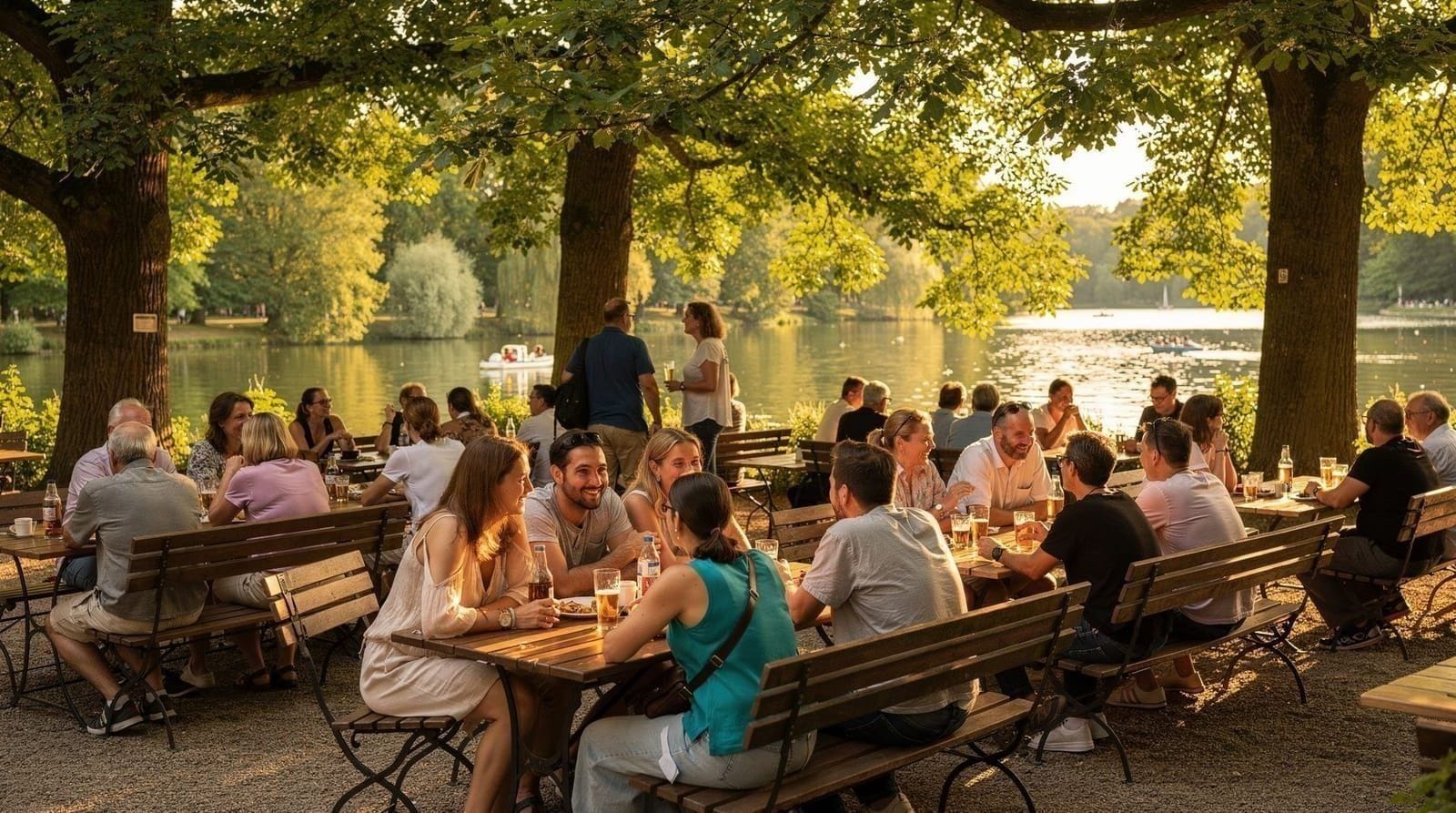
Inside the tower and immediately around it, a restaurant and biergarten operate seasonally. The biergarten is the more appealing option on a warm afternoon — you can sit among the trees with a beer and look out over the hills. The restaurant is reliable for traditional German food if the beach options at Strandbad do not appeal.
For those who enjoy longer walks, the Müggelberge trail network connects westward through the Köpenicker Stadtforst and can be extended into half-day or full-day hiking loops. This is good territory for the kind of unhurried forest walking that the Grunewald forest also provides but without the weekend crowds. Autumn visits — September and October — reward you with turning foliage and dramatically quieter trails.
Sailing and SUP on Müggelsee
Several sailing clubs have operated on the north shore of Müggelsee for decades, and the lake is considered one of the better sailing venues within easy reach of Berlin. The absence of motorboats means consistent, uninterrupted sailing conditions on windy days, and the size of the lake — 8 km in length — provides enough fetch to make it interesting.
Stand-up paddleboarding has grown considerably over the past decade. SUP board rental operates seasonally from the Friedrichshagen shore; the season typically runs May through September depending on weather. No advance booking is usually required on weekdays, but popular summer weekends can see boards hire out early.
This makes Müggelsee a natural complement to other water-based experiences around Berlin. If you have already explored the Spreewald by canoe or kayak, Müggelsee offers a change of register — a proper open lake rather than the tight network of canals and channels that characterises the Spreewald. Both are worth doing on a multi-day trip that includes the Spreewald region.
For a quieter paddle, the Müggelspree channel connecting the lake to the Spree proper is also navigable by SUP or kayak and is a peaceful stretch of water — wooded banks, occasional houseboats, very little traffic.
Köpenick: the town that makes the trip rounder
Few visitors who come specifically to Müggelsee bother to spend time in Köpenick itself, which is a small but real loss. The Altstadt Köpenick — old town — sits on a tongue of land between the Spree and the Dahme rivers, connected to the mainland by short bridges. It is compact, walkable in 30–40 minutes, and has the feel of a small provincial town that happens to sit within a major European capital.
The centrepiece of the old town is Köpenick Palace (Schloss Köpenick), a late 17th-century baroque building on its own small island. The palace houses the Kunstgewerbemuseum’s collection of decorative arts — silverware, furniture, and applied arts from the Renaissance through to the 18th century. Note that the palace has been undergoing restoration in recent years; verify current opening status before including it in firm plans.
The larger piece of local folklore is the story of Wilhelm Voigt, known as the “Captain of Köpenick.” In 1906, Voigt — a cobbler with a criminal record — bought a second-hand Prussian military captain’s uniform, commandeered a squad of soldiers he encountered on the street, marched them to Köpenick’s town hall, and had the mayor arrested on the grounds of suspected financial irregularities. He then demanded the municipal treasury. The soldiers followed his orders without question, because he wore a uniform. Voigt was eventually caught, imprisoned, and later pardoned by Kaiser Wilhelm II — who apparently found the whole episode funny. The story became a celebrated play by Carl Zuckmayer and remains one of the most quoted illustrations of the Prussian habit of obedience to authority. A statue of Voigt stands in front of the old town hall.
Combining a morning at Müggelsee with an afternoon in Köpenick old town gives the day a satisfying range of scale — open water and forest, then compressed history and a beer in a riverside café.
Comparing Müggelsee with Berlin’s other lakes
Berlin has a considerable number of lakes, and it helps to know how Müggelsee sits relative to the alternatives. A full comparison is in the Berlin lakes swimming guide, but the short version is this:
Wannsee is the most famous and has excellent facilities, but it is also the most crowded on summer weekends and sits in a wealthier residential district that feels somewhat curated. It is closer to the centre from the southwest (S1/S7 to Nikolassee or Wannsee).
Tegeler See in the northwest is easier to reach from central and northern Berlin, smaller and more sheltered, and popular with families. Less of the open-water feel that Müggelsee provides.
Schlachtensee and Krumme Lanke in the southwest are small, quiet, and beautiful, but deliberately low-capacity.
Müggelsee’s distinguishing features are its size — genuine sailing conditions and open horizon — and its forest hinterland, which gives a half-day visit more variety than any of the other Berlin lakes. It is also the lake most likely to have a quiet corner even on a warm weekend, simply because of its sheer surface area and the effort required to reach it.
| Lake | Distance from centre | Character | Best for |
|---|---|---|---|
| Müggelsee | 45–55 min (S3 + tram) | Large, forested, open water | Full-day escape, sailing, hiking |
| Wannsee | 30–40 min (S1/S7) | Grand, well-facilitated, busy | Classic lido feel, families |
| Tegeler See | 30–35 min | Sheltered, family-friendly | Easier half-day with kids |
| Schlachtensee / Krumme Lanke | 25–30 min | Small, quiet, wooded | A quick swim without the trek |
Month by month: when to go
June–August is peak swimming season — warm water, all facilities open, the ferry running, and the busiest weekends at Strandbad Müggelsee. Weekday mornings before 11 am stay manageable even in August. September–October shift the balance toward the forest: cooler water, thinning crowds, and the Müggelberge trails at their best as the foliage turns — this is the season locals quietly prefer. May is a good compromise: the SUP and sailing season is starting, the ferry usually begins running, but the beach is still uncrowded. November–March the lake is mostly for walkers; the Müggelturm restaurant keeps shorter hours, the ferry stops, and swimming is not realistic, but a cold, quiet forest walk followed by a hot drink at the tower has its own appeal.
Practical information
Getting there: S3 to Friedrichshagen (30 min from Alexanderplatz), then tram 60/61 to north shore, or S3 to Köpenick plus tram 68 to Strandbad. Budget 45–55 minutes from the centre.
Strandbad Müggelsee: Entry approximately €3–4. Seasonal lifeguards. Changing rooms and showers. Tram 68 from Köpenick.
North shore free bathing: No facilities, no fee. Accessible on foot from Friedrichshagen tram stop.
Müggelturm: Entry approximately €2.50. Restaurant and biergarten at the summit. 30-minute walk from Strandbad through the forest, or take the seasonal ferry to Rahnsdorf and approach from the east.
Ferry: Stern und Kreisschiffahrt seasonal service, Friedrichshagen to Rahnsdorf. BVG transport tickets valid.
Water quality: Monitored and published at berlin.de/badeseen. Consistently good. No swimming during heavy rain events.
Rübezahl restaurant: Traditional German, directly on the south shore. Busy on summer weekends; reservations advisable.
Wild camping: Not permitted anywhere on the lake shore or in the Müggelberge forest.
Best months: June–August for swimming. September–October for forest walking. The ferry and most rentals operate May–September.
A realistic day plan
A workable rhythm for a first visit: leave central Berlin by mid-morning, arrive at Strandbad Müggelsee or the north shore by around 10:30, and swim or relax through midday before the crowds peak. Early afternoon suits the walk up to the Müggelturm — the 30-minute forest climb is more comfortable before the day’s heat sets in, and the biergarten at the top makes a natural lunch or coffee stop. Come back down by mid-afternoon, catch the seasonal ferry back to Friedrichshagen if you approached from Rahnsdorf, and use the tail end of the day for Köpenick’s Altstadt — the palace exterior, the Voigt statue, and a drink by the river before heading back into the city. Compressing this into half a day is possible but tight; the honest version of the trip wants five to seven hours, door to door.
For those extending the day further, an early-evening return via Friedrichshagen lets you walk Bölschestraße one more time when the day-trippers have thinned out and the cafés settle into a quieter, more local rhythm — arguably the best single hour of the whole visit.
A three-day Berlin itinerary might reasonably dedicate one full day to southeast Berlin, combining Müggelsee with Köpenick old town. If you are spending a summer in Berlin or based in the city for longer, Müggelsee works well as a recurring destination — the north shore in the evening after work, a proper Sunday at the Strandbad, a forest walk in September when the crowds are gone.
The distance that puts many people off is the same thing that makes it worthwhile. Müggelsee is far enough from the centre to feel like a real escape, and large enough that it never quite feels overrun. That combination is rarer in a city this size than it might appear.
Frequently asked questions about Müggelsee guide
How do I get to Müggelsee by public transport?
Take the S3 from Alexanderplatz to Friedrichshagen (about 30 minutes), then tram 60 or 61 two stops to Müggelseedamm for the north shore, or continue to Köpenick and take tram 68 to reach Strandbad Müggelsee on the south shore. Total journey time from central Berlin is 45–55 minutes. There is no fast route — this is a genuine outer-Berlin destination.Is swimming at Müggelsee safe?
Yes. Müggelsee is officially designated for swimming, and water quality is monitored throughout the season. Results are published at berlin.de/badeseen. The lake reaches up to 8 metres deep but the bathing areas are well-marked and lifeguarded at Strandbad Müggelsee in peak season. Avoid swimming during or immediately after heavy rain when runoff can affect quality.Does Strandbad Müggelsee charge an entry fee?
Yes. Strandbad Müggelsee on the south shore charges around €3–4 for entry in peak season, which covers use of the changing rooms, showers, and the supervised beach area. The free bathing spots on the north shore near Friedrichshagen have no facilities but are popular with locals who want to avoid both the crowds and the fee.How do I get to the Müggelturm?
The Müggelturm observation tower stands in the Müggelberge hills southwest of the lake. You can walk from Strandbad Müggelsee in about 30 minutes through the forest, or take the seasonal ferry from Friedrichshagen across the lake to Rahnsdorf and walk from there. Entry to the tower is around €2.50. There is a restaurant and biergarten at the top.Can I hire SUP boards or kayaks at Müggelsee?
SUP board rental is available seasonally from Friedrichshagen on the north shore. Several sailing clubs also operate on the north shore and offer courses for beginners. Motorboats are not permitted on Müggelsee, which keeps the water calm and makes it genuinely pleasant for paddling.Is wild camping allowed at Müggelsee?
No. Wild camping is prohibited on the lake shore and in the surrounding Müggelberge forest. The Berliner Forsten — the city's forest authority — actively enforces this. Day visitors are welcome everywhere, but overnight stays outside designated campgrounds are not permitted.What else is there to do in Köpenick while visiting Müggelsee?
Köpenick's Altstadt — old town — sits on an island at the confluence of the Spree and Dahme rivers and is worth an hour of exploration. Köpenick Palace houses a museum of decorative arts, though it has been closed for restoration in recent years; check the current status before visiting. The town is also the setting of the famous "Captain of Köpenick" story from 1906, in which Wilhelm Voigt impersonated a Prussian officer and commandeered City Hall — a piece of Berlin folklore captured in a popular play and film.What is the best season to visit Müggelsee?
June through August for swimming, with the busiest weekends in July and August. Arrive before 11 am on warm summer Saturdays to avoid the worst crowds at Strandbad. September and October are excellent for the Müggelberge forest walks when the foliage turns, the lake is quieter, and the Rübezahl restaurant is less frantic. Winter visits are possible — the forest is atmospheric in frost — but the ferry and most rentals do not operate.How does Müggelsee compare to Wannsee for a first-time visitor?
Wannsee is closer, more polished and easier for a half-day trip, while Müggelsee is larger, wilder and better suited to a full day that combines swimming with forest hiking and Köpenick's old town. First-time visitors short on time often prefer Wannsee; those with a full day free and an interest in nature tend to find Müggelsee more rewarding.