Swimming in Berlin's lakes — the complete guide
Where can you swim in Berlin?
Berlin has more than 50 designated Badegewässer (bathing lakes) within the city limits. The most popular are Strandbad Wannsee (Germany's largest inland lido, entry around €6), Schlachtensee (free, S-Bahn direct), and Krumme Lanke (free, U3 direct). Most lakes are clean enough to swim in from June through August. Water quality is checked weekly and published at berlin.de/badeseen.
Quick answer: Berlin has over 50 designated swimming lakes within its city limits. Strandbad Wannsee is the big famous lido (entry around €6, huge sandy beach). Schlachtensee and Krumme Lanke are the local favourites — free, clean, and easy to reach by S-Bahn and U-Bahn respectively. Swimming season runs June through August; check weekly water quality reports at berlin.de/badeseen before you go.
| Best overall | Strandbad Wannsee — lido facilities, around €6 |
| Best free option | Schlachtensee — S-Bahn direct, no entry fee |
| Best U-Bahn access | Krumme Lanke — U3 terminus, quieter |
| Season | June 1 – August 31 (Badesaison) |
| Water temp (peak) | 19–24°C in July/August |
| Check before going | berlin.de/badeseen (weekly quality report) |
Berlin is a city built around water
Most visitors think of Berlin as a land-locked city of museums and nightlife. That impression is wrong. The city has around 180 lakes within its administrative boundary, more than 1,700 kilometres of rivers and canals, and a long, deeply embedded tradition of outdoor swimming that stretches back well over a century.
On a hot July day, a significant portion of Berlin’s population is not in the city at all — it is in the Grunewald forest, lying on the banks of Schlachtensee or floating in the shallows of Krumme Lanke. This is not a weekend escape to the countryside; these lakes are inside the city. Some are reachable by U-Bahn.
This guide covers the lakes that actually matter for visitors: where they are, how to get there, what they cost, how crowded they get, and what to know before you go.
Strandbad Wannsee — the great Berlin lido
The beach
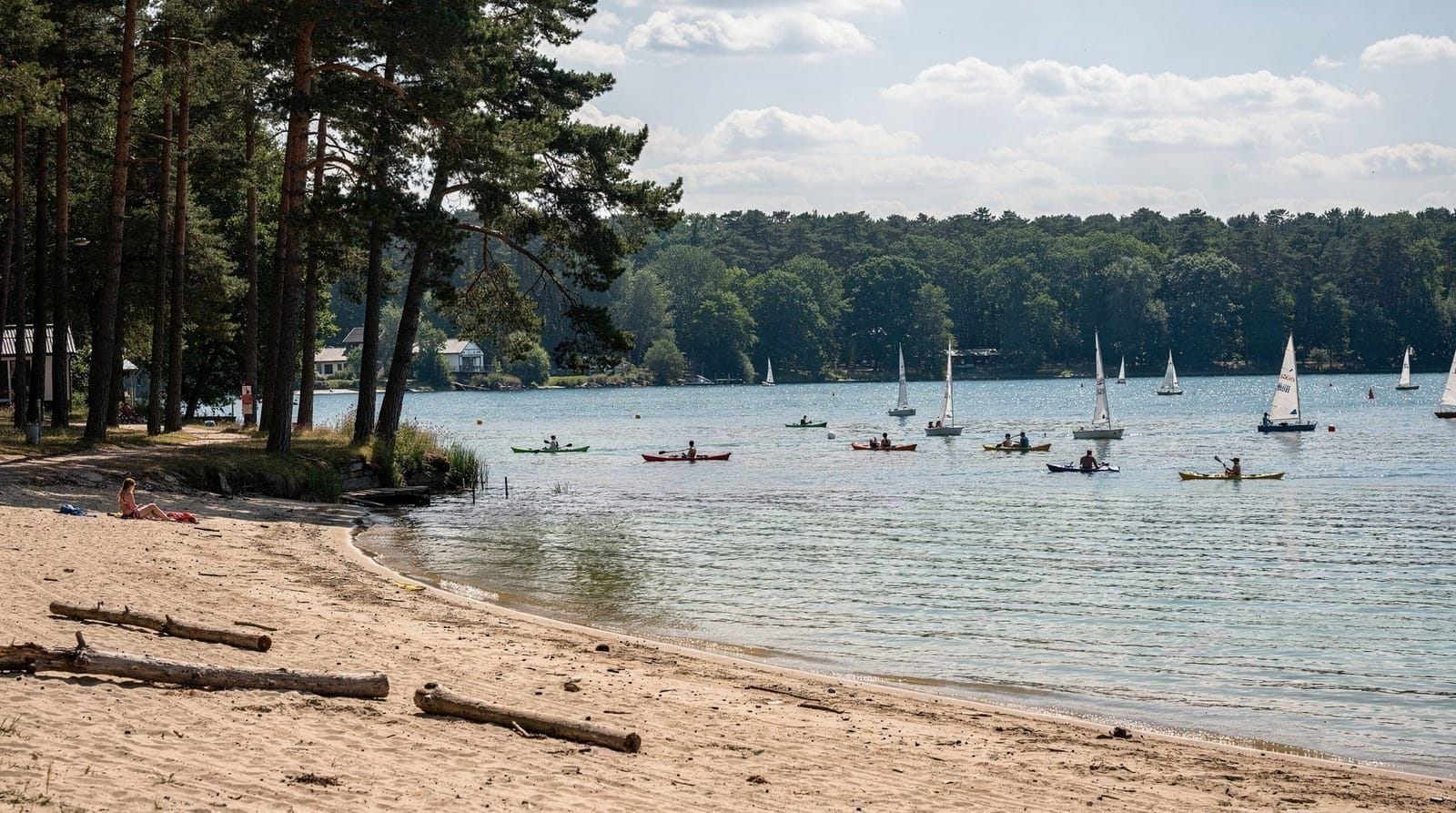
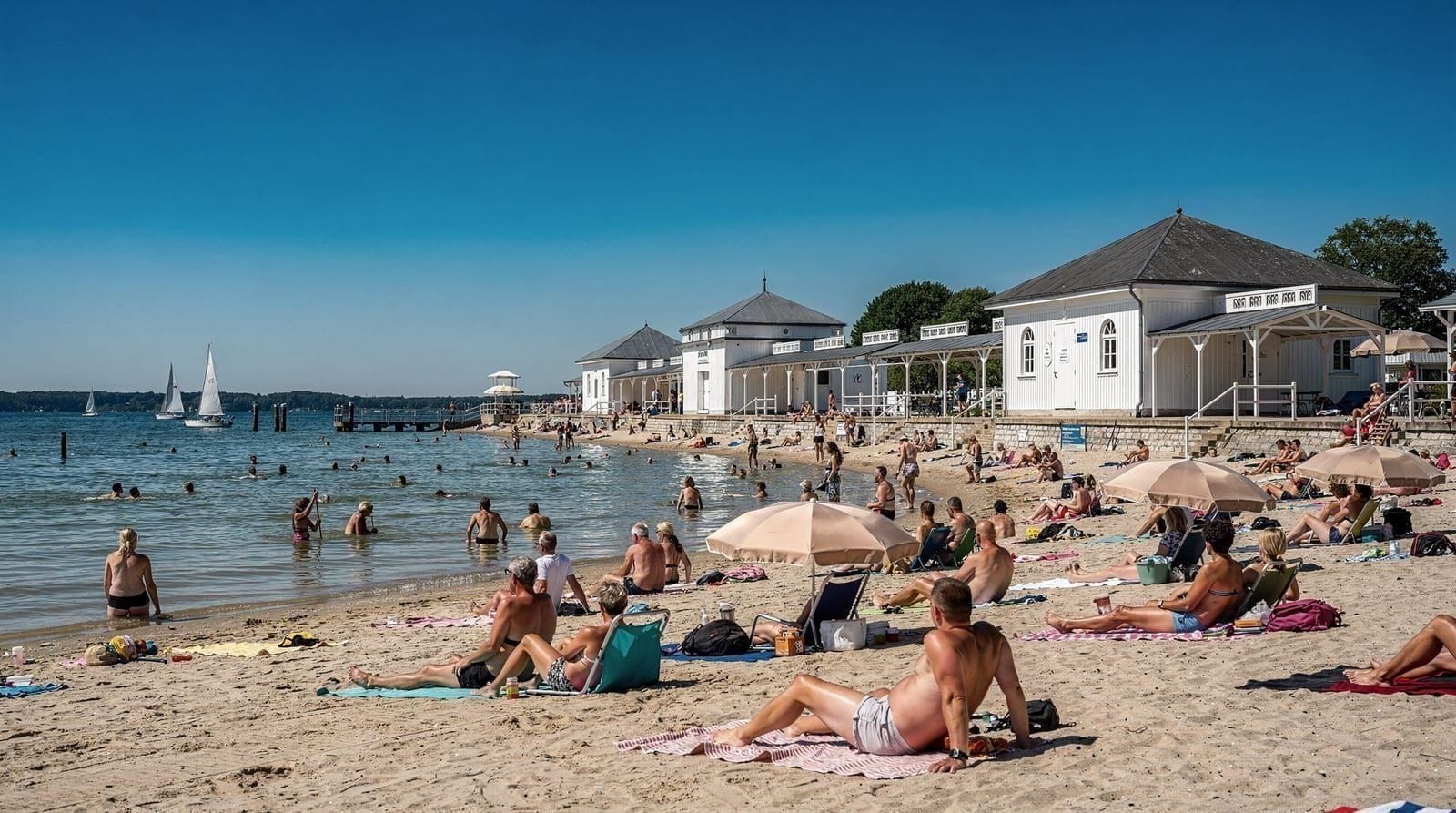
Wannsee is where Berlin swimming begins, historically and symbolically. Strandbad Wannsee opened in 1907 and at its peak in the 1920s was receiving a million visitors per summer. Today it remains Germany’s largest inland lido — 1,275 metres of sandy beach on the western shore of the Großer Wannsee, wide enough to absorb a serious crowd.
The beach is real sand, not gravel. It slopes gently into the water over a long, shallow stretch, making it genuinely good for children and non-swimmers. The water temperature in July and August typically sits between 20°C and 24°C — warm enough to spend hours in without discomfort.
Facilities
This is the most facilities-rich swimming spot in Berlin by a considerable margin. Changing rooms and coin-operated lockers, multiple snack bars and a sit-down restaurant, volleyball courts, table tennis, a dedicated paddling pool for young children, and professional lifeguards on duty throughout opening hours. There is also wheelchair-accessible entry to the water, making Strandbad Wannsee the best-equipped lake in the city for visitors with mobility requirements.
Entry and opening hours
Entry costs around €6 for adults and €3 for children (prices should be confirmed at the FBB website before visiting, as they adjust slightly each season). The lido is typically open from late May or early June through September, roughly 10am to 7pm, weather permitting. On overcast or cold days it may open later or close early.
How to get there
Take the S1 or S7 to Wannsee station. From there, bus 114 runs to the lido directly — about 10 minutes. Alternatively, it is a 20-minute walk through a pleasant residential area. The lake is also popular with cyclists; Berlin’s bike hire network is a reasonable option if you are combining the lake with a wider Grunewald ride.
You need an ABC zone BVG ticket for Wannsee — a standard AB day ticket does not cover it. Factor that in when planning.
The crowds problem
Strandbad Wannsee gets extremely crowded on hot summer weekends. Extremely. On a Saturday in July when temperatures exceed 30°C, queues form at the entrance gate before noon and the beach becomes genuinely packed. If you want a good spot, arrive before 10am, ideally earlier. Alternatively, come on a weekday morning — the difference between a Wednesday at 9am and a Saturday at 1pm is night and day.
If you arrive after midday on a hot weekend and find a long queue, seriously consider getting back on the S-Bahn and heading to Schlachtensee instead. The crowd dynamics at Wannsee can tip from pleasant to oppressive very quickly in peak conditions.
The quieter alternative: Kleiner Wannsee
A short walk from the main lido, the Kleiner Wannsee (Small Wannsee) offers free swimming with no facilities and considerably fewer people. It is the same general area, the same transport connection, but a completely different atmosphere — just a quiet stretch of bank and water. Good for those who want the Wannsee location without the lido infrastructure.
A historical note
The Wannsee Conference Memorial — the Haus der Wannsee-Konferenz where Nazi officials coordinated the Final Solution in January 1942 — is a 20-minute walk from the lido. It is an important site and a serious, emotionally heavy place. If you want to visit both in the same day, plan the memorial visit separately and deliberately; do not tack it onto the end of a beach afternoon without thinking about it. The two experiences do not sit comfortably together and each deserves its own time and attention.
Schlachtensee — the local favourite
Why locals choose Schlachtensee
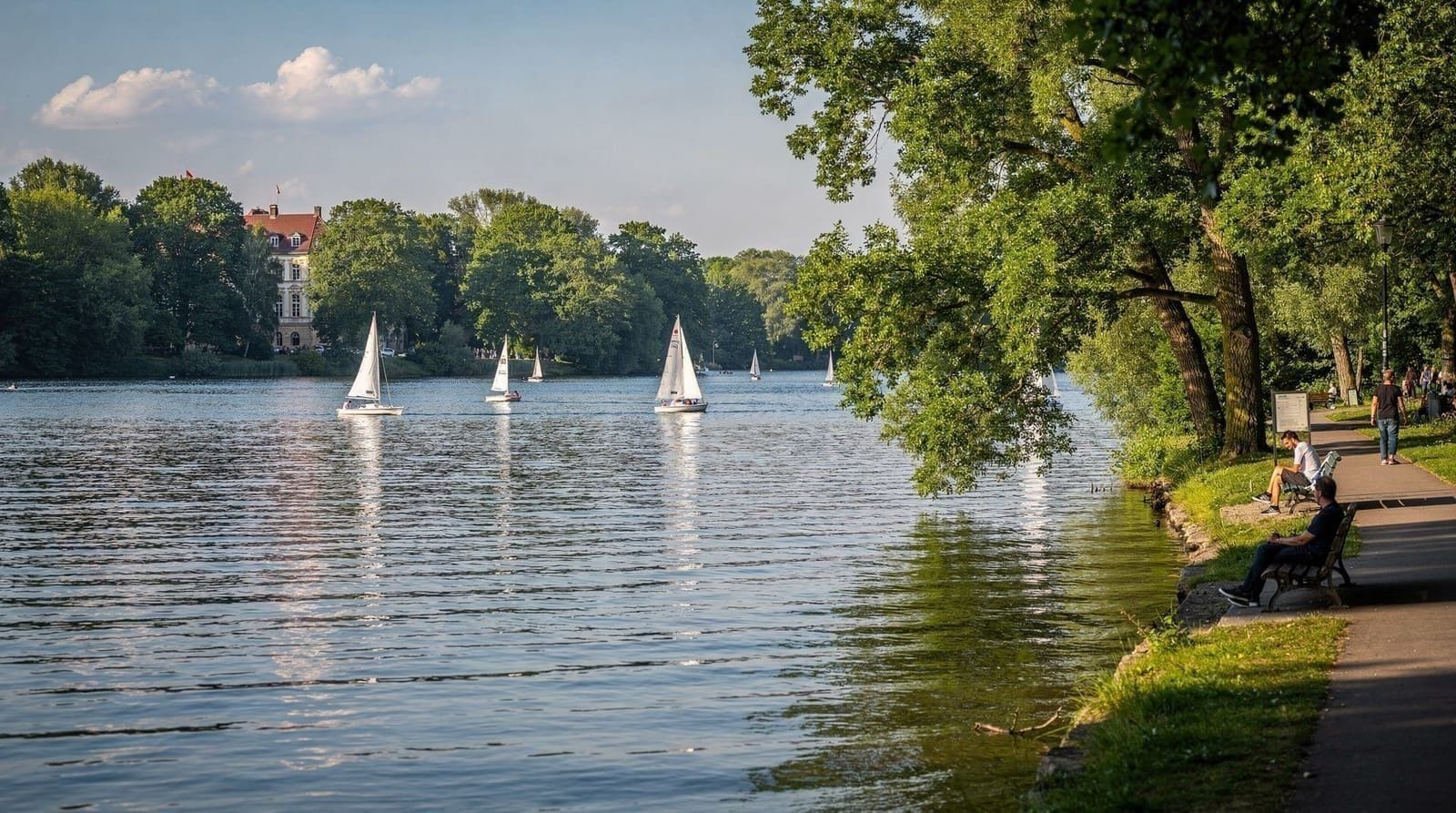
If you ask a Berliner where they actually swim, most will say Schlachtensee. It is long and narrow, set in the forested Grunewald area of southwest Berlin, and it has none of the lido infrastructure or entrance fees that Wannsee has — which is most of the point. You walk down from the S-Bahn station, find a spot on the bank, and swim. That is the entire transaction.
The lake is about 3.5 kilometres in circumference and the flat, shaded path around it takes around 45 minutes to walk at a relaxed pace. Many Berliners combine a morning swim with a full circuit of the lake — this is a genuinely pleasant way to spend a summer morning, and the forest keeps the path cool even in hot weather.
Access
The S1 stops at Schlachtensee station, from which the lake is a five-minute walk. This is one of the easiest lake access points in the city — no bus connection needed, no transfers from the main lines. An AB zone BVG ticket covers the journey from central Berlin.
Water quality
Schlachtensee is officially designated as a Badegewässer and its water quality is generally very good. Check berlin.de/badeseen before you go — the weekly report covers Schlachtensee specifically. Blue-green algae can appear in hot, airless summers; if the water looks greenish or has an unusual smell, heed the warning flags and do not swim that day.
Café Schlachtensee
At the north end of the lake, Café Schlachtensee has a terrace that becomes one of the more pleasant places to sit in Berlin on a summer afternoon. It is not a destination in itself but a good reason not to rush away after your swim. Coffee, cold drinks, basic food. The terrace fills up quickly on sunny weekends.
FKK and dogs
The southern end of Schlachtensee has a designated FKK (naturist) section. This is nothing unusual in Berlin — it is respected by other visitors and operates without fuss. Dogs are permitted in an area near the northern end; there is informal dog-swimming that local dog owners use regularly.
Walking to Krumme Lanke
One of the better short walks in the Grunewald is the 30-minute forest path connecting Schlachtensee to Krumme Lanke. Both lakes, a forest walk between them, and a U-Bahn station at the far end — this makes a natural half-day itinerary. Start at Schlachtensee station (S1), swim and walk the circuit, take the forest path to Krumme Lanke, swim again if you feel like it, then take the U3 home. No car needed.
Krumme Lanke — the U-Bahn lake
A quieter, wilder lake
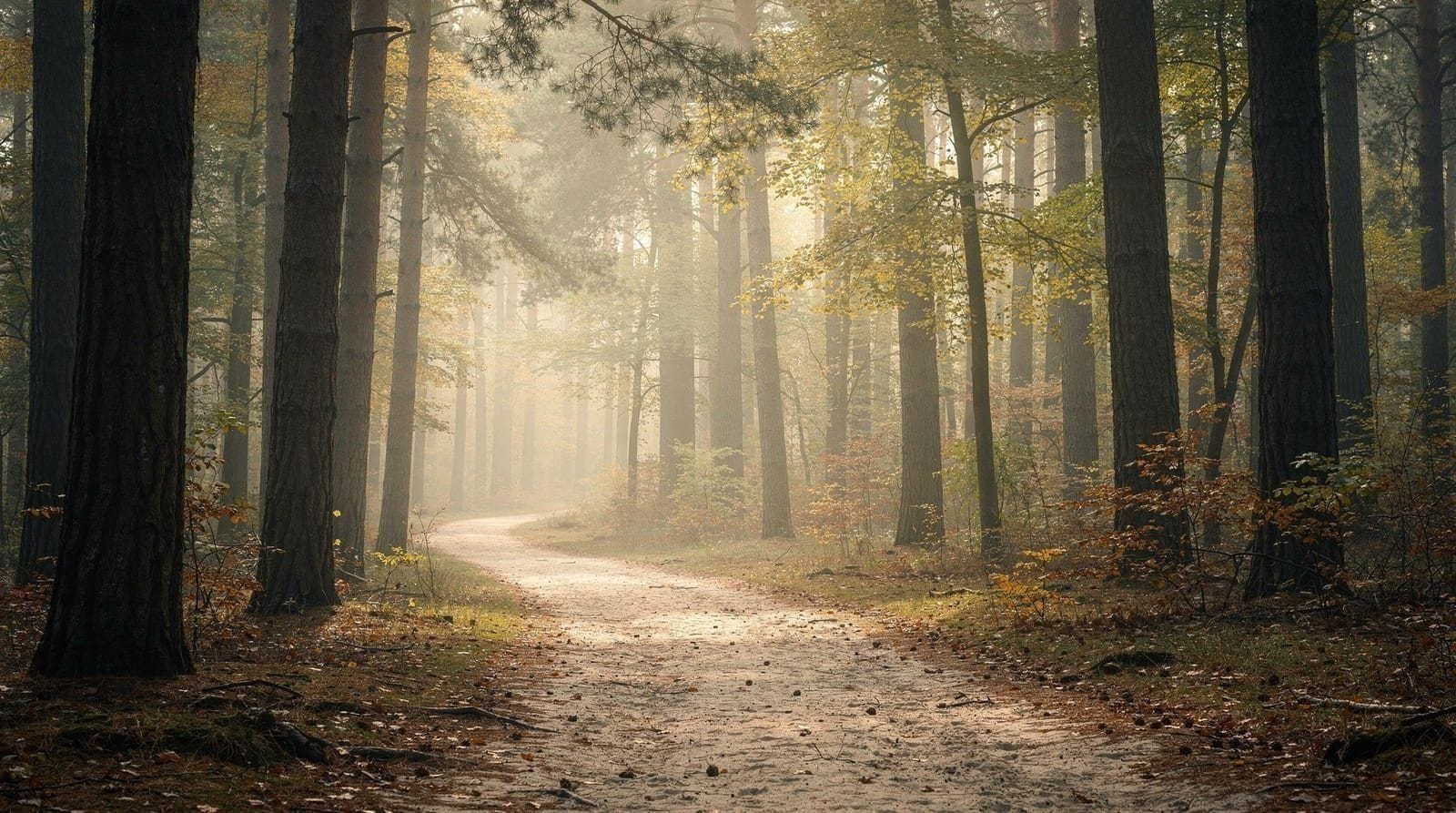
Krumme Lanke is the smallest of the main Grunewald lakes and the most wooded. There are no facilities — no changing rooms, no snack bars, no lifeguards — just a lake with forested banks, clear-ish water, and significantly fewer visitors than either Wannsee or Schlachtensee on most days. It attracts Berliners who want to swim without company and who are happy to bring their own towel, water and food.
The banks are narrow in places and genuinely forested — you are not lying on a sandy beach here. Bring a ground mat or towel. The entry points are well-worn paths through the trees.
Access
Krumme Lanke has a particular distinction: it is the only Berlin swimming lake served directly by U-Bahn. Take the U3 to Krumme Lanke — the last stop on the line — and the lake is a five-minute walk. This makes it genuinely easy to reach from central Berlin without a car, and the fact that it is the end of the line means there is no through traffic passing the station.
An AB zone BVG ticket covers the journey from central Berlin. The U3 connects to the main network at Wittenbergplatz and Nollendorfplatz.
FKK sections
Krumme Lanke has naturist (FKK) sections on the west bank. As with Schlachtensee, these are clearly marked and not particularly notable — simply a section of the bank where textile-free swimming is the convention. The rest of the lake is mixed.
The forest walk connection
The 30-minute forest path to Schlachtensee (described above) runs from the north end of Krumme Lanke. This is the most pleasant way to visit both lakes in one day. The path is flat, shaded, and not signposted in a complicated way — you can find it without difficulty.
Halensee — swimming inside the city
An urban swimming lake
Halensee is unusual among Berlin’s swimming lakes in that it sits in Charlottenburg, essentially within the western inner city rather than in the forests of the southwest. It is small, with a modest beach area, but the fact that you can reach it from Zoo station in 15 minutes without leaving the urban fabric is genuinely useful.
Swimming here is free. The water quality is generally acceptable, though being in a more urban environment means it can be more variable than the Grunewald lakes. Check berlin.de/badeseen before visiting.
Access
S5, S7 or S9 to Halensee station, or U7 to Konstanzer Strasse. The lake is a short walk from either. For visitors staying in Charlottenburg or around the Kurfürstendamm area, this is the most convenient swimming option by some distance — you do not need to cross the city.
Weissensee — the cleanest lake in northeast Berlin
Why Weissensee matters
Most of Berlin’s famous swimming lakes are in the southwest, in the Grunewald area. Weissensee, in the Pankow district of northeast Berlin, is the main exception and it is worth knowing about if you are staying on that side of the city.
Weissensee is consistently rated as one of the cleanest lakes in Berlin, and the Weißensee Strandbad — the lakeside bathing area — is free to access. There is a sandy beach area with some basic infrastructure, and the lake is large enough to offer proper open-water swimming.
Access
Tram M4 from Alexanderplatz, around 30 minutes to the Weissensee area. This is slower than S-Bahn or U-Bahn, but the tram is a pleasant ride and the journey time is not prohibitive. AB zone BVG ticket covers it.
Practical information for all lakes
Water quality and checking reports
The single most important practical step before swimming in any Berlin lake is to check berlin.de/badeseen. The city publishes weekly water quality reports for all 55 designated Badegewässer throughout the Badesaison (June 1 to August 31). The reports give a current status for each lake: green or blue means water quality is good and swimming is recommended; red means swimming is not recommended.
The most common reason for a red flag is blue-green algae (cyanobacteria). This appears in hot, still weather — typically during heatwaves — on some lakes and can cause skin rashes and eye irritation. It looks like green paint or scum on the water surface and often has a distinctive musty smell. If you see it, do not swim, regardless of the official rating. Lakes can change status within days when algae blooms develop.
E. coli contamination is the other main cause of red flags, usually following heavy rainfall that washes runoff into the water. This clears more quickly than algae but is equally worth respecting.
The reports are in German but the colour coding is self-explanatory.
Safety and lifeguards
Lifeguard coverage varies enormously between lakes, and this matters more than most visitors expect. Strandbad Wannsee has professional DLRG-trained lifeguards on duty throughout opening hours, patrolling the designated swimming area and enforcing buoy-marked limits for how far out you can swim. Schlachtensee, Krumme Lanke, Halensee and Weissensee have no lifeguards at all — you are swimming at your own risk, as is normal for open-water lake swimming across Germany. This does not mean the unsupervised lakes are dangerous, but it does mean the usual open-water precautions apply: do not swim alone if you can help it, do not swim after alcohol, respect any buoys or signage marking boat lanes, and be realistic about your own fitness before attempting a long crossing. Weaker swimmers or families with young non-swimmers are better served at Wannsee, where the shallow, gently sloping sand and lifeguard presence provide a real safety margin the forest lakes cannot.
Water temperature
Expect around 17–19°C in early June, rising to 20–24°C through July and August. The lakes warm up faster than the sea and cool down faster after extended cloud cover. September can still be warm enough to swim in a good year, but water temperatures drop noticeably after mid-September.
There are no jellyfish in Berlin’s lakes. This is occasionally worth stating for visitors from coastal countries.
FKK — understanding Berlin’s naturist culture
FKK (Freikörperkultur, literally “free body culture”) is a tradition in Germany, and particularly in Berlin and the former East Germany, where it has roots stretching back to the early twentieth century. Designated FKK zones exist at most of the Grunewald lakes. They are clearly signposted and respected by other visitors — the convention is that you do not photograph people in these zones and you do not behave as if textile-free swimming is remarkable or entertaining.
For visitors unfamiliar with FKK culture, the easiest summary is this: it is simply a section of the lake where people swim without swimwear. Nobody pays it particular attention. You do not need to use it, and if you want to avoid it, the zones are marked and easy to walk past.
Transport and BVG tickets
All the lakes in this guide are reachable without a car using BVG public transport. Key ticket note: Wannsee falls in BVG zone C, meaning an AB zone day ticket (the standard one) does not cover it. You need an ABC zone ticket, which costs slightly more. Schlachtensee, Krumme Lanke, Halensee and Weissensee are all within the AB zone.
Berlin’s summer is the right season to buy a weekly or monthly BVG pass if you are staying more than a few days — the maths typically favours it over individual day tickets.
Cycling is an excellent way to reach several of the Grunewald lakes, particularly if you are combining a lake swim with a ride through the forest. See the Berlin bike rental guide for hire options.
Renting a boat or paddleboard
Beyond swimming, several lakes offer boat and paddleboard rental in the warmer months. Kiosks near Strandbad Wannsee and Schlachtensee typically rent pedal boats, rowing boats and stand-up paddleboards, priced by the half-hour or hour, usually with ID or a cash deposit held at the counter. Prices and availability shift year to year and depend heavily on weather, so treat any figure you see quoted elsewhere as approximate and confirm on arrival. Krumme Lanke and Halensee do not have formal rental kiosks — bring your own inflatable if you want more than a swim. Paddling around the edge of Schlachtensee at sunset, away from the crowds, is one of the better low-key things to do with a Berlin summer evening.
What to bring
The lake essentials differ depending on where you go:
Strandbad Wannsee: You can travel relatively light. The lido has changing rooms, lockers (bring coins), and multiple food and drink outlets. Bring a towel and sunscreen; everything else is available on site.
Schlachtensee: No changing rooms or lockers. Bring a towel, all your food and drink (or plan to visit Café Schlachtensee for post-swim refreshment), and something to lie on if you want to sit comfortably on the bank. There are basic toilets at the north end.
Krumme Lanke: Bring everything. No facilities at all. Water, food, towel, mat, sunscreen. Plan to be self-sufficient for the duration of your visit.
All lakes: Sunscreen is consistently underestimated at Berlin’s lakes — the water reflection and open banks mean you can burn faster than you expect, particularly in late June and July. Bring more than you think you need.
Winter and cold-water swimming
Outside the official Badesaison, a small but committed group of Berliners keeps swimming through the cold months — Eisbaden (ice bathing) has a genuine local following, particularly around New Year. You will occasionally see swimmers at Schlachtensee or Wannsee in December and January, usually in short, deliberate dips followed by a hot drink rather than a leisurely swim. This is not something to attempt casually: cold-water shock is a real risk for anyone unprepared, and it should only be tried with people who know what they are doing, ideally as part of an organised local group. For the vast majority of visitors, the lakes are a June-to-August activity, and that is the sensible window to plan around; see Berlin in winter for what to do instead when the lakes are too cold.
Accessibility
Strandbad Wannsee is the only lake in this guide with proper accessibility infrastructure — accessible entry to the water, accessible changing facilities, and relatively level ground throughout the lido. The Grunewald lakes (Schlachtensee, Krumme Lanke) have uneven, natural banks and no dedicated accessibility provision.
Planning a lake day in Berlin
Half-day options
The most efficient half-day swim in Berlin: take the S1 to Schlachtensee, walk the circuit (45 minutes), swim, have a coffee at Café Schlachtensee, and take the S1 back. This takes three to four hours and involves no logistical complexity.
For families with young children, Strandbad Wannsee is the more practical choice despite the crowds: the paddling pool, lifeguards, food on site, and long shallow beach make it a better environment for small children than the unmanaged banks of the Grunewald lakes.
Full-day lake itinerary
S1 to Schlachtensee — morning swim and lake circuit. Forest walk to Krumme Lanke (30 minutes). Second swim at Krumme Lanke. U3 back to central Berlin via Nollendorfplatz. This is a genuinely satisfying day that covers the best of the southwest lakes without a car.
For more structured ideas about how to build a Berlin itinerary that includes the lakes alongside museums and city sights, see Berlin in three days and Berlin family day trips.
Combining lakes with other nature
The Grunewald lakes sit within a large forested area that connects to many of the city’s best green-space experiences. The Grunewald forest guide covers the wider area in depth. Tegeler See and Müggelsee are the two other major Berlin lakes worth knowing about — both larger, both in different parts of the city, and both with their own swimming areas.
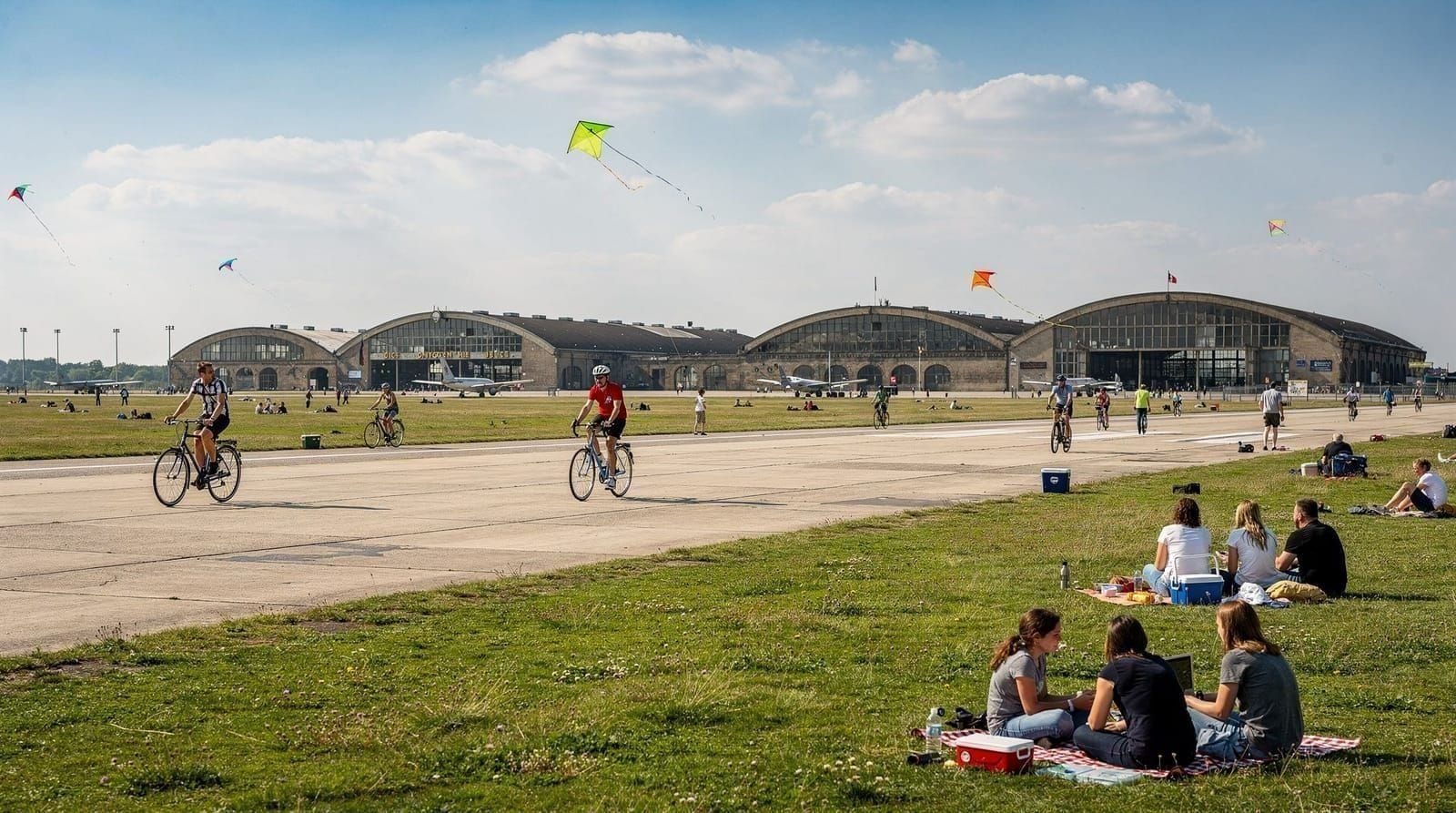
If you are visiting with children, the Berlin with kids guide has a section on lake days and what works best for different age groups. The Tiergarten and Tempelhof field are good complementary options for days when the weather does not quite justify swimming.
Lakes compared at a glance
| Lake | Cost | Access | Best for |
|---|---|---|---|
| Strandbad Wannsee | ~€6 adults, ~€3 children | S1/S7 to Wannsee + bus 114 | Families, facilities, lifeguards |
| Schlachtensee | Free | S1 direct, 5-min walk | Locals, lake-circuit walk, quiet mornings |
| Krumme Lanke | Free | U3 to the last stop | Wildest setting, fewest crowds |
| Halensee | Free | S5/S7/S9 or U7 | Central location, no forest trip needed |
| Weissensee | Free | Tram M4 from Alexanderplatz | Northeast Berlin, cleanest water rating |
When each lake gets crowded
Crowding at Berlin’s lakes follows a predictable rhythm, and knowing it saves a wasted trip. Strandbad Wannsee is worst on hot Saturdays and Sundays between noon and 5pm — this is when the entrance queue forms and the beach genuinely fills up. Weekday mornings before 10am are close to empty even in a heatwave. Schlachtensee gets busy on sunny weekend afternoons too, but because there is no entrance gate, “busy” simply means finding a bank spot takes a few extra minutes rather than queuing outside. Krumme Lanke rarely feels crowded even on the hottest days, since its lack of facilities and forested banks naturally cap the numbers who bother making the trip. Halensee, being the most central, sees steady local use after work on warm evenings rather than the tourist-heavy weekend spikes of Wannsee. If your visit lands on a peak weekend, the Grunewald lakes (Schlachtensee, Krumme Lanke) are the more reliable choice over the more famous but more crowded Wannsee.
Renting equipment at the lakes
A handful of the lakes rent basic gear in season — pedal boats and stand-up paddleboards are available at kiosks near Schlachtensee and Wannsee in the warmer months, typically priced by the half-hour with a deposit or ID held at the counter. Availability and exact pricing shift year to year and are weather-dependent, so treat any figure as a rough guide and confirm on arrival rather than planning around it. None of the smaller lakes (Krumme Lanke, Halensee) have formal rental kiosks — bring your own inflatable or simply swim.
Frequently asked questions about Swimming in Berlin's lakes
Which is the best lake for swimming in Berlin?
For a classic lido experience with facilities, lifeguards and a long sandy beach, Strandbad Wannsee is the answer. For a quieter, free swim that locals actually use, Schlachtensee or Krumme Lanke are better choices. Weissensee is the cleanest lake in northeast Berlin and worth the tram ride from Alexanderplatz.Is it free to swim at Berlin's lakes?
Most lakes are completely free — Schlachtensee, Krumme Lanke, Halensee and Weissensee all charge nothing. Strandbad Wannsee charges an entry fee of around €6 for adults and €3 for children; in exchange you get a 1,275-metre sand beach, changing rooms, lockers, lifeguards and snack bars.When is swimming season at Berlin's lakes?
The official Badesaison runs from June 1 to August 31. Water quality reports are published weekly throughout the season. In practice, locals start swimming in late May when water temperatures reach around 18°C, and the season can extend into September in warm years. July and August are warmest, with typical water temperatures of 19–24°C.Is the water safe to swim in?
Usually yes, but always check berlin.de/badeseen before you go. Each designated lake is given a weekly quality rating — green or blue means fine, red means swimming is not recommended due to algae or bacteria. Blue-green algae (cyanobacteria) can appear in hot, still summers and cause skin rashes; it is the main reason a lake gets a red flag. The site is in German but the colour coding is self-explanatory.Are there naturist (FKK) sections at Berlin's lakes?
Yes, at most of the Grunewald lakes. FKK (Freikörperkultur — free body culture) is a genuine Berlin tradition, not a novelty. At Schlachtensee the FKK zone is at the southern end; at Krumme Lanke it is on the west bank. Zones are clearly marked and the convention is respected without drama by other swimmers. Nobody pays them particular attention.How crowded does Strandbad Wannsee get?
Very crowded on hot summer weekends — queues at the entrance gate before noon are common, and the beach fills up fast. Arrive before 10am to get a good spot and avoid the worst of the queues. Weekday mornings are considerably calmer. If you arrive after midday on a hot Saturday in July, consider heading to Schlachtensee or Krumme Lanke instead.Can I bring a dog to Berlin's lakes?
Dogs are permitted at designated sections of some lakes. Schlachtensee has an unofficial dog-swimming area that locals use. Strandbad Wannsee does not allow dogs on the main beach during opening hours. Check signs at the lake; the rule is usually indicated at the entrance.How do I get to the lakes from central Berlin without a car?
Schlachtensee is the most accessible — S1 direct to Schlachtensee station, five-minute walk, no changes needed from central Berlin. Krumme Lanke is the only lake served by U-Bahn, on the U3 to the final stop. Strandbad Wannsee takes the S1 or S7 to Wannsee, then bus 114 or a 20-minute walk. All three are reachable with a standard BVG day ticket (ABC zone for Wannsee, AB zone for Schlachtensee and Krumme Lanke).