Tempelhofer Feld — Berlin's vast former airport turned open park
What is Tempelhofer Feld and is it worth visiting?
Tempelhofer Feld is a 386-hectare former airport in central Berlin that has been a free public park since 2010. The three original runways are open for cycling, skating, and longboarding. There are community gardens, wildlife protection zones, designated BBQ areas, and weekend food stalls. Entry is always free. It is one of the most genuinely local experiences in Berlin — heavily used by residents and largely untouched by tourist infrastructure.
Quick answer: Tempelhofer Feld is a 386-hectare former airport turned free public park in central Berlin. The intact runways form a 6 km loop for cycling, skating, and longboarding. Community gardens, BBQ zones, kite-flying, and wildlife protection areas fill the rest of the space. There is no entry fee, ever. It is one of the most singular urban spaces in the world, and it costs nothing to experience it.
| Where | Tempelhof-Schöneberg, between Kreuzberg and Neukölln |
| Cost | free, always |
| Time needed | 2-4 hours, longer with a full runway circuit |
| Getting there | U6 Tempelhof or U8 Boddinstrasse |
| Best time | weekday mornings for quiet; weekends for atmosphere |
A park that should not exist — and almost did not
There are larger urban parks in the world. There are more manicured ones, better-equipped ones, ones with lake swimming and concert venues. But Tempelhofer Feld has something almost no other city park possesses: the uninterrupted, wind-swept openness of an airport that has not been redeveloped.
When Tempelhof Airport closed in October 2008, the city of Berlin held what it assumed would be a formality: a consultation on the future of 386 hectares of prime central land. The proposals that followed were not modest. Housing, a library, event spaces, retail — the kind of mixed-use development that cities routinely build on former industrial sites. In 2014, Berlin held a referendum to approve the development plan. The result was unambiguous: 64 percent of voters rejected it. The field would stay as it was.
Six years after closure, Tempelhofer Feld had already become one of the most used green spaces in the city. Berliners had quietly taken possession of the runways, the grass, and the open sky. They were not prepared to give it back.
The Tempelhof Act, passed after the referendum, now protects the field from development. The runways remain tarmac. The field remains flat and open. The access remains free.
What you experience when you walk through one of the entrances on Tempelhofer Damm is the result of that vote: an expanse of sky above central Berlin that, in almost any other city, would have become apartments by now.
Getting there and getting oriented
Tempelhofer Feld sits in the Tempelhof-Schöneberg district, bordered by Neukölln to the east and Kreuzberg to the north. By Berlin standards this is remarkably central — you are not heading out to a suburban park.
The most straightforward approach is the U6 to Tempelhof station. The main entrance on Tempelhofer Damm is a two-minute walk from the station exit. There are several other entrances around the perimeter; if you are coming from Neukölln, the U8 to Boddinstrasse deposits you near the southern entrance.
The field is open daily from dawn to dusk. Exact seasonal hours are posted at each entrance and on the city’s stadtgruen.berlin.de portal. Entry is free at all times and has always been free — there are no ticket booths, no membership requirements, and no paid zones inside.
At the main entrance you will find large map boards showing the runway circuit, the BBQ zones, the community garden areas, the wildlife protection zones, and the food stall locations (active at weekends). Take a photo of the map before you head in; the field is large enough that orientation matters on your first visit.
The runways — the main event
The three original runways are the defining feature of Tempelhofer Feld. They are intact. They have not been dug up, repurposed, or converted into anything else. They are simply old airport tarmac, now used by everyone except aircraft.
Together the runways form a continuous circuit of approximately 6 km. The tarmac is smooth — unusually smooth by urban cycling standards, with no potholes and no cobblestones. This makes Tempelhofer Feld exceptional for inline skaters and longboarders as well as cyclists. There is no gradient worth mentioning; the entire loop is effectively flat.
On a weekday morning in spring, cycling the runway circuit feels like a private experience. The field stretches away on both sides, the sky opens up above you, and the background noise of the city drops noticeably. On a warm Saturday afternoon the circuit is busy — families, training cyclists, groups of skaters — but the runways are wide enough that it rarely feels congested.
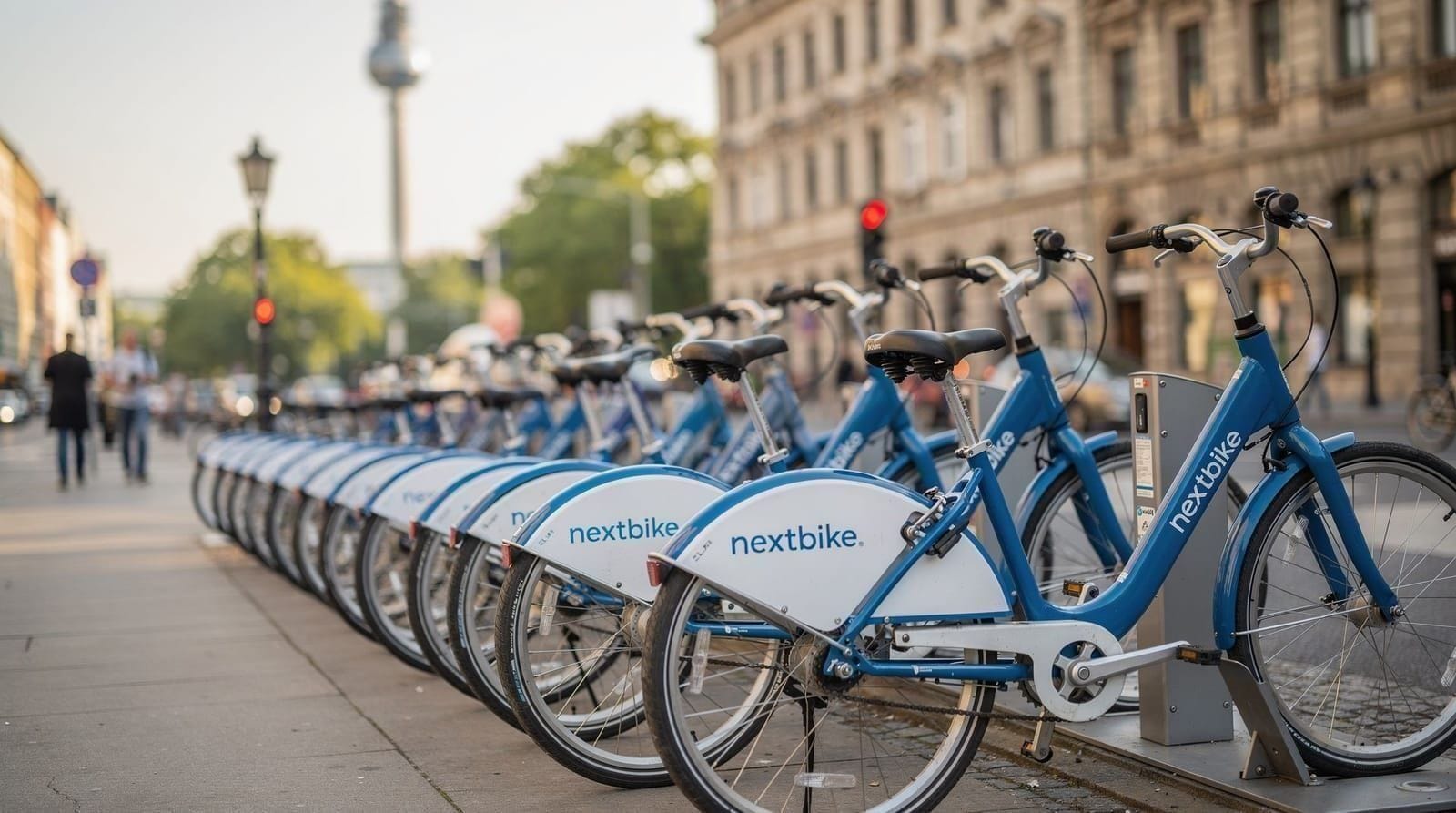
If you need a bike, do not plan on renting one inside the field. There is no rental operation on-site. The better approach is to hire from a shop in Kreuzberg or Neukölln before you arrive, both of which are walkable from the field’s perimeter. Our Berlin bike rental guide covers the options by neighbourhood, including shops near the Tempelhof entrances. If you are interested in a guided cycle experience around the broader city as well, the Berlin bike tours guide lists both self-guided and guided options.
For inline skaters who have not brought equipment: Sk8 House operates a seasonal rental near the main entrance on Tempelhofer Damm. Hours are weather-dependent, so check before relying on them — but on a good weekend they are reliably open.
Kite-flying, picnics, and what else you can actually do
The field is exposed and open in a way that most urban parks are not. There are no large trees in the runway zone to break the wind, which makes Tempelhofer Feld one of the most consistently good kite-flying spots in the city. Large delta kites and power kites are common sights on breezy weekends. If you are planning to bring a kite, this is the right place.
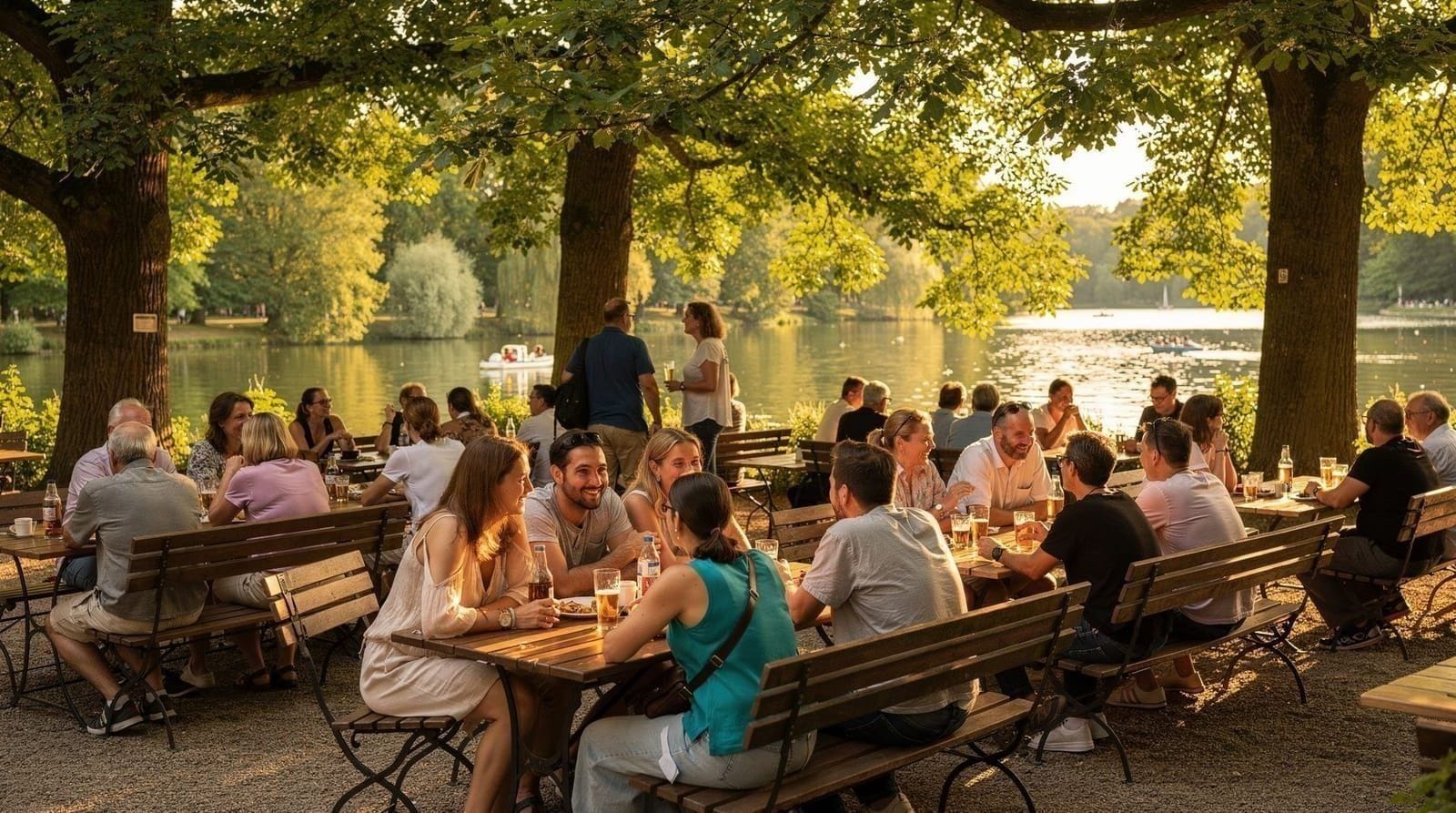
Picnicking is the dominant social activity. Berliners bring food, blankets, and sound systems and treat the field as an extension of their living rooms in warm weather. There are no permanent cafes or restaurants inside the park. On weekends, food trucks and stalls appear near the main entrances — expect currywurst, falafel, and similar street food. Outside of weekends, provision is minimal. Bring everything you need.
BBQ is permitted in designated zones marked on the entrance maps. The zones fill early on warm evenings. Disposable grills from supermarkets are the standard approach; wood-fire grills are also permitted. The prohibited zones — the runways, the grass areas, the wildlife protection areas — are clearly marked.
The community gardens, known as Gemeinschaftsgärten, occupy substantial portions of the field. Roughly 700 individual plots are rented to Berlin residents, who grow vegetables, herbs, and flowers in a patchwork of styles ranging from neat rows to near-wildness. The gardens are not open for the public to enter, but you can walk along the paths beside them. They are worth seeing — the contrast between the open industrial scale of the runways and the intensely personal scale of the individual plots is characteristic of what makes Tempelhofer Feld unusual.
Sports and other activities. Beyond cycling and skating, the field hosts informal football games on open grass sections, and several fixed volleyball nets are available on a first-come basis near some entrances. Model aircraft and drone flying is restricted to specific zones and requires checking current rules, since the field’s open sky also makes it attractive for radio-controlled hobbyists whose activity needs to be kept separate from cyclists and pedestrians. Running is popular year-round, with the flat, traffic-free runways offering one of the more pleasant long-distance routes in the city regardless of weather.
Events. The field occasionally hosts organised events — markets, festivals, and open-air fitness classes — mostly concentrated in the warmer months. These are announced on the stadtgruen.berlin.de portal and are worth checking if you want to time a visit around something specific, though the vast majority of your visit will likely be self-directed rather than event-based.
Wildlife and the protected zones
Between May and July, yellow tape cordons off sections of the grassland between the runways. These are active nesting zones for skylarks and lapwings — two species that require open, undisturbed grassland to nest, and which are increasingly rare in urban environments. Do not enter these zones during the season. The cordons are not excessive; you can see and hear the skylarks from the runway paths without approaching the nesting areas.
Outside nesting season the protected zones are open again. The management of the field involves a deliberate balance between public use and habitat maintenance — the grassland is not mowed uniformly, and different sections are managed on different schedules to provide a range of habitat types.
Rabbits are visible almost any time of day near the grassland edges. Foxes and hares are more likely at dawn and dusk. The field’s population of urban wildlife is one of the less-publicised aspects of visiting — if you arrive early on a summer morning before the cyclists appear, the field feels briefly like countryside. Kestrels are regularly seen hovering over the open grassland hunting for small mammals, a sight that takes advantage of exactly the open sightlines that make the field good for kite-flying.
The Berlin Airlift and Tempelhof Airport’s history
Tempelhof opened in 1923 as one of Europe’s earliest commercial airports. Its significance grew enormously after 1936, when Albert Speer’s plans for a massively expanded facility began to be realised. The terminal building — crescent-shaped, vast, constructed from limestone — was designed as part of the Nazi vision of a new Berlin and was never fully completed. It remains one of the largest buildings in the world measured by floor area. Walking past its facade from the field gives little sense of its true scale; it is almost impossible to see the whole structure from any single viewpoint.
The moment that defined Tempelhof internationally came in June 1948. The Soviet Union blockaded West Berlin, cutting off road and rail access to the city’s western sectors. For 11 months, the United States and United Kingdom ran a continuous airlift — over 200,000 individual flights — to supply food, coal, and medicine to more than two million civilians. Tempelhof was one of the two primary landing sites, alongside Gatow in the British sector, with a third airfield at Tegel built specifically during the blockade to add capacity. Aircraft landed at intervals of minutes throughout the day and night, a tempo that residents living under the flight path still recall being told about by parents and grandparents.
One American pilot, Gail Halvorsen, began dropping chocolate and chewing gum attached to handkerchief parachutes from his aircraft as he approached the runway threshold. He became known as the Rosinenbomber — the Raisin Bomber — and the gesture attracted enormous attention both inside and outside the city. A monument to the Airlift stands at the entrance to the former airport grounds on Platz der Luftbrücke.
The airport continued to operate for decades after reunification, serving as a hub for low-cost and charter flights. Its closure in 2008 was controversial in practical terms — it was closer to central Berlin than either Tegel or Schönefeld — but the decision was taken on political and logistical grounds. The closure left a 386-hectare void at the centre of the city. What Berlin did with that void was, in retrospect, unusual.
The years between closure and referendum. From 2008 to 2010, the field sat closed to the public while the city debated its future through official planning channels — architectural competitions were run, and early proposals sketched out housing districts, a new central library, and commercial development across large sections of the site. When the field finally opened to public access in May 2010, ahead of any formal redevelopment decision, the sheer popularity of the open space with residents shifted the political conversation. By the time the 2014 referendum forced the issue formally, years of accumulated public use had already made the case that a formal planning document could not.
The field also briefly served an unplanned humanitarian role: during the 2015-2016 period of increased refugee arrivals in Germany, part of the former terminal building was used as emergency accommodation, a use that added another layer to the site’s long history of responding to moments of crisis, echoing — in a very different register — its role during the 1948-49 Airlift.
Visiting the Tempelhof terminal building
The terminal is not simply the back wall of the park. It is a building of serious historical and architectural significance, and it can be visited — but only on guided tours.
Tours typically run on weekends and some weekday slots. They include interior spaces that are otherwise closed and, depending on the tour type, access to the rooftop terrace above the terminal. The rooftop view over the field and across the city is worth the tour price alone. Standard tours cost approximately €12–15 per person and last around 90 minutes. Booking in advance at tempelhofer-feld.berlin.de is strongly recommended — tours sell out on good-weather weekends.
A note on booking: several third-party ticket platforms list Tempelhof terminal tours at a markup. Book directly through the official site to avoid the added fees.
Themed tours. Beyond the standard historical tour, the terminal occasionally runs themed variants — architecture-focused sessions for visitors specifically interested in the building’s design and construction history, and evening tours timed for sunset views from the rooftop. These run less frequently than the standard tour and are worth checking for specifically if your travel dates allow flexibility.
The neighbourhood context
Tempelhofer Feld borders two of Berlin’s most characterful districts. Kreuzberg runs along the northern edge; Neukölln covers the eastern and southern perimeter. Both are worth time before or after the field — for food, independent shops, street art, and bar culture.
Cycling from the field’s Neukölln entrance to Hermannplatz takes around ten minutes on flat streets. From the Kreuzberg entrance, Südstern is similarly close. Both directions put you in neighbourhoods with a high density of casual dining options. Our Kreuzberg neighbourhood guide covers the area in more detail if you want to plan a combined visit.
The Berlin street art guide is also relevant here — Kreuzberg and Neukölln are two of the primary zones for street art in the city, and the route between the field and Hermannplatz passes several notable murals.
Tempelhofer Feld in summer
Summer is peak season. The field is busiest on warm Saturday and Sunday afternoons from late May through August. This is not a reason to avoid it — the social atmosphere on a good summer evening, with groups picnicking across the runways and kites overhead, is genuinely pleasant. But it is worth managing expectations: you will not have the runways to yourself.
For a quieter experience, visit on a weekday morning. The field empties considerably between Monday and Friday, particularly before midday. Early summer mornings are the best time for birdwatching, given the skylark activity. Our Berlin in summer guide covers the broader seasonal picture across the city.
If you are planning a broader exploration of Berlin’s green spaces, Tiergarten and Grunewald Forest offer very different but complementary experiences — Tiergarten for formal parkland close to the centre, Grunewald for forested walking on the western edge of the city.
Practical considerations
There are no permanent toilets with consistent opening hours inside the field, though portable facilities are often present near the main entrances, particularly at weekends. The nearest permanent public toilets are at Tempelhof U-Bahn station.
There is no on-site first aid post. The field is well-maintained, but the runways have no lighting; arrive before dusk if you are cycling.
Dogs are welcome but must be kept on a lead in the nesting protection zones (May–July). Outside the protected zones, dogs may run off-lead.
Motorised vehicles are not permitted on the field at any time, including electric scooters above a certain power rating. Cycling, skating, longboarding, and walking are the only means of transit inside.
Accessibility: The runways themselves are flat, smooth tarmac and among the most wheelchair-friendly outdoor spaces in Berlin — a genuine advantage over the city’s cobbled historic streets. Entrances have step-free access from the surrounding pavements. The grass sections between runways are less consistently even and may be harder going for wheelchair users, particularly after rain.
Weather: Because the field is so exposed, wind is a bigger factor here than at almost any other Berlin park — welcome news for kite flyers, less welcome on a cold day with no windbreak. Check the forecast and dress in layers; a calm-seeming day in the city centre can feel considerably breezier out on the open tarmac.
Commercial activity requires a permit from the city. Unofficial vendors occasionally operate near the entrances; buying from them is your choice, but the permit requirement exists for a reason. Similarly, “tour guides” offering Tempelhof Airport walks without official accreditation are common on fair-weather weekends — if you want the terminal building access and the historical briefing, the official guided tour is the more substantive option.
How Tempelhofer Feld fits into a Berlin trip
For a first visit to Berlin, the field works well as a half-day addition to a broader itinerary. The Berlin self-guided walk highlights route ends at Checkpoint Charlie, which is roughly 4 km from the Tempelhofer Damm entrance — manageable on a hired bike. The Berlin free walking tours generally concentrate on the historic centre, making them a good morning complement before heading south to the field in the afternoon.
For visitors with children, the flat terrain and car-free runways make the field one of the most practical outdoor destinations in the city. See our Berlin with kids guide for additional options. The two-day Berlin itinerary places the field in the context of a short city break, and the budget Berlin itinerary notes that free entry makes the field an anchor activity for cost-conscious visitors.
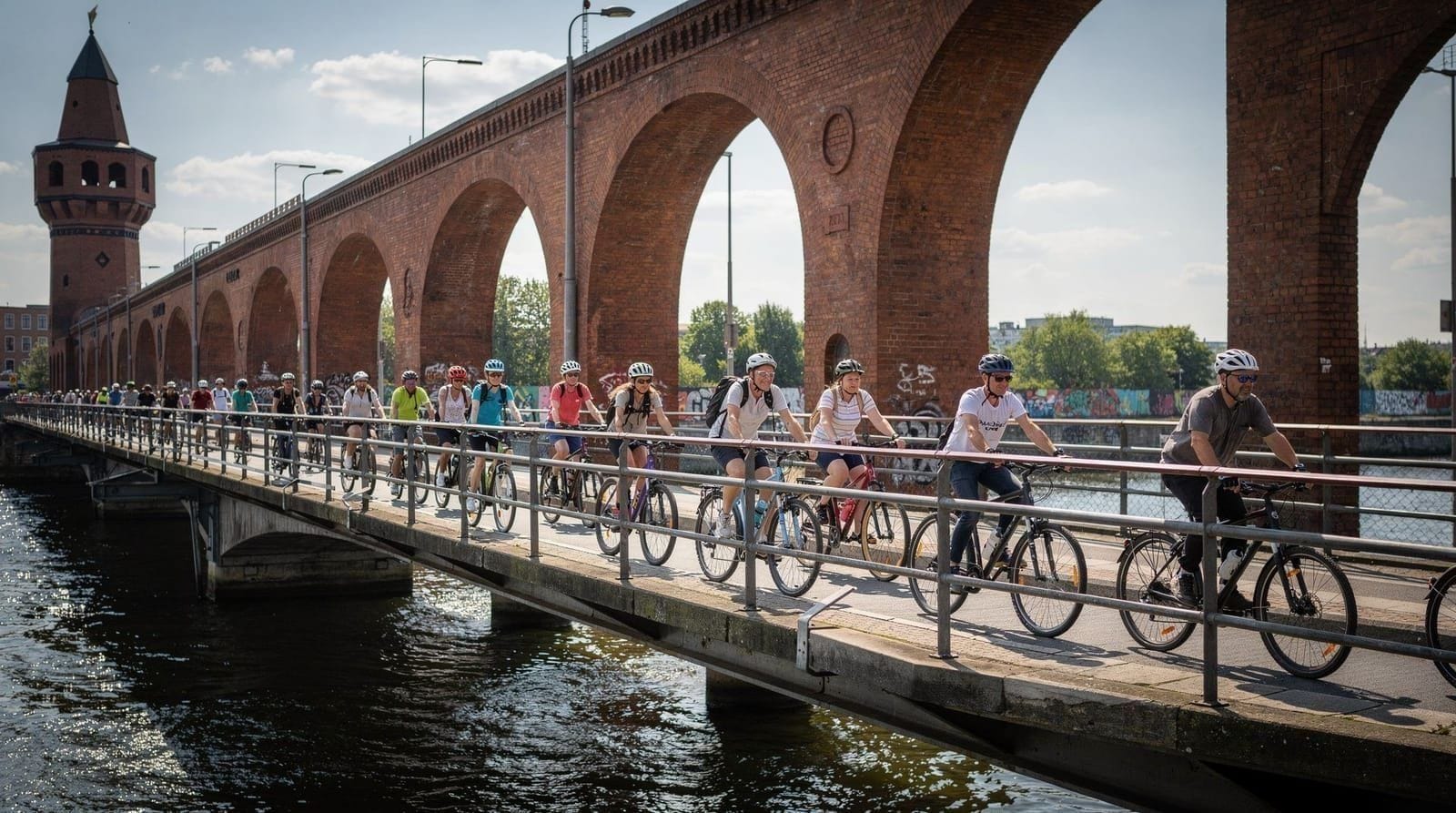
If you are spending more time exploring on two wheels, the Berlin bike tours guide covers multi-hour cycling options that can be combined with a pass through the field as part of a longer route.
How Tempelhofer Feld compares to Berlin’s other big green spaces
| Park | Character | Cost | Best for |
|---|---|---|---|
| Tempelhofer Feld | Vast, open, flat runways | Free | Cycling, kites, local atmosphere |
| Tiergarten | Formal, tree-lined, central | Free | Strolling, close to sights |
| Grunewald Forest | Dense forest, lake swimming | Free | Hiking, escaping the city feel |
Tempelhofer Feld is unique among these for its sheer openness and its history — nowhere else in Berlin gives you the sensation of standing on a runway with the sky uninterrupted in every direction.
Frequently asked questions about Tempelhofer Feld
How do I get to Tempelhofer Feld?
Take the U6 to Tempelhof station and use the main entrance on Tempelhofer Damm. Alternatively, take the U8 to Boddinstrasse and enter from the Neukölln side. The field is open daily from dawn to dusk; exact hours vary by season and are posted at stadtgruen.berlin.de. Entry is always free.Can I rent a bike or skates at Tempelhofer Feld?
There is no bike rental inside the field. Hire a bike in Kreuzberg or Neukölln before you arrive — both districts are directly adjacent. Sk8 House operates a seasonal inline skate rental near one of the main entrances if you want to skate the runways without bringing your own equipment.What is the runway circuit at Tempelhofer Feld?
The three original airport runways remain intact and form a roughly 6 km continuous loop of smooth tarmac. Cyclists, inline skaters, and longboarders use the runways. There are no cars and no traffic lights. On a calm weekday morning the runways feel almost surreally empty; on a sunny weekend they are busy but never uncomfortably crowded.Are there BBQ areas at Tempelhofer Feld?
Yes. Designated BBQ zones are marked on the map boards at each entrance. Disposable grills are permitted in those zones only — not on the runways or grass areas. The zones fill up quickly on warm weekend evenings; arriving before midday secures a good spot.What is the history of Tempelhof Airport?
Tempelhof opened in 1923 and was massively expanded from 1936 under Nazi-era plans — the terminal is one of the largest buildings in the world by floor area. Its most significant moment came during the Berlin Airlift of 1948–49, when US and British aircraft flew over 200,000 supply missions into the besieged city. The airport closed in 2008. In 2014 Berlin held a referendum on developing the site; residents voted to keep it as open public space, and the field is now protected by the Tempelhof Act.Can I visit the Tempelhof terminal building?
Yes, on guided tours. Tours of the historic terminal — including the rooftop — typically run on weekends and cost around €12–15 per person. Book in advance at tempelhofer-feld.berlin.de. The building is not fully open for independent exploration; the guided format is worth it given the scale and history of the architecture.Is there wildlife at Tempelhofer Feld?
Yes. Skylarks and lapwings nest in the open grassland between May and July. These areas are cordoned off with yellow tape during that period — do not enter the protected zones. Rabbits, hares, and foxes are commonly seen at dawn and dusk. The field is managed specifically to balance public use with habitat protection.Is Tempelhofer Feld good for families with children?
Very. The flat runways are ideal for children learning to ride bikes or scooters. The open space means children can run freely without traffic risk. Kite-flying is reliably good because the field is exposed with few wind breaks. There are no permanent playgrounds inside the field, but the space itself functions as one. Bring food and water — catering on-site is limited to weekend food trucks.