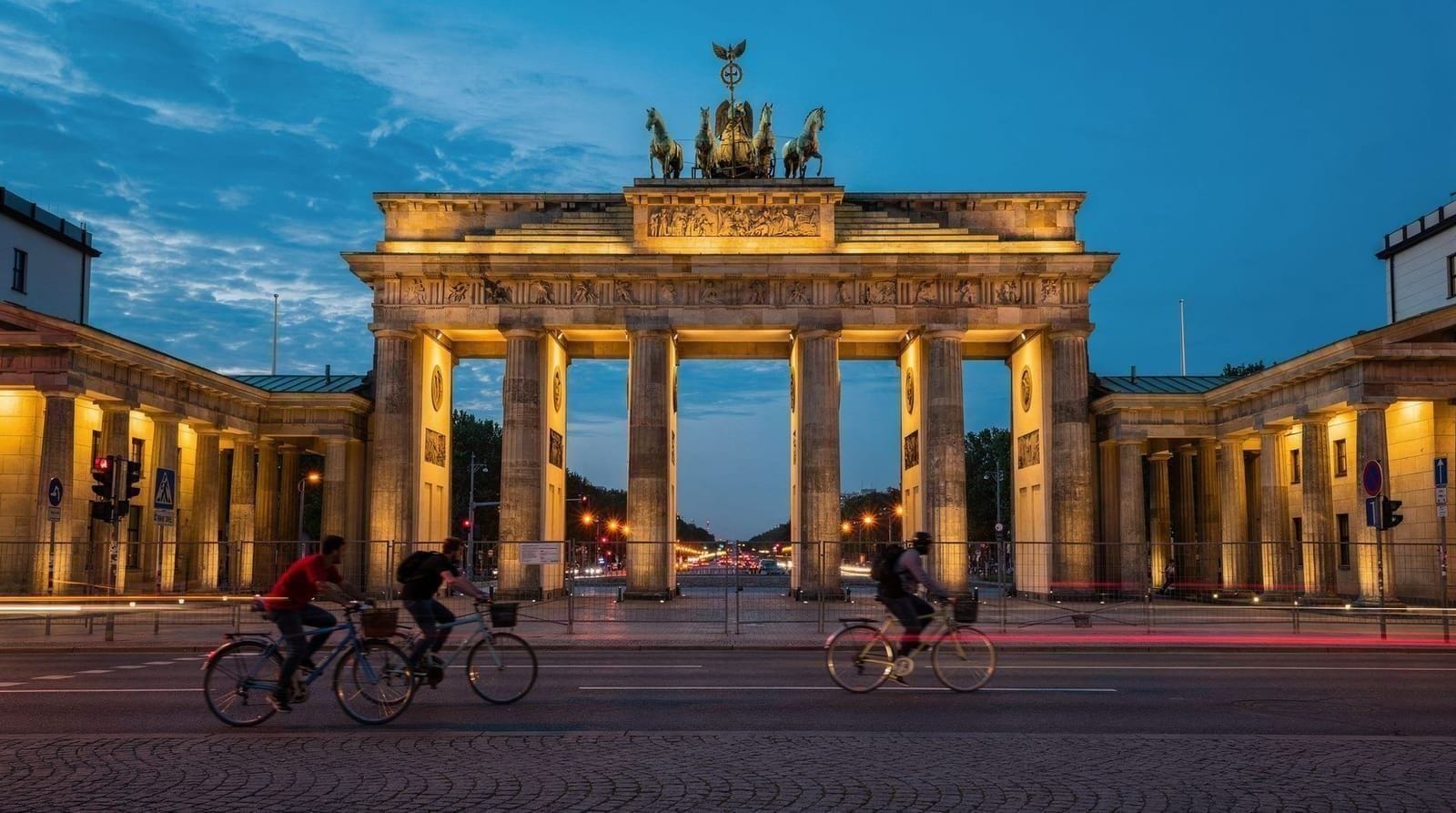
Budget Berlin itinerary: four days for free and cheap
Berlin: Discover Berlin Half-Day Walking Tour
Why Berlin is genuinely good for budget travel
Most European capitals make budget travel difficult — the significant sites cost money, and the free alternatives are thin. Berlin is structurally different. The major memorial sites are free by design, reflecting a political consensus that admission charges would imply profit from historical tragedy. This means Topography of Terror, Holocaust Memorial, East Side Gallery, Sachsenhausen Memorial (as an optional day trip), and Mauerpark cost nothing to enter. Add Tiergarten, the Berlin Wall Memorial at Bernauer Strasse, the Soviet War Memorial, and the Reichstag dome (free with advance booking), and you have a week’s worth of significant sites without paying for a single attraction.
Food and drink are also different from other major cities. The döner kebab is a Berlin institution — a full meal for €3.50–5.50. Turkish bakeries sell substantial pastries for under €2. Rewe and Lidl supermarkets are open most hours (note: most German supermarkets are closed Sunday, though exceptions exist near major stations). Street food at markets runs €4–8 per dish.
A note on cash: Berlin is unusually cash-friendly for a major European city. Markets, small restaurants, street food stalls, and many mid-range restaurants operate cash-only or strongly prefer it. Clubs are almost universally cash-only. Withdraw at a bank ATM (Commerzbank, Deutsche Bank, Sparkasse — avoid the independent ATMs in convenience stores, which charge high fees) and keep €50–80 in your wallet throughout the trip.
This itinerary is built around four days with a genuine attractions budget of under €80 per person, including transport.
| Where | Central Berlin: Mitte, Kreuzberg, Friedrichshain, Prenzlauer Berg |
| Cost | around €116 total for 4 days, incl. food and transport |
| Time needed | 4 days |
| Getting there | BVG AB day ticket covers all sites; ABC needed only for Sachsenhausen extension |
| Best time | Spring–autumn for parks; Mauerpark market runs Sundays only |
Day 1: Central memorials and the governmental district
Morning: Reichstag and Brandenburg Gate (9:00–12:00)
Start at the Reichstag dome (free, booking mandatory at bundestag.de — book at least 2–3 days in advance). The glass dome offers a 360-degree panorama of Berlin and, more usefully, an overhead view down into the Bundestag plenary chamber. A recorded audio guide is included. Allow 60–75 minutes.
Walk south to the Brandenburg Gate (free, open permanently). Cross through into Unter den Linden and walk east: the Neue Wache Memorial (free, open daily) is the central German war memorial, a former royal guardhouse now containing Käthe Kollwitz’s sculpture Mother with her Dead Son. It is small and very spare.
Late morning: Holocaust Memorial (12:00–13:30)
The Memorial to the Murdered Jews of Europe (Stelenfeld, free, open 24 hours) is two blocks south of the Brandenburg Gate. The 2,711 concrete stelae occupy an entire city block — walking into the field from the outside is an abrupt shift in the experience of space. The underground information centre (€6, closed Monday) is the single most worthwhile paid attraction in the central area if you have the budget. If not, the outdoor memorial is significant and complete in itself.
See our Holocaust Memorial guide.
Afternoon: Topography of Terror (13:30–17:00)
Walk 15 minutes south to the Topography of Terror (free, open daily 10:00–20:00, Niederkirchnerstrasse 8). The documentation centre stands on the former site of SS and Gestapo headquarters. The outdoor exhibition runs along a surviving section of the Berlin Wall; the indoor exhibition covers the SS and its crimes in substantial documentary depth. It is one of the most important free attractions in Europe. Allow 2–2.5 hours.
Lunch nearby: Turkish bakeries on Stresemannstrasse. Budget €3–4 for a substantial simit or börek.
Evening: Kreuzberg (17:00–21:00)
Walk or take bus M41 east into Kreuzberg. Oranienstrasse, Görlitzer Park, and the area around Kottbusser Tor are where Berlin’s budget eating scene is most concentrated. Döner kebab from Imren Grill (Oranienstrasse) or simply any independently run Turkish kebab stand is the standard budget dinner. Budget €4–6. Street food, affordable bars with €2.80–3.50 beer, and free street art on nearly every wall.
Day 2: East Side Gallery, Friedrichshain, and Prenzlauer Berg
Morning: East Side Gallery (9:30–11:30)
Take U1 or S3 to Warschauer Strasse. The East Side Gallery (free, always open, 1.3 km along Mühlenstrasse) is the largest surviving section of the Berlin Wall, now carrying 105 murals painted by international artists in 1990. Walking the full length takes about 40 minutes without stopping; allow 90 minutes for a proper look. The most significant works (the Vrubel kiss, Thierry Noir’s cartoon figures, Birgit Kinder’s Trabant) are well signposted.
The murals are on the eastern face of the Wall — the side that East Berliners could never reach. This detail is not incidental. See our East Side Gallery guide.
Late morning: Boxhagener Platz and Friedrichshain
Walk north into Friedrichshain. Boxhagener Platz (Boxi) has a Saturday flea market and a Sunday morning market. During the week it is a neighbourhood square with cafes and benches. The surrounding streets (Simon-Dach-Strasse, Gabriel-Max-Strasse) are full of independent shops, bars, and breakfast places — not cheap relative to supermarket prices, but reasonable relative to the city centre.
The Karl-Marx-Allee (10 minutes’ walk north) is a magnificent piece of Stalinist architecture — a full boulevard of Socialist Classical apartment buildings constructed in the early 1950s as the GDR’s showcase street. It costs nothing to walk and is architecturally extraordinary even if Soviet modernism is not your usual interest.
Afternoon: Volkspark Friedrichshain and Prenzlauer Berg (13:00–18:00)
Volkspark Friedrichshain (free, always open) is the oldest public park in Berlin. The two rubble mounds (Bunkerberg and Insulaner) are built on the compacted debris of bombed buildings — standing on them you are standing on the physical layer of the Second World War. The park has a fountain, a free outdoor chess area, and is heavily used by locals in warm weather.
Walk or take tram M10 north to Prenzlauer Berg. The neighbourhood has become expensive to live in but is still pleasant and not heavily touristy. Kastanienallee and Kollwitzplatz are the centre of gravity. The Kollwitz-Museum (€10) covers the artist whose sculpture you saw in the Neue Wache; the surrounding park with her memorial is free. The ZEISS Major Planetarium (€10–14) is an underrated option for families or bad weather.
Dinner: the Prenzlauer Berg area has many good mid-range options (€14–20) but the street food around Mauerpark — open Saturday and Sunday — is better value at €5–9. Thursday evenings see markets on Kollwitzplatz with local food producers.
Day 3: Tiergarten, free museums, and Mauerpark
Morning: Tiergarten (9:00–12:00)
Tiergarten (free, always open) is the largest park in central Berlin — 210 hectares in the middle of the city. It was the Electors’ hunting grounds until the 18th century, was badly damaged in the Second World War, and has been replanted since. Walking from Brandenburg Gate to the Victory Column (Siegessäule, €4 for the top — optional) takes about 25 minutes at a relaxed pace. The park is where Berliners come in summer with blankets and barbecues; in spring it is full of cherry blossom.
The Soviet War Memorial in Tiergarten (free) is smaller than the one in Treptower Park but is historically significant — it stood in the British sector of West Berlin throughout the Cold War, maintained by Soviet guards with special access rights across the sector boundary. A deliberate Cold War oddity.
Late morning: Berlin Wall Memorial at Bernauer Strasse (12:30–14:30)
Take bus 245 or tram M10 north to Bernauer Strasse. The Berlin Wall Memorial (free, outdoor accessible always, visitor centre open 09:00–19:00 April–October, 09:00–18:00 November–March) has the most complete surviving section of the Wall in its original form: both walls, the death strip, the patrol road, and a watchtower. The documentation trail is free and comprehensive. The Chapel of Reconciliation, built where a church was demolished by the GDR, hosts a brief remembrance service most mornings. Allow 2 hours.
See our Berlin Wall Memorial guide.
Afternoon: Mauerpark (Sunday only) or Mauerfall sites (13:30–18:00)
If this is Sunday, Mauerpark flea market (free to enter, Bernauer Strasse, 09:00–18:00) is the best single free afternoon in Berlin. Thousands of vendors across an enormous park that was part of the former death strip. Good food, vintage clothing, vinyl, genuine junk, and occasionally worthwhile antiques. Budget €0 to enter, whatever you choose to spend. The outdoor karaoke in the amphitheatre (from around 15:00) is a genuinely unusual Berlin institution — several hundred people watching strangers perform, mostly well.
If this is another day, walk the cobblestone line embedded in the road surface marking the Wall’s route through Mitte: it runs from Brandenburger Tor along Ebertstrasse and south. The map at bundestag.de has the full route. Free, self-guided, takes 60–90 minutes to walk the central section.
Late afternoon: Naturkundemuseum or budget beer (17:00–20:00)
The Natural History Museum (€11, Invalidenstrasse 43, closed Monday) is not free but is inexpensive and genuinely impressive — the dinosaur skeleton hall alone is worth the entry. Alternatively, an Spätkauf (late-night off-licence) beer in Mauerpark, along the Spree, or in Tempelhof Field (see Day 4) requires only the price of the beer (€1.50–2.50 from any Späti).
Day 4: Tempelhof Field, Turkish Market, and a bike tour option
Morning: Tempelhof Field (9:00–13:00)
Tempelhofer Feld (free, always open) is the former Tempelhof Airport, closed in 2008 and reopened as public parkland. The runways are intact and are used by cyclists, rollerbladers, kite-buggy enthusiasts, and anyone who wants an enormous flat space in the middle of the city. The terminal building (visible from the field but requiring a separate guided tour to enter) is the largest surviving example of Nazi monumental architecture. In summer, community garden plots and barbecue areas make this the most locally used large park in Berlin. Walking from the main entrance on Columbiadamm to the far edge of the runway and back is about 4 km. Bring food.
See our Tempelhof Field guide.
Afternoon: Turkish Market at Maybachufer (Tuesday and Friday only) (13:00–16:00)
If this is Tuesday or Friday, the Türkenmarkt on Maybachufer in Neukölln is unmissable — it runs every Tuesday (10:00–18:30) and Friday (10:00–18:30) along the Landwehrkanal. This is a working market used by the local Turkish-German community, with fresh produce, fish, textiles, and street food at prices aimed at residents rather than tourists. A full lunch of simit, cheese, olives, and vegetables costs €5–7. The Landwehrkanal waterside is pleasant for eating on.
Afternoon alternative: free walking tour (10:00–13:00)
Free walking tours (tip-based, typically €10–15 suggested) cover the central historical sites with English-language commentary. They depart daily from Brandenburg Gate and from Alexanderplatz. The guides work for tips and the quality varies, but most are genuinely informative. A structured morning tour is the most efficient way to cover the governmental district, Holocaust Memorial, and Museum Island exterior in one go. See our Berlin walking tours guide.

For a different physical perspective on the city — and a faster way to cover the East Side Gallery, Tiergarten, and the Wall in a single session — a guided bike tour is an excellent budget option:

Evening: Sunset options
Tempelhof at sunset is the best free view in Berlin. There are no buildings between the western runway and the horizon — the sky is enormous, and the view of the illuminated city to the north and east is genuinely beautiful. No entry charge, no queue, no problem. Beer from the Spätkauf on Hermannstrasse: €1.80.
Four days at a glance
| Day | Focus | Cost profile |
|---|---|---|
| Day 1 | Reichstag, Brandenburg Gate, Holocaust Memorial, Topography of Terror | Mostly free |
| Day 2 | East Side Gallery, Friedrichshain, Prenzlauer Berg | Free |
| Day 3 | Tiergarten, Berlin Wall Memorial, Mauerpark (Sundays) | Free |
| Day 4 | Tempelhof Field, Turkish Market or walking tour | Free to low cost |
Budget summary (per person, 4 days)
| Item | Cost |
|---|---|
| Reichstag dome | Free (book at bundestag.de) |
| Holocaust Memorial (outdoor) | Free |
| Holocaust Memorial info centre | €6 |
| Topography of Terror | Free |
| East Side Gallery | Free |
| Karl-Marx-Allee walk | Free |
| Volkspark Friedrichshain | Free |
| Berlin Wall Memorial | Free |
| Mauerpark | Free |
| Tempelhofer Feld | Free |
| Natural History Museum | €11 |
| Transport: 4 × BVG AB day ticket | €39.20 |
| Total attractions + transport | ~€56 |
| Add food (€15/day average) | €60 |
| 4-day total | ~€116 |
Accommodation is separate. For context: hostels in Kreuzberg and Friedrichshain run €15–25/night in dorms. See our Berlin budget guide for accommodation options and further cost breakdowns.
Stretching the budget further
A few adjustments push this itinerary even lower still, without cutting into the sites that make Berlin worth visiting in the first place. Skip the Holocaust Memorial’s underground information centre (€6) if funds are genuinely tight — the outdoor stelae field is free and, on its own, a complete and significant experience. Swap paid museum stops (the Natural History Museum, €11) for another free afternoon in Tiergarten or a repeat visit to Tempelhofer Feld. For food, Rewe and Lidl supermarket picnics run €4–6 per person versus €10–15 for a sit-down meal, and Turkish bakeries on Oranienstrasse or in Neukölln remain the best value hot food in the city. If you are travelling with a rail pass or arriving by international train, check whether a Berlin WelcomeCard (covering transport plus discounts on some paid attractions) works out cheaper than a plain day ticket for your specific mix of days — see our Berlin WelcomeCard guide for the comparison.
Free things this itinerary does not have room for
Berlin has more free sites than four days can cover. If you extend the trip or want to swap something out, consider the Mauerpark karaoke (Sundays, free to watch), the Soviet War Memorial at Treptower Park (a larger and more elaborate counterpart to the Tiergarten memorial), the Stolpersteine brass memorial plaques scattered throughout Mitte and Prenzlauer Berg, and the free viewing platforms at the Reichstag’s surrounding government district. Rotating in one of these on a fifth day, or in place of a paid museum, keeps the total cost close to zero for attractions while still leaving you with a genuinely varied, well-paced trip rather than a thin list of box-ticking free stops.
Frequently asked questions about budget travel in Berlin
Is Berlin the cheapest major European capital?
It is among the cheapest. In direct comparison: food, public transport, and street food are significantly cheaper than Paris or Amsterdam. Entry prices for museums are comparable to London (where major museums are free) but the concentration of free historical sites makes Berlin more budget-friendly overall. See our Berlin budget guide.
Do I need cash in Berlin?
Yes. Much more so than in most Western European cities. Markets, street food vendors, many restaurants, döner stands, and essentially all clubs and bars operate cash-only or strongly prefer cash. Bank ATMs (Commerzbank, Sparkasse, Deutsche Bank) charge no or low fees for card withdrawals. Independent ATMs in convenience stores typically charge €5 per withdrawal. Withdraw a reasonable sum at a bank ATM at the start of the trip.
What is the cheapest transport option in Berlin?
A BVG AB day ticket (€9.80) covers all buses, trams, U-Bahn, and S-Bahn within zones A and B (which covers all sites in this itinerary) for one calendar day. If you are making more than three journeys, the day ticket saves money over single tickets (€3.20 each). A 7-day ticket costs €39.10 and covers a full week. See our Berlin public transport guide.
What are the best free museums in Berlin?
The Topography of Terror (free), the Berlin Wall Memorial at Bernauer Strasse (free), the Holocaust Memorial (free), and the German History Museum permanent collection (free on certain hours — check in advance) are the strongest free museum-quality experiences. The Brücke Museum in Dahlem has periodic free entry. Most federal state museums are free for under-18s.
Are the free walking tours worth doing?
Yes, with calibration. The guides are tip-dependent and generally well-motivated. Quality varies significantly; those that have been operating longest (New Berlin Tours, Sandeman’s) are more consistent. The tours cover 2.5–3 hours and include the main central historical sites. The value is primarily in orientation and contextualisation on Day 1; for a four-day trip, a tour on the first morning sets up everything else.
Can I do a day trip from Berlin on a budget?
Sachsenhausen memorial is accessible by S1 from central Berlin to Oranienburg (50 minutes, about €3–4 single or included in an ABC zone day ticket for €10.80). Entry to the memorial is free. It is the best-value day trip from Berlin in historical terms — the concentration camp memorial covers the Nazi and Cold War periods in depth, and the journey is accessible without a guide. See our Sachsenhausen guide.
Is the Berlin WelcomeCard worth buying for a budget trip?
Usually not for this specific itinerary, since most of the sites here are free anyway and the card is priced around transport plus paid-attraction discounts. It becomes worthwhile if you are also planning several paid museums or a Sachsenhausen extension within the same trip. See our Berlin WelcomeCard guide for a full cost comparison.
Can this itinerary be done in three days instead of four?
Yes, by combining Day 3 and Day 4’s outdoor sites (Tiergarten, Berlin Wall Memorial, Tempelhofer Feld) into a single longer day and dropping one of the optional markets. It compresses the pace but keeps the free-attraction core intact.
Top experiences
Bookable activities with verified prices and instant confirmation on GetYourGuide.