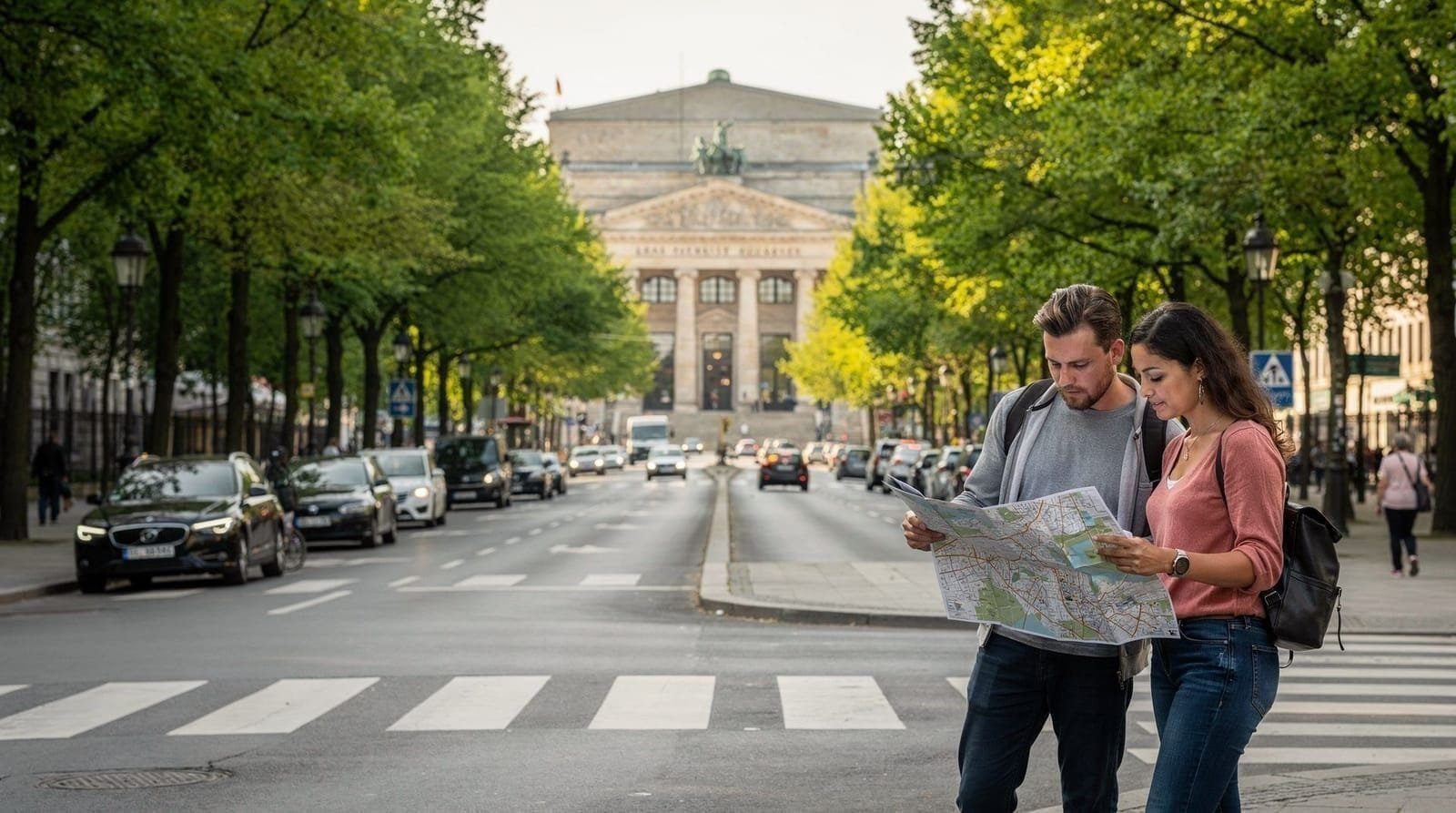
Berlin self-guided walk — the essential highlights on foot, step by step
Berlin: Guided Walking Tour in English
Can I walk Berlin's highlights without a guided tour?
Yes, easily. The core landmark circuit from the Brandenburg Gate to Museum Island covers about 4 km and takes 3–4 hours at a relaxed pace including stops. The key sites are all signposted in English, have free entry, and are within easy walking distance of each other. No guide is required unless you want deep historical context.
Can you walk Berlin’s highlights without a guide? Yes, easily. The core circuit from the Brandenburg Gate to Museum Island covers 4 km and 3–4 hours at a relaxed pace. Every major site is well-signposted in English, most are free, and the route is flat and straightforward. This guide provides a step-by-step itinerary with distances, honest time estimates, and notes on what actually merits a stop.
| Distance (core route) | around 4 km |
| Time needed | 3-4 hours with stops |
| Cost | free if you skip museum interiors |
| Starting point | Brandenburg Gate |
| Best time to start | around 09:00, before the 10:30-14:00 crowd peak |
| Terrain | flat, paved, pram-friendly |
Before you start — the basics
Starting point: Brandenburg Gate (Brandenburger Tor). S-Bahn S1/S2/S25/S26 to Unter den Linden station, or U55 to Brandenburger Tor. From Hauptbahnhof, the S-Bahn journey takes 8 minutes. Walking from Hauptbahnhof takes 25 minutes through Tiergarten (a pleasant option if arriving fresh).
What to bring: A charged phone for navigation (or a city map). Water — there are limited drinking fountains but several supermarkets and bakeries along the route. Comfortable shoes. The route is all tarmac and paving; no special footwear needed. A portable charger is worth packing too if you’re relying on your phone for navigation and photos for a full 3-4 hour outing — battery drain is real on a long walk with the screen frequently on.
Costs: This walk can be done for zero euros if you stick to exterior visits and free exhibitions. Paid options are flagged below, and none are compulsory — you can complete the entire circuit and come away with a genuine sense of the city’s key sites without spending a cent on entry fees, only food and drink.
Toilets: Paid public toilets (€0.50–1.00) at Brandenburg Gate, Checkpoint Charlie, and Alexanderplatz. Free toilets inside museum foyers — most allow entry without a ticket if you explain.
The route — step by step
Stop 1 — Brandenburg Gate (Brandenburger Tor)
Time: 20–30 minutes. Cost: Free.
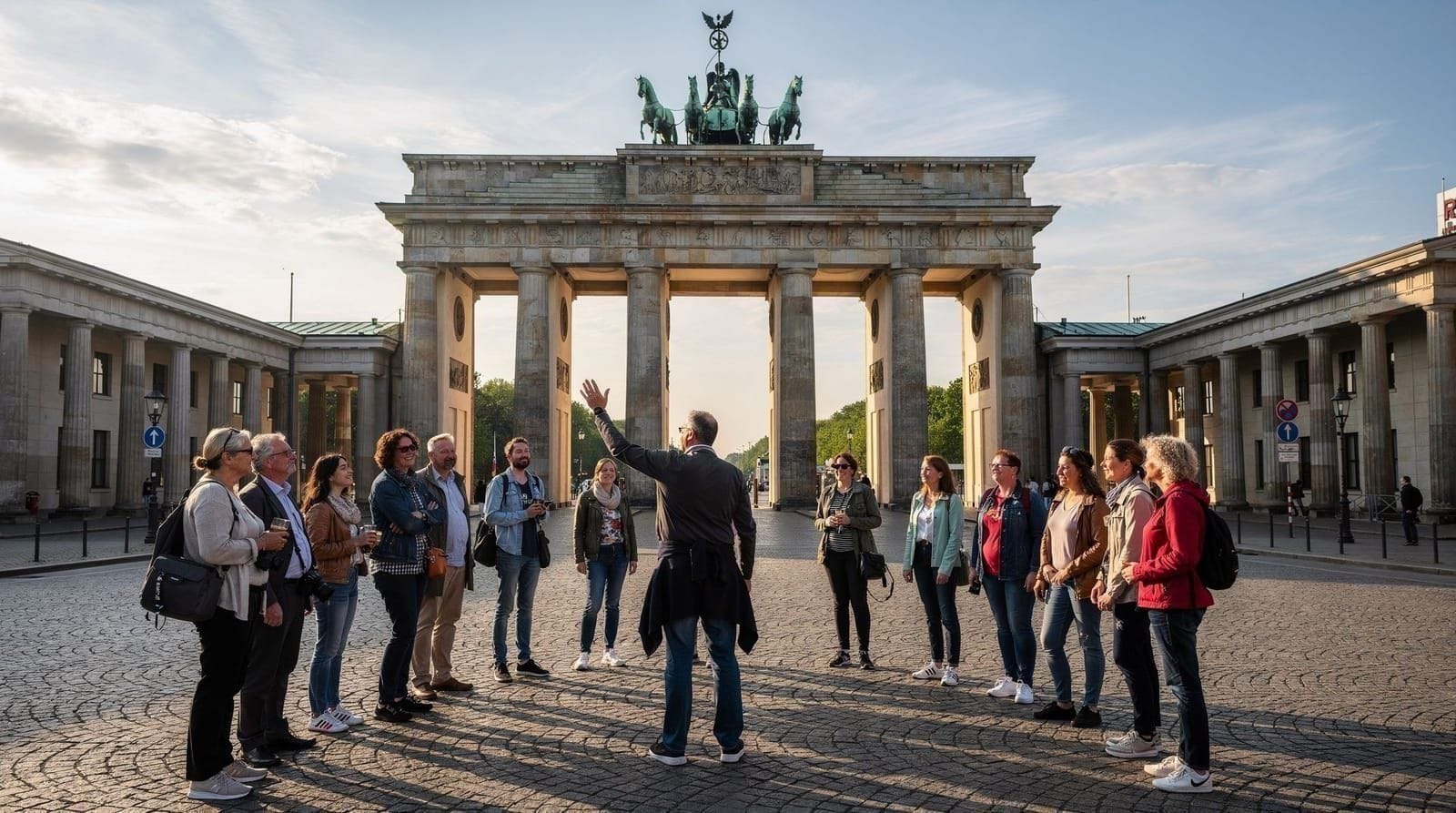
Begin at the gate from the western (Tiergarten) side. The 18th-century neoclassical gate was commissioned by Prussian King Friedrich Wilhelm II and completed in 1791. Its position at the end of Unter den Linden made it the ceremonial entrance to the city.
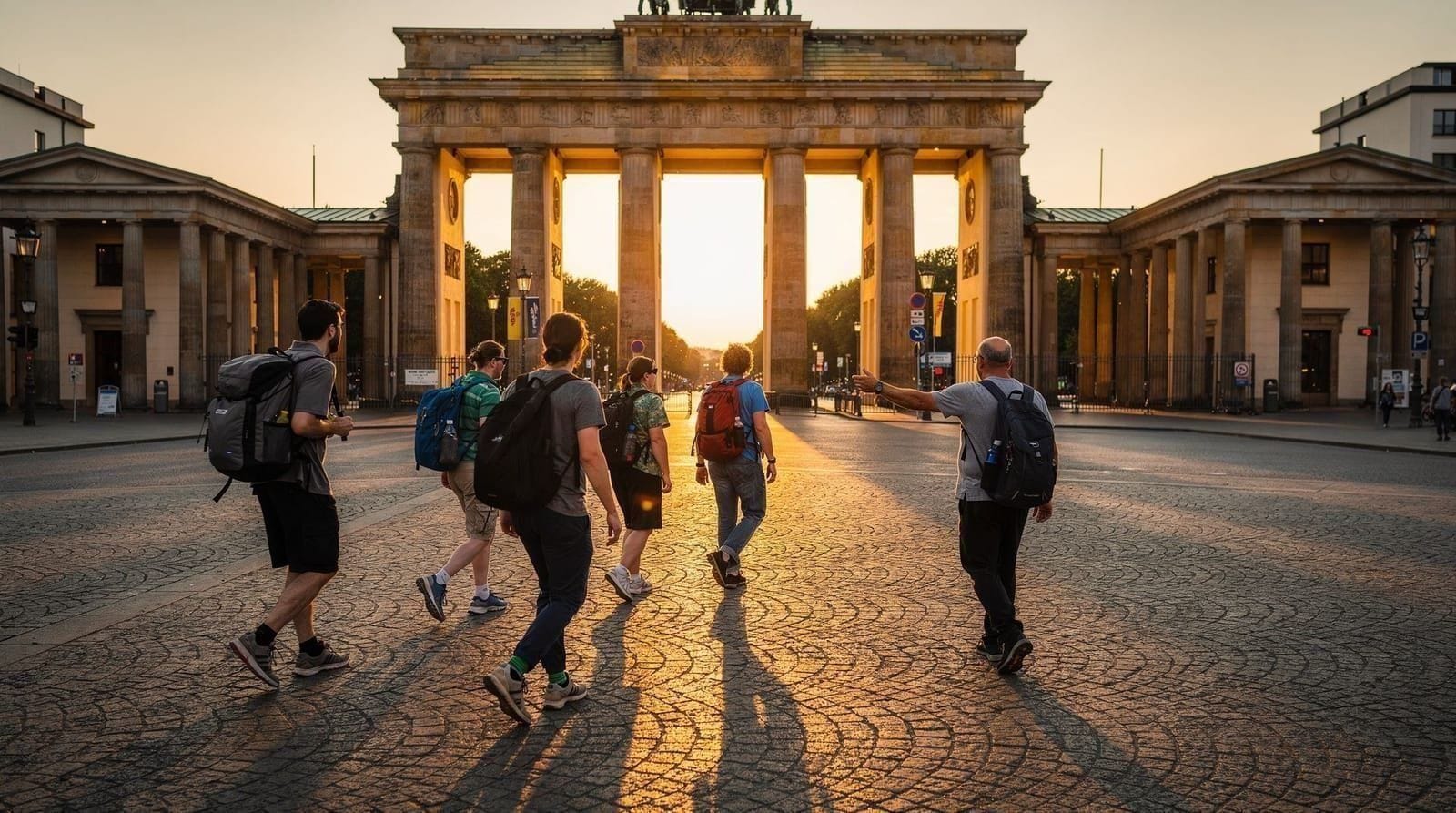
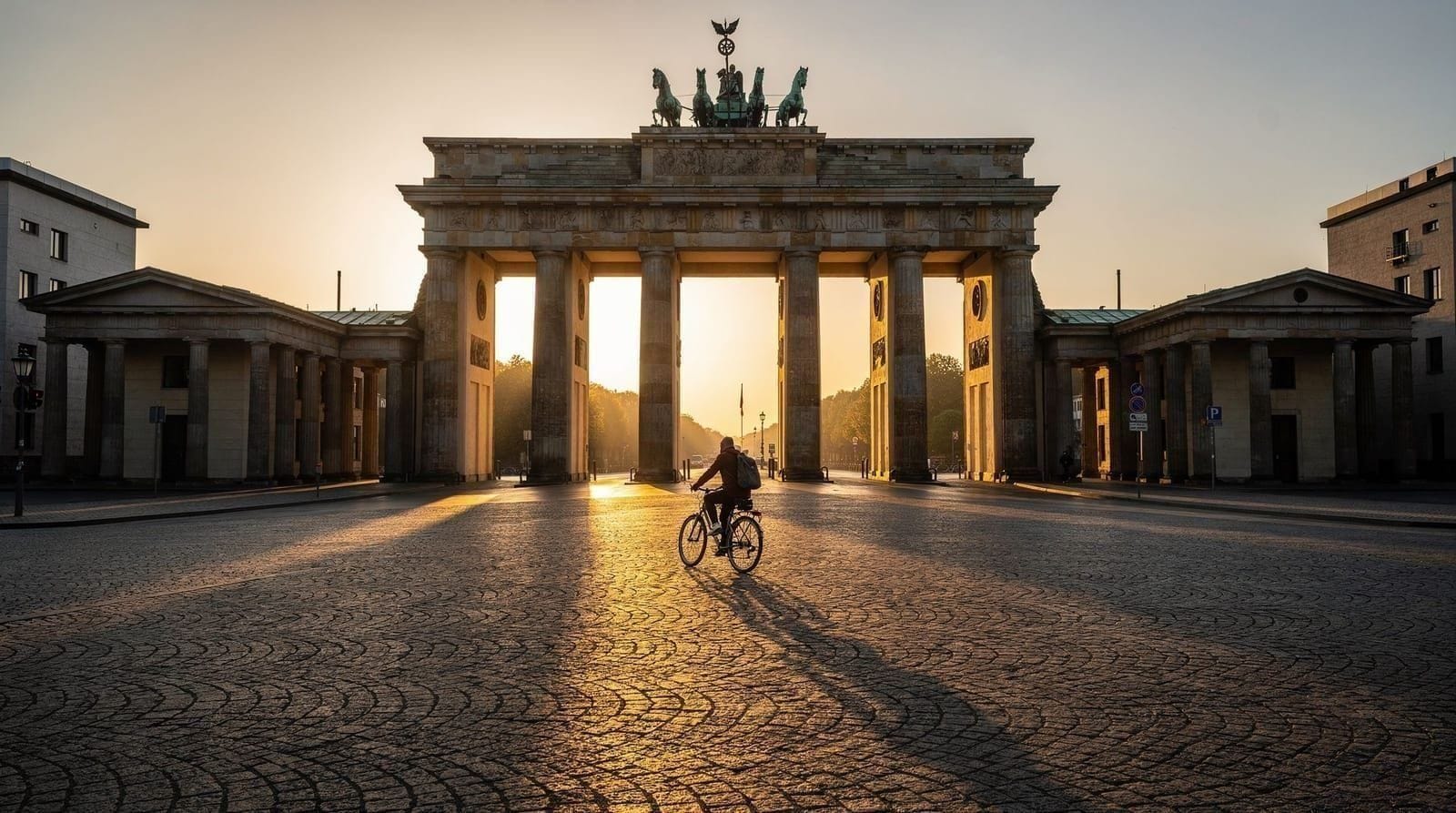
The gate was directly on the Wall’s path from 1961 to 1989, locked into the exclusion zone and accessible from neither side. After reunification it became the central symbol of German unity. It is now always crowded — the best photographs are taken from the flanking buildings’ angles or in the early morning (before 09:00) when the Pariser Platz is quiet.
Walk through the gate onto Pariser Platz. The French Embassy and DZ Bank building (by Frank Gehry, visible on the right) flank the square.
Note: The Reichstag dome (250 metres north of Brandenburg Gate) requires a free but mandatory pre-booking at bundestag.de — usually 2–3 weeks in advance in peak season. If you have pre-booked, factor in 1.5 hours for the Reichstag visit and do it before or after the main walk.
Stop 2 — Memorial to the Murdered Jews of Europe
Distance from Brandenburg Gate: 300 metres south on Ebertstrasse. Time: 20–40 minutes. Cost: Memorial exterior free. Information centre free.
The 19,000-square-metre field of 2,711 concrete steles designed by Peter Eisenman is one of the most effective memorial spaces in Europe. It is also one of the most misunderstood — visitors sometimes laugh or treat it as an obstacle course. Spend time moving through the interior where the ground dips and the steles rise above head height. The spatial disorientation is deliberate.
The underground information centre documents the Holocaust through individual family stories. It is excellent and worth 30–40 minutes. Open Tuesday–Sunday 10:00–20:00 (last entry 19:45), closed Monday.
Practical note: The memorial is directly above a paid car park, which creates an incongruous contrast. The car park access ramps are visible on the southern edge. This is a source of ongoing controversy and is mentioned in the information centre.
Stop 3 — Tiergarten (optional extension — adds 1.5 hours and 3 km)
Optional. If skipping, proceed directly to Stop 4.
If you have time, walk west through the Tiergarten park to the Victory Column (Siegessäule). The column (€3 entry for the upper platform) stands at the junction of the main Tiergarten avenues and offers a view across the treetops and the government district.
Also in the Tiergarten: the Soviet War Memorial at Straße des 17. Juni (free, outdoor), a monument to the Red Army soldiers who died in the battle for Berlin in April–May 1945. The avenue Straße des 17. Juni was the site of mass demonstrations on 17 June 1953 in East Berlin, crushed by Soviet tanks.
Return east along Straße des 17. Juni toward the Brandenburg Gate (1.5 km from the column).
Stop 4 — Under den Linden to Bebelplatz
Distance from Brandenburg Gate: 600 metres east along Unter den Linden. Time: 20–30 minutes walking and looking.
Walk east along Unter den Linden — the 1.4 km ceremonial boulevard planted with double rows of linden trees. The buildings lining it are a mixed record of Berlin’s history: 18th-century Prussian palaces, GDR-era embassy blocks, and post-reunification reconstructions.
Key landmarks along Unter den Linden:
- Prussian State Library (Staatsbibliothek): Right side. Building dates to 1914. Still a working research library.
- Humboldt University: Left side. Founded 1810. Alumni include Marx, Engels, Einstein, Hegel, and Grimm.
- Neue Wache (New Guardhouse): Small neoclassical building on the right. Now a memorial to victims of war and tyranny with Käthe Kollwitz’s “Mother with Dead Son” sculpture inside. Free entry. Worth 10 minutes.
At the Opernplatz (now Bebelplatz), look down through the glass panel in the pavement. The underground “Versunkene Bibliothek” (Sunken Library) — an empty white room with empty bookshelves for 20,000 books — marks the site of the Nazi book burning on 10 May 1933. Free, always visible.
Across the square: the State Opera House (Staatsoper Unter den Linden), reconstructed after WWII damage and reopened in 2017.
Stop 5 — Museum Island (Museumsinsel)
Distance from Bebelplatz: 500 metres east. Time: 30 minutes to 3 hours depending on museum entries.
The Spree island containing five major museums (Pergamon, Neues, Bode, Alte Nationalgalerie, Altes Museum) is a UNESCO World Heritage Site. The island itself and the exterior gardens are free to walk through.
Important — 2026 update: The Pergamonmuseum main hall is closed until at least 4 June 2027. The Pergamon Panorama Asisi (an immersive 360-degree panorama of ancient Pergamon) is open as an alternative. See the Pergamon Museum 2026 status guide for the full situation.
What is open and worth it:
- Neues Museum: Egyptian Collection including the Nefertiti Bust. €14 entry. The most significant single object on Museum Island. See the Neues Museum guide.
- Alte Nationalgalerie: 19th-century German and European art. €12 entry.
- Bode Museum: Byzantine art, coins, sculpture. €12 entry.
- Altes Museum: Classical antiquities. €10 entry.
A day pass covering all open Museum Island institutions costs €22. The James Simon Galerie serves as the central visitor hub with bag storage, toilets, and a ticket hall.
The Berliner Dom (Cathedral) faces the James Simon Galerie across a bridge. Entry costs €9 and includes rooftop access. The interior is Protestant neoclassical and slightly overdone, but the crypt (with Hohenzollern tombs) is historically interesting.
Stop 6 — Gendarmenmarkt
Distance from Museum Island: 800 metres south. Time: 20 minutes.
The most formally elegant square in Berlin, framed by the French Cathedral, the German Cathedral, and the Konzerthaus concert hall. Unlike Pariser Platz, Gendarmenmarkt is rarely overcrowded outside of the Christmas market season (December) and Festival of Lights (October). A good coffee stop — there are several cafés on the square and the adjacent Charlottenstrasse.
This square was bombed flat in WWII and rebuilt in the GDR period as a showpiece of East Berlin urbanism. The French Cathedral (Französischer Dom) has a small Huguenot museum inside and rooftop access (€4, 284 steps). The views from the tower are worthwhile.
Stop 7 — Checkpoint Charlie
Distance from Gendarmenmarkt: 500 metres south. Time: 15–20 minutes.
Walk south along Charlottenstrasse to Zimmerstrasse. The intersection with Friedrichstrasse is the site of the former US-Soviet checkpoint.
Honest assessment: The main roadway structure is a replica. The “guards” in Cold War uniforms charging for photographs are not official — they are private operators. The Checkpoint Charlie Museum (Mauermuseum, €15) has genuine historical artefacts but presents them badly, with crowded displays and limited English signage. The outdoor information boards on the street are free and provide adequate context.
What is genuinely worth stopping for: the open-air Wall sections on Zimmerstrasse just east of the checkpoint, and the historical marker explaining the 1961 tank standoff between US and Soviet forces on this exact spot.
Optional extension — East Side Gallery
Distance from Checkpoint Charlie: 3.5 km east (S-Bahn S3/S5/S7/S9 from Ostbahnhof, or U1 to Warschauer Strasse). Time: 1.5 hours. Cost: Free.
The 1.3 km mural wall in Friedrichshain is the longest surviving stretch of the Berlin Wall and worth the additional journey. See the East Side Gallery guide for specific mural information.
If adding this to the day, take the S-Bahn from Friedrichstrasse station (5 min from Checkpoint Charlie on foot, then 12 min train journey) rather than walking the full 3.5 km.
The Wall cobblestone trail — an underrated thread
Throughout this entire walk, watch for a double row of cobblestones embedded in the pavement. This is the Berliner Mauerweg trail, marking the path of the Berlin Wall. It runs 16 km through the city and crosses several points on this route — most visibly at Potsdamer Platz (a 15-minute detour south of the Memorial to the Murdered Jews) and near Checkpoint Charlie.
Potsdamer Platz, now a modern commercial square with the Sony Center and DZ Tower, was bisected by the Wall for 28 years. The cobblestone line crosses the middle of the current square, and several original Wall segments stand preserved near the Sony Center as a free outdoor display.
Distances and time budget
| Segment | Distance | Time (with stops) |
|---|---|---|
| Brandenburg Gate exterior | — | 20–30 min |
| Brandenburg Gate to Holocaust Memorial | 300 m | 5 min walk + 30 min visit |
| Holocaust Memorial to Bebelplatz | 800 m | 15 min walk + 20 min |
| Bebelplatz to Museum Island | 500 m | 10 min walk |
| Museum Island (exterior only) | — | 30 min |
| Museum Island to Gendarmenmarkt | 800 m | 15 min walk + 15 min |
| Gendarmenmarkt to Checkpoint Charlie | 500 m | 10 min walk + 15 min |
| Core route total | ~4 km | 3–4 hours |
| Optional: Tiergarten extension | +3 km | +1.5 hours |
| Optional: East Side Gallery | +3.5 km (train) | +1.5 hours |
What to eat and drink along the route
Coffee and breakfast: Bäckerei chains (Lidl Bakery, Backwerk, Zeit für Brot on Checkpoint Charlie street) are the cheapest option at €3–5 for coffee and a pastry. The Café im Literaturhaus on Fasanenstrasse (near Charlottenburg, off-route) is the best sit-down coffee stop in this zone.
Lunch: The Markthalle IX (Eisenbahnstrasse 42/43, Kreuzberg) is off the main route but the best food market option. On-route: the Hackescher Markt area (between Museum Island and Rosenthaler Platz) has a range of cafés and restaurants covering €8–15 per person for lunch.
Currywurst: Konnopke’s Imbiß in Prenzlauer Berg is the most cited currywurst institution in Berlin (Schönhauser Allee 44a, near U2/Eberswalder Strasse). It is off this route but worth a detour if you are staying in Prenzlauer Berg. For on-route currywurst, the Curry 36 branch near Checkpoint Charlie is reliable.
Doing this walk in different weather and seasons
This route works year-round, but the experience shifts noticeably by season. In summer (June–August), start as early as possible — 08:00 if you can manage it — since Pariser Platz and Checkpoint Charlie get genuinely crowded by mid-morning and the exposed sections (Unter den Linden, Museum Island’s exterior) offer little shade. Carry water; the Bäckerei stops along the route are more reliable than public fountains. In winter (November–February), the route is equally walkable but shorter daylight hours mean starting earlier still makes sense, and several of the outdoor highlights — the Holocaust Memorial in particular — feel starkly different in low winter light. Rain doesn’t meaningfully disrupt this walk since almost every stop has some form of shelter nearby (cafés, museum foyers, the Hackescher Markt arcades), but a compact umbrella is worth carrying regardless.
Doing the route in reverse or split across two half-days
If you’re staying near Museum Island or in eastern Mitte, there’s no rule that says you must start at the Brandenburg Gate — the route works equally well walked in reverse, ending at the gate for a photogenic finish at golden hour. Alternatively, if a single 3-4 hour block doesn’t suit your schedule (common with young children or older travellers), the route splits naturally into two halves: Brandenburg Gate through Bebelplatz as a morning walk, and Museum Island through Checkpoint Charlie as a separate afternoon or next-day walk, each roughly 1.5-2 hours. This flexibility is one of the real advantages of a self-guided route over a fixed-schedule guided tour — nothing forces you to complete it in one sitting.
If you want more context than a self-guided walk provides
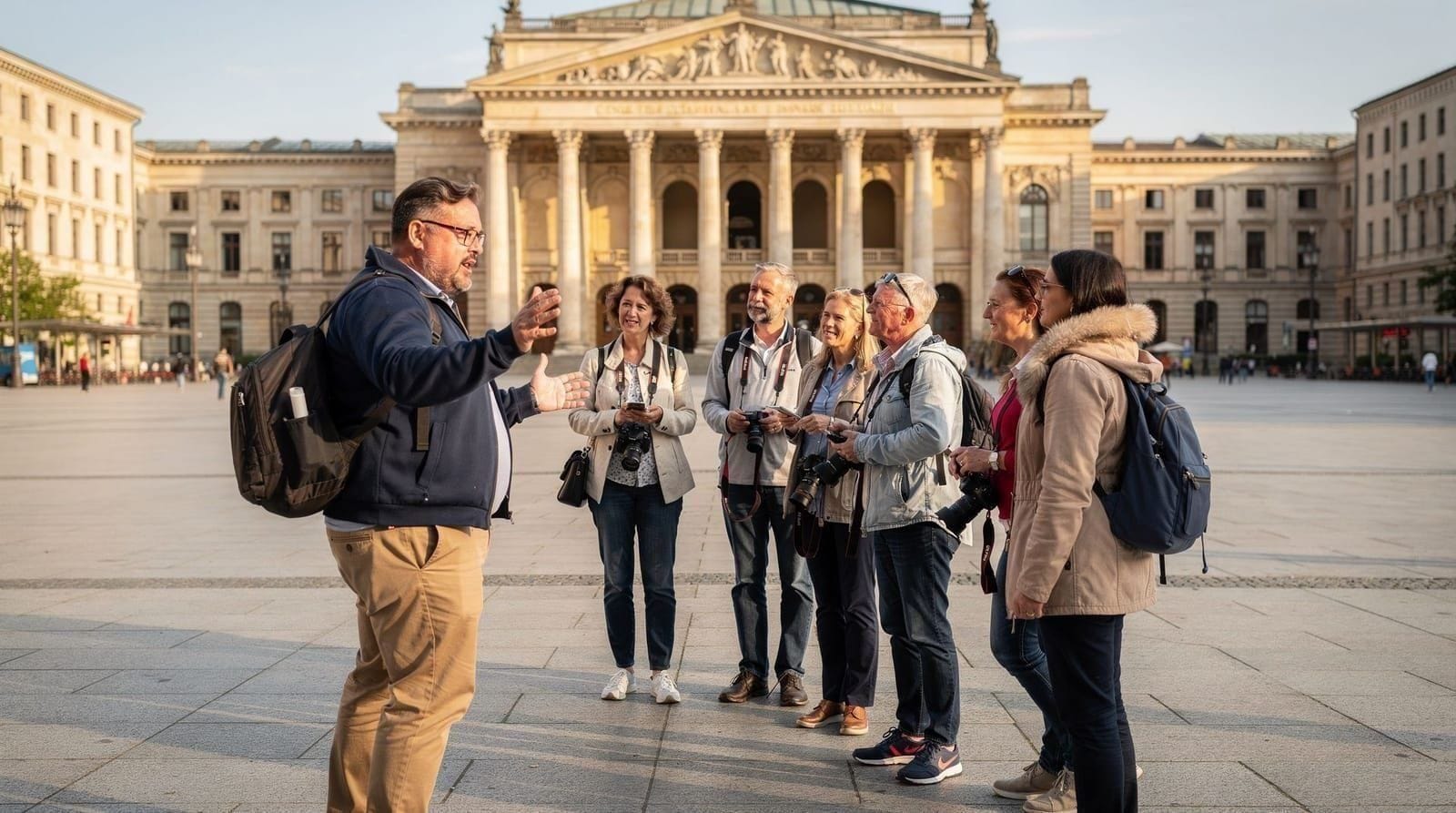
The free information boards at each major site are extensive. However, a guided tour adds interpretive depth that signage cannot fully replicate — specifically, the human stories behind the sites (who lived there, what decisions were made, what was suppressed). The Berlin free walking tours guide covers the tip-model tours that depart daily from Brandenburg Gate.
Alternatively, the Berlin best tours for first-time visitors guide compares guided formats side by side.
Guided walking tour of central Berlin in English — same route, added contextTurning this walk into a longer visit
This route is designed as a single day’s core circuit, but it slots easily into a longer trip. If you only have one day in the city, the Berlin 1-day itinerary builds around essentially this same route. For a fuller first visit, the Berlin first-timer 3-day itinerary uses this walk as day one and adds Kreuzberg, Potsdam, or the East Side Gallery on subsequent days. Travelling on a tight budget, the budget Berlin itinerary leans on exactly this kind of free, self-guided sightseeing to keep costs down while still covering the essentials.
Frequently asked questions about Berlin self-guided walk
How long is the Berlin highlights self-guided walk?
The core route from Brandenburg Gate to Museum Island is approximately 4 km and takes 3–4 hours with stops. Adding Checkpoint Charlie and the East Side Gallery extends it to 9 km and a full day. The Tiergarten segment (Soviet War Memorial and Victory Column) adds another 3 km if you include it.Is the Brandenburg Gate free to visit?
Yes. The Brandenburg Gate exterior is always free and accessible 24 hours. There is no interior to enter — the gate is solid. The Pariser Platz square in front of it is free to access. Note that the Reichstag dome visit requires a free but mandatory pre-registration at bundestag.de, typically 2–3 weeks in advance.What is the best starting point for a Berlin walking tour?
Brandenburg Gate (Brandenburger Tor) is the conventional starting point and has the best transport connections — U-Bahn U55 from Hauptbahnhof, S-Bahn S1/S2/S25/S26 to Unter den Linden. Arriving here first allows you to orient yourself with a clear visual reference point and plan the rest of the day from a known location.What are the free highlights along this walk?
The following are free — Brandenburg Gate exterior, Memorial to the Murdered Jews, Topography of Terror (outdoor exhibition), Bebelplatz and the book burning memorial, Museum Island exterior and gardens, Gendarmenmarkt square, and the East Side Gallery. The Berlin Wall cobblestone trail running through the route is also free. Paid attractions include most museum interiors and the Reichstag dome.Is this walk doable with children?
The route is flat and suitable for prams and young children. The pacing is flexible — you can stop as needed. The Tiergarten segment is ideal for children who need to run. The Holocaust Memorial and Topography of Terror are meaningful but heavy for very young children; these sections can be shortened or bypassed.Is there a GPX file or app for this route?
No official GPX is provided here, but Google Maps handles this route well. Search each landmark by name and use the "walking" mode. Alternatively, AllTrails and Komoot both have user-submitted Berlin city walk routes covering these landmarks. Offline maps (Maps.me or Google Maps offline) are useful in areas with poor mobile signal near the Tiergarten.When is the best time of day to do this walk?
Starting at 09:00 lets you reach the Brandenburg Gate before the main tourist wave (which peaks 10:30–14:00). Museum Island sites open at 10:00. The Topography of Terror outdoor exhibition is accessible from 10:00. Avoid Saturday afternoon in summer — crowds at Checkpoint Charlie and the East Side Gallery are at maximum.