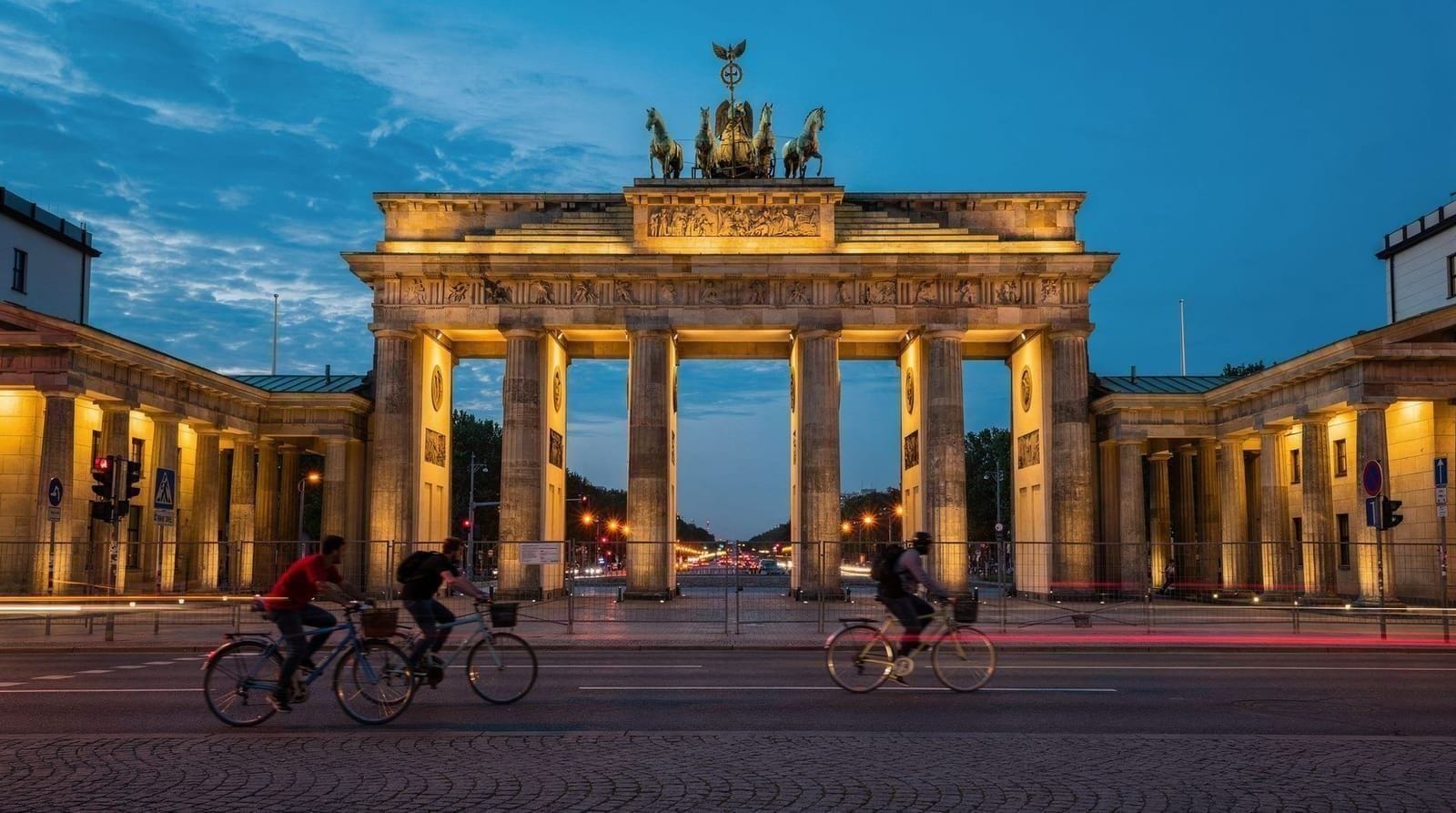
Berlin for first-timers: three days by neighbourhood
Berlin: Guided Walking Tour in English
How to read Berlin before you arrive
Berlin is not a city that centres on a single historic core. It is a collection of former villages, districts, and — for 40 years — two entirely separate cities that have been slowly growing back together since 1989. The practical consequence is that first-time visitors who try to “do Berlin” by moving between monuments on a map end up crossing the city repeatedly, wasting time on transport, and seeing things without context.
The alternative — and what this itinerary is built around — is to organise each day by neighbourhood. Mitte and the governmental district on Day 1. Museum Island, East Berlin, and Friedrichshain on Day 2. Kreuzberg and Charlottenburg on Day 3. The sites within each day are within walking distance of each other, and each neighbourhood has a distinct character that makes the individual sites make more sense.
A few orienting facts: the Brandenburg Gate is roughly at the centre of the old West/East divide. Everything west of it (Charlottenburg, Tiergarten, Schöneberg) was West Berlin. Everything east (Mitte, Prenzlauer Berg, Friedrichshain, Lichtenberg) was East Berlin. The TV Tower at Alexanderplatz — visible from almost everywhere in the city — is a useful east reference point. The divide is not purely symbolic: the street layouts, architecture, and character of the two halves are still noticeably different 35 years after reunification.
| Where | Mitte/government district, Museum Island/Friedrichshain, Kreuzberg/Charlottenburg |
| Cost | around €150–200/person incl. transport, entries and meals |
| Time needed | 3 full days, organised by neighbourhood not by clock |
| Getting there | on foot within each day, U-Bahn/S-Bahn between neighbourhoods |
| Best time | weekdays; visit Türkenmarkt on Day 3 if it falls on Tue/Fri |
Day 1: The western centre — government, memorials, and the Brandenburg Gate (9:00–20:00)
Morning: Government district and Reichstag (9:00–11:00)
Start at the Reichstag (dome free, book in advance at bundestag.de — 2–3 days minimum). The dome is a glass spiral ramp surrounding a mirrored cone that reflects light down into the plenary chamber below. The audio guide (included) explains both the architecture and the political history of the building: built 1884–94, famously burned in 1933, bombed heavily in 1945, abandoned in divided Berlin, and restored by Norman Foster after reunification. The 360-degree view from the top of the dome is the best orientation panorama in the city. Allow 60–75 minutes.
Walk west along the Spree riverbank to the Paul-Löbe-Haus and Marie-Elisabeth-Lüders-Haus (the modern parliamentary buildings) — the Spree here marks the former boundary between West and East Berlin, and the bridge crossing is worth noting. The architectural contrast between the neo-Renaissance Reichstag and the Foster glass additions is substantial.
Late morning: Brandenburg Gate and its context (11:00–12:30)
Brandenburg Gate (free, always open) was built between 1788 and 1791 as a triumphal arch for the Prussian capital. During the Cold War it stood in the death strip, accessible from neither side. Its current status as the city’s symbolic centre is a post-1989 development. Take a moment to look at the traffic and pedestrians moving freely through the gate — this was impossible for 28 years.
Walk south past the American Embassy to the Memorial to the Murdered Jews of Europe (free). The field of 2,711 concrete stelae of varying heights creates a disorienting, immersive experience — the ground is uneven, the stelae get taller as you move inward, and the surrounding city disappears. The information centre underground (€6, closed Monday) is the best single use of €6 in the central area, covering the persecution and murder of European Jews in documentary detail.
See our Holocaust Memorial guide.
Lunch: several cafes and quick food options on Potsdamer Platz (10 minutes east on foot). Budget €12–18.
Afternoon: Unter den Linden east (13:30–18:00)
Walk east along Unter den Linden — the main ceremonial boulevard of the former Prussian and GDR capitals. Note the buildings on both sides: the State Opera, St. Hedwig’s Cathedral (the Catholic cathedral in a historically Protestant city, built by Frederick the Great), and Humboldt University. The Neue Wache Memorial (free) at Unter den Linden 4 is the central German war memorial — one small room containing Kollwitz’s sculpture, deliberately and powerfully minimal.
Bebelplatz (free, always accessible): the square is the site of the Nazi book burning of 10 May 1933. Look for the glass panel in the pavement that reveals an underground installation of empty white shelves — the permanent memorial. The square itself is flanked by the State Opera and the old royal library (now Humboldt Law Faculty).
Continue east over the bridge to Museum Island: even if you plan to go inside tomorrow, the exterior of the island is worth 20 minutes. The Bode Museum at the north tip of the island sits exactly where the two arms of the Spree rejoin.
Turn south and walk back via Gendarmenmarkt — two matching cathedrals and a concert hall in what may be Berlin’s most photogenic square. The square is free to walk; the cathedral towers have paid viewpoints.
Evening: Hackescher Markt (18:30–21:00)
The Hackescher Markt area (five minutes north of Museumsinsel) is a network of Wilhelmine courtyards and streets that survived wartime bombing and was in East Berlin. Now it has a concentration of restaurants, bars, and independent shops at various price points. It is lively in the evening without being aggressively touristy. Dinner here: €16–26 depending on restaurant.

Day 2: East Berlin — Museum Island, the TV Tower, and East Side Gallery
Morning: Museum Island (9:00–12:30)
Take U5 or S-Bahn to Hackescher Markt and walk to Museum Island. For a first visit, the Neues Museum (€14) is the clearest recommendation: the Egyptian collection and the famous Nefertiti bust are the headline, but the building — David Chipperfield’s 2009 restoration of a bombed shell — is extraordinary in its own right. Pre-book timed entry online.
Note on the Pergamon: the main Pergamon Museum building is closed until at least June 2027. The Pergamon Altar is not accessible. The Asisi Panorama (€12.50, same area) gives a sense of the monument through a 360-degree immersive image and is a worthwhile supplement. Do not assume Pergamon is open based on older guidebooks.
See our museum-lovers’ Berlin itinerary if museums are a primary interest.

Late morning: DDR Museum (12:30–14:00)
Walk 5 minutes south to the DDR Museum (€10.50, Karl-Liebknecht-Strasse 1) on the riverbank opposite the Palace of the Republic site. This is the fastest way to understand what daily life in East Germany actually felt like: the exhibition is interactive (sit in a Trabant, open apartment kitchen drawers, read school assignments). Book online to avoid the queue. Allow 80–90 minutes.
Lunch at one of the options along the river or in the streets around Alexanderplatz. The Platz itself is dominated by the GDR-era TV Tower (€26.50 standard, worth it for the view) and surrounded by Socialist-era architecture. You can enter the tower on the walk east.
Afternoon: Friedrichshain and East Side Gallery (14:30–18:00)
Walk or take the U5 two stops east from Alexanderplatz to Strausberger Platz, then walk south on Karl-Marx-Allee — a showcase boulevard of Stalinist architecture from the early 1950s, built as the GDR’s answer to Unter den Linden. It is impressive in scale, quieter than the centre, and free to walk.
Take the U5 east to Warschauer Strasse, then walk north 5 minutes to the East Side Gallery (free, always open): 1.3 km of Wall murals on the eastern face of the last large section of the Berlin Wall. This is a primary document of November 1989 — the murals were painted from the east side, which had been impossible until that moment. Allow 60–90 minutes for the full length.
See our East Side Gallery guide.
Evening: Friedrichshain (18:30–21:00)
The streets between Warschauer Strasse and Boxhagener Platz are where the former East Berlin’s creative energy landed after reunification. The area is still genuinely local in character — less tourist-oriented than Prenzlauer Berg, less intense than Kreuzberg. Boxhagener Platz has beer gardens in summer and several good restaurants in the streets around it. Budget €14–20 for dinner.
Day 3: Kreuzberg south, Charlottenburg west
Morning: Topography of Terror and Kreuzberg (9:00–13:00)
Take U1 or U6 to Kochstrasse. The Topography of Terror (free, open 10:00–20:00, Niederkirchnerstrasse 8) is 5 minutes’ walk east. This is the most important free historical site in Berlin — the documentation centre on the site of the former SS and Gestapo headquarters covers the Nazi state’s apparatus of terror in substantial detail. The outdoor exhibition runs along a surviving Wall fragment; the indoor exhibition is dense but good. Allow 90–120 minutes.
Walk 15 minutes north and west into Kreuzberg: specifically to the area between Oranienstrasse and the Landwehrkanal. This was West Berlin’s counterculture neighbourhood — cheap rents, Turkish immigrant community, squatters, and artists, all up against the Wall on three sides. The Wall’s position explains the neighbourhood’s history: properties adjacent to the death strip were the cheapest in West Berlin, attracting the only people willing to live there.
Oranienstrasse is the main artery: street art on nearly every surface, independent shops, cafes, and döner stands that have been there since the 1970s. If it is Tuesday or Friday, the Türkenmarkt on Maybachufer (15 minutes’ walk south) is essential — a working canal-side market with food and produce at local prices.

Lunch in Kreuzberg: Turkish, Vietnamese, and international options in the €8–15 range are everywhere. The neighbourhood is genuinely multicultural and the food reflects it.
Afternoon: Charlottenburg (14:00–18:00)
Take U1 west to Uhlandstrasse or U2 to Sophie-Charlotte-Platz. Charlottenburg is in every way the counterpoint to Kreuzberg: formally planned, bourgeois, intact baroque architecture, the Kurfürstendamm (Ku’damm) shopping boulevard. The Kaiser Wilhelm Memorial Church (free to enter, always open) is worth 20 minutes — a deliberately unrestored bombed church kept as a war memorial in the middle of a commercial boulevard. The contrast between the ruins and the surrounding shopping streets is arresting.
Charlottenburg Palace (€19 combined ticket) is 20 minutes further west by U2. If palaces are of interest, this is the best Baroque palace in Berlin and significantly less visited than the Sanssouci complex in Potsdam. The gilded state rooms, the porcelain cabinet, and the formal gardens (free to enter) are well preserved. Allow 90 minutes. See our Charlottenburg Palace guide.
If palaces do not appeal, the Käthe-Kollwitz-Museum on Fasanenstrasse (€10) covers the sculptor whose work you will have encountered at the Neue Wache on Day 1 and (if you went) at the Jewish Museum. It gives her work coherent context and is much less crowded than the state museums.
Evening: Ku’damm area or back to Mitte (18:30–21:00)
The Kurfürstendamm area has a good concentration of restaurants at various price points. If the past two and a half days have been heavy on history, this is the least historically charged neighbourhood in which to spend an evening. Zoo area beer gardens (in summer), restaurants on Savignyplatz, and bars on Bleibtreustrasse are all within walking distance.
Alternatively, take U2 back east to Prenzlauer Berg and eat on Kastanienallee or around Kollwitzplatz — the neighbourhood is slightly removed from the tourist circuit and significantly more pleasant in the evenings for it.

Transport logic: how to get around without wasting time
Berlin’s public transport network (BVG) is dense and fast. The relevant tools:
- U-Bahn (U): fast, frequent (every 5–10 minutes most of the day, every 10–15 minutes evenings)
- S-Bahn (S): covers longer distances, connects major hubs including the airport
- Trams (M): cover East Berlin (former GDR areas) where U-Bahn coverage is thinner
- Night buses (N): from 00:30 when U and S lines close (except on weekends, when they run 24 hours)
A day ticket AB (€9.80) covers all modes in zones A and B for one calendar day. Three day tickets (€29.40) cost less than a 7-day ticket (€39.10) if you are only here for three days. The ABC ticket adds the airport and Potsdam.
Download the BVG Fahrinfo app for real-time journey planning. Google Maps is reliable for Berlin public transport.
Budget overview (per person, 3 days)
| Item | Cost |
|---|---|
| Reichstag dome | Free |
| Holocaust Memorial info centre | €6 |
| Neues Museum | €14 |
| Asisi Panorama (optional) | €12.50 |
| DDR Museum | €10.50 |
| TV Tower (optional) | €26.50 |
| Topography of Terror | Free |
| Charlottenburg Palace | €19 |
| Transport: 3 × BVG AB day ticket | €29.40 |
| Total (with optional items) | ~€118 |
Meals: €15–22 per day at mid-range. See our Berlin budget guide for detailed cost planning and money-saving tips.
How this differs from a day-by-attraction itinerary
Our Berlin 3-day itinerary covers similar ground but structures the trip around a Potsdam day-trip on Day 3 rather than Kreuzberg and Charlottenburg. Both are valid three-day plans; the difference is what you prioritise. Choose this neighbourhood-based version if you want a deeper feel for Berlin’s contemporary character and don’t mind skipping Potsdam on this visit; choose the 3-day itinerary if Prussian palaces and a proper day-trip matter more to you. Both can be extended — see our 4-day itinerary for what a fourth day adds either way.
If you’d rather see museums in more depth
This itinerary allocates roughly half a day to Museum Island, which suits most first-time visitors but shortchanges anyone with a genuine interest in ancient history or European art. If that’s you, our museum-lovers’ Berlin itinerary restructures the trip around the collections rather than treating them as one stop among many.
Adjusting for children or limited mobility
This route assumes comfortable walking of 8–12 km/day, which doesn’t suit every traveller. With children, expect each day’s sites to take 30–50% longer and consider dropping one afternoon activity per day in favour of downtime — the Tiergarten and the Landwehrkanal are both good unstructured spaces for a break. See our Berlin with kids guide for family-specific adjustments, or our Berlin rainy day guide if the weather doesn’t cooperate.
For visitors with limited mobility, the good news is that Berlin’s public transport network is largely step-free — most U-Bahn and S-Bahn stations have lifts, and buses kneel at stops. The walking distances within each day above are the bigger constraint than the sites themselves; consider using taxis or the bus network to shorten the connective walks between stops on Day 1 and Day 3 in particular, both of which cover more ground on foot than Day 2.
Choosing which neighbourhood to base yourself in
Because this itinerary moves through several distinct neighbourhoods, your hotel location matters less than it would for a single-area trip — Mitte, Prenzlauer Berg, and even parts of Friedrichshain all put you within a reasonable U-Bahn ride of every day’s starting point. Mitte has the edge for Day 1’s early start, since several sites are within walking distance. See our where to stay in Berlin guide for a fuller comparison by neighbourhood, budget, and trip style.
Frequently asked questions about visiting Berlin for the first time
How many days do you need for a first visit to Berlin?
Three days covers the major sites across the main neighbourhoods: the governmental district and memorials, Museum Island and East Berlin, Kreuzberg and Charlottenburg. You will not exhaust the city in three days, but you will have a coherent understanding of its history, geography, and character. For more depth, see our Berlin 4-day itinerary.
Is Berlin safe for solo travellers?
Yes. Berlin has lower rates of violent crime than comparable European capitals. The U-Bahn and night buses are generally fine at all hours. Standard city precautions apply — watch bags in crowded tourist areas, do not leave valuables visible in cars — but Berlin is not a high-alert city for personal safety.
What is the single most important thing to see in Berlin?
There is no honest single answer. The Holocaust Memorial and its information centre is the most sobering. The Berlin Wall Memorial at Bernauer Strasse is the most historically complete. The East Side Gallery is the most accessible. Museum Island’s Neues Museum is the strongest collection. This itinerary is built around all four rather than forcing a hierarchy.
Do I need to speak German?
No. English is widely spoken in central Berlin, especially in the tourist areas, and very widely in the under-40 population. Restaurant menus in tourist areas have English translations. Transport announcements are in German but BVG apps show everything visually. You can navigate the entire three days without a word of German, though learning a few basics (Bitte, Danke, Entschuldigung) is appreciated.
When is the best time to visit Berlin?
Late spring (May–June) and early autumn (September–October) give the best weather, manageable crowds, and full daylight for the outdoor sites. Summer (July–August) is warm but more crowded, especially at Museum Island. Winter (November–February) is cold and grey but has the Christmas markets (late November to Christmas Eve) and significantly lower accommodation prices. See our best time to visit Berlin guide.
How do I get from Berlin airport (BER) to the city?
The Airport Express trains S9 and FEX connect Berlin Brandenburg Airport to central Berlin (Ostbahnhof, Friedrichstrasse, Hauptbahnhof) in 30–45 minutes. A single ticket costs approximately €3.80 (AB zone) or €4.20 (ABC zone). Taxis to the centre cost €40–60 depending on destination and traffic. See our Berlin airport guide.
Can I swap the order of the three days?
Yes, with one caveat: Day 1’s government district sites (especially the Reichstag) are the most time-booking-dependent, so it’s worth keeping that day fixed around whatever slot you secure and building the other two days around it rather than the reverse.
Is this itinerary suitable for a solo traveller on a tight budget?
Yes — most of the highest-value sites (Brandenburg Gate, Holocaust Memorial, Topography of Terror, East Side Gallery, Karl-Marx-Allee) are free, and the paid sites can be trimmed to fit almost any budget without losing the itinerary’s structure. See our Berlin on a budget guide for a version of this trip built around minimising costs.
Top experiences
Bookable activities with verified prices and instant confirmation on GetYourGuide.