Berlin music scene history — Bowie and Iggy, Hansa Studios, and the rise of techno
What is Berlin's significance in music history?
Berlin was the site of David Bowie and Iggy Pop's most artistically significant period (1976–1978), producing the "Berlin Trilogy" albums recorded at Hansa Studios near the Wall. After 1989, the vacant spaces of East Berlin became the incubator for techno music culture — Tresor, E-Werk, and later Berghain created a global electronic music movement from the ruins of a divided city.
What is Berlin’s significance in music history? Berlin gave David Bowie the artistic catalyst for his most influential work. It gave techno music the physical spaces — vacant, unregulated, cheap — needed to develop from a subculture into a global movement. The city’s particular history as a divided, rebuilt, scarred urban environment produced music that could not have been made anywhere else.
| Key sites | Hansa Studios (Kreuzberg), Hauptstrasse 155 (Schöneberg), Tresor, Berghain |
| Time needed | Half a day for a self-guided walking route |
| Cost | Free — all key sites are viewed from the street |
| Getting there | U-Bahn/S-Bahn, mostly walkable between Kreuzberg and Mitte |
| Best paired with | An evening at Berghain or a Tresor night |
West Berlin as an artistic refuge — the 1970s context
Understanding why Berlin attracted artists like Bowie in the 1970s requires understanding West Berlin’s peculiar political status. The western half of the city was a capitalist enclave 170 km inside East Germany, surrounded by the Wall and economically dependent on West German federal subsidies. Its isolation and subsidy created unusual social conditions.
West Berlin men were exempt from West German military conscription — they were already in a “frontline” city and the West German government did not require their service. This made West Berlin a magnet for people seeking to avoid the draft, producing a disproportionate number of young artists, musicians, and political activists.
Rents were extraordinarily cheap by Western European standards. Buildings in areas adjacent to the Wall (most undesirable in the eyes of bourgeois Berliners) could be rented or squatted at minimal cost. Kreuzberg and Schöneberg, which abutted the Wall on the west, became the centres of this alternative culture.
The atmosphere was both creative and nihilistic — West Berlin was a city that felt simultaneously central (in its Cold War symbolic importance) and terminally peripheral (surrounded, subsidised, unable to grow in any conventional sense). This tension suited a particular kind of artistic energy.
David Bowie in Berlin — the facts
David Bowie arrived in Berlin in late 1976 at a personal and artistic crisis point. His career had produced extraordinary commercial success (Ziggy Stardust, Diamond Dogs, Young Americans), but cocaine addiction and the overheated Los Angeles lifestyle had left him physically depleted and artistically repetitive by his own account.
Berlin offered the opposite: anonymity, cheap living, a working environment (Hansa Studios) close to his apartment, and the company of Iggy Pop, who had similar reasons for extracting himself from the American rock circuit.
Hansa Studios: Hansa Tonstudio at Köthener Strasse 38, then in Kreuzberg (the immediate area was close to the Wall), was where the musical transformation happened. The studio’s large main room — Studio 2 — had an unusually large live space, and Bowie, Iggy Pop, Brian Eno, and Tony Visconti used the room’s physical character as part of the sonic palette.
The proximity to the Wall was not incidental. Looking out of Hansa’s windows during the recording of Heroes in 1977, Bowie could see the Wall and the death strip below. The song “Heroes” was partly inspired by seeing two lovers meeting in the shadow of the Wall — a scene that may have been his guitar player Robert Fripp and producer Antonia Maas, though the identification is uncertain.
Heroes (the song) was recorded with the studio microphones positioned at three distances from the source: one close, two progressively more distant, creating a sense of increasing scale as the track builds. The sound of the studio’s acoustic space in that recording is as important as any individual instrument.
Low and Heroes as albums: Low (January 1977) established the “Berlin” approach — side one with fragmented, emotionally opaque songs; side two with largely ambient instrumental pieces using synthesizers alongside conventional instruments. Heroes (October 1977) refined this, with more complete songs on side one and more developed instrumentals on side two. The influence of Krautrock (particularly Neu! and Cluster) and the synth experiments of Tangerine Dream is audible throughout.
Lodger (1979), completed these albums, though most of it was recorded in Montreux. It is conventionally included in the trilogy because of its personnel and approach, though Berlin’s influence is less direct.
The apartment at Hauptstrasse 155: Bowie and Pop shared a flat in this Schöneberg apartment block during their Berlin years. The address is marked with a bronze plaque. The building is a few minutes from Innsbrucker Platz station on the U4. It is private property; the exterior and plaque can be viewed from the street.
Iggy Pop’s Berlin work
Iggy Pop’s Berlin albums — The Idiot (March 1977) and Lust for Life (September 1977) — were produced by Bowie and recorded primarily at Château d’Hérouville in France and Musicland in Munich, with elements at Hansa. They are often grouped with the Bowie Berlin Trilogy as representative of the same moment, and both Bowie and Pop treat them as a shared artistic project.
The Idiot was an unusual record: minimal, cold, with industrial undertones and a disengaged vocal performance. “China Girl” (later re-recorded by Bowie) and “Nightclubbing” defined the album’s aesthetic. Lust for Life, by contrast, was energetic and direct — “Lust for Life” and “The Passenger” remain two of the most durable songs from the era.
The Einstürzende Neubauten and industrial music
While Bowie was recording his most artistically refined work, a different musical movement was developing in West Berlin’s squatter scene. Einstürzende Neubauten (Collapsing New Buildings), formed in 1980 by Blixa Bargeld and others, pioneered what became known as industrial music — performances using power tools, construction equipment, metal sheets, and conventional instruments alongside screamed vocals.
The band’s name and aesthetic were explicit responses to the physical environment of West Berlin: a city in which the Wall and its surrounding desolation made construction (and deconstruction) a constant presence. Their early recordings were made partly on location in the city — the sounds of building sites and infrastructure incorporated directly.
Einstürzende Neubauten has continued operating with periods of activity. Blixa Bargeld also played guitar in Nick Cave’s Bad Seeds for two decades — another strand of the cross-fertilisation between Berlin’s music scene and broader post-punk developments.
The fall of the Wall and the birth of techno
The connection between Berlin’s techno scene and the fall of the Wall is not mythological — it is literal and documentable.
Detroit techno reached West Berlin in the mid-to-late 1980s through two channels: American servicemen stationed in Germany who brought records home from the US, and German DJs who made contact with Detroit producers (particularly Juan Atkins, Derrick May, and Kevin Saunderson) through music press and early export.
When the Wall fell on 9 November 1989, East Berlin’s built environment provided what West Berlin’s relatively conventional city fabric could not: vast, empty, unmonitored spaces with no functioning property market, no enforcement of regulations, and no clear ownership.
The key early venues:
Tresor (1991): Founded by Dimitri Hegemann, Tresor opened in the basement vault of the former Wertheim department store on the West/East Berlin border at Potsdamer Platz. The vault had survived the war and the subsequent dereliction of the site. The combination of genuine industrial atmosphere — low ceilings, exposed steel, the vault itself — with Detroit techno DJs (Richie Hawtin, Robert Hood, Surgeon all played early Tresor) created the template for Berlin club culture. Tresor also launched a record label that became one of the most important in electronic music.
E-Werk (1993): The former electrical substation at Wilhelmstrasse in Mitte opened as a club and became notorious for its scale — a vast main room that could hold several thousand people — and the extremity of the music and the behaviour it accommodated. E-Werk closed in 1997.
Bunker: Located in the actual World War II bunker at Reinhardtstrasse (now the Boros Collection art museum), Bunker was the most extreme early club — very dark, no natural light, concrete walls, noise. Closed in the late 1990s. The building was bought by Christian Boros and converted to a private art museum (see the Berlin contemporary art scene guide for details on the Boros Collection).
Berghain and the mature club scene
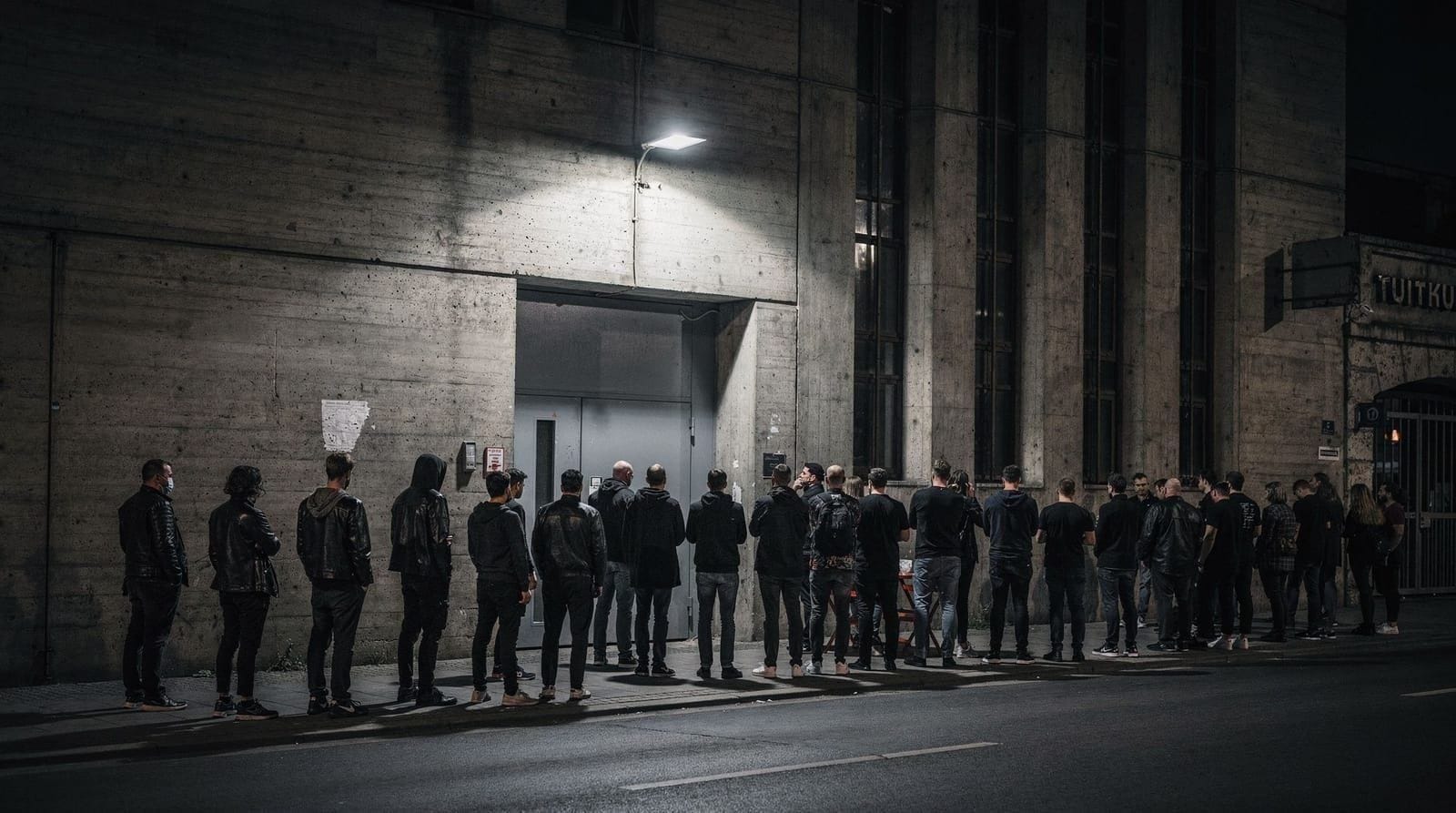
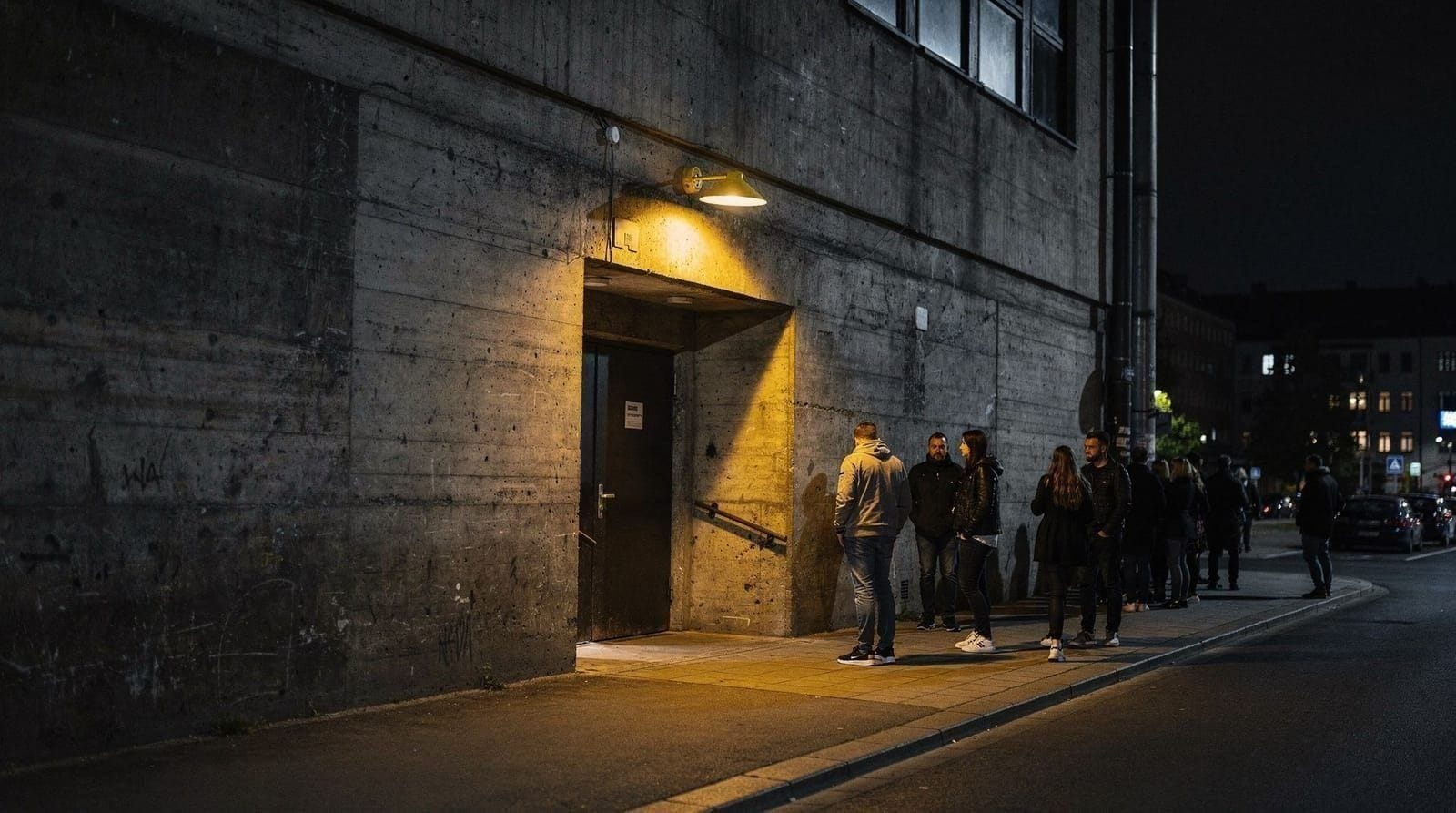
Berghain, which opened in 2004 in a former heat plant on Revaler Strasse in Friedrichshain, is now the most globally recognised club in the world for techno music. Its reputation rests on the quality of its DJ programme, its physical environment (vast main floor, dark, industrial), and the unusual door policy that controls entry in a way that keeps the internal atmosphere distinctive.
Berghain’s importance to the Berlin music scene is as the mature institutional form of what began in Tresor’s basement in 1991. It is no longer a spontaneous occupancy of derelict space — it is a highly managed institution with an extensive programme and significant cultural capital.
For practical guidance on attending Berghain — door policy, what to wear, what to expect — see the Berghain guide. For the wider techno club scene beyond Berghain, see the Berlin techno clubs guide.
Where to trace Berlin’s music history today
Hansa Studios, Köthener Strasse 38: The building is recognisable and marked with a plaque. The studios are operational and not open to the public, but the exterior and surrounding area are worth visiting. The Bowie plaque is visible from the street. Walk south from Potsdamer Platz along the former Wall corridor — the studio is close to where the Wall ran.
Hauptstrasse 155, Schöneberg: The Bowie-Iggy Pop apartment. Take U4 to Innsbrucker Platz, walk northeast on Hauptstrasse. Plaque on the building facade.
Tresor, Köpenicker Strasse 70: The current Tresor operates Friday and Saturday nights in a converted power plant. Entrance on Köpenicker Strasse, near Ostbahnhof. The club’s visual character continues the Tresor aesthetic of industrial spaces.
Berghain, Am Wriezener Bahnhof: In Friedrichshain, the building is visible from the street even when the club is not open. Its exterior — a former GDR-era heat plant — is characteristic of the post-Wall appropriation of industrial space.
Record shops worth a stop: Berlin’s independent record shop scene is one of the strongest in Europe, concentrated in Kreuzberg and Friedrichshain — a reflection of the same DIY culture that produced Tresor and Berghain. Browsing a couple of these shops on the walk between sites is a low-key way to engage with the living scene rather than only its history, and staff are often happy to talk through what is currently playing in the city’s clubs.
Practical planning — combining music history with nightlife
Berlin’s music history is concentrated enough to cover in a day of walking and transit:
Morning: Walk from Potsdamer Platz past Hansa Studios on Köthener Strasse (noting the former Wall corridor) to Tresor on Köpenicker Strasse (30–40 minutes walking through Kreuzberg and along the former border area).
Afternoon: U-Bahn to Innsbrucker Platz for the Hauptstrasse apartment. Walk or transit back to Friedrichshain for the RAW-Gelände and Berghain exterior.
For visiting clubs in the evening, see the Berlin nightlife neighborhoods guide.
For the broader Berlin alternative culture of which the music scene is part, see the Berlin club culture history guide.
Live music beyond the history trail
Berlin’s music scene did not stop developing after techno’s founding moment — the city has a genuinely strong live jazz and improvised-music circuit, largely centred in Kreuzberg and Prenzlauer Berg, alongside the electronic scene the history above focuses on. See the Berlin jazz and live music guide for current venues if you want to hear something other than techno during your trip. The RAW-Gelände area near Berghain has also become a live-music and street-art hub in its own right, worth combining with a Friedrichshain evening.
How the history trail compares to other Berlin history walks
| Walk | Focus | Time | Emotional register |
|---|---|---|---|
| Music history trail (this guide) | Bowie, Iggy Pop, techno origins | Half day | Cultural, celebratory |
| Third Reich sites walk | WWII and Nazi history | Half to full day | Heavy, historical |
| Cold War Berlin history | Division, espionage, the Wall | Half to full day | Tense, geopolitical |
| Street art guide | Contemporary visual culture | 2–3 hours | Light, visual |
The music history trail sits closer to the street-art walk in tone — it is a celebratory, low-key way to spend a few hours, and it pairs naturally with an evening out rather than requiring a separate, heavier day of its own.
Why the story keeps drawing visitors
Part of what makes Berlin’s music history durable as a travel subject is that it is not a closed chapter — the city’s reputation as a music capital is self-renewing. Musicians who moved to Berlin for cheap rent and creative freedom in the 1970s and the 1990s are, in different forms, still doing so today, and the same qualities (affordable studio space relative to London or Paris, a permissive nightlife culture, a critical mass of working musicians) continue to attract producers and DJs from around the world. Walking the historical sites is, in a sense, walking the origin story of a scene that is still actively being written in the clubs you pass along the way.
Frequently asked questions about Berlin music scene history
What were the David Bowie Berlin albums?
The "Berlin Trilogy" consists of three albums recorded primarily in Berlin: Low (1977), Heroes (1977), and Lodger (1979). Low and Heroes were recorded at Hansa Tonstudio (now Hansa Studios) at Köthener Strasse 38, near the Wall. The albums were produced by Brian Eno and Tony Visconti and marked a radical shift from Bowie's Ziggy Stardust era — ambient and electronic, influenced by Krautrock.Where is Hansa Studios and can you visit it?
Hansa Studios is at Köthener Strasse 38 in Kreuzberg, approximately 200 metres from where the Berlin Wall ran. The studio is still operational as a recording facility (albums by U2, Iggy Pop, Depeche Mode, and many others have been recorded here). It is not open to the public for general visits. A blue plaque on the exterior marks it as a historical site.Where did Bowie and Iggy Pop live in Berlin?
David Bowie and Iggy Pop shared an apartment at Hauptstrasse 155 in Schöneberg from 1976 to 1978. The building is now marked with a commemorative plaque. It is a short walk from Innsbrucker Platz U-Bahn station. The apartment is private and not open to visitors.How did techno develop in Berlin after 1989?
The fall of the Wall opened vast areas of derelict East Berlin — empty warehouses, underground bunkers, and industrial spaces — to ad hoc occupation. A group of DJs and promoters, influenced by Detroit techno and Chicago house (brought to Germany partly through American servicemen stationed in the country), began organising parties in these spaces. Tresor, opened in the basement of the former Wertheim department store at Potsdamer Platz in 1991, became the defining venue.What is Tresor and is it still open?
Tresor is the club most associated with the genesis of Berlin techno. The original venue on Potsdamer Platz (in the vault of a pre-war department store) operated from 1991 to 2005. A new Tresor opened at Köpenicker Strasse 70 in a former power plant in 2007 and operates to this day. It remains one of the most globally significant clubs for electronic music.Did any other famous musicians live or record in Berlin?
Yes. Iggy Pop's The Idiot (1977) and Lust for Life (1977) were also recorded in Berlin. Depeche Mode recorded extensively at Hansa Studios. Nick Cave lived in Berlin in the 1980s and the city influenced The Birthday Party and early Bad Seeds albums. The Einstürzende Neubauten, formed in West Berlin in 1980, pioneered industrial music using the city's construction sounds. The German bands Tangerine Dream, Klaus Schulze, and the early electronic Krautrock scene were based partly in West Berlin.