East Side Gallery murals — the stories behind the art
The East Side Gallery is the most visited outdoor art exhibition in Germany. It is also one of the most misunderstood. Most visitors photograph two or three of the most famous murals and move on, missing both the depth of the individual works and the historical moment they document.
This post is about the stories — what the artists were responding to in 1990, how the paintings have survived and changed, and which murals are worth slowing down for. For the practical logistics, history of the Wall segment, and a complete walking route, see the East Side Gallery murals guide and the East Side Gallery complete guide.
| Where | Mühlenstrasse, Friedrichshain, along the Spree |
| Cost | free, no ticket needed |
| Time needed | 30–45 min casual, 90 min–2hrs thorough |
| Getting there | S-Bahn Ostbahnhof, or U-Bahn Warschauer Straße |
| Best time | early morning (before 9am) for uncrowded photos |
What happened here in 1990
In February 1990, four months after the Wall fell, an organisation called Künstler für offene Grenzen (Artists for Open Borders) invited 118 artists from 21 countries to paint the eastern face of a surviving 1.3-kilometre stretch of the Berlin Wall in Friedrichshain. The western face was already covered in graffiti — West Berliners had painted it for years as an act of appropriation. The eastern face had been maintained as a sterile control strip, unreachable from the East.
The 1990 paintings were not just about the fall of the Wall. They were made in a moment of extraordinary political flux — between the opening of the border and the formal reunification of Germany in October 1990. The artists were responding to a world being remade in real time. Their themes include freedom, division, utopian aspiration, satire of power, nuclear anxiety, and the specific joy of movement across a border that had killed people for trying to cross it.
The original paintings deteriorated rapidly. By the early 2000s, many were faded, damaged, or covered in graffiti. In 2009, a controversial restoration project hired the original artists (where possible) to repaint their works in time for the 20th anniversary. Some artists refused, citing changed artistic intentions. Some restorations are faithful; others reflect how the artist’s perspective had changed in two decades.
The Fraternal Kiss — the most reproduced image
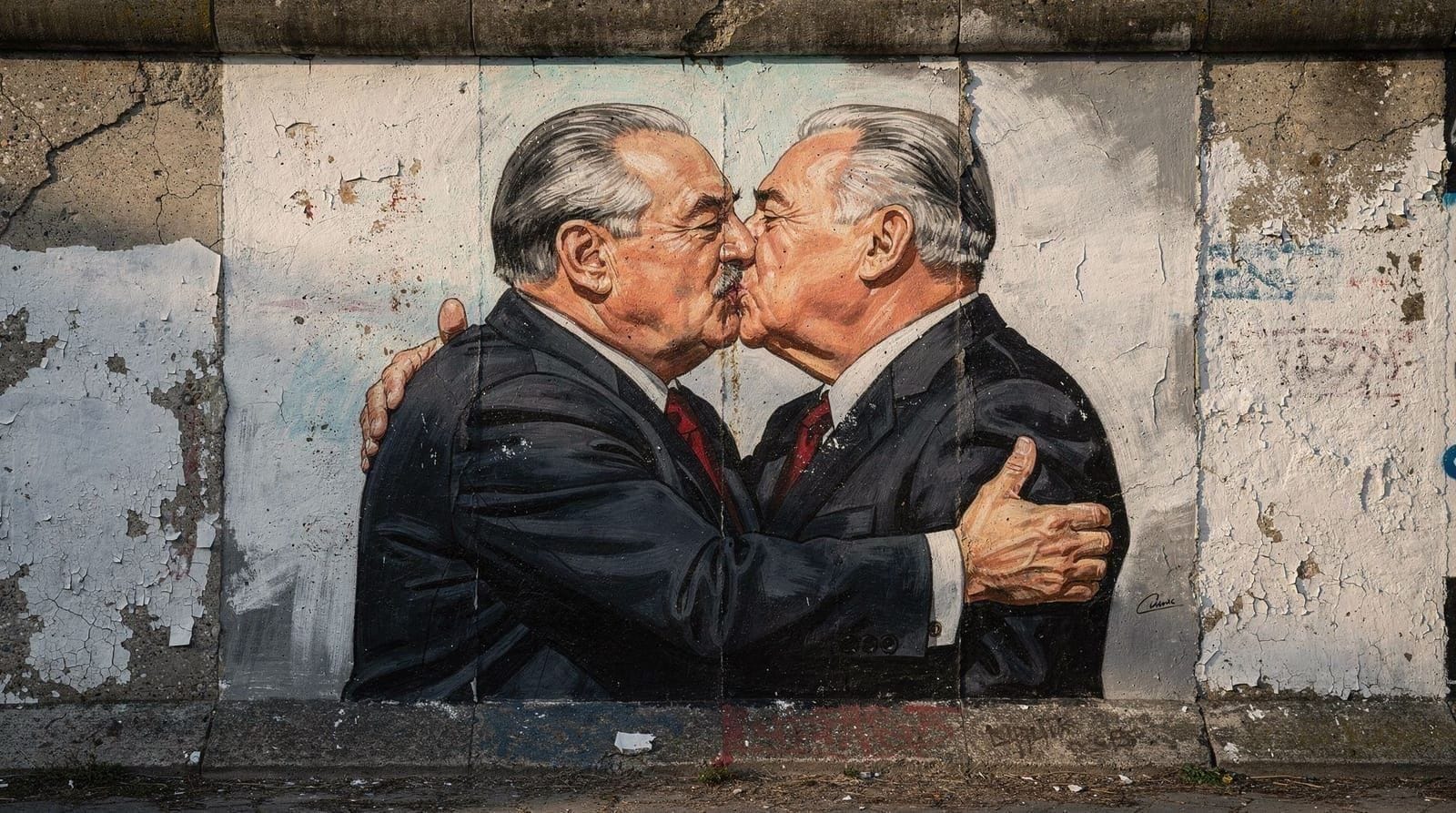
Dmitri Vrubel’s “My God, Help Me to Survive This Deadly Love” is the most photographed image in the East Side Gallery. It depicts the famous embrace (Bruderkuss, or fraternal kiss) between Soviet leader Leonid Brezhnev and GDR leader Erich Honecker, based on a photograph taken in 1979 at the GDR’s 30th anniversary celebrations.
The image plays on the contrast between the formal socialist greeting and the visual intimacy of a kiss. Vrubel’s accompanying text — in Russian and German — translates to “My God, help me to survive this deadly love.” The painting is satirical and political: it comments on the suffocating closeness of the GDR’s relationship with the Soviet Union, a relationship that literally died as the Wall was coming down.
In 2009, Vrubel repainted the mural and added a signature and the date. The original had been so deteriorated it was essentially gone. Whether the restoration preserves the work or replaces it is a question the artist has answered pragmatically: the image is what matters.
The mural has been heavily vandalized over the years and requires regular touch-up. The souvenir stalls that cluster around it by mid-morning are part of its context now.
”Es fiel die Mauer” — the crowd passing through
Kani Alavi’s “Es fiel die Mauer” (The Wall Fell) depicts a crowd of faces surging forward through a gap. The faces are compressed, layered, and differentiated — each individual within the mass. The expressions range from joy to shock to fear to grief.
Alavi, who was born in Iran and came to Berlin in 1980, painted this from direct experience of the night of November 9, 1989. The compression of the crowd — the sense of mass and movement — captures something that the famous television footage of the night doesn’t: the physicality and emotion of crossing, the fact that this was happening to thousands of individual people simultaneously.
This is one of the murals worth spending time with rather than photographing quickly. The detail is substantial and the composition rewards careful looking.
The Trabant breaking through
Birgit Kinder’s “Test the Rest” (also called “Trabant through the Wall”) is among the gallery’s most iconic images: a white Trabant car punching through the Wall, its licence plate reading “November 9, 89.”
The Trabant (or Trabi) was the two-stroke plastic-bodied car produced in the GDR from 1957. It became both a symbol of East German everyday life and a shorthand for the economic gap between East and West — hundreds of thousands of Trabants crossed into West Berlin in the days after the Wall opened. The queues stretched for kilometres.
Kinder’s image is deliberately optimistic and celebratory — the Trabi as a vehicle of liberation. It’s frequently reproduced on merchandise, which the artist has mixed feelings about. The 2009 restoration altered some of the original colours.
The “Hand of God” over the divided city
Ingrid Seyfert’s mural depicts two hands — one from each side of a divide — reaching toward each other but not quite touching, with the Berlin skyline below. The composition deliberately echoes Michelangelo’s Sistine Chapel ceiling, translating a divine creative act into a human-political one.
The work raises a question the gallery itself embodies: is connection between divided people an act of will, an accident, or something requiring intervention from outside?
Seyfert’s mural is among the less-reproduced images but one of the most philosophically rich. It stands toward the southern end of the gallery (the Galerien section).
Other murals worth slowing down for
Beyond the four or five images every visitor photographs, a handful of lesser-known works reward attention. Thierry Noir’s contribution here echoes the naive, cartoon-figure style he pioneered on the West Berlin side of the Wall through the 1980s — he was one of the first artists to paint the Wall at all, years before it fell, and his East Side Gallery piece connects the 1990 project to that earlier, illegal tradition documented in the Berlin Wall complete guide. Further along, several murals dealing explicitly with nuclear anxiety and Cold War paranoia are easy to walk past quickly but reward a minute of reading — they capture a specific 1990 fear (of a world that had just avoided catastrophe) that’s easy to forget from today’s vantage point.
For visitors interested in how this fits into Berlin’s wider street art culture — much of it contemporary, unrelated to the Wall — the Berlin street art guide covers Kreuzberg and Friedrichshain locations where the tradition continues today, and kreuzberg urban art goes deeper into that neighbourhood specifically.
The section that was demolished — and the controversy
In 2013, a significant section of the East Side Gallery was demolished to allow the construction of a riverside luxury development. The decision prompted major protests in Berlin and internationally — thousands of people linked hands around the gallery in opposition. Ultimately, the section was removed, the development built, and then (in a partial concession) the removed Wall segments were rebuilt alongside the new buildings.
The rebuilt section is not original — this is a copy of the mural-covered wall, positioned slightly differently than it was. The experience of walking through the full gallery now involves this rebuilt section, which is visually continuous but historically distinct.
The controversy over the 2013 demolition continues to affect how Berliners relate to the gallery. It’s a reminder that the site’s status as a “protected monument” does not make it immune to development pressure.
The “Pink Floyd Wall” connection
Despite what some tour guides suggest, the East Side Gallery is not the “Pink Floyd Wall” — Pink Floyd’s 1979 album “The Wall” and its 1982 film predated the fall of the Berlin Wall. However, Roger Waters performed “The Wall” at the Potsdamer Platz on July 21, 1990, using the ruins of the demolished Wall as a backdrop. This was one of the largest concerts in history, with over 300,000 attendees.
The connection between rock music and the political Wall is real but often confused. The East Side Gallery was created after the Wall fell; it is not a memorial to the Wall as it existed.
The original artists — who they were
The 118 artists came from across the world: East and West Germany, the Soviet Union, France, Spain, the Netherlands, Australia, the United States. The call went out through artist networks and the response was global. Many were young artists working in a moment of intense political electricity. Some became significant figures in the art world; others are obscure. The gallery is thus both a time capsule of the 1990 moment and a cross-section of international art practice at a specific historical juncture.
Short guided art tour of the East Side GalleryWalking the gallery — what to notice
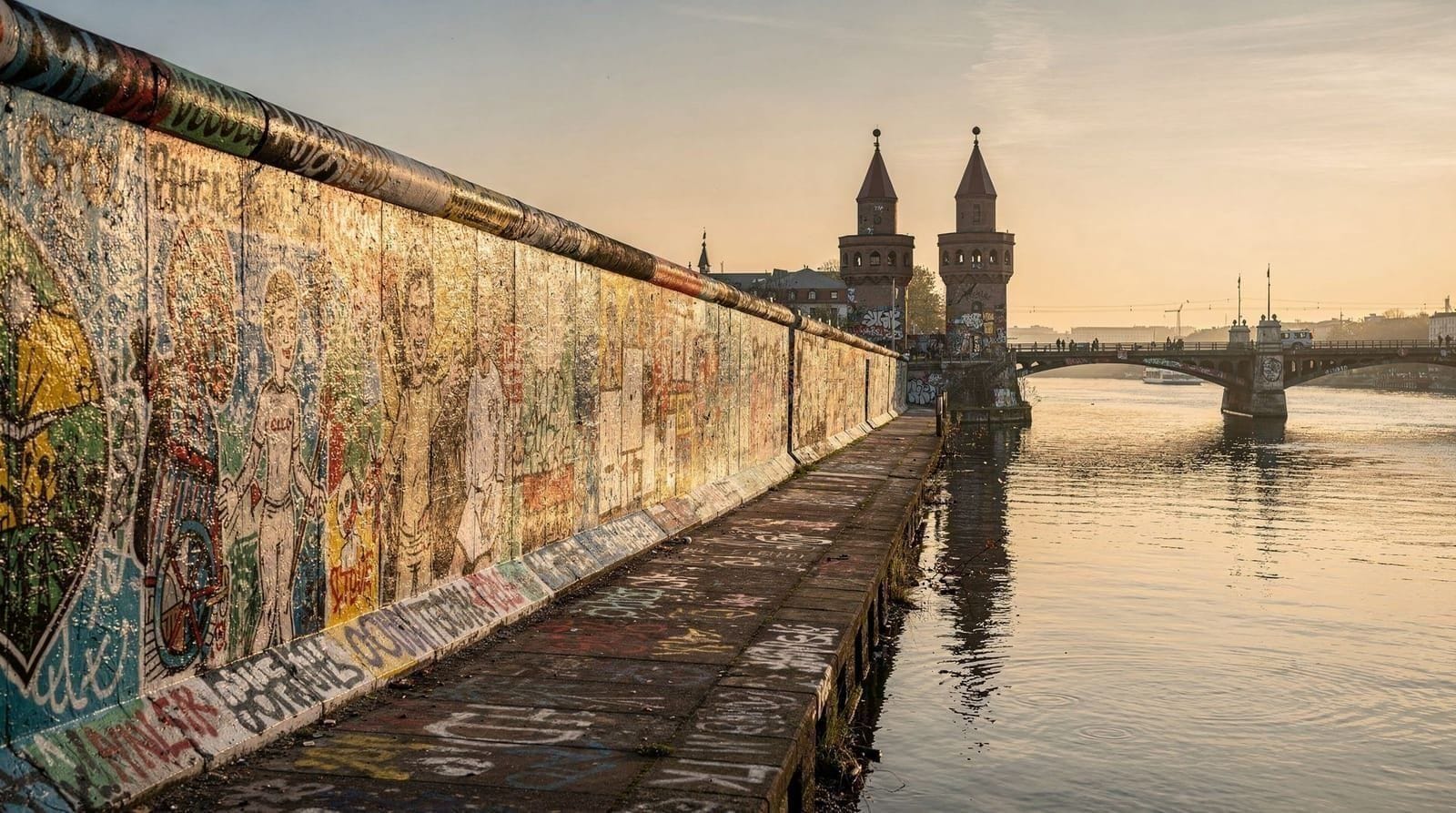
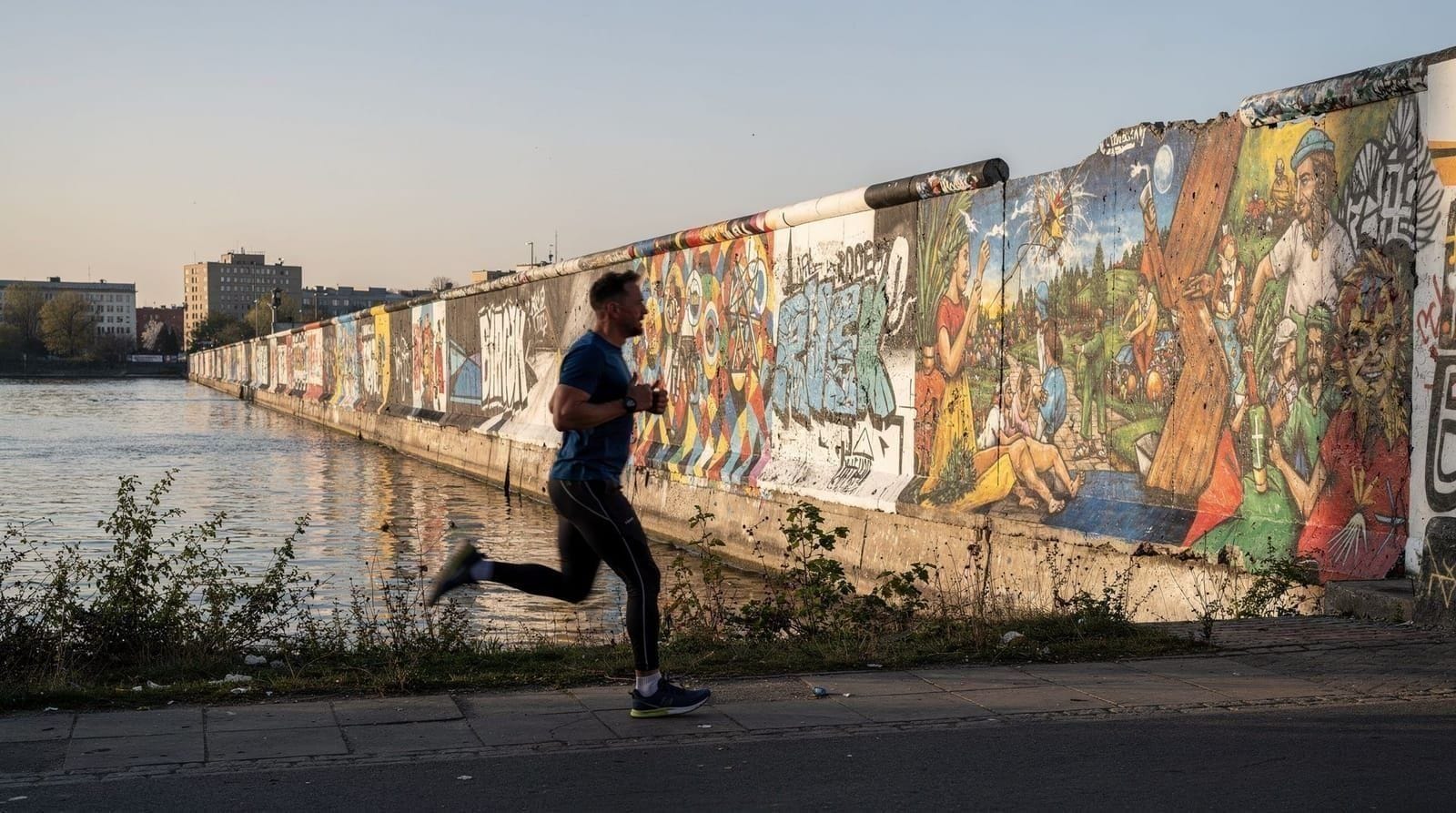
The gallery runs along the north bank of the Spree between Ostbahnhof and the Oberbaumbrücke — 1.3 kilometres. The murals face the river; the outer (street) side of the Wall is heavily tagged with contemporary graffiti, which has its own visual history.
Walk from Ostbahnhof toward the Oberbaumbrücke (south to north) for the conventional direction. Walk back along the river bank to see the murals from the water side.
The full walk takes 30-45 minutes at a reasonable pace. A thorough exploration — reading the information plaques, looking at individual murals in detail — takes 90 minutes to two hours.
Best times: early morning (before 9am) for photography with no crowds. Midday in summer is hot and crowded. Late afternoon is pleasant. The gallery is accessible at all times.
For the neighbourhood around the gallery, the Friedrichshain guide covers where to eat and drink nearby.
What’s missing — the murals that are gone
Of the original 118 murals, many are now palimpsests — painted over, restored, replaced. A few are genuinely lost. The gallery’s own historical documentation (available online and in the visitor information) tracks what the original paintings looked like.
Some artists painted murals in 1990 that they declined to restore in 2009, arguing that the original was site-specific and temporally bound. Their sections now show other artists’ work or restoration blanks. This is an honest response to the challenge of preserving political art that was made for a moment.
Berlin Wall and East Side Gallery walking tourFAQ
Q: Is entry to the East Side Gallery free? Yes. The outdoor gallery is free to visit at all times. No tickets required.
Q: Can I touch the murals? You can, but please don’t. The surfaces are deteriorating and every hand makes it worse. The restoration cycles are expensive and time-consuming.
Q: How long should I spend at the East Side Gallery? 30-45 minutes minimum for a casual walk-through. 90 minutes to two hours for a thorough visit.
Q: What is the “Fraternal Kiss” mural officially called? “Mein Gott, hilf mir, diese tödliche Liebe zu überleben” (My God, Help Me to Survive This Deadly Love), by Dmitri Vrubel, 1990, restored 2009.
Q: Is the gallery open at night? Yes, it’s outdoors and accessible at all times. Some of the murals are illuminated at night, though the lighting quality for photography is low.
Q: Where exactly is the East Side Gallery? On Mühlenstrasse in Friedrichshain, between Ostbahnhof S-Bahn station and the Oberbaumbrücke bridge. The nearest S-Bahn station is Ostbahnhof.
Q: Were all the murals originally painted in 1990? Yes, the original paintings date from 1990. Many were restored (repainted by the original artists or by others) in 2009. Some sections are now on their third or fourth iteration.
Q: Is the East Side Gallery the same as the Berlin Wall Memorial? No, they’re different sites with different focuses. The East Side Gallery is an outdoor art exhibition on a surviving Wall segment in Friedrichshain. The Berlin Wall Memorial on Bernauer Strasse focuses on the death strip, border fortifications, and personal escape stories — see the Berlin Wall complete guide for how the two sites complement each other.
Q: How does the East Side Gallery compare to Mauerpark’s street art? They’re different in kind. The East Side Gallery is a curated, historically anchored 1990 project with 118 named artists. Mauerpark is an informal, constantly repainted graffiti space with no fixed artworks — worth visiting for a completely different, more chaotic street art experience.