East Side Gallery murals — the stories behind Berlin's most famous Wall paintings
Berlin: Berlin Wall Short History & Art Tour at East Side Gallery
What are the most famous murals at the East Side Gallery?
The three most reproduced works are Dmitri Vrubel's "My God, Help Me to Survive This Deadly Love" (the Brezhnev-Honecker kiss), Birgit Kinder's "Test the Rest" (a Trabant driving through the Wall), and Kani Alavi's "It Happened in November." All 105 paintings were created in 1990 by artists from 21 countries and are on the original outer Wall facing the Spree.
What are the most famous murals at the East Side Gallery? Dmitri Vrubel’s fraternal kiss between Brezhnev and Honecker is the most photographed. Birgit Kinder’s Trabant breaking through the Wall is the most warmly received by German visitors. Kani Alavi’s “It Happened in November” is the most emotionally direct. All were created in 1990 on original Wall sections by artists who came voluntarily, without institutional commission.
| Where | Mühlenstrasse, Friedrichshain, between Ostbahnhof and Warschauer Strasse |
| Cost | Free |
| Time needed | 45 minutes (quick pass) to 2 hours (full walk with photography) |
| Getting there | S-Bahn to Ostbahnhof or U1/tram M10 to Warschauer Strasse |
| Best time | Before 9am, weekdays, for both crowds and light |
Where to find the three most famous murals
| Mural | Artist | Distance from Ostbahnhof |
|---|---|---|
| ”My God, Help Me to Survive This Deadly Love” | Dmitri Vrubel | About 400 metres |
| ”Test the Rest” | Birgit Kinder | About 200 metres |
| ”It Happened in November” | Kani Alavi | About 150 metres |
If you’re short on time, walking just the first 400 metres from Ostbahnhof covers the three most reproduced works.
What the East Side Gallery actually is
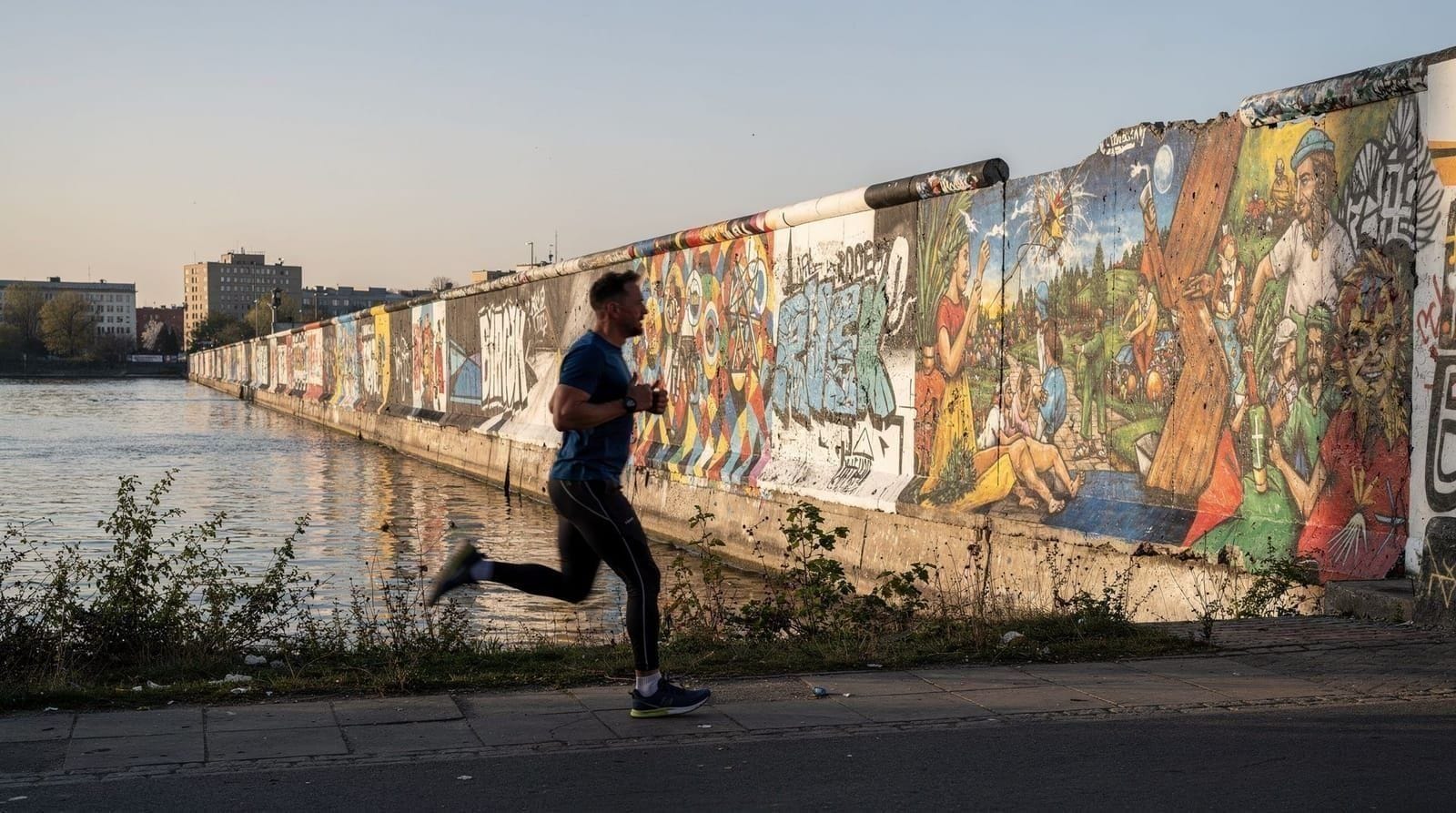
The East Side Gallery is an original segment of the Berlin Wall’s outer barrier — the concrete face that looked toward East Berlin — left standing after the Wall was demolished in 1990. It runs 1.3 km along Mühlenstrasse in Friedrichshain, following the north bank of the Spree river.
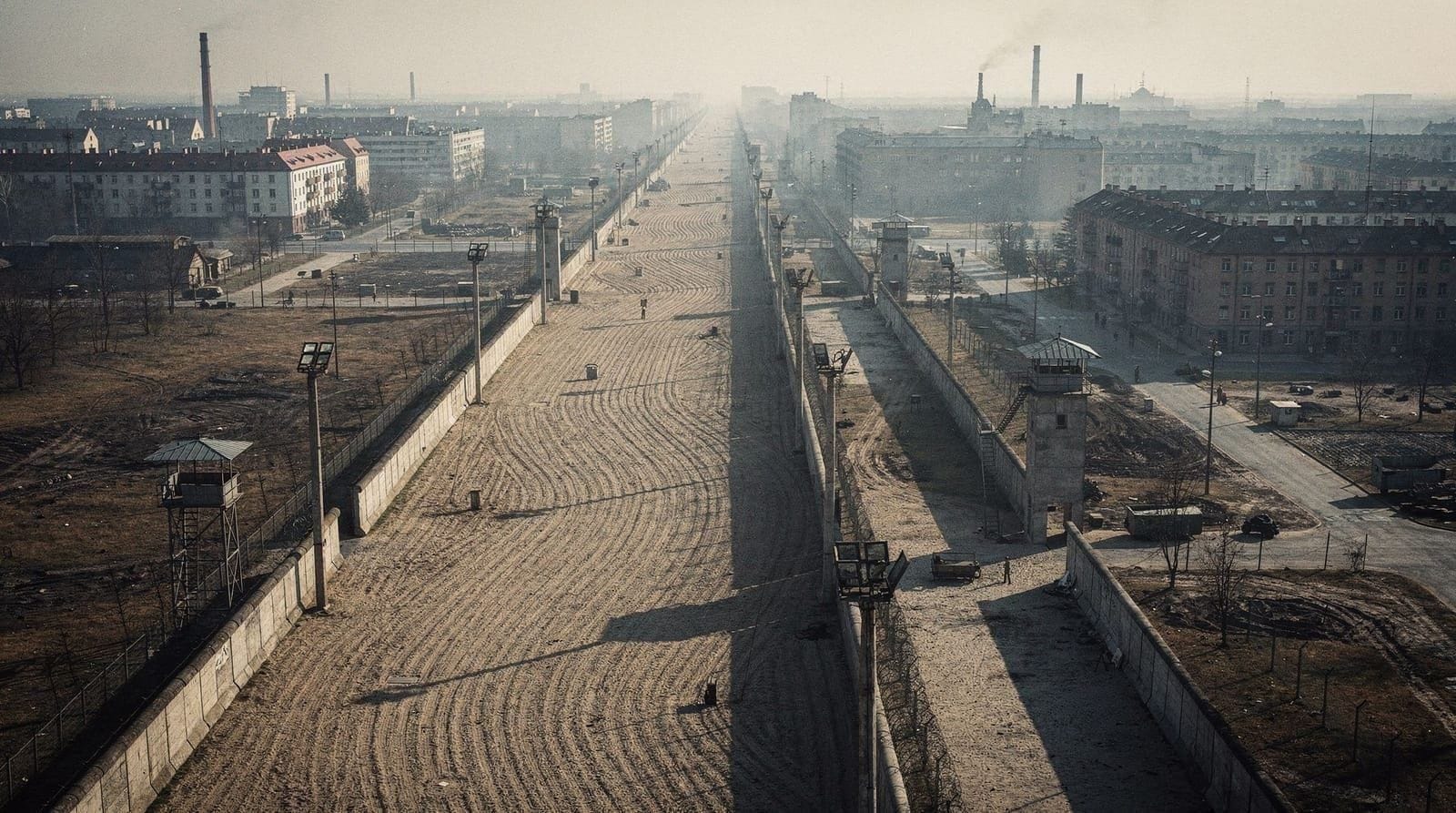
The distinction matters: this is not a reproduction or a memorial reconstruction. These are actual precast concrete segments (the fourth-generation “UL 12.11” type, 3.6 metres high, with the characteristic smooth rounded pipe along the top) that formed part of the border system until November 1989.
The paintings were added between February and September 1990, when Christine Kühn and a small group of artists began inviting colleagues to paint the wall as a collective response to the fall of the regime. Over 100 artists from 21 countries participated. There was no unified curatorial brief — each artist was allocated a number of segments and given freedom to respond as they chose.
The result is not a coherent artistic programme but a snapshot of how international artists processed the end of the Cold War division in real time, months after it happened.
The three most important murals
”My God, Help Me to Survive This Deadly Love” — Dmitri Vrubel
Dmitri Vrubel is a Russian artist born in Moscow in 1960. His mural at the East Side Gallery has become one of the most widely reproduced images in contemporary history.
The painting depicts Soviet leader Leonid Brezhnev and East German leader Erich Honecker kissing on the mouth — a reference to the “socialist fraternal kiss” (sozialistischer Bruderkuss) that was a ritual greeting between Communist leaders at official state occasions. The image was based on a photograph taken at the 30th anniversary of the GDR in October 1979.
Vrubel’s addition of the caption — “My God, Help Me to Survive This Deadly Love” (in Russian and German) — transforms a documentary photograph into a bitter commentary on the political relationship between the Soviet Union and the GDR: the East German state’s dependence on, and suffocation by, its Soviet patron.
The mural has been vandalised repeatedly and restored multiple times. The current version is not identical to the original 1990 painting — Vrubel himself repainted it in 2009 for the 20th anniversary of the Wall’s fall. The 2009 version is considered the authoritative current work, though subsequent restoration after vandalism has altered it further.
Location on the gallery: approximately 400 metres from the Ostbahnhof end.
Berlin: Wall Short History and Art Tour at the East Side Gallery — 1.5 hours, covers major murals with context”Test the Rest” — Birgit Kinder
Birgit Kinder is a German painter from Erfurt. Her contribution to the East Side Gallery is perhaps the most beloved among German visitors precisely because of its humour in the face of history.
The painting shows an East German Trabant (the characteristic small car produced in the GDR, a symbol of everyday East German life) bursting through the concrete Wall, its occupant’s hand reaching out to catch a West German passport from a bouquet of flowers. The title “Test the Rest” is painted in the style of a car dealer’s advertisement.
The Trabant had become a defining symbol of the 1989 fall of the Wall — long columns of Trabants crossing into West Germany on the night of November 9 were among the most iconic images of the event. Kinder’s painting captures both the absurdity and the joy of that moment.
The image has been reproduced on thousands of souvenirs, postcards, and advertising materials. Like Vrubel’s kiss, it has been vandalised and restored; Kinder repainted it in 2009.
Location: approximately 200 metres from the Ostbahnhof end.
”It Happened in November” — Kani Alavi
Kani Alavi was born in Tehran in 1951 and has lived in Germany since the late 1970s. His mural is one of the most emotionally direct at the East Side Gallery.
The painting shows a crowd of figures pressing through a gap in the Wall, hands reaching out and faces showing a range of expressions — from euphoria to grief to disorientation. Some faces are screaming; others are blank. The scale is overwhelming: the crowd fills the entire surface.
Alavi, who was in Berlin on the night the Wall fell, described the experience of watching thousands of people cross into West Berlin as not simply a moment of joy but one of collective shock — decades of constraint released in a single night, without preparation. His painting tries to capture that emotional complexity.
The mural is widely considered the most artistically significant of the 105 works at the gallery. Alavi has become a public spokesperson for the East Side Gallery’s preservation, particularly during the 2013 developer conflict.
Location: approximately 150 metres from the Ostbahnhof end.
Other significant works
”Détente” — Thierry Noir
Thierry Noir (born 1958, Lyon) is often cited as the first artist to paint the Berlin Wall. He began painting the western face of the Wall in Kreuzberg in 1984, working illegally with his colleague Christophe-Emmanuel Bouchet. His characteristic large-headed cartoon faces — painted rapidly to avoid arrest — became an early visual identity for Wall art.
At the East Side Gallery, Noir contributed a row of his characteristic figures in bright colours, referencing his earlier illegal work. The style is deliberately simple and repeated — a formal contrast to the more painterly works around it.
”Hommage à la Jeunesse” — Thierry de Cordier
Belgian artist Thierry de Cordier contributed a minimal painting that shows a large, stylised tree against a stark background. The work is less immediately legible than the figurative murals but has attracted sustained critical attention for its restraint.
”Vaterland” — Fulvio Pinna
Italian photographer and artist Fulvio Pinna painted a large panel referencing the division of Germany through abstract imagery. Like many of the less-visited works, it has deteriorated more than the frequently photographed and restored pieces.
Works near the Warschauer Strasse end
Visitors who only walk the first few hundred metres from Ostbahnhof — where the most famous murals sit — miss the section closer to Warschauer Strasse, which is quieter and includes several works dealing with themes beyond Germany specifically: nuclear disarmament, international solidarity movements, and abstract meditations on freedom that reflect the diverse backgrounds of the artists invited in 1990. This section is also where some of the least-restored panels survive, giving a more direct sense of how the paintings have aged over three decades without intervention. If your interest runs more toward the gallery as a historical artifact than as a highlight reel, walking the full length in this direction rather than turning back after the famous section is worth the extra 20-30 minutes.
For the wider street art culture that grew out of the Wall-painting tradition beyond the East Side Gallery itself, Mauerpark — a short U-Bahn ride away in Prenzlauer Berg — has an active, constantly changing legal graffiti wall that contrasts usefully with the fixed, historically protected murals here.
The 2013 conflict and the gap in the gallery
In early 2013, the owner of property adjacent to the East Side Gallery received permission to demolish 22 Wall segments to create access to a luxury residential development (Mediaspree project). The demolition began in March 2013.
The protests that followed were the largest public demonstrations over the East Side Gallery since its creation. On 17 March 2013, an estimated 6,000 people gathered to block the work. Artists including Kani Alavi chained themselves to the Wall. A court injunction was obtained.
The compromise reached allowed fewer segments to be removed. The resulting gap in the gallery — now filled by a low fence — is still visible at the Warschauer Strasse end. The luxury residential tower (Living Bauhaus / Mercedes-Benz Arena development) was built behind the gallery, its upper floors visible above the Wall.
The conflict exposed a structural vulnerability: despite being a protected monument (Denkmalschutz), the Wall segments sit on land owned by the Berlin Senate, which had authorised the access route for the developer. Monument status had been applied to individual panels, not the site as a whole.
Berlin: Wall and East Side Gallery Walking Tour — covers the full 1.3 km with guide, 2 hoursRestoration versus originality
The question of how much of the East Side Gallery is “original” does not have a clean answer.
Weather damage begins within years on outdoor acrylic paintings — fading, cracking, and water infiltration cause significant deterioration. Vandalism (including people writing on the murals) compounds this. Several works had deteriorated severely by the late 1990s.
The first major restoration was in 2000, when several panels were repainted with the artists’ involvement. A second major restoration occurred in 2009 for the 20th anniversary. Individual panels have been restored at various points since.
Some artists repainted their own works and consider the restored version to be the definitive piece. Others were not involved and the restoration was done by professional conservators working from photographs. In some cases, artists are no longer alive or cannot be located.
The result is a gallery where some panels are essentially identical to their 1990 originals, others are 2009 repaints by the original artists, and others are third-party restorations that may differ from the original in colour and detail.
This is not a secret or a scandal — it is the practical reality of maintaining outdoor painted concrete over three decades. But visitors expecting to see unaltered 1990 work should understand the situation.
A practical way to engage with this honestly is to treat the gallery as a living document rather than a fixed artifact — the same framing that applies to any outdoor mural tradition, from Berlin’s own Kreuzberg street art scene to comparable open-air galleries elsewhere in the world. The murals’ meaning as a historical statement about 1989-90 does not depend on every brushstroke being untouched; what matters is that the site continues to function as the location where that statement was first made, repeatedly renewed by many of the same hands.
Practical information for visiting
Getting there: S-Bahn S3, S5, S7, or S9 to Ostbahnhof (western/start end), or U1 or tram M10 to Warschauer Strasse (eastern end). Walking from Ostbahnhof, turn left out of the main entrance and follow the river for 2 minutes. The painted surface is immediately visible.
Hours: Open 24 hours, always free. There are no entrance gates or barriers.
Time needed: Walking the full 1.3 km at a moderate pace with stops to photograph individual works takes 1.5 to 2 hours. A quick pass takes 45 minutes.
Best time to visit: Early morning (before 9 am) has the fewest tourists. The gallery faces roughly north, meaning it receives good light in mid-morning. Summer afternoons are very crowded. The evening murals are lit by street lighting but photographic quality decreases significantly.
Crowds: The section between Ostbahnhof and the Mercedes-Benz Arena (first 400 metres) is the most visited. The eastern section toward Warschauer Strasse is consistently less crowded.
Facilities: There are toilets at the Ostbahnhof station. Cafés and food stalls open in summer along the river side (Spree beach/YAAM area). No lockers or storage.
For broader context on the Wall, its history, and other surviving sections across Berlin, see the Berlin Wall complete guide.
For the street art and graffiti culture that developed from the Wall painting tradition, see the Berlin street art guide.
For neighbourhood information on Friedrichshain, where the gallery is located, see the Friedrichshain guide.
For a structured multi-day Cold War itinerary that places the East Side Gallery alongside Checkpoint Charlie and Bernauer Strasse, see the Cold War Berlin itinerary. The Berlin 2-day itinerary also includes a shorter version for first-time visitors with limited time.
Frequently asked questions about East Side Gallery murals
Is the East Side Gallery original Wall?
Yes. The East Side Gallery is the original outer concrete Wall (the side that faced East Berlin), left standing after reunification. The paintings were added in 1990. However, several individual panels have been restored or entirely repainted since due to weather damage and repeated vandalism. The degree of originality varies panel by panel and is not always clearly labelled on-site.Who commissioned the East Side Gallery murals?
The murals were initiated by East German artist Christine MacLean (now known as Christine Kühn) and painter David Monty in early 1990. They invited artists from around the world to paint the Wall as an international response to reunification. The project was not funded by a single institution — artists came at their own initiative, coordinated through the East Side Gallery organisation that subsequently formed to protect the site.How long is the East Side Gallery?
The East Side Gallery stretches 1.3 km along Mühlenstrasse between Ostbahnhof and the Warschauer Strasse bridge. It contains 105 paintings on 118 segments of original Wall. The full walk, including time to photograph individual works, takes about 1.5 to 2 hours.What happened when developers tried to remove sections of the East Side Gallery?
In 2013, a real estate developer (Investor Living Bauhaus) sought to remove 22 segments of Wall to build a luxury residential tower and provide river access. The demolition triggered massive protests — a demonstration drew 6,000 people in March 2013. Several segments were removed before a court injunction halted the work. The tower was eventually built, but with fewer segments removed than originally planned. The gap is still visible in the gallery.Can you enter from both sides of the East Side Gallery?
No. The gallery is against the north bank of the Spree. The painted face (what was the eastern face of the Wall) looks north toward the street. You walk along Mühlenstrasse to view the paintings. There is no access from the river side (south) without a boat. The rear face of the Wall, which looks toward the Spree, is unpainted.What is the Ostbahnhof end versus the Warschauer Strasse end?
The Ostbahnhof end (western end of the gallery) has the highest concentration of well-known paintings and is where most guided tours start. The Warschauer Strasse end (eastern end) has fewer visitors and some less-restored sections. Walking east to west gives you the most famous works at the end; walking west to east means you encounter them at the start.Is the East Side Gallery free?
Yes. The East Side Gallery is an open-air public space, free to enter at any time, 24 hours a day. There are no tickets and no entrance gates. Guided tours of the gallery charge separately for their service.
Top experiences
Bookable activities with verified prices and instant confirmation on GetYourGuide.