Surviving Berlin Wall watchtowers — a guide to what remains
Berlin: East Berlin and the Wall Walking Tour
How many Berlin Wall watchtowers survive, and where are they?
Of the 302 watchtowers that formed part of the Berlin Wall fortification system, fewer than 10 remain standing in Berlin today. The most accessible surviving towers are at Schlesischer Busch (Treptow, near the Spree), Kieler Strasse (Wedding), the Berlin Wall Memorial on Bernauer Strasse (partial), and in the Nieder Neuendorf area outside the city. Most are visible from outside only; some open for guided visits.
How many Berlin Wall watchtowers survive? Of the 302 watchtowers that formed part of the Berlin Wall fortification system, fewer than 10 remain standing in Berlin today. The most accessible are at Schlesischer Busch (Treptow), Kieler Strasse (Wedding), and the Berlin Wall Memorial on Bernauer Strasse. Most are viewable from outside only; interior access is limited to occasional organised open days.
| Where | Scattered across Berlin — Treptow, Wedding, Mitte, Brandenburg |
| Cost | Free to view exteriors; interior access is occasional and free |
| Time needed | 30–45 min per tower, or a 5–6 hour self-guided circuit |
| Getting there | U-Bahn/S-Bahn plus a 10–20 minute walk per site |
| Best time | Weekday mornings; the Mauerweg is best cycled April–October |
The watchtower system: how the Wall was guarded
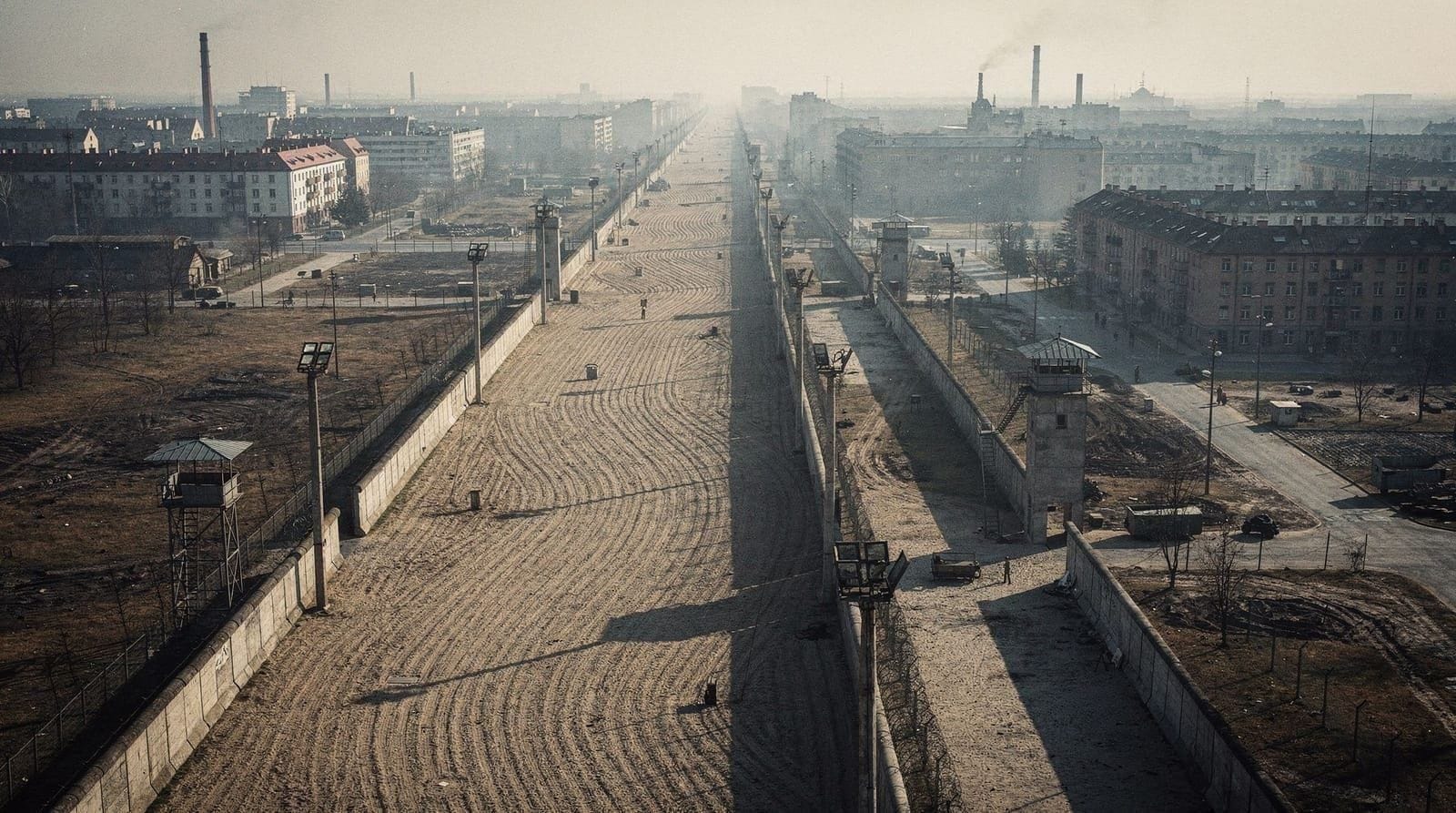
The Berlin Wall was not a single wall. It was a fortification system — a layered sequence of barriers, obstacles, and surveillance infrastructure stretching 155 km around the entire perimeter of West Berlin. Of those 155 km, approximately 107 km consisted of the reinforced concrete wall most associated with the image of the Wall; the remaining 47 km was metal mesh fencing used in less densely populated sections. The fortification zone also included 20 bunkers, 259 dog runs (metal wire cables along which patrol dogs were chained), hundreds of kilometres of patrol roads, and motion-activated lighting strips.
At the centre of the surveillance system were the 302 watchtowers. Their purpose was to maintain uninterrupted visual coverage of the death strip — the controlled no-man’s-land between the inner and outer walls — and to allow rapid response to any escape attempt. Every section of the Wall was within sight of at least one tower; the denser sections of the fortification, particularly in urban areas, had towers spaced as close as 300-400 metres apart.
The guards who staffed the towers were members of the Grenztruppen der DDR — the Border Troops of the German Democratic Republic. This was a separate military force from the regular NVA (Nationale Volksarmee), responsible specifically for the inner-German border and the border with West Berlin. Conscripts served in the border troops as a form of obligatory military service, but volunteers and career soldiers also served. The force numbered approximately 11,000 at its peak, responsible for the entire 1,393-km inner-German border as well as the Berlin Wall.
Towers were staffed in two-person shifts around the clock. The standard duties included visual monitoring of the death strip and adjacent areas, operation of searchlights, radio communication with mobile patrol units and command posts, and documentation of any unusual activity. The question of what guards were ordered to do in the event of an escape attempt has been legally and historically contested since reunification.
There was no single written “shoot-to-kill” order (Schiessbefehle). What existed was a series of orders to “prevent border violations by all means,” including the use of firearms as a last resort. In practice, the orders were applied inconsistently — some guards fired, some did not, and some deliberately missed. At least 140 people died attempting to cross the Berlin Wall between 1961 and 1989; the full figure, including those who died later from injuries or whose deaths were not recorded at the border, may be higher. After reunification, prosecutions of border guards and the officers who gave their orders resulted in convictions in some cases, acquittals in others. The legal proceedings clarified that following orders was not an absolute defence, and that specific guards who fired could be held criminally responsible.
The standard watchtower type from the 1970s onwards was the BT-9 (Beobachtungsturm Typ 9). This is the cylindrical concrete tower most visible in photographs of the Wall — a narrow base supporting a slightly wider circular observation cabin, with continuous windows at the top providing 360-degree visibility. The observation cabin was heated, had communications equipment, and had space for two guards to work. The BT-9 was prefabricated in sections and assembled on site, making rapid installation possible. Several BT-9 towers survive, including the one at Schlesischer Busch.
Earlier tower types varied in design. The first watchtowers constructed in 1961-1962 were often wooden structures, quickly built and improvised. Rectangular concrete towers followed, then the more sophisticated cylindrical designs. By the time the Wall reached its final configuration in the mid-1970s, the BT-9 had largely replaced earlier types in Berlin’s urban sections. Understanding the difference between tower types is useful for reading surviving examples: the BT-9’s distinctive profile makes it immediately recognisable, while earlier types have a more angular, utilitarian appearance.
A useful overview of how the full fortification system was laid out is in the Berlin Wall complete guide and the Cold War Berlin history guide.
The Schlesischer Busch tower — the most accessible example
The most readily visited surviving watchtower in Berlin stands in Schlesischer Busch park in the Treptow district, on the south bank of the Spree. This location is significant: the River Spree marked the sector boundary here, with East Berlin on the south bank and West Berlin’s Kreuzberg district directly across the water. The river itself was part of the fortification system. The bank was walled, lit, and patrolled; access to the riverbank from the East was restricted. The watchtower stood here to cover both the riverbank approach and the area immediately south.
The tower is a BT-9 type in good structural condition. It stands to its full original height within the park, surrounded by trees that have grown significantly since 1989 and now partially obscure the view of the tower from some angles. The contrast between the tower’s original purpose — unobstructed surveillance — and its current context of mature parkland is one of the more striking visual ironies at any Wall site.
Getting to the Schlesischer Busch tower:
By U-Bahn: U1 to Schlesisches Tor (Kreuzberg side), then walk south across the Gröbenufer bridge and into the park. The walk takes approximately 10-12 minutes. This route gives a sense of the former border geography — you cross the Spree at the point where it marked the sector boundary.
By S-Bahn: S-Bahn to Treptower Park, then walk west through Treptower Park approximately 15 minutes. This approach passes the Soviet War Memorial at Treptower Park, which is worth a separate visit — the scale of the memorial (built by the Soviet Union in 1949 to commemorate soldiers who died in the Battle of Berlin) is extraordinary, and its continued existence in what was East Berlin into the reunified city makes it a historically unusual site.
The tower is visible from outside at all times. The park has no gate or access restriction. Interior access requires pre-arrangement through the Berlin Wall Memorial Foundation (berliner-mauer-gedenkstaette.de), which organises occasional open days and guided visits; check their current schedule before planning a visit specifically around interior access, as these events are not weekly.

The Kieler Strasse tower — Wedding district
The second most accessible surviving tower stands on Kieler Strasse in the Wedding district, in what was during the division the French sector of West Berlin. This location illustrates a different aspect of the Wall’s geography: Wedding was a working-class residential district, and the Wall here ran through streets and between apartment buildings rather than along a river or through parkland. The visual character of the Wall in Wedding — concrete barriers between ordinary urban blocks — was quite different from the more photogenic sections at Checkpoint Charlie or the Brandenburg Gate, which received the majority of Western media attention.
The Kieler Strasse tower is now in private ownership. It is not part of a memorial or public institution; it survives through a combination of the owner’s decisions and the listing status that many surviving Wall structures received in the 1990s. The tower is viewable from the street on Kieler Strasse at all times; entry to the structure is not available as a walk-in visit. The owner has occasionally permitted access for events or exhibitions, but there is no regular programme.
Getting to the Kieler Strasse tower:
By U-Bahn: U6 to Seestrasse, then walk east along Müllerstrasse and turn onto Kieler Strasse. The walk takes approximately 10 minutes.
Wedding is less frequented by tourists than central Berlin Wall sites. This has both advantages and disadvantages. There are no crowds, no souvenir stands, no organised tours running past on schedule. The tower stands in a residential neighbourhood context that makes the banality of the Wall’s presence — how it simply cut through ordinary urban fabric — more legible than at more intensively memorialised sites. The Berlin divided city history guide has context on how the Wall affected different Berlin districts differently depending on their urban geography and sector assignment.
Bernauer Strasse Wall Memorial — tower remnant in context
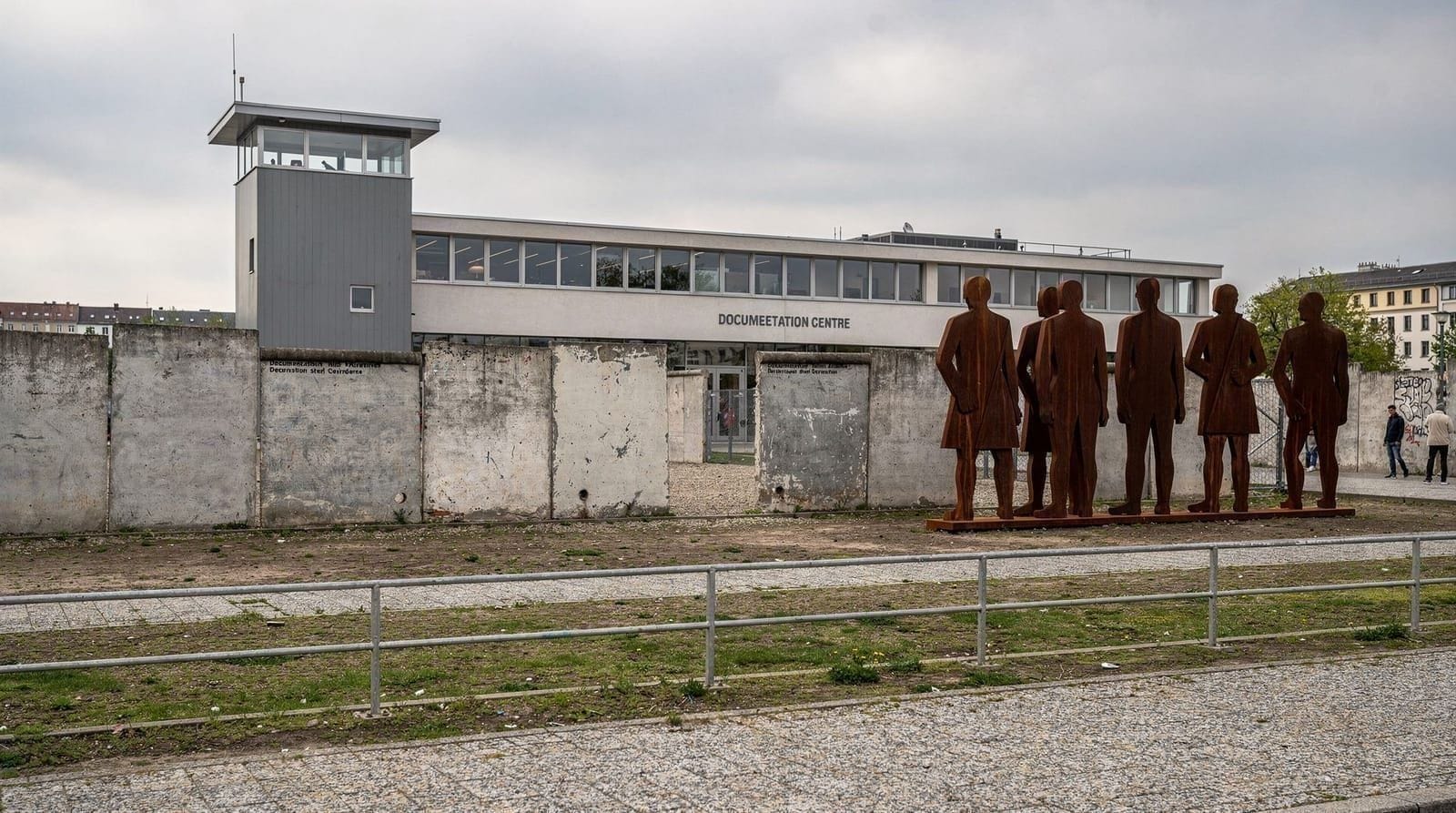
The Berlin Wall Memorial on Bernauer Strasse preserves the most historically layered section of the Wall system accessible in Berlin. The outdoor memorial area, stretching for approximately 1.4 km along Bernauer Strasse, includes: a surviving section of the outer wall, traces of the inner wall, the original cobblestone marking of the death strip, exposed foundations of apartment buildings demolished to create the death strip, a steel information module with photographs, and — most relevant here — a partial guard tower remnant integrated into the outdoor exhibition.
The tower remnant at Bernauer Strasse is not a complete surviving BT-9 but rather a preserved lower section with explanatory context. Its value is contextual rather than architectural: standing within the preserved memorial area, adjacent to the death strip traces and wall fragments, it allows visitors to understand the relationship between the tower’s position and its field of view over the death strip. A guard standing in that tower could observe every metre of the fortification zone in its section.
The documentation centre at Bernauer Strasse 111 houses the indoor exhibition — free entry, with original photographs of the Wall under construction (including the famous images from the street’s first days in August 1961 when residents jumped from windows), testimony from survivors, escapees, guards, and relatives of those who died, and detailed maps and diagrams of the full fortification system around the entire Berlin perimeter. The cartographic exhibits are particularly valuable for understanding the 302-tower system in spatial terms.
Getting there: U8 to Voltastrasse and walk east along Bernauer Strasse (5 minutes), or tram M10 to Bernauer Strasse stop. Free. Outdoors section accessible at all times; documentation centre has standard museum hours (check berliner-mauer-gedenkstaette.de for current times). If you make one stop related to the fortification system as a whole, this is the most informative.
The Nieder Neuendorf tower — outside Berlin
The Nieder Neuendorf watchtower stands on the Oder-Havel Canal in Brandenburg, north of Berlin near Hennigsdorf. It is one of the best-preserved surviving towers in the entire Berlin Wall system and is worth the trip out of the city for visitors with a serious interest in the physical remains of the fortification.
This tower’s location on the canal illustrates an aspect of the Wall that urban Berlin sites do not convey: the fortification system extended to all waterways around the West Berlin perimeter. Canals, lakes, and the Havel River were all integrated into the border system with their own barriers, boat patrols, and surveillance infrastructure. The Nieder Neuendorf tower stands at a canal crossing point, its sightlines over the water essentially unchanged because there has been no development to obstruct them. Looking from the tower location across the canal — even without access to the interior — the original function of the position becomes immediately clear in a way that an urban tower site surrounded by later construction does not permit.
Getting there: S25 from Berlin city centre to Hennigsdorf, then walk or cycle approximately 20 minutes east to the canal. The tower has interpretive panels in both German and English; no entry fee for the exterior. Interior access may be possible on certain dates; check with Brandenburg tourism or the Gedenkstätte Berliner Mauer.
The Nieder Neuendorf location is also a good starting or ending point for a section of the Berliner Mauerweg cycling trail, described below.
The Berliner Mauerweg — cycling the full Wall line
The Berliner Mauerweg is a marked 160-km cycling and walking trail following the former Wall line around the entire perimeter of West Berlin. The trail is waymarked with brown signs and passable at all points, though surface quality varies. By bicycle, the full circuit takes 4-6 days; individual sections work as half-day excursions.
The Mauerweg passes all 302 former tower locations. Most have interpretation boards with a historical photograph showing the view from that spot in the 1970s or 1980s; the contrast between the photograph and the current landscape — development where death strip once stood — is a recurring feature of the route.
Three particularly worthwhile sections: Bornholmer Strasse south through Wedding and Bernauer Strasse to Mitte (dense with documented tower sites); Treptow along the Spree past the Schlesischer Busch tower; and the south-western Havel lake sections near Potsdam, where the border ran through open water and fortification presented the GDR with an especially complex engineering challenge.
For itinerary planning, the Cold War Berlin itinerary covers the Mauerweg’s most historically significant sections.
Other surviving traces of the Wall in Berlin
The watchtowers are the most architecturally complete remnants of the fortification system, but they are not the only physical traces in the city.
Double cobblestone line (Mauerstreifen): Embedded in Berlin streets and pavements throughout the former Wall’s course, a double row of cobblestones marks where the Wall stood. The line is most clearly visible on Niederkirchnerstrasse near the Topography of Terror, on Bernauer Strasse, and on Ebertstrasse near the Reichstag. Walking the cobblestone line through central Berlin — where it runs through hotel lobbies, across car parks, and through shopping areas — makes the Wall’s urban penetration viscerally clear in a way that preserved sections in parks do not.
Foundation exposures: Some excavations for new buildings near the former Wall line have uncovered original concrete foundations, which were subsequently left exposed and incorporated into public space design. Several exist near Checkpoint Charlie, where the former border crossing point’s complicated site history has produced a palimpsest of Wall-era and post-reunification archaeology.
The Topography of Terror: The outdoor section of the Topography of Terror on Niederkirchnerstrasse includes a surviving Wall fragment and a series of information panels documenting the fortification system with photographs. The Topography of Terror site is built on the former headquarters of the Gestapo and SS; the combination of Nazi-era and Cold War history in a single location is dense. Free, open daily, outdoor section accessible at all times.
Checkpoint Charlie: The most visited Wall-related site in Berlin, and the most commercially developed. The original checkpoint booth is a replica; the surrounding area has been substantially redeveloped. For the Cold War context of checkpoint operations and the espionage activity associated with the crossing point, the Checkpoint Charlie guide is a better starting point than arriving without preparation. The Cold War espionage guide covers the intelligence activities that centred on this area.

How to plan a self-guided watchtower circuit
The surviving towers in Berlin are spread across the city and cannot be seen in a single morning’s walk. The following half-day route is the most time-efficient combination of tower sites and related Cold War context:
Suggested half-day route (approximately 5-6 hours including travel):
Start at Bernauer Strasse: take U8 to Voltastrasse and walk east to the Berlin Wall Memorial (arrive by 10 am). Spend 60-90 minutes at the outdoor memorial and documentation centre — this provides the conceptual foundation for everything you see at other sites. The tower remnant here is in context; the photographs and maps establish the full scale of the fortification system.
Walk 5 minutes east to Nordbahnhof S-Bahn station. Enter the platform level (requires a valid BVG ticket; the ghost station exhibits are on the platform itself). The photographs of the sealed platform as it appeared during the division — frozen, empty, patrolled by guards — are brief but worth 15 minutes.
Take the S-Bahn from Nordbahnhof south to Treptower Park (S41/S42 ring, direction Ringbahn). From Treptower Park station, walk west through the park (passing the Soviet War Memorial if time allows — add 20 minutes). Continue to Schlesischer Busch park to see the BT-9 tower from outside. Allow 30-45 minutes at this site.
From Schlesischer Busch, the U1 at Schlesisches Tor connects back to the U-Bahn network for the return to central Berlin.
Total walking: approximately 5-7 km depending on diversions. Total transit: approximately 45 minutes. The route can be extended by continuing from Treptower Park to the East Side Gallery (30-minute walk east along the Spree, or one stop on the S-Bahn to Ostbahnhof).
For visitors who prefer a guided framework for the Cold War material, a specialist walking tour provides commentary on the fortification system that self-guided visits cannot replicate.

Practical information
Exterior access: All surviving towers listed in this guide are viewable from outside without charge or advance booking at any time. They stand in parks or on public streets.
Interior access: Organised by the Berlin Wall Memorial Foundation for the Schlesischer Busch tower and occasionally for other sites. Check berliner-mauer-gedenkstaette.de for the current schedule. There is no permanent walk-in access to any tower interior.
Photography: Permitted at all public outdoor sites. No restrictions on photographing towers from public ground.
Transport: All sites described are accessible by BVG public transport (U-Bahn or S-Bahn plus a walk of 10-15 minutes). The Berlin Welcome Card and Berlin ABC ticket cover all zones needed, including S-Bahn routes to the Nieder Neuendorf area.
Combination visits: The Bernauer Strasse memorial and Nordbahnhof ghost station can be combined in a single morning. The Schlesischer Busch tower and the Soviet War Memorial at Treptower Park work as an afternoon pairing. The Kieler Strasse tower in Wedding is best combined with the neighbourhood’s other Wall remnants rather than with sites in Treptow or Prenzlauer Berg — the travel time between Wedding and south-east Berlin is 40+ minutes by public transport.
Seasonal considerations: All exterior sites are accessible year-round. The Berliner Mauerweg is most pleasant for cycling from April through October; winter sections on unpaved tracks can be muddy. Documentation centres and indoor exhibitions follow museum hours; most are closed on Mondays.
For further context on the border system and the human history of crossing it, the Berlin Wall Memorial on Bernauer Strasse documentation centre is the single most informative resource in the city. The Mauerpark guide covers the park built directly on the death strip in Prenzlauer Berg, including its Cold War geography.
Comparing the four main surviving towers
| Tower | District | Interior access | Best paired with |
|---|---|---|---|
| Schlesischer Busch | Treptow | Occasional open days | Soviet War Memorial, Treptower Park |
| Kieler Strasse | Wedding | Privately owned, rare events only | Other Wedding Wall remnants |
| Bernauer Strasse (remnant) | Mitte | Part of outdoor memorial, always visible | Nordbahnhof ghost station |
| Nieder Neuendorf | Brandenburg, near Hennigsdorf | Occasional, check ahead | Mauerweg cycling section |
Why preservation was so inconsistent
The gap between 302 original towers and fewer than 10 survivors is not accidental — it reflects the specific politics of the early 1990s. In the rush to reunify the city and erase visible symbols of division, demolition crews moved quickly, often before any systematic decision had been made about what, if anything, should be preserved as a historical record. Land values played a role too: tower sites, especially in central and increasingly desirable districts, were valuable for redevelopment, and preservation orders came too late to save many structures that would today be considered obviously significant. The towers that survived largely did so by accident of location — standing in parkland or industrial areas not immediately needed for construction — rather than through a coordinated preservation strategy. This is worth knowing before visiting: what you’re seeing is less a curated museum display than the surviving remnant of a much larger system that was mostly erased under time pressure.
Visiting etiquette and what to expect
These sites differ from the memorialised, well-signposted stretches of Wall at Bernauer Strasse or the East Side Gallery. Several are in ordinary parks or residential streets with minimal or no interpretation on-site, so doing a little reading beforehand (this guide, or the Berlin Wall complete guide) genuinely improves the visit — arriving cold, a concrete tower in a park can look like nothing more than an old utility structure. Treat privately owned sites like Kieler Strasse with particular respect: photograph from the public street, don’t attempt to enter the property, and don’t expect staff or information on-site. None of the sites described here charge admission for exterior viewing, and none require booking unless you’re specifically trying to arrange interior access through the Berlin Wall Memorial Foundation.
A practical note on photography: the towers photograph best in low, angled light — early morning or late afternoon — since the concrete surfaces are largely a uniform grey that flattens out under harsh midday sun. At Schlesischer Busch in particular, the surrounding trees mean the tower is only fully visible from certain angles depending on the season; leaf cover from May through September obscures more of the structure than a winter visit would. If a clear, unobstructed photograph matters to you, a winter or early spring visit gives a cleaner view of the tower’s full silhouette against the sky.
It’s also worth setting expectations about scale. These are not monumental structures in the way the Siegessäule or the Fernsehturm are — a BT-9 tower stands roughly 10 metres tall, modest by the standards of a city skyline, and easy to walk past without registering its significance if you don’t already know what you’re looking at. The historical weight is entirely in the knowledge you bring to the site, not in the physical presence of the structure itself. This is precisely why the interpretive panels at Bernauer Strasse and Nieder Neuendorf do more work than the unmarked towers at Schlesischer Busch and Kieler Strasse, and why reading up beforehand changes the visit more than it would at a typically self-explanatory monument.
Frequently asked questions about Surviving Berlin Wall watchtowers
Why were so few Berlin Wall watchtowers preserved?
After reunification in 1990, most watchtowers were demolished quickly — partly to erase visible symbols of division, partly because the land they stood on was valuable for redevelopment. Preservation decisions were inconsistent and often came too late. The towers that survived did so through local campaigns, accidental oversight, or deliberate conservation decisions in areas earmarked for Wall memorials.Can I go inside a surviving Berlin Wall watchtower?
The watchtower at Schlesischer Busch (Treptower Park area) is occasionally open for guided visits and exhibitions; check with the Berlin Wall Memorial Foundation for current access dates. The tower at Kieler Strasse is privately owned and viewable from outside. The Berlin Wall Memorial on Bernauer Strasse has a partial tower remnant integrated into its outdoor exhibition. Access to interiors is limited and not available as a walk-in visit.What did Berlin Wall guards do in the watchtowers?
Guards in the watchtowers monitored the death strip and the outer Wall facing West Berlin. Their duties included reporting movement, directing searchlights, communicating with patrol units, and in the case of escape attempts, deciding whether to fire. Towers were staffed around the clock in two-person shifts. The standard type used from the 1970s was the BT-9 — a prefabricated cylindrical tower with panoramic windows.What is the BT-9 watchtower type?
The BT-9 (Beobachtungsturm Typ 9) was the standardised prefabricated watchtower introduced by the GDR from the early 1970s. It is the cylindrical concrete tower most commonly seen in photographs of the Wall. The upper observation cabin had 360-degree windows, heating, and communications equipment. The towers were manufactured in sections and assembled on site. Several BT-9 towers survive, including the one at Schlesischer Busch.Where is the Schlesischer Busch watchtower?
The Schlesischer Busch watchtower stands in the park of the same name in Treptow, on the former East bank of the Spree where the river marked the sector border. It is reached by U1 to Schlesisches Tor, then a 10-minute walk south, or by S-Bahn to Treptower Park and a 15-minute walk west. The tower is visible from outside at all times; occasional open days are organised.Are there watchtowers outside Berlin I can visit?
Yes. The Nieder Neuendorf watchtower on the Oder-Havel Canal (Brandenburg) is well-preserved and has interpretive panels. It's accessible by S-Bahn to Hennigsdorf and a short walk. The Berlin Wall Trail (Berliner Mauerweg) — a 160-km cycling and walking route along the former Wall line — passes several tower sites, some with foundations or platforms remaining.How do the surviving watchtowers relate to the Berliner Mauerweg trail?
The Berliner Mauerweg is a marked 160-km cycling and walking path that follows the former line of the Berlin Wall around the entire perimeter of West Berlin. The path passes the locations of all former watchtowers; some sites have interpretation boards, a few have preserved towers. The full trail takes 4-6 days by bicycle; individual sections make good half-day excursions from the city centre.
Top experiences
Bookable activities with verified prices and instant confirmation on GetYourGuide.