Soviet War Memorial in Treptower Park — what to expect before you visit
Berlin: Original Cold War, East & Communism Wall Tour
What is the Soviet War Memorial in Treptower Park?
The Sowjetisches Ehrenmal (Soviet War Memorial) in Treptower Park is a monumental military cemetery and memorial to the approximately 5,000 Soviet soldiers buried here who died during the Battle of Berlin in April and May 1945. Completed in 1949, it is one of three Soviet war memorials in Berlin and by far the largest. Entry is free; the site is open year-round.
What is the Soviet War Memorial in Treptower Park? The Sowjetisches Ehrenmal (Soviet War Memorial) in Treptower Park is a monumental military cemetery and memorial to the approximately 5,000 Soviet soldiers buried here who died during the Battle of Berlin in April and May 1945. Completed in 1949, it is one of three Soviet war memorials in Berlin and by far the largest. Entry is free; the site is open year-round.
| Where | Treptower Park, south-east Berlin, around 5km from Mitte |
| Cost | free, open year-round |
| Time needed | 45 minutes to 1.5 hours |
| Getting there | S-Bahn Treptower Park (S8/S9/S41/S42), 10 min walk |
| Best time | weekday mornings, outside 8-9 May ceremonies |
The Battle of Berlin and the context for the memorial
The Sowjetisches Ehrenmal in Treptower Park was not built as an abstract monument. It marks the graves of soldiers who died in a specific battle in a specific place over a period of seventeen days. Understanding the scale and nature of the Battle of Berlin is a prerequisite for understanding what the memorial represents.
The Battle of Berlin began on 16 April 1945 and ended with the German military surrender of the city on 2 May 1945. It was the last major European battle of the Second World War and among the most costly of the entire conflict. The Soviet forces committed to the assault were enormous in scale: approximately 2.5 million soldiers, supported by roughly 6,250 tanks and 7,500 aircraft. These forces were organised into three army groups — the 1st Belorussian Front under Marshal Georgy Zhukov, the 2nd Belorussian Front under Marshal Konstantin Rokossovsky, and the 1st Ukrainian Front under Marshal Ivan Konev.
The German forces defending Berlin were a combination of regular Wehrmacht and Waffen-SS units, Volkssturm (a militia of older men and boys conscripted in the final phase of the war), and Hitler Youth formations. Total German defensive strength in and around the city has been estimated at approximately 750,000 soldiers, though many units were severely understrength by this point in the war. The city’s civilian population — several million people, a substantial proportion of them women and children as many men had been conscripted — remained in the city throughout the battle.
Soviet casualties during the Battle of Berlin were approximately 81,000 killed and 280,000 wounded. These figures reflect both the intensity of the urban combat — fighting through a large city against defenders who had prepared positions over months — and the operational imperative felt by Soviet command to take the city before Western Allied forces could approach. The sheer scale of loss on the Soviet side is the reason a memorial of this scale exists.
The German military losses were also severe, though reliable figures are harder to establish given the collapse of administrative structures in the final weeks. Civilian casualties from artillery, bombing, fires, and the breakdown of order in the final days of the battle ran into the tens of thousands.
Adolf Hitler died by suicide in the Führerbunker beneath the Reich Chancellery garden on 30 April 1945. German forces in Berlin surrendered on 2 May 1945. The war in Europe formally ended with Germany’s unconditional surrender on 8 May 1945 (7 May by some timings), known as Victory in Europe Day in the West and Victory Day on 9 May in Russia and the former Soviet republics.
For the broader context of how Berlin was divided among the four Allied powers after the battle and what followed in the years of occupation and Cold War, see our guide to Berlin divided city history.
Construction of the memorial, 1947–1949
The decision to build a formal Soviet war memorial in Berlin was taken by the Soviet military administration of East Germany (the SMAD — Sowjetische Militäradministration in Deutschland) in 1946. The scale of Soviet losses in the Battle of Berlin warranted commemoration proportionate to the sacrifice. The location selected in Treptower Park — then in the Soviet occupation sector of Berlin — provided the necessary space for a monumental complex.
The memorial was designed by Soviet architect Yakov Belopolsky, who conceived the overall layout as a formal processional axis — a tradition with deep roots in both classical monumental architecture and the conventions of Soviet memorial design. The central sculptural elements were created by Yevgeny Vuchetich, a prominent Soviet sculptor who worked primarily in the tradition of socialist realism and who designed several of the most significant Soviet war memorials of the postwar period.
The materials used reflect both the aspirations of the project and the practical resources available to the Soviet authorities in postwar Berlin. Red granite, shipped from Sweden via the Baltic Sea, forms the principal structural and decorative elements — the entry pavilions, the main plaza, and the stepped plinth of the central statue. White marble was used for the 16 sarcophagi that line the main axis. German workers, working under Soviet direction in the conditions of the early occupation period, carried out much of the physical construction.
The memorial was completed and formally opened on 8 May 1949, on the fourth anniversary of Germany’s unconditional surrender. The date was deliberately chosen. In the same year, on 7 October 1949, the German Democratic Republic was formally proclaimed as a separate state in the Soviet occupation zone. The Treptower Park memorial was from the outset both a war cemetery and a political statement.
The smaller Sowjetisches Ehrenmal in the Tiergarten — a single monument with two grave sites, built in 1945 using marble removed from Hitler’s demolished Reich Chancellery — predates the Treptower complex by several years and represents an earlier, less formally planned commemoration. The contrast between the Tiergarten memorial and the Treptower complex reflects the shift from immediate postwar commemoration to deliberate Soviet monumental architecture.
The physical layout of the memorial
The Treptower Park memorial is approached from a park pathway that leads to a formal entry marked by two large kneeling soldier figures in red granite. The soldiers, each several metres high, flank the beginning of the processional axis and establish the tone of the site immediately — the scale is significantly larger than most European war memorials, and the formal symmetry of Soviet monumental design is apparent from the entry.
From the entry pavilions, the visitor descends via steps into the main commemorative space, a slightly sunken courtyard that runs the full length of the memorial’s central axis. The descent is physically significant: you move below the level of the surrounding park, which creates an enclosure and separates the commemorative space from the parkland context around it.
Running along both sides of the main axis are the 16 white marble sarcophagi. These are substantial objects — roughly coffin-shaped but many times the scale of an actual coffin — and each bears a bas-relief panel on its outer face depicting a scene from the Eastern Front or the broader Soviet war effort. The scenes are rendered in the high-relief socialist realist style: soldiers in combat, civilians in distress and liberation, military machines and flags. On the lateral faces of each sarcophagus, inscriptions in Russian and German carry quotations from Stalin’s wartime speeches.
At the far end of the axis, raised above the level of the main courtyard on a stepped plinth, is the mausoleum structure that forms the base of the central statue. The mausoleum chamber beneath the statue contains a mosaic ceiling depicting the Soviet peoples, their leadership, and the themes of sacrifice and renewal that Soviet monumental art consistently employed. The chamber is accessible to visitors; allow a moment for your eyes to adjust from the outdoor light.
Above the mausoleum, on a plinth approximately 11 metres high, stands the central bronze statue by Vuchetich. The total height of the statue and its base reaches approximately 30 metres, making it one of the tallest bronze sculptures in Europe. The main axis of the memorial from the entry kneeling soldiers to the base of the central statue is approximately 250 metres.
The central statue: symbolism and reception
The figure Vuchetich created for Treptower Park depicts a Soviet soldier of enormous scale — the figure itself stands 12 metres high — in a pose that compresses several symbolic elements into a single image. In the soldier’s left arm, a child; in the right hand, a sword — lowered, not raised — resting on the remnants of a broken swastika beneath the soldier’s foot.
The child has been interpreted as representing the German civilian population, spared by the Soviet liberator. The broken swastika is the most legible element: the defeat of National Socialism. The lowered sword suggests that the fighting is over, though the sword’s presence makes clear that force was what decided the matter. The overall composition is one of protection and dominance combined — formally, it follows conventions established in earlier Soviet monumental sculpture and shares a visual language with Vuchetich’s other major works, including the Motherland Calls statue at Volgograd, completed 1967.
The statue’s sheer physical scale — a bronze figure of this height, mounted atop an 11-metre plinth — made it a significant engineering and construction undertaking for the resource-constrained conditions of postwar Berlin, and it remains one of the largest bronze figurative sculptures anywhere in Europe.
Reading this symbolism requires holding multiple frames simultaneously. As an artistic object, the statue is a significant work of socialist realism at monumental scale — technically accomplished, deliberately composed, functioning exactly as its creators intended within the visual conventions of Soviet public art. As a political statement, it was created by an occupying power during the early years of Soviet control of East Germany, in a period when the political uses of the memorial were inseparable from its commemorative ones. As a war grave marker, it stands above ground in which thousands of soldiers are buried.
After German reunification in 1990, there was public discussion about how to contextualise or in some cases modify elements of the memorial that carried explicit Soviet-era political content. The Stalin quotations on the sarcophagi were a particular focus of this discussion. However, the memorial is protected under both German monument law and international conventions on the treatment of war graves — protections that substantially constrain what changes can be made. The Stalin quotations remain; information panels provided by the Berlin Senate offer historical context for visitors.
The Stalin question — inscriptions and their context
The 16 sarcophagi each carry quotations from Stalin’s speeches, inscribed in Russian on one face and German on another. These are not incidental inscriptions: they are a central element of the memorial’s original design, as the memorial was commissioned and built while Stalin was still Soviet leader (he died in March 1953, four years after the memorial opened).
The quotations come primarily from Stalin’s wartime addresses — speeches given at critical moments of the war on the Eastern Front, calling for resistance, sacrifice, and the defence of the Soviet homeland. Their selection for the Treptower memorial was deliberate: these were the words of the supreme commander whose forces fought and died in the battle being commemorated.
The political and historical complications of these inscriptions became more apparent after Khrushchev’s 1956 speech partially denouncing Stalin’s cult of personality — the same de-Stalinisation process that led to the removal of Stalin’s name and image from many Soviet monuments and public spaces. By the time de-Stalinisation began, the Treptower memorial was already a decade old and established in the ceremonial calendar of the GDR. It was not modified.
After German reunification, the question of what to do with monuments bearing Stalin’s words became live again. The position adopted by Berlin’s Senate and by the relevant heritage authorities has been to maintain the memorial in its original form as a historic monument and war grave, while providing modern contextual information through information panels at the site. This approach reflects a distinction between active political endorsement of the inscriptions’ content and the recognition that a war cemetery cannot be redesigned according to subsequent political assessments of the leaders who built it.
For visitors, the inscriptions are part of what the site is — they document what the memorial was built to say, and the discomfort some visitors feel in reading them is itself historically informative. The broader context of the Cold War Berlin history shapes how the GDR’s use of such sites fits into a longer political narrative.
The GDR use of the memorial and post-reunification
Throughout the existence of the German Democratic Republic (1949–1990), the Treptower Park memorial served as a primary site of state ceremony. 8 May (the Western date for VE Day) and 9 May (the Soviet date, Victory Day) were both occasions for official ceremonies involving GDR leadership and Soviet military delegations. These events combined genuine commemoration of the wartime dead with the political function of displaying Soviet-GDR solidarity and legitimising the GDR’s founding narrative, which was built substantially around anti-fascism and the Soviet role in defeating National Socialism.
The memorial’s high-maintenance stonework and bronze required consistent attention. Regular restoration work was carried out during the GDR period, partly because the site’s ceremonial importance made its physical condition a matter of political prestige.
After reunification in 1990, the memorial passed from GDR administration to the authority of the Berlin Senate. The status of the site became more complex: it was no longer a GDR state monument but retained its character as a Soviet-built war cemetery containing thousands of graves. The Russian Federation, as the successor state to the Soviet Union, retained an interest in the site’s maintenance, and Russian diplomatic and military delegations continue to attend ceremonies on 8 and 9 May.
A major restoration programme carried out between 2003 and 2009 addressed the deterioration that had accumulated since reunification. The stonework was stabilised and cleaned, the bronze elements were treated and conserved, and the overall site was brought to a condition appropriate for a significant historic monument. The restoration was funded jointly by Berlin’s Senate and through diplomatic arrangements with the Russian Federation.
Ongoing maintenance since the 2003-2009 programme has continued on a smaller scale, with periodic cleaning of the granite surfaces and conservation checks on the bronze statue, which is exposed to Berlin’s weather year-round. Visitors examining the sarcophagi closely will notice some natural weathering of the marble, consistent with a monument of this age standing outdoors continuously since 1949.
The memorial is currently managed as both a war grave site — with the protections that status carries under international conventions — and as a cultural heritage monument under Berlin’s monument protection laws. Proposals to make structural modifications to the inscriptions or artistic elements have consistently been declined on both legal and heritage grounds.
Visiting the memorial
The Sowjetisches Ehrenmal in Treptower Park is freely open to the public year-round. There is no gate or formal entry point, no admission charge, and no fixed opening hours — the site is part of Treptower Park, which is accessible during daylight hours.
The most practical approach is to treat the visit as requiring at least 45 minutes for a genuine engagement with the site, and up to 1.5 hours if you intend to read the sarcophagus inscriptions carefully, examine the bas-reliefs in detail, and spend time in the mausoleum chamber beneath the central statue. Walking the 250-metre axis at a measured pace, stopping at each sarcophagus, and then returning via the other side gives a complete experience of the memorial’s structure and intended sequence.
The site is an active war cemetery — roughly 5,000 people are buried beneath the grounds. Appropriate conduct follows from that fact without needing elaboration. Low voices, no climbing on the sarcophagi or statues, and an awareness that the site serves a commemorative purpose for those to whom these soldiers mattered are the basic expectations. Photography of the architectural and sculptural elements is permitted — this is an outdoor public monument — and many visitors do photograph the memorial. Discretion in framing and in general conduct is appropriate given the character of the site.
On 8 May and 9 May, the memorial sees significant ceremonial activity, including wreath-laying by Russian diplomatic representatives and various groups who come to commemorate the Soviet war dead. If you visit on these dates, allow for the possibility that parts of the central area may be in use for formal ceremonies.
The best times for a quiet visit are weekday mornings, outside the May commemoration dates and the peak summer tourist season.
Seasonal considerations. The memorial is outdoors and unsheltered along its full length, so weather matters more here than at an indoor museum. Winter visits mean shorter daylight hours but often the quietest atmosphere, with the red granite and bronze taking on a different, starker character under grey skies. Summer brings longer opening light and the surrounding park in full leaf, which softens the site’s otherwise stark formality. Spring and autumn weekday mornings tend to offer the best balance of good light and low visitor numbers.
Accessibility. The main pathways through the site are paved and relatively level, making the axis walkable for visitors using wheelchairs or pushchairs, though the descent into the sunken courtyard involves a series of shallow steps rather than a ramp. The mausoleum chamber beneath the central statue is reached by additional steps and may not be accessible to all visitors.
The broader context: other Soviet memorials in Berlin
Berlin has three Soviet war memorials, and understanding their differences is useful for situating the Treptower Park complex in its historical context.
The Sowjetisches Ehrenmal in the Tiergarten, near the Reichstag building, is the earliest of the three. Built in 1945 in the immediate aftermath of the battle, it contains the graves of only two Soviet soldiers and uses a relatively modest design. Its most noted feature is the material from which it was partially constructed: marble removed from Hitler’s demolished Reich Chancellery. The ironic recycling of this material was deliberate. The memorial is freely accessible at any time and lies within a few hundred metres of the Brandenburg Gate.
The Schönholzer Heide memorial in the Pankow district of northern Berlin is the largest Soviet military cemetery in the city in terms of the number of graves — approximately 13,200 Soviet soldiers are buried there. The memorial is architecturally less elaborate than Treptower Park and is situated in a quieter, more residential part of Berlin. It receives fewer visitors than the Treptower complex but may be of interest to visitors specifically researching Soviet war graves or the demographics of the Battle of Berlin casualties.
Treptower Park remains the most architecturally significant and most visited of the three, and the site that best represents the full ambition of Soviet memorial construction in postwar Germany.
Berlin’s three Soviet war memorials compared
| Memorial | Graves | Built | Character |
|---|---|---|---|
| Treptower Park | around 5,000 | 1949 | Largest, most monumental, most visited |
| Tiergarten | 2 | 1945 | Smallest, built from Reich Chancellery marble |
| Schönholzer Heide | around 13,200 | 1949 | Most graves, less elaborate, quieter |
For the broader context of German wartime sites and what the end of the war meant for Berlin’s built environment, our guide to Third Reich sites in Berlin provides relevant background. The Memorial to the Murdered Jews of Europe in central Berlin, while commemorating a different history, is another significant site of postwar memorial architecture that visitors interested in how Germany has approached commemoration will want to include.
Treptower Park and the surrounding area
The memorial occupies a portion of Treptower Park, which was established in 1876 as one of Berlin’s first large municipal parks. The park predates the memorial by more than 70 years and extends considerably beyond the commemorative complex. For visitors arriving by S-Bahn, the walk from the station to the memorial passes through the park’s older sections along tree-lined paths, giving a sense of the setting before the memorial complex comes into view.
Within the park, the ruins of a medieval Abteikirche (abbey church) survive — a fragment of masonry that predates the park itself by several centuries. The Spree riverbank within the park has historical boat landing stages, and the river provides a different perspective on the park’s geography than is apparent from the S-Bahn approach.
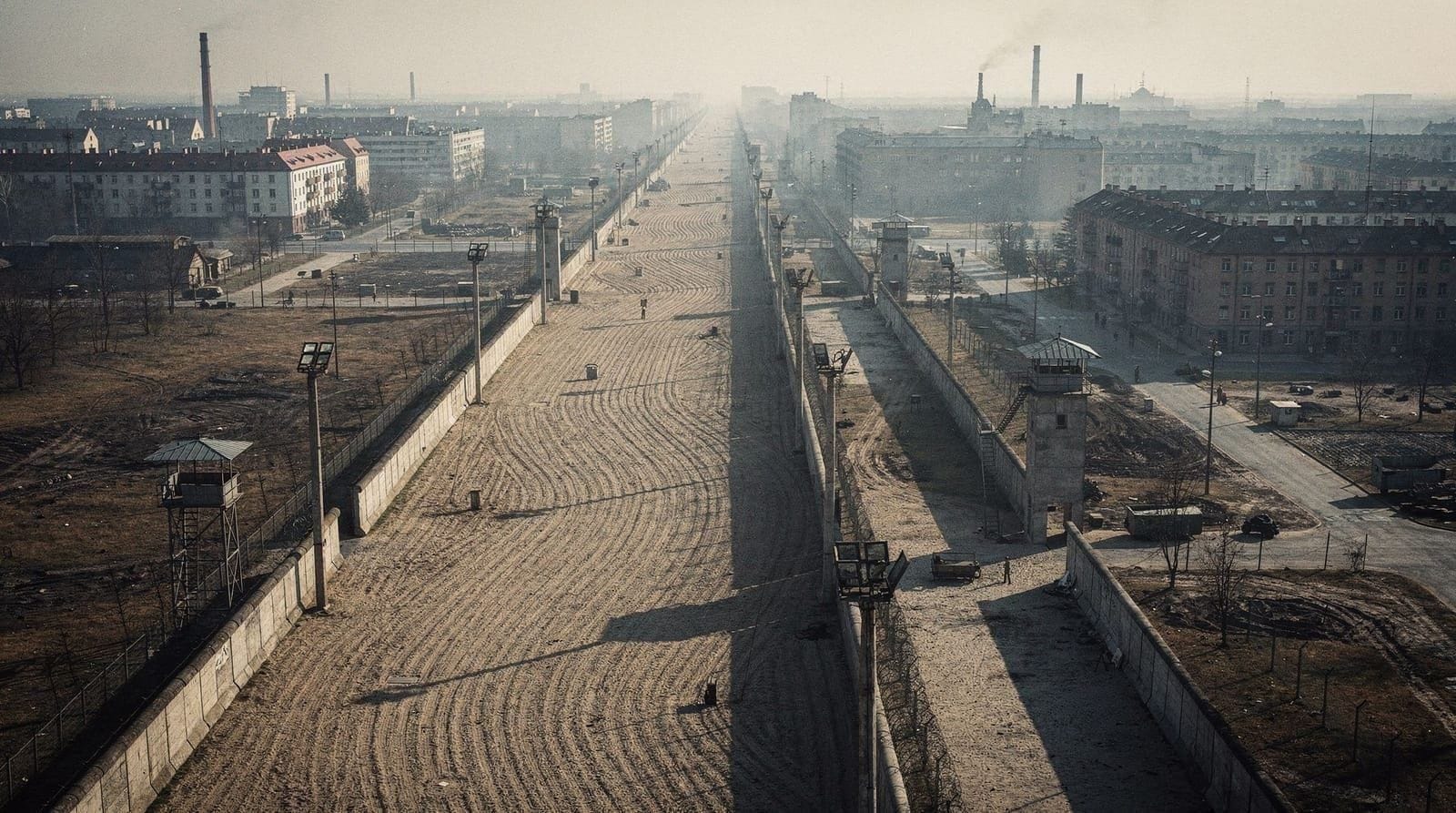
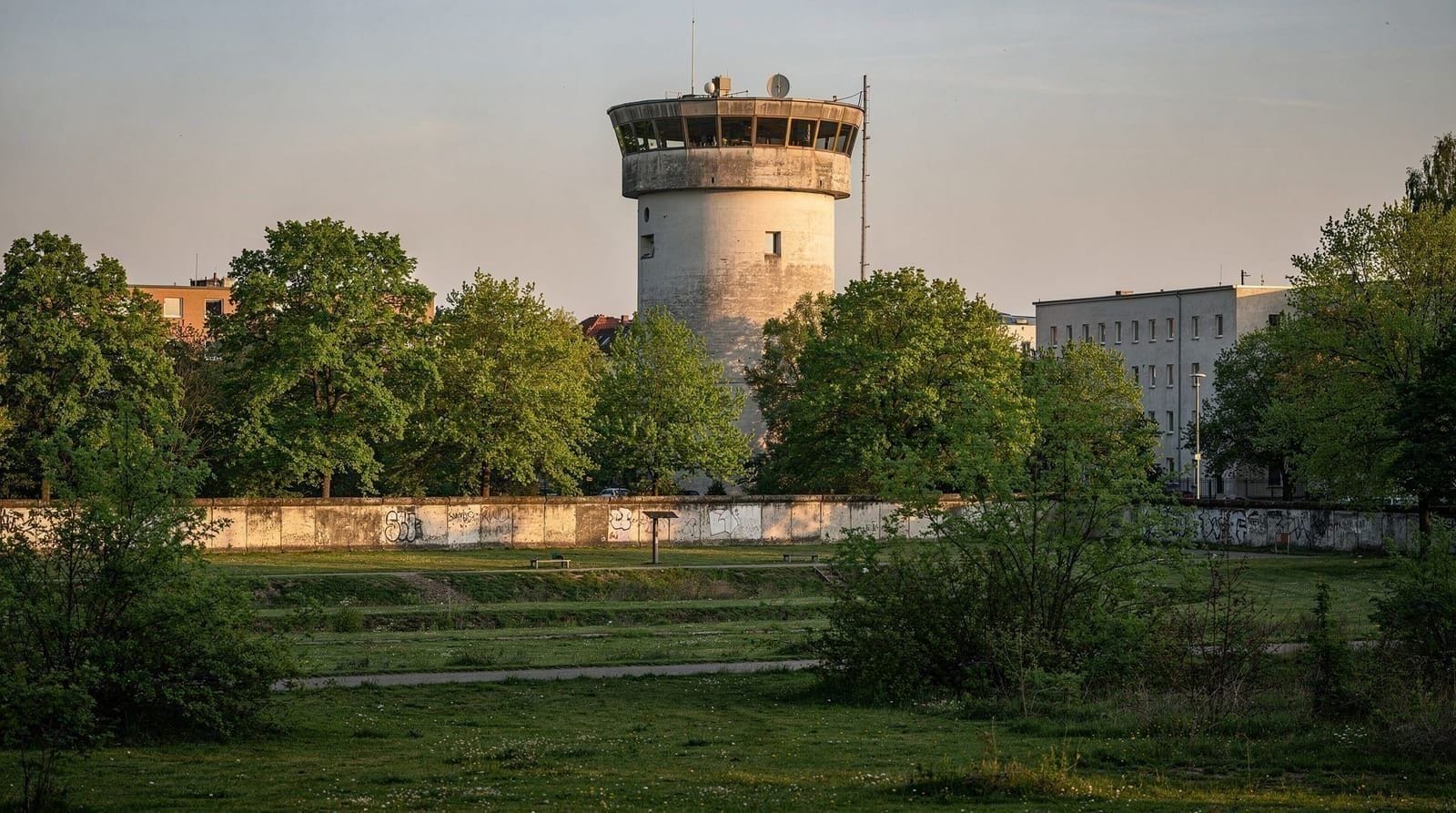
In the immediate vicinity — a short walk from the park’s southern edge — is the Schlesischer Busch park and nature area, which contains a surviving Wall watchtower from the Cold War-era Berlin Wall border installations. The watchtower is one of only a small number of intact Guard towers surviving in Berlin and can be accessed during opening hours. Our guide to surviving Wall watchtowers covers this and the other remaining tower sites across the city, which adds useful Cold War context to a Treptower visit.
Also within Treptower Park: the Archenhold-Sternwarte (Archenhold Observatory), Germany’s oldest public observatory, founded in 1896. The observatory is a small, quiet institution with a working telescope and a small science museum; admission is modest. It requires no advance booking and is an interesting secondary stop if time allows.
What first-time visitors often miss
Several details of the site reward attention beyond the headline elements. The bas-reliefs on the sarcophagi are arranged in a loose narrative sequence moving along the axis — early panels depict the outbreak of war and Soviet resistance, later panels move toward liberation and victory. Reading them in order, rather than at random, gives a more coherent sense of what the designers intended.
The mosaic ceiling inside the mausoleum chamber beneath the central statue is frequently overlooked by visitors who admire the statue from outside and do not descend into the chamber itself. It depicts Soviet peoples of different republics gathered around a red banner, a deliberate statement about the multi-ethnic character of the Soviet war effort that is easy to miss without knowing to look for it.
The two kneeling soldier statues at the entrance are often photographed in passing but rarely examined closely — each carries distinct facial and uniform detail rather than being identical figures, a nuance lost from a distance.
Finally, the sheer scale of the site is difficult to grasp from photographs. Standing at one end of the 250-metre axis and looking toward the central statue conveys the memorial’s intended psychological effect — of insignificance before a vast commemorative gesture — in a way that no single image communicates.
Photography and etiquette
Photography of the memorial’s architecture and sculpture is permitted and common; this is a public monument in an open park, not a restricted site. That said, given its status as an active war cemetery, visitors are asked to exercise the same discretion expected at any cemetery: avoid posed or celebratory photography styles, keep drones out (not permitted over the site), and be mindful of other visitors who may be there for genuinely personal or ceremonial reasons, particularly around 8-9 May. Early morning light on the red granite plaza is genuinely striking for photographers willing to visit before the site gets busy.
Getting to Treptower Park from central Berlin: the S8, S9, S41, and S42 S-Bahn lines all stop at Treptower Park station. From the station, the memorial is a 10-minute walk on a clearly signposted path through the park. Tram 21 stops at Puschkinallee, a 5-minute walk from the memorial’s main entrance. Journey time from central Berlin (Alexanderplatz) is approximately 15 minutes by S-Bahn.
The park itself borders the Spree river, and on warmer days the riverside paths draw a mix of joggers, cyclists, and families quite separate from the memorial’s visitors — a reminder that Treptower Park functions as an ordinary recreational green space for the surrounding neighbourhood alongside its role as a historic site. Cafes and casual food options are limited immediately around the memorial; the better choices are back toward the S-Bahn station or across the river in Alt-Treptow, a quieter residential district worth a short wander if time allows before or after the visit.
How this site fits into a Berlin history itinerary
Treptower Park is in the south-east of Berlin, approximately 5 kilometres from Mitte. This geographic reality affects how the memorial fits into a day’s visiting pattern. Combining it with central Berlin sites — the Reichstag, the Memorial to the Murdered Jews of Europe, or Museum Island — in a single day is possible but requires deliberate planning and means spending significant time in transit.
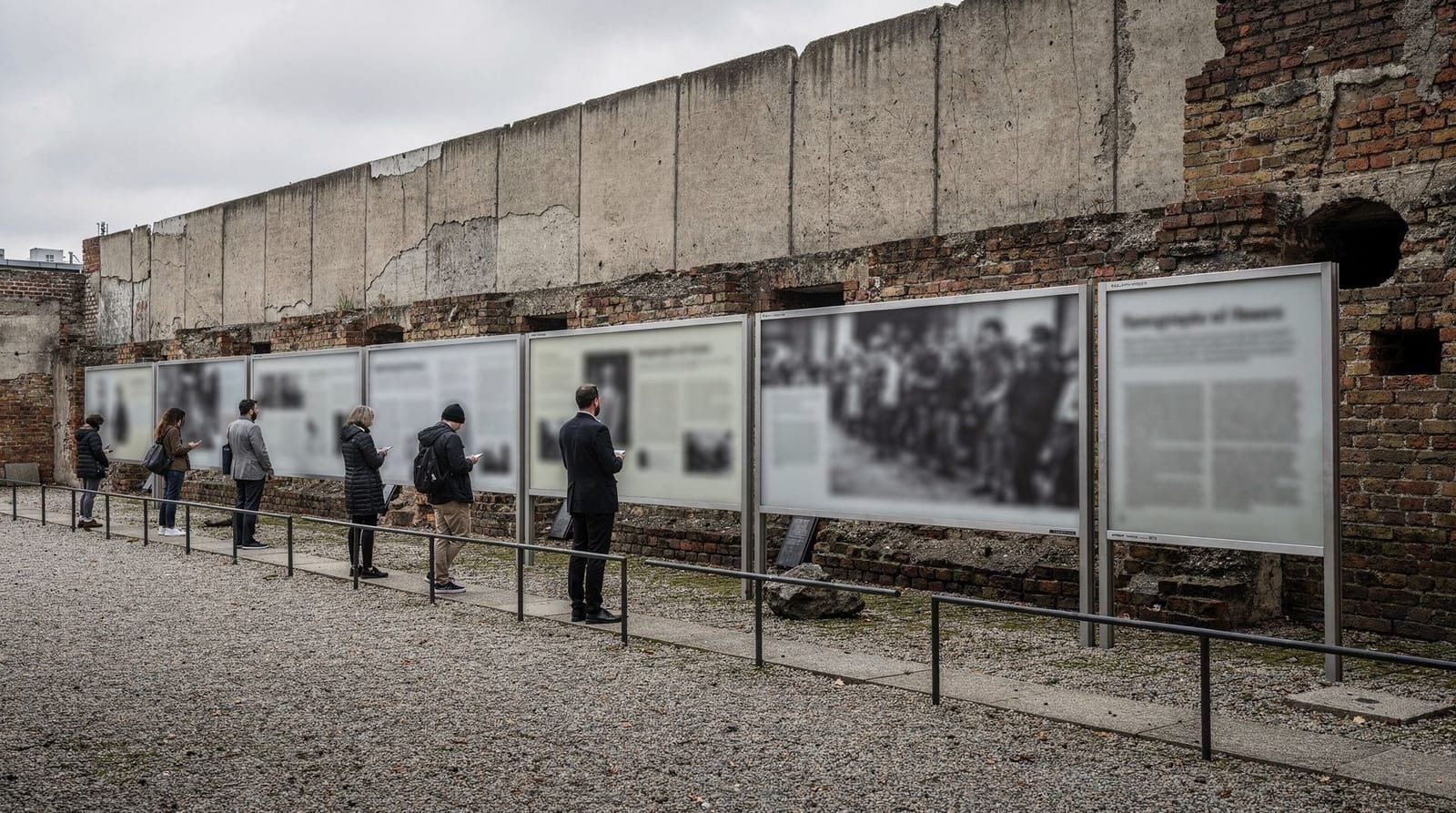
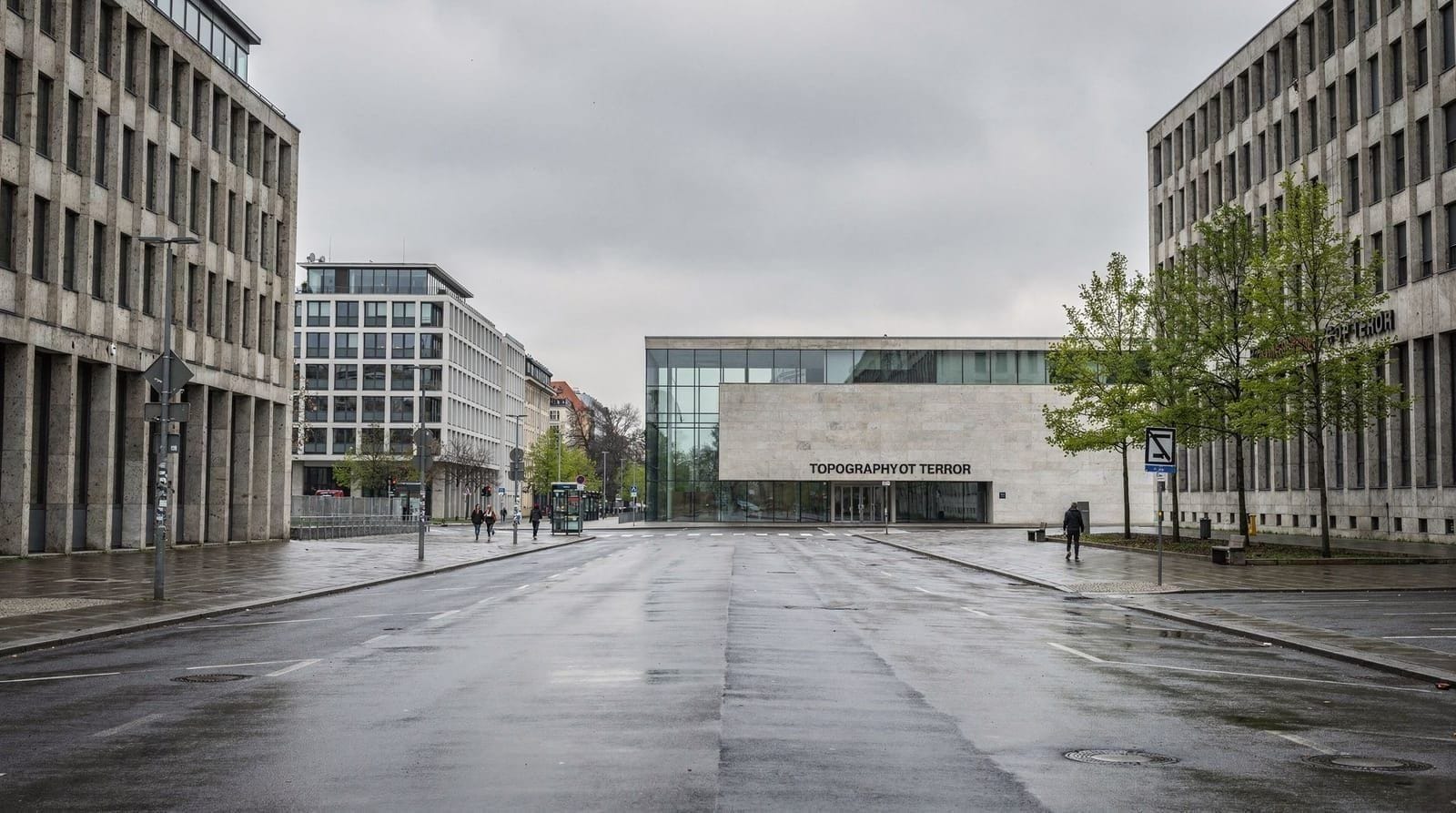
A more coherent arrangement places the Treptower memorial as the anchor of a south-east Berlin history afternoon. The practical combination that makes geographic sense is: a morning visit to the Topography of Terror in central Berlin (free, no advance booking required, covering the Nazi security state from 1933–1945), followed by travel to Treptower Park for the afternoon. The journey from the Topography of Terror area to Treptower Park station takes 20 to 25 minutes by S-Bahn.
After the memorial, the Schlesischer Busch watchtower is a 15-minute walk from the park’s south entrance — a Cold War border installation that connects directly to the political world in which the memorial functioned during the GDR decades.
Our Cold War Berlin itinerary sets out a multi-day sequence that places Treptower Park in relation to the other major Cold War sites across the city. The Third Reich history trail itinerary covers a complementary sequence for visitors specifically following the Nazi-period history.
For visitors arriving from Sachsenhausen or incorporating a day trip to the former concentration camp, Treptower Park is accessible from the S-Bahn route between the city centre and Oranienburg and can be included on the return leg of a Sachsenhausen day trip without significant additional travel.
The Topography of Terror guide and Cold War espionage in Berlin both provide relevant context for a visit to the memorial that is informed by the political history of the period in which it was built and used.
For visitors who prefer a guided approach that ties the Battle of Berlin, the Soviet occupation, and the wider Cold War narrative together with an expert on hand, a themed walking or van tour of the era’s key sites is a practical option.
Book an original Cold War and communism history tour of BerlinFrequently asked questions about Soviet War Memorial in Treptower Park
How many Soviet soldiers are buried at Treptower Park?
Approximately 5,000 Soviet soldiers who died in the Battle of Berlin in April-May 1945 are buried beneath the grounds of the Treptower Park memorial. The total Soviet death toll in the Battle of Berlin was approximately 81,000 killed, with a further 280,000 wounded. The Treptower memorial contains a portion of the fallen; other Soviet cemeteries exist at Schönholzer Heide and Tiergarten.What does the central statue at Treptower Park represent?
The central statue — a Soviet soldier 12 metres tall, made of bronze — stands on a mausoleum-plinth and depicts a soldier holding a rescued German child in one arm and a lowered sword resting on a broken swastika in the other. The sculpture by Yevgeny Vuchetich was intended to symbolise Soviet liberation. It is a work of Soviet socialist realism on a monumental scale and is a recognised landmark regardless of how one reads its political symbolism.How do I get to the Soviet War Memorial in Treptower Park?
Take the S-Bahn (S8, S9, S41, S42) to Treptower Park station. From the station, follow signs for the memorial through the park — a 10-minute walk along the main path. The memorial is clearly signposted from the station. Alternatively, tram 21 stops at Puschkinallee, a 5-minute walk from the main entrance.How long should I allow for a visit to the Treptower memorial?
Allow 45 minutes to 1.5 hours depending on how thoroughly you read the inscriptions and walk the full length. The main axis of the memorial is approximately 250 metres long. The memorial includes two kneeling soldier statues at the entrance, a large red granite plaza, 16 sarcophagi with socialist realist bas-reliefs, and the central statue at the far end. Reading the sarcophagus inscriptions (Stalin quotations in Russian and German) takes additional time.Is the Soviet War Memorial politically controversial?
The memorial has a complex reception. It was built during the Soviet occupation of East Germany and used by the GDR as a site of political ceremony. The Stalin quotations on the sarcophagi were not removed after German reunification — the memorial is protected as a war grave site under international convention. For many visitors, it is both a genuine war cemetery deserving of respect and an example of Soviet political monumentalism. Both readings coexist at the site.Are there other Soviet war memorials in Berlin?
Yes. The Sowjetisches Ehrenmal in Tiergarten (near the Reichstag) was built in 1945 using marble from Hitler's demolished Reich Chancellery; it contains the graves of only two soldiers. The Schönholzer Heide memorial in Pankow is a larger cemetery (13,200 graves) but less architecturally monumental. Treptower Park is the most visited and architecturally significant of the three.What are the sarcophagi at Treptower Park?
The 16 white marble sarcophagi along the main axis each bear a bas-relief depicting scenes from the Eastern Front and Soviet military operations. On the sides, quotations from Stalin's wartime speeches are inscribed in Russian and German. The sarcophagi mark the graves of Soviet soldiers and serve as symbolic markers for the larger burial ground beneath the memorial grounds.Can I combine a visit to Treptower Park with other sights in one afternoon?
Yes, though it works best as the anchor of a south-east Berlin history afternoon rather than squeezed alongside central Mitte sights. The Schlesischer Busch watchtower is a 15-minute walk from the park's south entrance, and the Archenhold Observatory sits inside the park itself. Combining with central sites like the Topography of Terror is possible earlier in the same day, allowing 20-25 minutes travel time between the two.Is the Treptower Park memorial suitable for children?
It suits older children and teenagers with some historical context more than young children, given the scale, the war-grave nature of the site, and the density of the inscriptions. There are no interactive elements aimed at younger visitors. Families visiting with school-age children studying the Second World War or Cold War often find it a powerful, tangible complement to classroom learning.