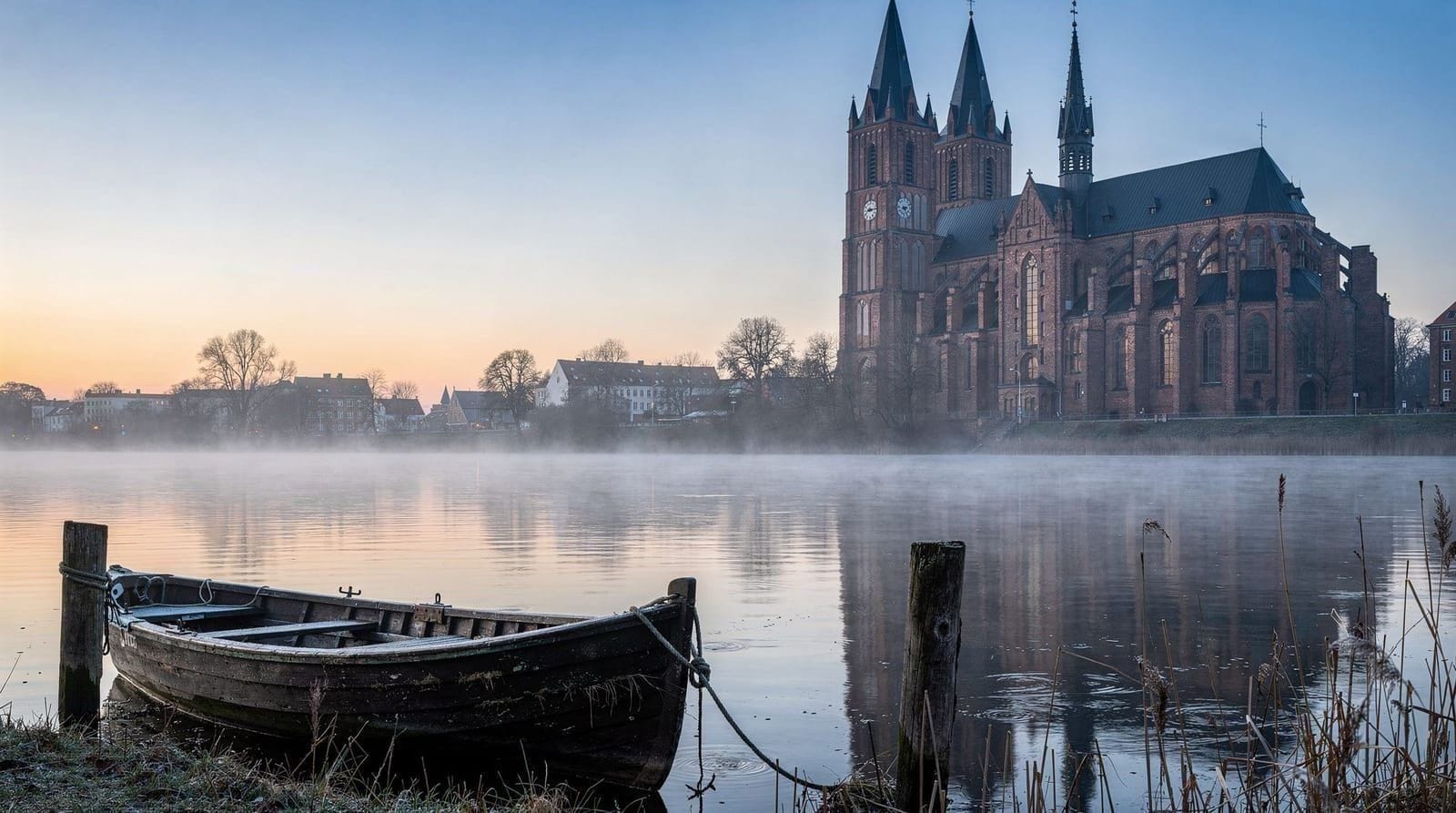
Magdeburg — Imperial Cathedral City and Hundertwasser Surprise on the Elbe
Visit Germany's oldest Gothic cathedral, Otto the Great's imperial city, and the extraordinary Hundertwasserhaus — just over an hour from Berlin by ICE.
Quick facts
- Distance from Berlin
- ~165 km south-west of Berlin
- Train
- ICE from Berlin Hauptbahnhof (~1h 10 min, ~€30–50 return)
- Admission
- Cathedral free; Hundertwasserhaus exterior free; museum entry €6–9
- Season
- Year-round; Elbe riverside best April–October
- Highlights
- Dom (Germany's oldest Gothic cathedral), Green Citadel, Elbe walks, Kloster Unser Lieben Frauen
Magdeburg has the awkward distinction of being a major German city that almost no one from outside Germany visits deliberately. That is their loss. Sitting on the west bank of the Elbe roughly 165 km from Berlin, Magdeburg holds two things of extraordinary significance: Germany’s oldest Gothic cathedral, where the Holy Roman Emperor Otto the Great is buried, and the Green Citadel, an entirely serious building designed in the last years of his life by the artist Friedensreich Hundertwasser and completed in 2005. The combination of medieval imperial grandeur and 21st-century organic architecture is not something you encounter often in a single city. Add the Elbe, wide here and fast-moving, and an afternoon on the riverbank, and Magdeburg makes for one of the most genuinely interesting day trips from Berlin that most travellers completely overlook.
| Where | Saxony-Anhalt, ~165 km south-west of Berlin |
| Getting there | ICE from Berlin Hbf, ~1h10, around €18–60 return |
| Cost | Cathedral free; Hundertwasserhaus exterior free; museums €6–9 |
| Time needed | 1 full day |
| Best time | April–October for the Elbe riverside; December for the cathedral Christmas market |
Otto the Great and the imperial city
To understand Magdeburg, you need to know something about Otto I — and most Western European visitors do not. Otto the Great (Otto I) was the first Holy Roman Emperor, crowned in Rome by Pope John XII in 962. He is, in the conventional reckoning of German historiography, one of the most consequential rulers of the early medieval period: he reunified the Frankish territories after Charlemagne’s successors had fragmented them, defeated the Magyar invasions at the Battle of Lechfeld in 955, extended Christian and Frankish influence deep into Slavic territories, and founded the archbishopric of Magdeburg in 968 as the eastern bulwark of his empire.
Magdeburg was Otto’s favourite city. He built an imperial palace here (Kaiserpfalz), married his first wife Edith of England here (she is also buried in the cathedral), and spent a substantial portion of his reign holding court here rather than at Frankfurt or Aachen. When he died in 973, he was buried in Magdeburg cathedral, where his tomb remains.
Standing at that tomb — a plain medieval sarcophagus under Gothic vaulting that was still being built when it was placed there — connects you to the founding moment of the Holy Roman Empire. It is a serious historical experience that very few tourists take the trouble to have.
Magdeburg Cathedral: Germany’s oldest Gothic cathedral
The Magdeburg Cathedral (Dom zu Magdeburg, formally the Cathedral of Saints Catherine and Maurice) is not just significant for its imperial burial. Built between 1209 and 1520 on the site of earlier Ottonian churches, it is Germany’s oldest Gothic cathedral — its construction preceded Cologne, Strasbourg, and Ulm cathedrals, and it established the Gothic style in German church architecture in a way that influenced everything that came after.
The exterior is composed of two massive twin towers visible from across the Elbe and from much of the city centre. The stone is pale sandstone, darkened in sections by weathering and by a century of industrial pollution since cleared. Inside, the nave is long, high, and austere in the Northern Gothic manner — far less ornamented than French Gothic cathedrals of comparable date, which reflects the Ottonian/Saxon tradition of stern, structural beauty over decorative elaboration.
Key things to look for inside:
Otto I’s tomb: In the choir, a 13th-century Gothic sarcophagus. Simple, powerful, appropriate for a man who spent his life fighting.
Queen Edith’s tomb: Otto’s first wife, daughter of King Edward the Elder of England, died in 946 and was buried here before the current cathedral was built. Her remains were re-interred in the choir; a 2008 archaeological investigation confirmed their identity and discovered she had come to Saxony as a teenager and died in her twenties — a poignant piece of medieval European history now on display in the cathedral’s exhibition.
The Paradise Portal (Paradiesportal): The north portal of the cathedral, carved in the 13th century with figures of wise and foolish virgins, is one of the finest pieces of Romanesque-to-Gothic transitional sculpture in Germany. Look at the detail in the faces — the carvers were working at the very edge of what stone allowed.
Ernst Barlach’s war memorial: Inside the cathedral, a sombre bronze relief by sculptor Ernst Barlach commemorating the dead of the First World War. Barlach’s work was later designated entartete Kunst (degenerate art) by the Nazis; this piece survived.
Entry to the cathedral is free, though a donation box is present and the work of maintaining a building of this scale is constant. The cathedral shop has good academic books on the Ottonian period if you want to go deeper.
The Berlin to Magdeburg day trip guide covers timing and what to combine in a single day.
The 1631 massacre: Magdeburg’s darkest chapter
Any honest account of Magdeburg has to confront 1631. During the Thirty Years’ War, Imperial and Catholic League forces under Count Tilly besieged the strongly Protestant city. On 20 May 1631, the walls were breached. What followed was one of the worst atrocities in European history before the 20th century: the city was sacked and burned, and estimates of civilian deaths range from 20,000 to 25,000 — the great majority of the population. Almost the entire city was destroyed. The phrase Magdeburgisierung (Magdeburgisation) entered contemporary German as a term meaning the complete destruction of a city and its population.
The cathedral survived, largely intact, partly because Imperial troops used it as a shelter. The city was rebuilt, substantially Baroque in character, over the following century. Then came WWII: Allied bombing in January 1945 destroyed approximately 90% of the rebuilt historic core, leaving Magdeburg as one of the most heavily bombed cities in Germany.
The result of all this history is a city that is visually fragmented — medieval survivals standing next to GDR-era reconstruction next to post-reunification development — but which carries an almost palpable weight of accumulated experience that more conventionally pretty cities lack.
The Green Citadel: Hundertwasser’s last building
Walking south from the cathedral toward the Alter Markt, you encounter the Green Citadel (Grüne Zitadelle) without quite being able to believe it is real. This building — completed in 2005, the year after Friedensreich Hundertwasser’s death at sea in 2000, based on his final architectural design — occupies an entire city block in coral pink and gold ochre, with planted rooftop meadows visible above curved facades, gilded onion dome turrets, irregular windows of varying sizes, and not a single straight line to be seen anywhere.
Hundertwasser, the Austrian artist and architect best known for the Hundertwasserhaus in Vienna (1986), spent the last decades of his life arguing that straight lines were spiritually violent, that human beings could not flourish in buildings built to orthogonal grids. The Green Citadel is, depending on your architectural sympathies, either a profound statement or a beautiful indulgence. It is certainly arresting. Walking around the exterior at street level takes about 15 minutes; the building has apartments, a hotel, shops, and a small café inside the courtyard, which visitors can enter freely.
The contrast with the cathedral — severe, grey, 800 years old, built to the glory of an emperor — is so stark that you could spend an hour just thinking about what these two buildings say about the respective cultures that produced them. If you have any interest in architecture at all, Magdeburg earns its place on an itinerary from this contrast alone.
Kloster Unser Lieben Frauen: medieval art in a surviving monastery
Between the cathedral and the city centre, the Monastery of Our Lady (Kloster Unser Lieben Frauen) is the oldest surviving building in Magdeburg, its Romanesque church dating from the 11th and 12th centuries. Unlike most German monastery churches, which were either destroyed, converted to other uses, or so heavily restored as to lose coherence, this one is intact in its original mass: low, thick-walled, with a nave that has barely changed in 900 years.
The monastery now operates as a concert hall and art museum — Kunstmuseum Kloster Unser Lieben Frauen — with a permanent collection of modern and contemporary sculpture alongside temporary exhibitions. Admission is around €6–9. The combination of Romanesque architecture and 20th-century art works better than it sounds; the low stone rooms are good galleries. The cloister garden is one of the quietest places in central Magdeburg and worth ten minutes simply sitting.
The Elbe and the Jahrtausendturm
Magdeburg sits directly on the Elbe, and the river here is wide, fast, and impressive. The Elbauenpark on the west bank of the Elbe, a short tram ride from the city centre, was created for the Federal Garden Show in 1999 and remains a large park with river views, cycling paths, and the Jahrtausendturm (Millennium Tower) — a 60-metre wooden tower completed in 1999, the tallest timber tower in the world at the time of construction. The tower houses an exhibition on the history of scientific discovery, quirky and worth an hour if you have children in tow or an interest in the history of invention.
The Elbe flood plains (Elbwiesen) north and south of the city centre are excellent for cycling and walking, with views of the cathedral towers across the water. Spring brings wild flowers; autumn is moody and atmospheric. Cyclists with a full day can continue north along the riverside path toward the Wasserstraßenkreuz water bridge rather than doubling back — the flat, well-marked Elberadweg (Elbe Cycle Route) makes this an easy, largely traffic-free extension rather than a separate excursion.
The water bridge: an engineering landmark most visitors never hear about
A few kilometres north of the city centre, Magdeburg holds a piece of infrastructure that regularly surprises visitors who stumble onto it: the Wasserstraßenkreuz Magdeburg, opened in 2003, is the longest navigable canal aqueduct in the world at just under a kilometre. It carries the Mittellandkanal directly over the Elbe river on a raised concrete channel, allowing barges to cross above the river rather than descending into it — solving a centuries-old bottleneck between the Rhine-Ruhr industrial region and Berlin. Watching a loaded barge glide across the aqueduct, apparently suspended above the Elbe, is one of those sights that photographs poorly but leaves a stronger impression in person than most conventional monuments.
It is reachable by bicycle along the Elbe cycle path (about 25 minutes from the centre) or by car; there is a small visitor viewpoint on the eastern bank. It is not a formal attraction with opening hours or an entry fee — you simply go and look — but it rewards travellers with even a mild interest in engineering, and it is a genuinely unusual add-on to a day built mostly around medieval and Ottonian history.
Cultural History Museum: the collection behind the cathedral
The Museum für Kulturgeschichte Magdeburg (Cultural History Museum), housed in a grand late-19th-century building a short walk from the cathedral, holds one of the most significant collections of Ottonian-period art and artefacts in Germany, alongside broader city history spanning the medieval period through the 20th century. Its centrepiece is a bronze equestrian statue known as the Magdeburger Reiter (Magdeburg Rider), created around 1240 and widely regarded as the oldest surviving free-standing equestrian statue north of the Alps since antiquity — a genuinely rare survival, and one whose identity (Otto I, Frederick Barbarossa, or an idealised knightly figure) remains debated among historians.
Admission is around €6, with combined tickets available alongside the cathedral exhibition. Allow at least an hour; visitors with a deeper interest in the Ottonian period can easily spend two.
Getting there from Berlin
The fastest route from Berlin to Magdeburg is the ICE (InterCity Express) from Berlin Hauptbahnhof, which reaches Magdeburg Hauptbahnhof in approximately 1 hour 10 minutes. ICE trains run roughly every hour. Return fares vary widely depending on how far in advance you book: advance purchase (Sparpreis) tickets can be as low as €17.90 each way; flexible fares are typically €40–60 return. The Brandenburg ticket does not cover ICE services, so budget accordingly.
From Magdeburg Hauptbahnhof, the cathedral and city centre are approximately 15 minutes on foot or one stop by tram. The Green Citadel is a 20-minute walk from the station, or take tram 1 toward Alter Markt.
For context on taking the train from Berlin to reach historic cities, see Berlin to Germany by train and the day trips by train from Berlin overview.
A suggested full-day itinerary
08:00 — Take the first ICE from Berlin Hauptbahnhof; arrive Magdeburg around 09:15.
09:30–12:00 — Cathedral and Otto I’s tomb; Paradise Portal; cathedral exhibition on Queen Edith. Walk to Kloster Unser Lieben Frauen.
12:00–13:00 — Lunch in the city centre. The market square (Alter Markt) has multiple options; Restaurant im Allee-Center serves reliable regional food.
13:00–14:30 — Green Citadel exterior and courtyard; coffee at the café inside.
14:30–16:00 — Tram to Elbauenpark; walk the Elbe riverside; optional Jahrtausendturm.
16:30 — Return to Magdeburg Hauptbahnhof; evening ICE back to Berlin, arriving around 18:00.
This leaves a full afternoon free without feeling rushed. If you skip the Elbauenpark, you have time to add the Kunstmuseum in the morning.
Alternative for engineering and museum enthusiasts: swap the Elbauenpark slot for the water bridge (cycle rental available near the Hauptbahnhof, about 25 minutes each way along the Elbe) and add the Museum für Kulturgeschichte in the late morning after the cathedral. This version trades the park’s open-air relaxation for a more history-and-engineering-dense day, and suits visitors who have already seen enough parkland on other Berlin day trips.
Combining Magdeburg with other destinations
Magdeburg sits on the corridor between Berlin and some of Germany’s most significant medieval and Reformation heritage cities. Lutherstadt Wittenberg is about 90 minutes south-east by train — the town where Martin Luther nailed his Theses to the church door. Quedlinburg, a UNESCO World Heritage town of half-timbered houses and another Ottonian cathedral (burial place of Henry the Fowler, Otto I’s father), is about 90 minutes south-west of Magdeburg by train. Either can be added to a multi-day trip through central Germany’s historic heartland rather than attempted the same day as Magdeburg.
Brandenburg an der Havel and Magdeburg form a natural thematic pair — both are ancient cities with Gothic cathedrals that were culturally dominant before Berlin existed — but they are in different directions from Berlin and connect poorly to each other without a car. Visit them on separate day trips.
For the full picture of what is reachable from the German capital, see best day trips from Berlin and Berlin trip planning guide.
Frequently asked questions about Magdeburg
How far is Magdeburg from Berlin and how long does the train take?
Magdeburg is approximately 165 km south-west of Berlin. The ICE from Berlin Hauptbahnhof reaches Magdeburg Hauptbahnhof in around 1 hour 10 minutes. Regional trains (RE) take approximately 1 hour 45 minutes and are significantly cheaper if the Brandenburg ticket applies to your route, though standard ICE is the most practical option for a day trip.
Is Magdeburg Cathedral really Germany’s oldest Gothic cathedral?
Yes. Construction of the current cathedral began in 1209, making it the first Gothic cathedral built in German-speaking territories. Cologne Cathedral was begun later (1248) and is more famous internationally, but Magdeburg’s Dom has the earlier construction date. Previous Ottonian churches on the same site dated to the 10th century; the current Gothic building incorporates some Romanesque elements from those earlier structures.
Who is buried in Magdeburg Cathedral?
Emperor Otto I (Otto the Great, 912–973), the founder of the Holy Roman Empire, is buried in the choir of the cathedral. His first wife, Edith of Wessex (daughter of King Edward the Elder of England), is also interred there. Edith’s remains were positively identified by archaeological analysis in 2008 and are considered the oldest identified English royal remains outside Britain.
What is the Green Citadel and can you go inside?
The Green Citadel (Grüne Zitadelle) was designed by the Austrian artist Friedensreich Hundertwasser and completed in 2005 based on his final architectural concept. The building contains private apartments, a hotel (Hotel Grüne Zitadelle), shops, and a café. The exterior and the inner courtyard are freely accessible to visitors. Guided tours of the interior architecture are available for around €7–9 and must be booked in advance at the building’s reception.
What happened to Magdeburg in 1631?
During the Thirty Years’ War, Imperial troops breached Magdeburg’s defences on 20 May 1631. The ensuing massacre killed an estimated 20,000–25,000 civilians and destroyed virtually the entire city. It was one of the most catastrophic episodes of civilian destruction in European history before the 20th century. The term Magdeburgisierung was used in contemporary German-language sources to describe total urban annihilation. The cathedral survived largely because soldiers sheltered inside it.
Is Magdeburg worth visiting for a full day?
Yes, comfortably. The cathedral, Kloster Unser Lieben Frauen, Green Citadel, and a walk along the Elbe fill a day without rushing. History enthusiasts will want more time; the Cultural History Museum (Museum für Kulturgeschichte) covers Ottonian art and the medieval city in depth and could easily absorb another two hours. Magdeburg is not a city for aimless wandering — it lacks the visual coherence of a Quedlinburg or a Lutherstadt Wittenberg — but its individual monuments are of the first rank.
Is the Brandenburg ticket valid for travel to Magdeburg?
No. Magdeburg is in Saxony-Anhalt, not Brandenburg, and the Brandenburg ticket covers only trains within Brandenburg state. To reach Magdeburg you need a separate DB ticket or Deutschlandticket. ICE services (the practical option for the 1h10 journey) are not covered by the Deutschlandticket either — you need a standard DB fare for those. Regional trains taking the longer route can be covered by the Deutschlandticket, but journey times are significantly longer. See the Brandenburger Ticket Guide for what the Brandenburg ticket does and does not cover.
What is the best time of year to visit Magdeburg?
Spring (April–May) and early autumn (September–October) are the most pleasant for walking the Elbe riverside and exploring the city without summer heat. The Christmas market around the cathedral (late November to December) is one of the better markets in the region — relatively uncrowded compared to Berlin or Dresden, set against the backdrop of the cathedral’s facade. July and August are warm but busy with German domestic tourism. The city’s museums and cathedral are open year-round.
What is the Magdeburg water bridge?
The Wasserstraßenkreuz Magdeburg is a canal aqueduct, opened in 2003, that carries the Mittellandkanal over the Elbe river — at just under a kilometre, it’s the longest navigable aqueduct in the world. It’s free to view from a riverside viewpoint a short cycle from the centre, and is a genuinely unusual piece of modern engineering to pair with the city’s medieval sights.
What is the Magdeburger Reiter?
A bronze equestrian statue, created around 1240 and held in the Museum für Kulturgeschichte, widely considered the oldest surviving free-standing equestrian statue north of the Alps since antiquity. Historians still debate whether it depicts Otto I, Frederick Barbarossa, or an idealised knight figure.