Lutherstadt Wittenberg
Wittenberg is where Martin Luther nailed his 95 Theses and launched the Reformation. A 40-min ICE from Berlin, UNESCO-listed, genuinely unmissable.
From Berlin: Martin Luther's Wittenberg Day Tour
Quick facts
- Distance from Berlin
- ~100 km southwest
- Train from Berlin Hbf
- ~40 min (ICE), ~1h (regional)
- Return fare
- €25–45 (ICE); Brandenburg ticket valid on regional
- UNESCO status
- Listed 1996 (expanded 2004)
- Castle Church (Schlosskirche)
- Free entry; Luther's tomb inside
- Lutherhaus Museum
- €8 adult; world's largest Luther collection
A small town that cracked Europe open
On 31 October 1517, an Augustinian monk named Martin Luther walked to the door of the Castle Church in Wittenberg and nailed — or at least publicly posted — a document listing 95 academic theses for debate. The document challenged the Roman Catholic practice of selling indulgences. Within weeks, copies were circulating across German-speaking lands. Within a decade, the unified Western Church had fractured permanently.
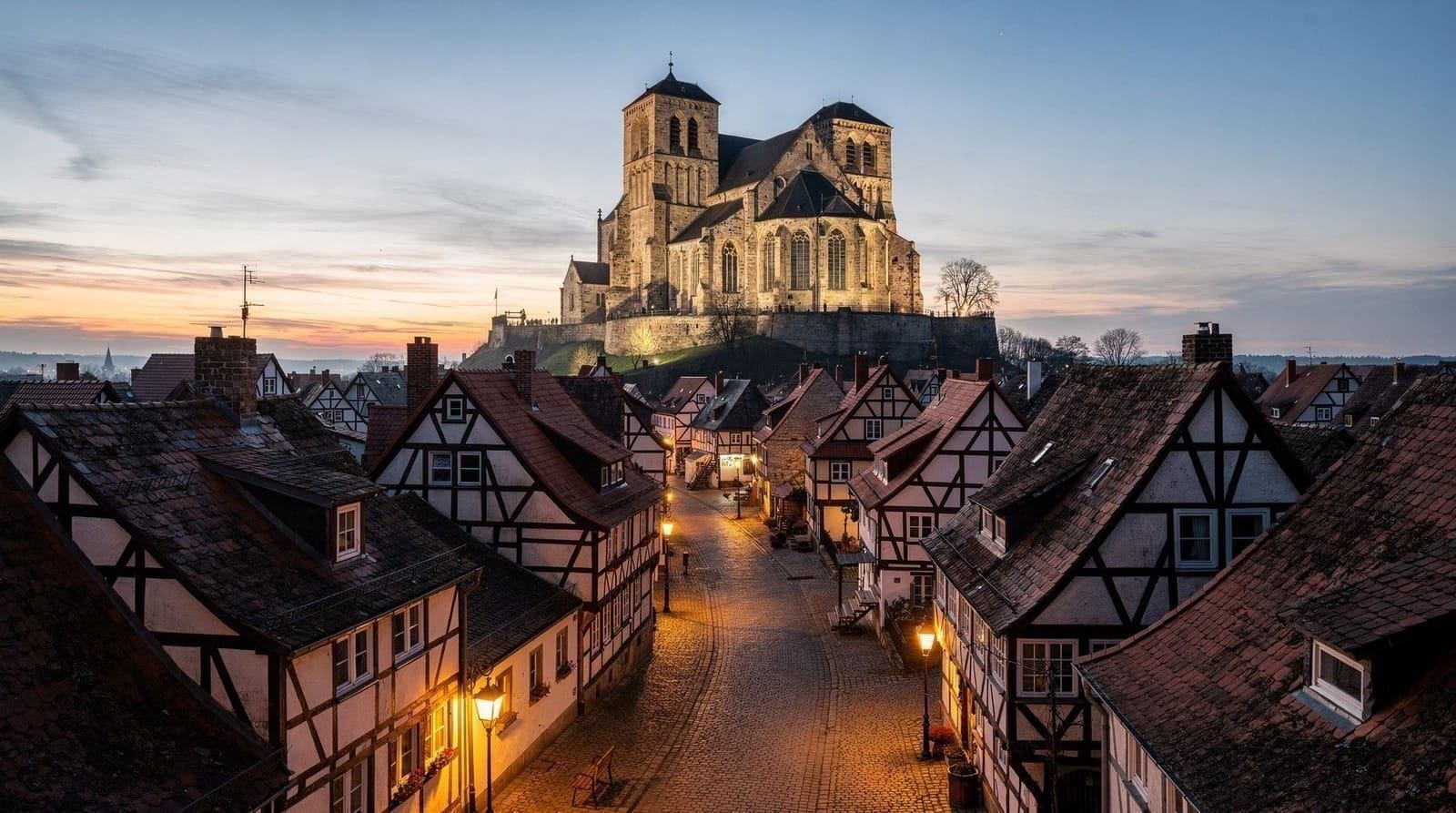
Wittenberg is that town. It has a population of around 46,000, sits on a bend of the Elbe about 100 kilometres southwest of Berlin, and looks roughly as it did when Luther lived and taught here — compact, red-brick, unhurried. UNESCO inscribed the town’s key sites in 1996, and even with that imprimatur it draws nowhere near the visitor numbers its historical significance deserves. On a weekday in late September you can stand in front of the Castle Church door where it all started and spend several minutes alone with your thoughts.
For anyone staying in Berlin, Wittenberg is an easy and deeply rewarding day trip: 40 minutes on the ICE, a manageable and walkable town, and a density of genuinely important historical sites contained within about 1.5 kilometres of pedestrianised streets. The Berlin to Wittenberg day trip guide covers logistics in detail.
| Where | Saxony-Anhalt, ~100 km south-west of Berlin |
| Getting there | ICE from Berlin Hbf, ~40 min, around €19–45 return |
| Cost | Castle Church free; Lutherhaus around €8; combined tickets available |
| Time needed | Half-day minimum; full day for all main sites |
| Best time | April–October; 31 October (Reformation Day) is atmospheric but crowded |
Getting from Berlin to Wittenberg
By ICE (fastest)
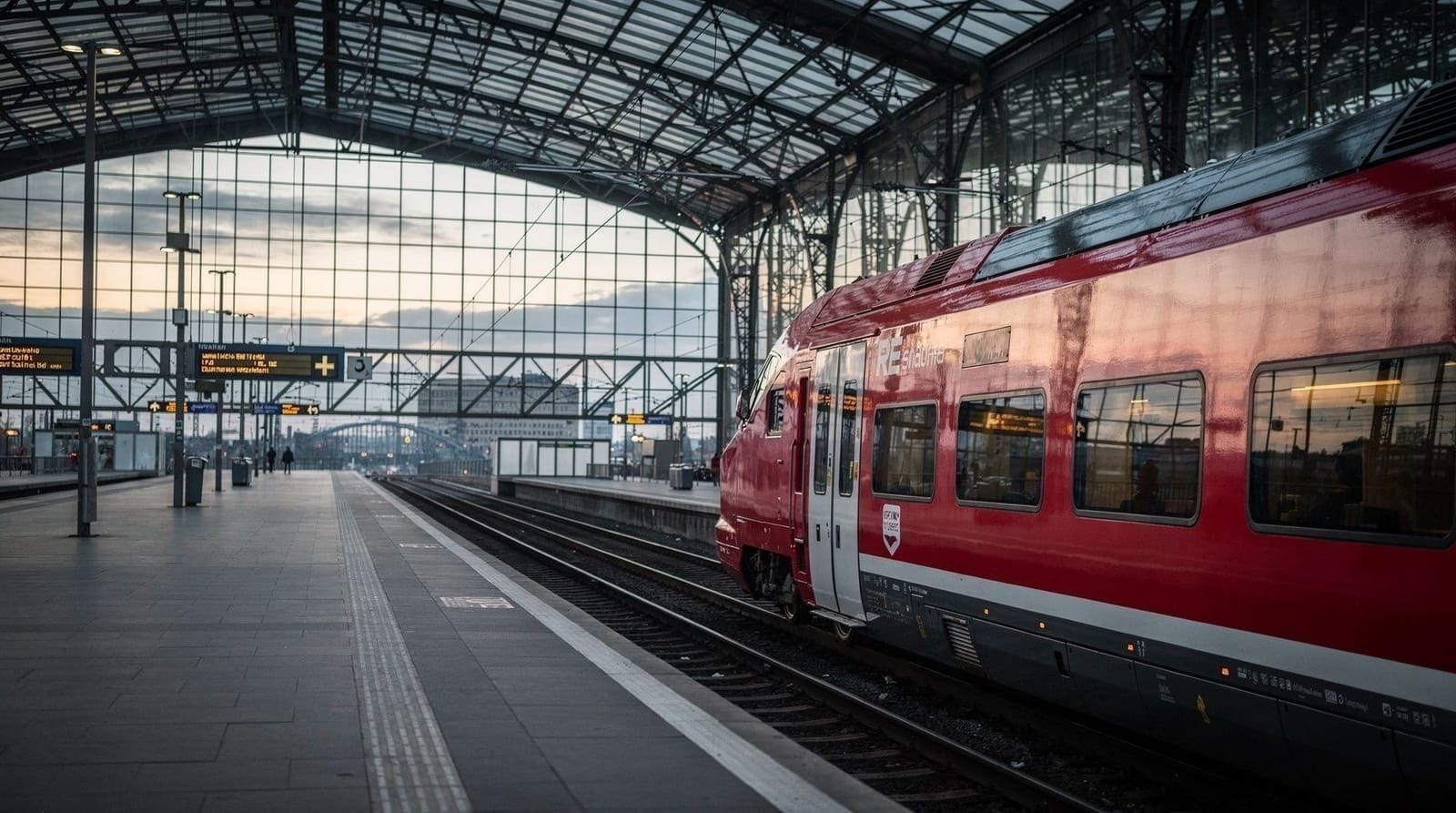
The simplest option: ICE trains run from Berlin Hauptbahnhof (and stop at Berlin Südkreuz) directly to Lutherstadt Wittenberg in approximately 38–42 minutes. Fares booked in advance start around €19–25 each way; flexible tickets run €35–45. Return journeys are straightforward — trains run roughly hourly through the day.
Book via the Deutsche Bahn website. The town is officially spelled “Lutherstadt Wittenberg” on all train schedules, which can catch first-time searchers out.
By regional train (Brandenburg ticket)
The Brandenburg Ticket (€29 for one person, €5 for each additional person, valid all day on regional trains across Brandenburg and Berlin) covers regional trains to Wittenberg — technically just across the Saxony-Anhalt border, but the ticket’s validity extends here. Journey time on the regional RE service: approximately 55–70 minutes. For solo travellers this offers modest savings over a cheap ICE advance; for groups of two or more it is substantially cheaper. See the Brandenburg ticket guide for details on how it works.
Arriving in Wittenberg
The train station is about 10 minutes’ walk from the historic centre. There are taxis at the station rank, but the walk is pleasant and direct — straight down Collegienstrasse, which runs past the Lutherhaus to the Market Square.
The Castle Church: where the Reformation started
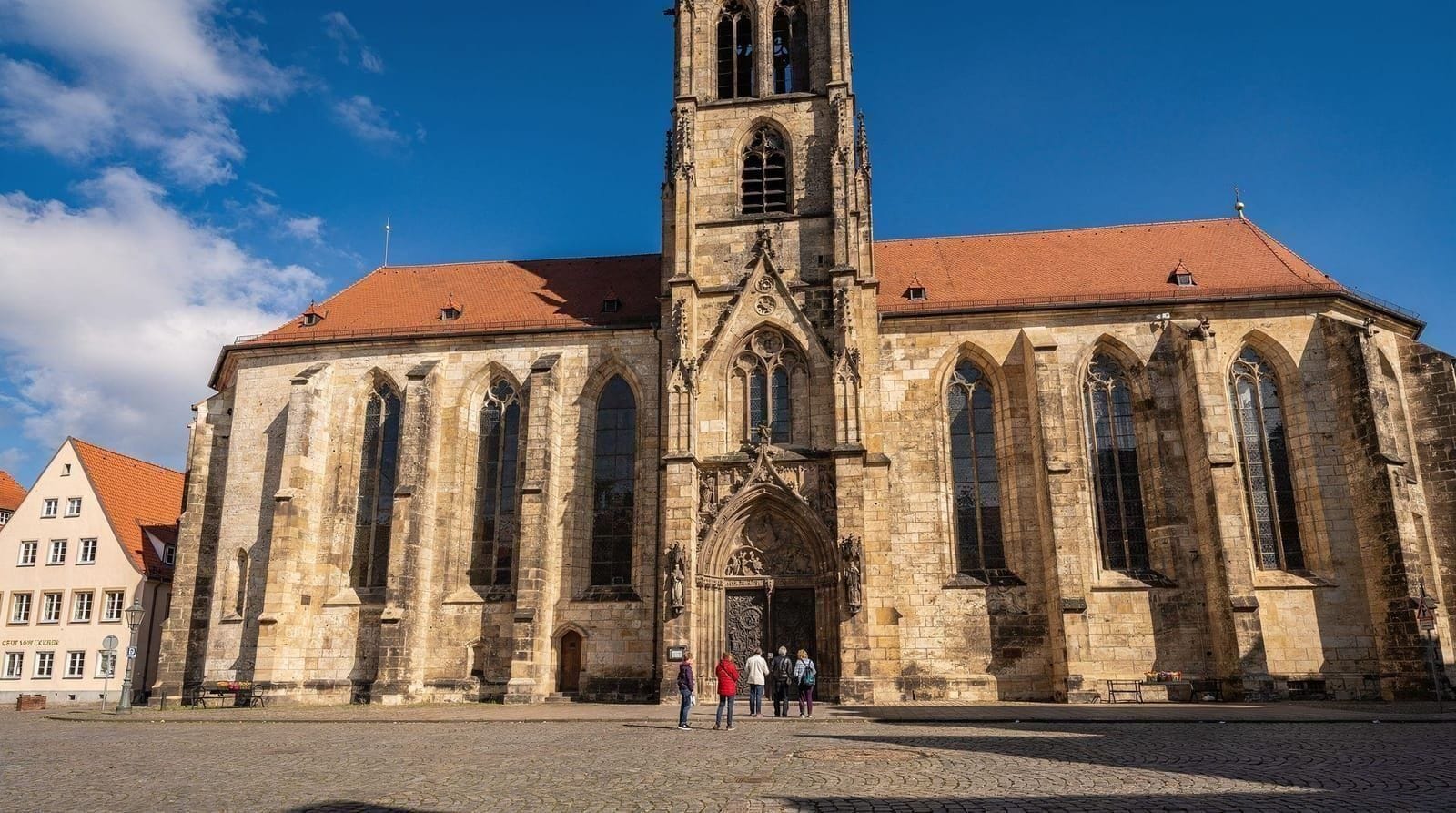
The Schlosskirche (Castle Church or All Saints’ Church) stands at the western end of the old town and is the anchor point of any visit. The famous north door — the Thesenportal — is where Luther’s 95 Theses were posted. The original wooden door burned down in 1760; the current bronze door, cast in 1858 and engraved with the Latin text of all 95 theses, is what visitors see today. It is genuinely moving to read them.
Inside, the church is a Lutheran hall of history. Luther is buried beneath the pulpit, on the left side of the nave before the altar. His close colleague and fellow reformer Philipp Melanchthon is buried opposite, on the right. Both graves are marked by simple, elegant bronze epitaphs cast by Peter Vischer the Younger. Elector Frederick the Wise, who protected Luther from papal and imperial prosecution and made Wittenberg’s role in the Reformation possible, is buried in the choir.
The church also contains an extraordinary collection of portrait medallions and reliefs of Reformation figures, and two magnificent altarpieces including one by Lucas Cranach the Elder — whose workshop was based in Wittenberg and who painted the definitive portraits of Luther that circulated across Europe.
Entry is free. The church is open daily (hours vary slightly by season; check current times at the door).

The Lutherhaus: where the man actually lived
The Lutherhaus on Collegienstrasse is the most important Luther museum in the world and, after the Castle Church, the essential stop. It occupies the former Augustinian monastery where Luther lived as a monk, then — after the monastery was dissolved and he married the former nun Katharina von Bora in 1525 — continued to live with his family until his death in 1546.
The building itself is remarkable: a late-Gothic brick structure that survived largely intact because Luther’s descendants maintained it, and because successive generations understood its significance. The collection inside is exceptional. Original Luther manuscripts, including his own handwritten marginal notes in books; early printed editions of his Bible translation that essentially standardised the modern German language; portraits by Cranach; Luther’s original study, reconstructed from historical inventories; correspondence between Luther and the leading intellectual figures of 16th-century Europe.
The museum contextualises Luther not as a theological abstraction but as a human figure navigating enormous political and personal pressures — his relationship with Katharina, his difficult late writings on the Jews (not elided here), his physical ailments and psychological struggles. The scholarship on display is serious without being dry.
Admission: €8 adults, €5 reduced. Allow 1.5–2 hours.
Market Square and the Luther statue
The Marktplatz at the centre of the old town is one of the best-preserved Renaissance market squares in Germany. The Rathaus (Town Hall), built in the 1530s, runs along the north side; the square itself is flanked by 16th- and 17th-century burgher houses whose facades have changed little in external appearance.
At the centre stands a cast-iron statue of Martin Luther by Johann Gottfried Schadow, erected in 1821 — the first public monument to Luther in Germany and still among the most compelling. A few metres away stands a companion statue of Philipp Melanchthon. The juxtaposition captures the relationship accurately: Luther, defiant and oratorical; Melanchthon, the scholar who organised and systematised the theological work Luther began.
The square is also where you will find the most concentrated selection of cafés and lunch options — practical for the midday break of a day trip.
The Melanchthon House
The Melanchthonhaus on Collegienstrasse, a short walk from the Lutherhaus, is Melanchthon’s actual residence — preserved largely as it was in the 16th century and now a museum. Philipp Melanchthon (1497–1560) is the figure the Reformation often overlooks: a child prodigy who began teaching at Wittenberg University at 21, the author of the Augsburg Confession (the foundational document of Lutheran theology), and the man who reformed German education so thoroughly that he earned the title Praeceptor Germaniae — Teacher of Germany.
The house is smaller and quieter than the Lutherhaus and can be covered in 45–60 minutes. The combination ticket for Lutherhaus + Melanchthonhaus (€12) is good value if you intend to visit both.
The Cranach Courtyards
Lucas Cranach the Elder (1472–1553) was court painter to the Electors of Saxony, Luther’s friend and neighbour, and one of the most important artists of the German Renaissance. His workshop in Wittenberg produced the definitive visual imagery of the Reformation — portraits of Luther and Melanchthon that became the recognisable faces of the movement across Protestant Europe.
Cranach’s house and workshop occupied a substantial courtyard complex near the Market Square. The Cranachhöfe (Cranach Courtyards) have been partially restored and house a gallery space, workshops, and a garden. The courtyard architecture gives a sense of how a prosperous 16th-century artist’s establishment functioned as a production facility as well as a residence.
Cranach also painted one of the Castle Church’s altarpieces and designed the earliest Lutheran altar as a unified theological programme — the Last Supper, Baptism, Confession, and Sermon depicted as coordinated scenes. Understanding his work enriches everything else in Wittenberg considerably.

The Luther 1517 panorama
Away from the historic centre — about a 15-minute walk south of the Marktplatz, near the former arsenal grounds — the Panorama Museum houses artist Yadegar Asisi’s Luther 1517, a 360-degree panoramic painting more than 100 metres in circumference depicting Wittenberg at the moment of the Reformation’s outbreak. Asisi, known for similar large-scale panoramas of the Battle of Leipzig and Rügen’s chalk cliffs, built the piece from extensive historical research: the streets, the crowds, the social detail of a 16th-century German town going about ordinary life while a theological earthquake begins a few streets away.
It is a different register of experience from the museums — immersive and atmospheric rather than object-based — and works well as a complement to the Lutherhaus rather than a substitute. Entry is around €14 for adults; allow 45 minutes. Because it sits slightly outside the main pedestrian loop, it is the site most day-trippers on a tight schedule skip, but anyone with a full day should not.
Piesteritz Garden City: an unexpected 20th-century footnote
Roughly 3 km east of the old town, reachable by local bus or a pleasant 40-minute walk along the Elbe, the Gartenstadt Piesteritz is one of Germany’s best-preserved early-20th-century garden-city developments — built from 1916 to house workers at a nearby nitrogen factory, and notable for its coordinated Reform-era architecture, curving tree-lined streets, and cooperative housing model. It has no connection to the Reformation and is easy to miss on a first visit, but for anyone interested in German urban planning history it is a genuinely worthwhile half-hour detour, and a reminder that Wittenberg’s history did not stop in the 16th century.
What the Reformation actually meant
It is worth pausing to consider why this matters beyond the monuments. Luther’s challenge to Rome triggered a century and a half of religious warfare across Europe — the Thirty Years’ War (1618–1648) killed approximately 8 million people and reshaped the political map of the continent. The Peace of Westphalia that ended it established the principle of state sovereignty that still underlies international law. The Reformation drove the development of vernacular literacy (Luther’s German Bible translation created the standard German language), contributed to the rise of capitalism (Max Weber’s contested but influential argument), and permanently altered the relationship between individual conscience and institutional authority.
The town of Wittenberg is where this began because of a specific convergence: Frederick the Wise’s protection of Luther, the presence of Wittenberg University as an intellectual centre, and the recent invention of the printing press that allowed Luther’s ideas to spread faster than the Church could respond. Standing on the Marktplatz with this in mind changes the texture of what is otherwise a pleasant but modest provincial town.
Practical information
Getting around: the historic centre is compact and fully walkable. The three main sites — Lutherhaus, Marktplatz, Schlosskirche — form a straight line along Collegienstrasse roughly 1.2 kilometres long.
Food and drink: the Marktplatz has several cafés suitable for lunch. Brauhaus Wittenberg (near the Market Square) serves regional food and local beer in a historic setting, brewing its own beer on-site — a Luther-appropriate touch, since Luther himself was a noted enthusiast of the local brew and wrote about it in his letters. Prices are noticeably lower than Berlin tourist-area equivalents; expect €10–16 for a hearty main course. For a coffee break between sites, the small cafés along Collegienstrasse and Schlossstrasse are quieter than the Marktplatz options and equally good.
Combined tickets: a day ticket covering multiple sites is available at the Lutherhaus ticket desk and saves money if you plan to visit three or more sites.
Reformation Day: 31 October is the anniversary of the Theses and draws large crowds to Wittenberg, with open-air events and services. Worth experiencing if you can tolerate the numbers; less ideal for quiet contemplation at the door of the Castle Church.
Time needed: the castle church and a circuit of the Marktplatz: 1 hour. Add the Lutherhaus: 2.5–3 hours total. Full day including Melanchthonhaus, Cranach Courtyards, and a sit-down lunch: 5–6 hours.

Frequently asked questions about Lutherstadt Wittenberg
Did Luther actually nail his theses to the church door?
The nailing is probably legendary rather than literal. The most reliable contemporary accounts, including Melanchthon’s biography of Luther (written after Luther’s death), describe the posting but do not mention the dramatic hammering of nails. Luther himself described sending the theses to his bishop and other clergy. The door was, however, the standard place at Wittenberg University for posting notices for academic debate — so the Castle Church door was the appropriate place to make the challenge public, whatever the exact method.
Is Wittenberg worth visiting if I’m not religious?
Entirely. The Lutherhaus is among the best history museums in Germany regardless of theological interest — the story of how a university professor’s academic dispute triggered the collapse of medieval Christendom and reshaped European politics is genuinely gripping told through original documents and objects. The town’s architecture and setting are also appealing in their own right.
How do I get to Wittenberg from Berlin most cheaply?
The Brandenburg Ticket (€29 for one person) covers regional trains to Wittenberg for the whole day, making it the most economical option for a solo day trip — and excellent value for pairs or small groups. See the day trips by train from Berlin guide for comparison with other options.
Can I combine Wittenberg with another destination in the same day?
Potentially with Magdeburg (west along the same rail corridor) or Leipzig (a further 45 minutes south). Either combination makes for a long day. Wittenberg is also thematically paired with Quedlinburg for a Saxony-Anhalt history focus, though the logistics require an overnight.
What is the UNESCO listing for?
The Luther Memorials in Eisleben and Wittenberg were listed in 1996, covering the Lutherhaus, the Melanchthonhaus, the Schlosskirche, and the Town Church of St Mary (Stadtkirche). In 2004 the listing was expanded to include sites in Eisleben (Luther’s birthplace and death town), about an hour west of Wittenberg by regional train.
Is the Castle Church open every day?
Generally yes, but hours vary by season. The church may close early on days with special services. Admission to the nave is free; the crypt and tower may have separate arrangements or guided access. Check the Lutherstadt Wittenberg tourism website before visiting to confirm current hours.
What’s the Stadtkirche and should I visit it?
The Stadtkirche St Marien (Town Church of St Mary) on the Marktplatz is the church where Luther actually preached — far more frequently than at the Castle Church — and where the first Lutheran services in the reformed rite were held. It contains a remarkable Cranach altarpiece (the Reformation Altarpiece, c. 1547) depicting Luther, Melanchthon, and other Reformers alongside biblical scenes. For visitors with time after the Castle Church and Lutherhaus, it is a genuinely important stop that is often overlooked.
How does Wittenberg compare to other Reformation sites in Germany?
Wittenberg is the core site — everything starts here. Magdeburg has important Luther connections but is secondary. For anyone making a Reformation pilgrimage from Berlin, Wittenberg is the essential first stop, with Eisleben (Luther’s birth and death town, an hour further west) as the natural companion for those with a full day to dedicate.
What is the Luther 1517 Panorama and is it worth the extra walk?
It’s a 360-degree panoramic painting by artist Yadegar Asisi depicting Wittenberg at the moment the Reformation began, housed in the Panorama Museum about 15 minutes’ walk south of the Marktplatz. Entry is around €14. It’s an immersive, atmospheric complement to the object-based Lutherhaus exhibits, and worth including if you have a full day rather than a rushed half-day.
Is there anything in Wittenberg unrelated to the Reformation?
Yes — the Gartenstadt Piesteritz, a well-preserved early-20th-century garden-city housing development about 3 km east of the old town, is an unrelated but genuinely interesting detour for anyone curious about German urban planning history.
Top experiences
Bookable activities with verified prices and instant confirmation on GetYourGuide.