Berlin to the rest of Germany by train — ICE routes, Hauptbahnhof, and ticket tips
How do I travel from Berlin to other German cities by train?
Long-distance trains (ICE, IC, EC) depart from Berlin Hauptbahnhof. The ICE reaches Hamburg in 1h 47min, Frankfurt in 3h 55min, and Munich in 4h. Advance booking via DB (bahn.de) can reduce prices significantly below the walk-up fare. The Deutschlandticket (€58/month) does not cover ICE trains.
Quick answer: Long-distance trains from Berlin depart from Hauptbahnhof on ICE, IC, and EC services. Hamburg takes under 2 hours; Munich takes 4 hours. Book via bahn.de or the DB app. Advance saver fares are substantially cheaper than walk-up prices. The Deutschlandticket does not cover these trains.
Berlin is well-connected to the rest of Germany by rail. The German high-speed ICE (Intercity Express) network covers the main corridors, and the opening of the Berlin-Munich route (2018) significantly reduced intercity journey times. For a city that was cut off from the rest of West Germany for decades, the connectivity is now genuinely good.
| Departure point | Berlin Hauptbahnhof (some services also Ostbahnhof/Südkreuz/Spandau) |
| Fastest route | Hamburg, around 1h 47min |
| Longest common route | Munich, around 4 hours |
| Cost | Sparpreis from around €17.90; walk-up fares much higher |
| Deutschlandticket | Not valid on ICE/IC/EC — regional-only |
Berlin Hauptbahnhof — the departure point
Almost all long-distance trains from Berlin use Berlin Hauptbahnhof (Hbf), the central station on the Spree riverfront near the government district. It opened in 2006, replacing the old Lehrter Bahnhof, and is now Germany’s largest through-station.
Station layout:
- Ground level / main concourse: Ticket offices (DB Reisezentrum), shops, food, BVG information
- Lower track level (Untergeschoss, tracks 1-8): Long-distance ICE and IC trains — most common departure level for intercity services
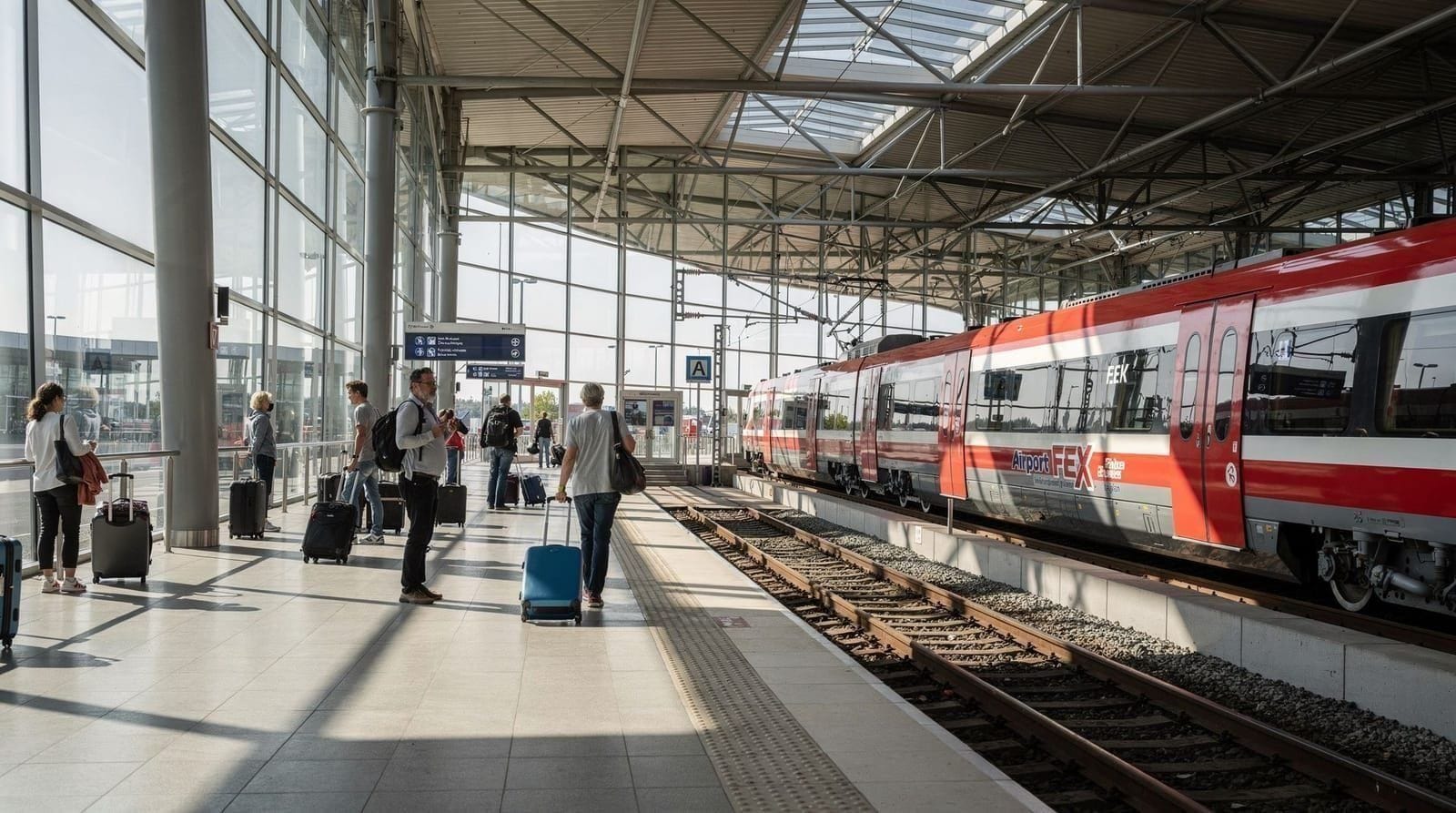
- Upper track level (Oberbahnhof, tracks 11-16): S-Bahn east-west corridor (S5, S7, S75), and the FEX/S9 airport express
- Underground level: U5 U-Bahn
Navigating the station takes a few minutes to learn. Check the departure board (Abfahrt) on arrival and look for your train number and platform. Electronic signs at the track entrance confirm the next departure. Long-distance trains typically open for boarding 10-15 minutes before departure.
Alternative Berlin stations for some services:
- Berlin Ostbahnhof: Some ICE and IC trains from Berlin also stop at Ostbahnhof (east). If you’re staying in Friedrichshain, boarding here saves travel to Hauptbahnhof.
- Berlin Südkreuz: Trains arriving from southern Germany (Munich, Frankfurt via Erfurt) often call at Südkreuz before Hauptbahnhof. Note the direction of travel — some Munich services call Südkreuz before Hbf.
- Berlin Spandau: Western services (Berlin to Hamburg) also stop at Spandau. If staying in Charlottenburg or western Berlin, Spandau may be more convenient.
Key routes from Berlin
Berlin to Hamburg
Duration: 1h 47 min (direct ICE) Frequency: Every 30-60 minutes Operators: DB ICE (primary); Flixtrain on some services
Hamburg Hauptbahnhof is the arrival point. From there, Hamburg’s HVV public transport network covers the city.
Walk-up (Flexpreis) price: €70-120 Advance saver (Sparpreis): From €17.90 booked weeks ahead Flixtrain: Often €10-30, slightly longer journey on some routes
This is one of the most competitive routes in Germany — Flixtrain genuinely undercuts DB on price if timing is flexible.
Berlin to Munich
Duration: 3h 55 min – 4h (direct ICE via Nuremberg) Frequency: Roughly every 2 hours Operators: DB ICE
The Berlin-Munich route via the Erfurt–Nuremberg high-speed line opened in 2017, cutting journey times from over 6 hours to under 4. The line runs through central Germany rather than the historic northern route.
Walk-up price: €100-175 Sparpreis: From €29.90 (book 4-8 weeks ahead) Sparpreis Super Early (3+ months ahead): From €19.90
Nuremberg (Nürnberg) is a worthwhile stop — the Berlin ICE reaches it in approximately 3 hours, making a day trip or overnight break realistic.
Berlin to Frankfurt am Main
Duration: 3h 45 min – 4h (direct ICE) Frequency: Every 1-2 hours
Frankfurt Hauptbahnhof (not to be confused with Frankfurt (Oder), the much smaller city near the Polish border) is Germany’s busiest railway station and the main hub for connecting trains. If you’re heading to southwest Germany (Heidelberg, Stuttgart, Rhine Valley), Frankfurt is the major interchange.
Walk-up: €90-155 Sparpreis: From €29.90
Berlin to Cologne (Köln)
Duration: 4h 20 min – 4h 45 min Frequency: Every 1-2 hours, some require change at Frankfurt
Cologne is the gateway to the Rhine Valley and western Germany. The route connects to the high-speed Cologne-Paris corridor (Thalys/Eurostar), making Berlin-Paris by rail possible in around 7-8 hours with a connection.
Berlin to Dresden
Duration: 2h 15 min (direct EC or IC train) Frequency: Every 1-2 hours
Dresden is popular as a Berlin day trip. The IC/EC trains (not high-speed ICE) run on the Berlin-Dresden corridor. Advance prices are modest — a Sparpreis from €15-25 each way is common.
Berlin to Leipzig
Duration: 1h 10 min (direct ICE)
Leipzig is reachable in just over an hour. The city has a strong arts and music scene and is growing as a Berlin alternative for people priced out of the capital.
Ticket types — what to buy and when
Walk-up (Flexpreis)
The standard refundable, changeable fare valid on any train on the day. Expensive for popular routes but provides flexibility. Worth considering if plans are uncertain or the trip is last-minute.
Sparpreis
The advance saver. Tied to a specific train. Not refundable (or partially refundable with a fee). Available from about 6 months ahead; best prices typically at 3-8 weeks ahead. Savings of 40-60% vs. Flexpreis are common on Berlin routes.
Supersparpreis
The deepest discount category, very train-specific and early booking dependent. Available in limited quantities — worth checking if booking well in advance for a specific journey.
BahnCard
DB’s loyalty card for frequent travellers. BahnCard 25 (€62.90/year or €37.90/half-year) gives 25% off all DB fares. BahnCard 50 (€255/year) gives 50% off. Not worth it for a single trip but makes sense for anyone spending more than a week in Germany by train.
Rail passes
Eurail and Interrail passes can be used for DB long-distance trains but require a seat reservation (€4-10 extra per journey). For visitors doing a multi-country European rail trip with Germany as one stop, passes can be economical. For Germany-only travel, point-to-point tickets usually work out cheaper.
The Deutschlandticket — what it covers and what it doesn’t
The Deutschlandticket is a €58/month subscription (as of 2026) that covers all local and regional public transport across Germany:
- All BVG services in Berlin (U-Bahn, S-Bahn, tram, bus)
- All RE (RegionalExpress) and RB (RegionalBahn) regional trains
- Local buses and trams in any German city
- The S-Bahn in Hamburg, Munich, Frankfurt, Cologne, and other cities
It does NOT cover:
- ICE trains
- IC trains
- EC (EuroCity) trains
- Any FlixTrain
- Seat reservations on any service
The Deutschlandticket is extraordinary value for residents and longer-term visitors. For a short city break in Berlin, the BVG 7-day ticket is more economical. If you’re spending 3+ weeks in Germany and plan to move between cities primarily by regional train, the Deutschlandticket pays for itself.
Regional train journeys possible on the Deutschlandticket from Berlin:
- Berlin to Potsdam: yes, the RE1 is a regional train
- Berlin to Sachsenhausen/Oranienburg: yes, S1 and RE5
- Berlin to Cottbus: yes, RE2 regional train
- Berlin to Frankfurt (Oder): yes, RE1 regional train
- Berlin to Hamburg: NO (only ICE/IC serve this route quickly; regional route exists but takes 5+ hours)
- Berlin to Munich: NO
Booking — bahn.de vs. the DB app vs. other platforms
bahn.de: The DB website. Comprehensive route search, all ticket types, seat reservations, BahnCard discount automatically applied. Available in English. Ticket can be displayed on smartphone (print-at-home PDF also works).
DB Navigator app (iOS/Android): DB’s official app, essentially the same functionality as the website. Better for mobile use. Tickets stored in-app. Disruption alerts and live tracking of train positions.
Third-party platforms (Trainline, Omio): These aggregate train tickets including DB. They work, but often display the same prices as DB with an added booking fee. Use them if you’re booking multi-country journeys that include non-DB legs; for Germany-only DB journeys, go direct.
At the station: DB Reisezentrum offices at major stations sell all ticket types and accept cash. Staff speak English at Hauptbahnhof. Queues can be long during peak travel periods (Friday afternoons, Sunday evenings).
At machines: DB ticket machines at Hauptbahnhof sell long-distance tickets. Interface in English. Card and cash accepted. Machines are faster than queuing for staff.
Seat reservations on long-distance trains
Seat reservations (Sitzplatzreservierung) are optional but recommended on busy routes and travel times. Cost: €4-6 per seat per journey, on top of the ticket price. During peak travel (Friday evenings to Hamburg, Sunday evenings back from Munich), unreserved trains can be standing-room only.
With a Sparpreis ticket, you have the option to add a seat reservation at booking. With a Flexpreis, you can add one any time. Reservation is not mandatory but makes long journeys significantly more comfortable.
Travelling with luggage on German trains
DB trains do not charge for luggage (unlike some airlines operating from BER). Bicycles require a bicycle ticket (Fahrradkarte, €6-9 on DB intercity) and must go in the designated cycle space — book this when buying your train ticket as cycle spaces are limited.
Large luggage goes in the overhead racks or the end-of-carriage luggage area. DB has no weight limits for hand luggage.
Delays and disruption: German long-distance rail has a reputation for punctuality that has slipped in recent years — delays of 10–20 minutes on ICE routes are common enough that they shouldn’t derail a tight connection plan. Build in a buffer of at least 20–30 minutes for any connection you can’t afford to miss, and use the DB Navigator app’s live tracking to check your specific train’s status before heading to the platform. If a delay causes you to miss a connecting Sparpreis train, DB staff will typically rebook you onto the next available service at no extra charge — ask at the Reisezentrum or via the app rather than assuming the ticket is void.
Connections onward from Berlin Hauptbahnhof
When arriving at or departing from Berlin Hauptbahnhof, connections to BVG public transport:
- U5 U-Bahn: Underground level, connects to Museum Island, Alexanderplatz, and beyond
- S-Bahn S5/S7/S75: Upper track level (Oberbahnhof), connects east-west across the city
- FEX/S9 airport express: Same Oberbahnhof level, platforms 11-16, to BER in 30-32 minutes
- Trams: M5, M8, M10 tram stops on the street outside the east exit
- Buses: Multiple routes from bus stops on the Washingtonplatz (western side) and Europaplatz (eastern side)
For all connections within Berlin, a standard BVG AB zone ticket is valid. See the Berlin public transport guide for the full network overview. If you’ve just landed, the BER airport to city guide covers the reverse journey; and our broader Berlin trip planning guide covers how long-distance rail fits into a wider itinerary.
Berlin as a base for onward day trips
Because Berlin Hauptbahnhof handles both regional and long-distance services from the same building, it works well as a base for exploring beyond the city without changing hotels. Regional trains covered by the Deutschlandticket reach Potsdam in around 25 minutes and Sachsenhausen in about 40, while long-distance ICE and EC services put Dresden within a comfortable single day. If a longer trip elsewhere in Germany fits your schedule, Leipzig at just over an hour is genuinely close enough for a half-day visit, and Hamburg at under two hours works as an overnight add-on without much dead travel time.
Choosing between DB, Flixtrain and driving
For the Berlin–Hamburg corridor specifically, it’s worth pricing all three options before booking: DB’s Sparpreis fares, Flixtrain’s often-cheaper seats on the same infrastructure, and car rental if you’re travelling with a group of three or more where splitting a rental cost can undercut individual train fares. Our car rental guide covers the practicalities if driving turns out to make more sense for your group size and route. For most solo and paired travellers, though, train remains faster door-to-door once you account for city-centre pickup and parking.
Frequently asked questions about Berlin to the rest of Germany by train
What is the fastest train route from Berlin to Hamburg?
ICE trains connect Berlin Hauptbahnhof to Hamburg Hauptbahnhof in approximately 1 hour 47 minutes. Trains run every 30-60 minutes throughout the day. Walk-up prices can be high (€70-120) but advance saver fares (Sparpreis) can be as low as €17.90. Book 3-4 weeks ahead for the best prices.How long is the train from Berlin to Munich?
Direct ICE trains from Berlin Hauptbahnhof to Munich Hauptbahnhof take approximately 4 hours. Services run roughly every 2 hours. Walk-up prices reach €150 or more; advance Sparpreis fares start from €29.90. The route passes through Nuremberg (3h journey) which can be combined as a stop.Does the Deutschlandticket cover trains from Berlin to other cities?
No. The Deutschlandticket (€58/month subscription) covers only local and regional public transport (S-Bahn, U-Bahn, regional RE and RB trains, buses, trams). It does not cover ICE or IC intercity express trains. For Berlin to Hamburg, you need a separate long-distance train ticket from DB or a competing operator.What is Berlin Hauptbahnhof and how do I navigate it?
Berlin Hauptbahnhof (Hbf) is Germany's largest railway station, a multi-level glass-and-steel structure opened in 2006. Long-distance ICE trains use the lowest track level (Untergeschoss, tracks 1-8). S-Bahn uses the higher covered concourse level (Oberbahnhof, tracks 11-16). U5 U-Bahn has its own underground platform. Platforms and connections are well signed in German and English.Can I buy a train ticket from Berlin to Germany on the day?
Yes, walk-up (Flexpreis) tickets are available on the day but are often significantly more expensive. For popular routes like Berlin-Hamburg on a Friday evening, walk-up prices can exceed €140. The DB app or bahn.de allow same-day purchase. Buying at least 2-3 weeks ahead saves considerably on most routes.What is a Sparpreis and how does it work?
Sparpreis (saver fare) is DB's advance ticket category for long-distance trains. Prices are lower but the ticket is tied to a specific train. If you miss that train, the ticket is not valid on the next service. Standard Flexpreis tickets allow travel on any train on the same day. The Sparpreis Supersaver (very early booking) can be drastically cheaper — check bahn.de 4-8 weeks ahead.Are there alternative operators to DB for Berlin train travel?
Flixtrain operates on some routes including Berlin-Hamburg at competitive prices (sometimes €10-25), using DB infrastructure. FlixBus also covers the same routes by road, typically 3-5 hours and €10-30. Neither FlixBus/Flixtrain accepts the Deutschlandticket. For Berlin to Munich, the direct Flixtrain is a genuine alternative worth checking.Is it worth taking a sleeper train from Berlin?
DB and Austrian Federal Railways (OBB) operate Nightjet sleeper trains from Berlin. Routes include Berlin to Vienna (7-8 hours overnight), Zurich, Brussels, and Amsterdam. A seat reservation in a couchette berth costs from €35-50 in a shared compartment. It doubles as overnight accommodation and transport. Good option for Vienna or Zurich if travelling in or out of Germany.