Türkenmarkt Berlin — the Turkish market on Maybachufer canal
Berlin: Private Kreuzberg Food and Street Art Tour
When is the Türkenmarkt open and where is it?
The Türkenmarkt (Turkish market) runs along Maybachufer canal in the Neukölln neighbourhood every Tuesday and Friday from 11am to 6:30pm. It is one of the largest weekly markets in Berlin and the most important Turkish market in Germany outside of food-focused supermarkets. Take U8 to Schönleinstrasse and walk two minutes south to the canal.
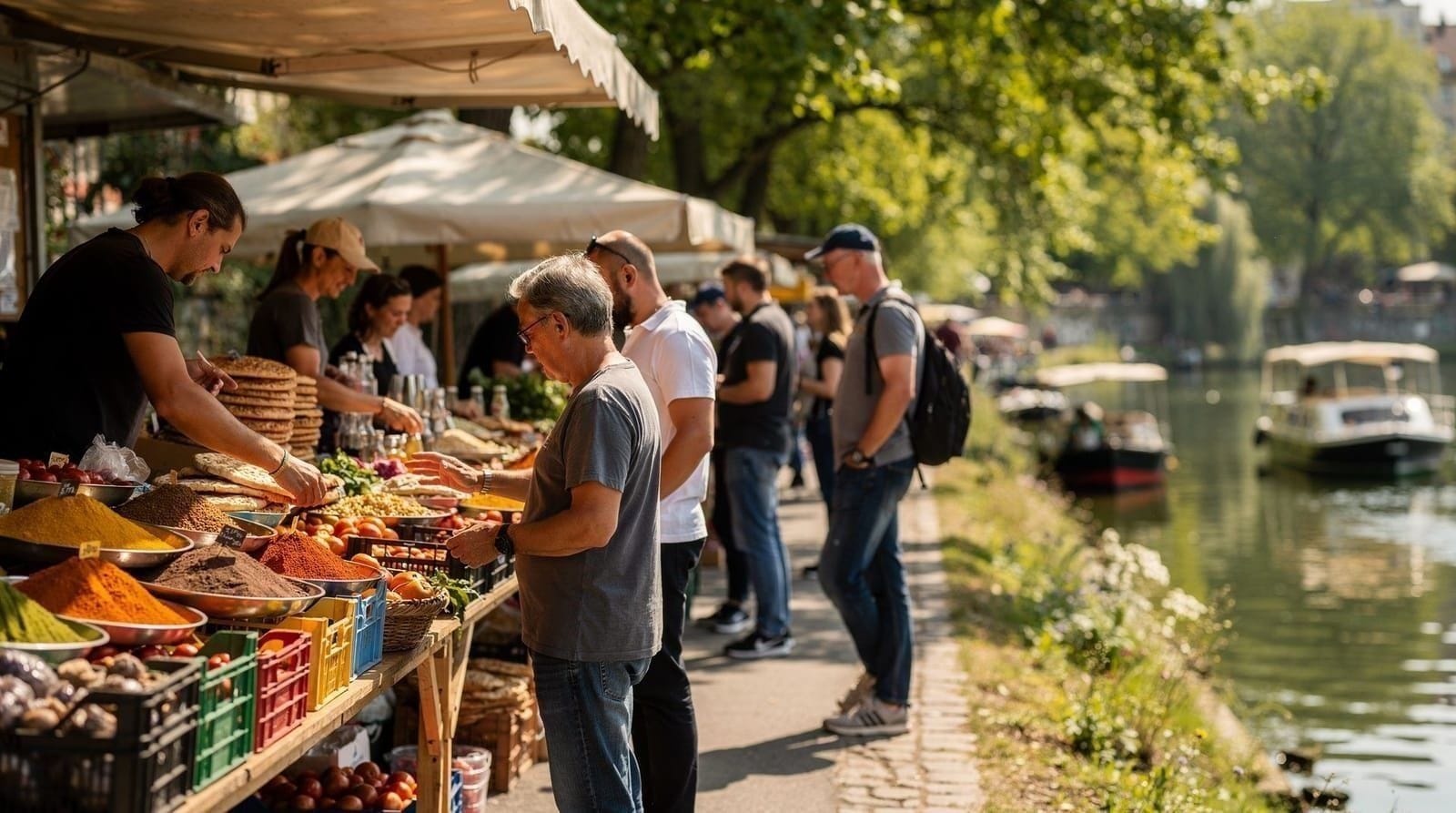
On the banks of the Landwehrkanal in Neukölln, twice a week, one of Germany’s most significant Turkish markets sets up along Maybachufer. The Türkenmarkt is not a tourist attraction dressed as a market — it is an actual working market used by the neighbourhood, and that functional reality is precisely what makes it interesting to visit.
| Where | Maybachufer canal, Neukölln (U8 Schönleinstrasse) |
| Cost | Free to browse; produce and snacks from around EUR 1 |
| Time needed | 1–2 hours |
| Getting there | U8 to Schönleinstrasse, 2-minute walk |
| Best time | Tuesday mornings, 11:00–13:00, for the calmest browsing |
History and context
Berlin has had a significant Turkish-origin population since the 1960s, when post-war West Germany brought in guest workers (Gastarbeiter) under labour agreements with Turkey to rebuild the economy. Many of these workers and their families settled permanently, particularly in Kreuzberg and Neukölln. By the 2020s, the Turkish and Turkish-German community in Berlin numbers over 200,000 — making Berlin one of the largest Turkish cities outside Turkey itself.
The Türkenmarkt on Maybachufer developed from this community’s need for familiar ingredients and goods. It has operated in its current form since the 1970s and has grown to around 100 stalls during its busiest periods. It is embedded in the neighbourhood in a way that more performatively “multicultural” markets are not — it serves the needs of people who live there, not a concept of them.
This matters for what to expect as a visitor. The market is not curated for photogenic presentation. Stalls can be crowded together, prices are written in German and Turkish, and the flow of shoppers is functional rather than leisurely. It is more interesting than most markets for exactly these reasons.
Getting there
Address: Maybachufer, 12047 Berlin (between Hobrechtbrücke and Maybachufer park)
Transport:
- U8 to Schönleinstrasse: 2 minutes’ walk south to the canal. This is the closest stop.
- U8 to Boddinstrasse: 8 minutes’ walk north along Hermannstrasse.
- Bus 104 or 167 to Maybachufer stop, directly adjacent.
The market runs along the north bank of the Landwehrkanal for approximately 500 metres. Most of the food section concentrates in the first 200 metres east of the Hobrechtbrücke bridge. The textile and household sections extend further east.
Cycling: Maybachufer has a cycle path. Locking points are available at both ends of the market stretch, and the canal-side path makes the approach from Kreuzberg along the water pleasant.
Car: Not recommended. Parking in this part of Neukölln is tightly controlled, and Tuesday and Friday afternoons see residential permit zones in effect throughout most of the adjacent streets.
What to buy — section by section
Fresh produce
The vegetable and fruit section begins closest to the Hobrechtbrücke and is the market’s commercial heart. Stalls are competitive with each other and with nearby supermarkets. Expect:
- Vegetables: Tomatoes, aubergines, courgettes, peppers, cucumbers, fresh herbs (flat-leaf parsley, dill, mint, fresh coriander), okra, leeks, and seasonal items.
- Fruit: Figs, pomegranates, quince, citrus, watermelon (seasonal), grapes, berries.
- Prices: Generally 30–50% below Rewe or Edeka for the same items. A kilo of tomatoes may cost €0.80–1.20 here versus €2–3 in a supermarket. A bunch of fresh herbs runs €0.50–1.
The produce is not certified organic and not particularly scenic — but it is fresher than much of what sits in supermarket chiller sections, sourced from wholesale markets early in the morning.
Olives, pickles and preserved goods
A cluster of stalls in the middle of the market concentrate on olives (loose, available by weight), pickled vegetables, preserved lemons, tahini, pomegranate molasses, grape molasses, and Turkish condiments not commonly available in standard German supermarkets. These are good value and make practical gifts or pantry additions.
Sample prices:
- Olives: €4–7 per kilo depending on type
- Pomegranate molasses: €3–5 per bottle
- Tahini (500g jar): €3–4
Spices and dried goods
This is one of the most valuable sections for anyone who cooks. Spices sold loose by weight are significantly cheaper than pre-packaged equivalents (sometimes 60–80% cheaper by weight). Common items:
- Dried red pepper flakes (pul biber): the Turkish equivalent of chilli flakes, in multiple heat levels
- Sumac: essential for many Turkish and Middle Eastern dishes
- Dried mint, oregano, thyme
- Nigella seeds, cumin, coriander seed
- Turkish tea (çay): loose-leaf and boxed
- Various lentil types not in standard supermarkets
A 200g bag of dried spices typically costs €1–3. Compare this with branded pre-packed spices at €2–4 for 30–50g.
Bread and pastries
Several stalls sell bread, and this is where the most distinctive items appear:
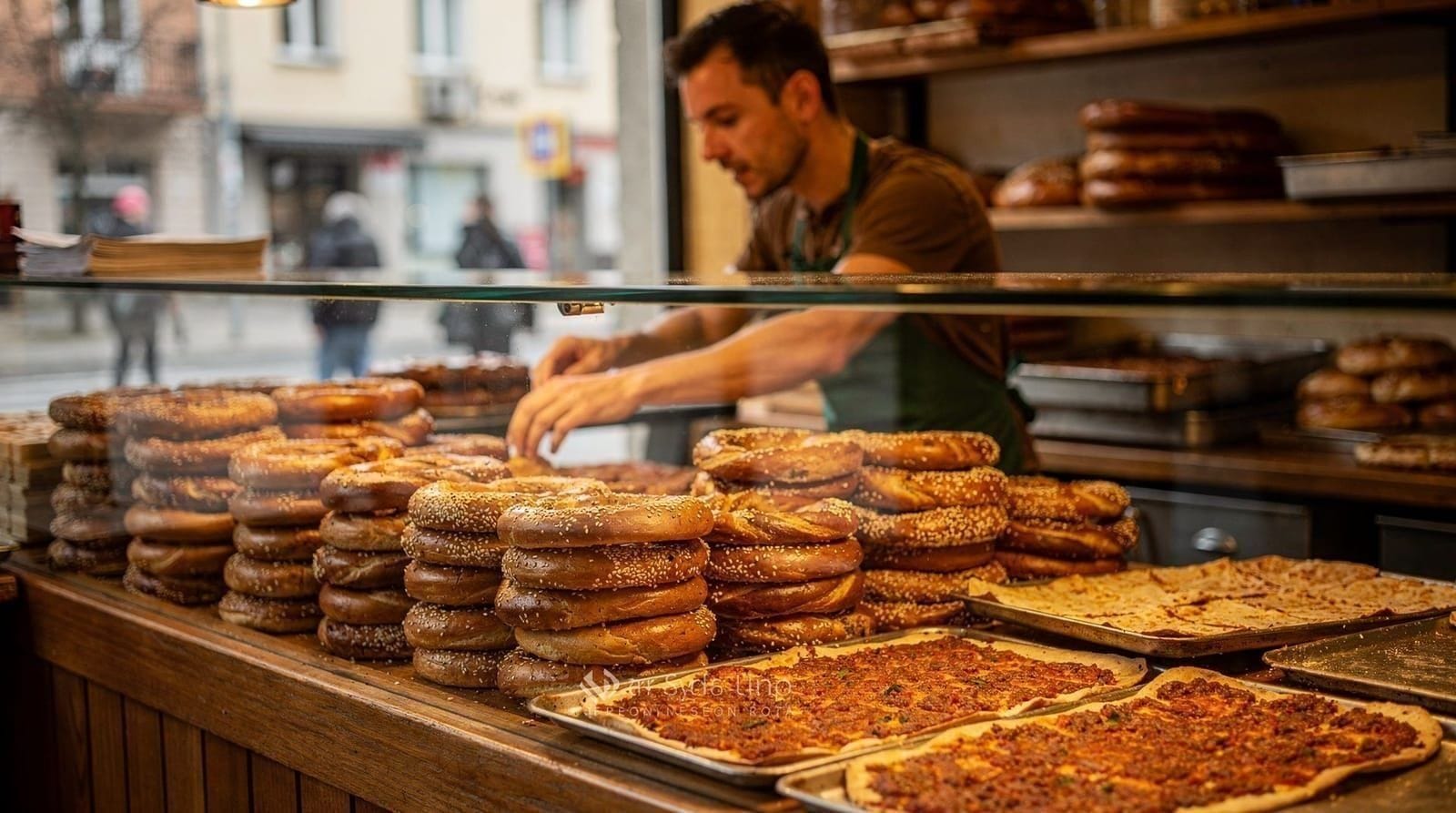
Simit: Ring-shaped bread encrusted with sesame seeds, baked in Turkey and brought to Berlin’s Turkish bakeries for distribution. Crispy outside, slightly chewy inside. Eaten plain or with cheese. Cost: €0.80–1 each.
Gözleme: Flatbread filled and pan-cooked on the stall. Fillings include spinach and feta, minced meat and onion, or potato with herbs. Cost: €3–4 for a gözleme.
Börek: Filo pastry layered with cheese, spinach, or meat. Sold by the slice (€2–3).
Baklava and sweet pastries: Several stalls sell Turkish sweets. These are typically machine-made rather than the individually crafted product of a patisserie, but the price (€5–8 for a box of mixed pieces) reflects this.
Textiles and fabrics
The eastern end of the market is dominated by textile stalls selling fabric by the metre, ready-made clothing, and domestic textiles. The range covers:
- Cotton and polyester fabric for sewing (€3–8 per metre depending on fabric)
- Curtains and net curtaining (€5–15 per panel)
- Towels, bath mats, and kitchen towels
- Ready-made shalwar trousers and modest-cut dresses
- Work aprons and domestic clothing
Prices are low by European retail standards. If you sew or need specific fabric types, the range is useful. If you are looking for contemporary fashion, this is not the right section.
Household goods
Alongside textiles, the household section covers ceramics (Turkish tea glasses, small plates, bowls), cleaning products, large plastic storage containers, prayer items, and general homeware. Few of these are of particular interest to visitors, but the ceramic tea glasses (small, tulip-shaped, sold in sets of 6 or 12) are a practical and inexpensive souvenir (€5–12 for a set).
What to eat at the market
The market is one of the better places in Berlin to eat cheaply and well at the same time. The food is not staged for visitors — it is what local market workers and shoppers eat.
Gözleme from the flatbread stalls (€3–4): Watch the flatbread being rolled, filled, and cooked on the griddle in front of you. The spinach and feta version is the most common.
Simit with white cheese: Buy a simit ring and a small piece of white (feta-style) cheese from the produce section for about €1.50 total. The standard breakfast of eastern Turkish cities.
Turkish tea: Several sellers offer small glasses of tea from an urn (€0.80–1). Strong, brewed in a double-boiler, served without milk. Standard practice is to drink two or three.
Baklava: A small box costs €5–8 and works well as a post-market treat.
Avoid: the stalls near the main market entrance that sell printed-packaging packaged items — same goods available in any Turkish supermarket, sold at market prices.
Practical information
Opening times: Tuesday 11am to 6:30pm, Friday 11am to 6:30pm. Closed all other days, including Sundays.
Best time to visit: Tuesday morning (11am to 1pm) for calm browsing with full stall selection. Avoid Friday between 3pm and 6pm if you dislike crowds.
Payment: Cash only at virtually all stalls. ATMs are on Hermannstrasse (7 minutes) and Karl-Marx-Strasse (10 minutes). Do not arrive without cash.
Bags: Bring your own shopping bags. Sellers provide thin plastic bags, but these are inadequate for loose produce. A canvas or woven bag is ideal.
Photography: The market is publicly accessible and photography is generally accepted, but ask before photographing stall holders or their customers at close range. Some sellers prefer not to be photographed — respect this.
Language: German and Turkish are the working languages. English is understood by most younger stallholders. Basic phrases in German (numbers, prices) will be appreciated but are not required.
The canal setting
Maybachufer is one of the more pleasant stretches of Berlin canal. The Landwehrkanal runs east-west through Kreuzberg and Neukölln before rejoining the Spree, and the stretch here has mature trees on both banks, cycle and pedestrian paths, and a calm urban water setting.
After the market, the canal-side path west toward Kreuzberg (15–20 minutes’ walk) passes through the Paul-Lincke-Ufer, one of the more attractive residential canalsides in Berlin. This connects eventually to Kottbusser Damm and deeper into Kreuzberg’s food and cultural scene.
For the full picture of Berlin’s Turkish food culture, also read the Berlin Turkish food guide and the Neukölln neighbourhood guide, which covers the district the market sits in. If you want a guided introduction rather than navigating the stalls solo, a walking food tour through Kreuzberg’s street food scene covers similar culinary territory with local context:
Kreuzberg food and street art walking tour — Turkish and multicultural food culture, guidedTürkenmarkt vs Berlin’s other markets
| Market | Focus | Days | Character |
|---|---|---|---|
| Türkenmarkt (Maybachufer) | Turkish produce, spices, textiles | Tue, Fri | Working local market, not curated |
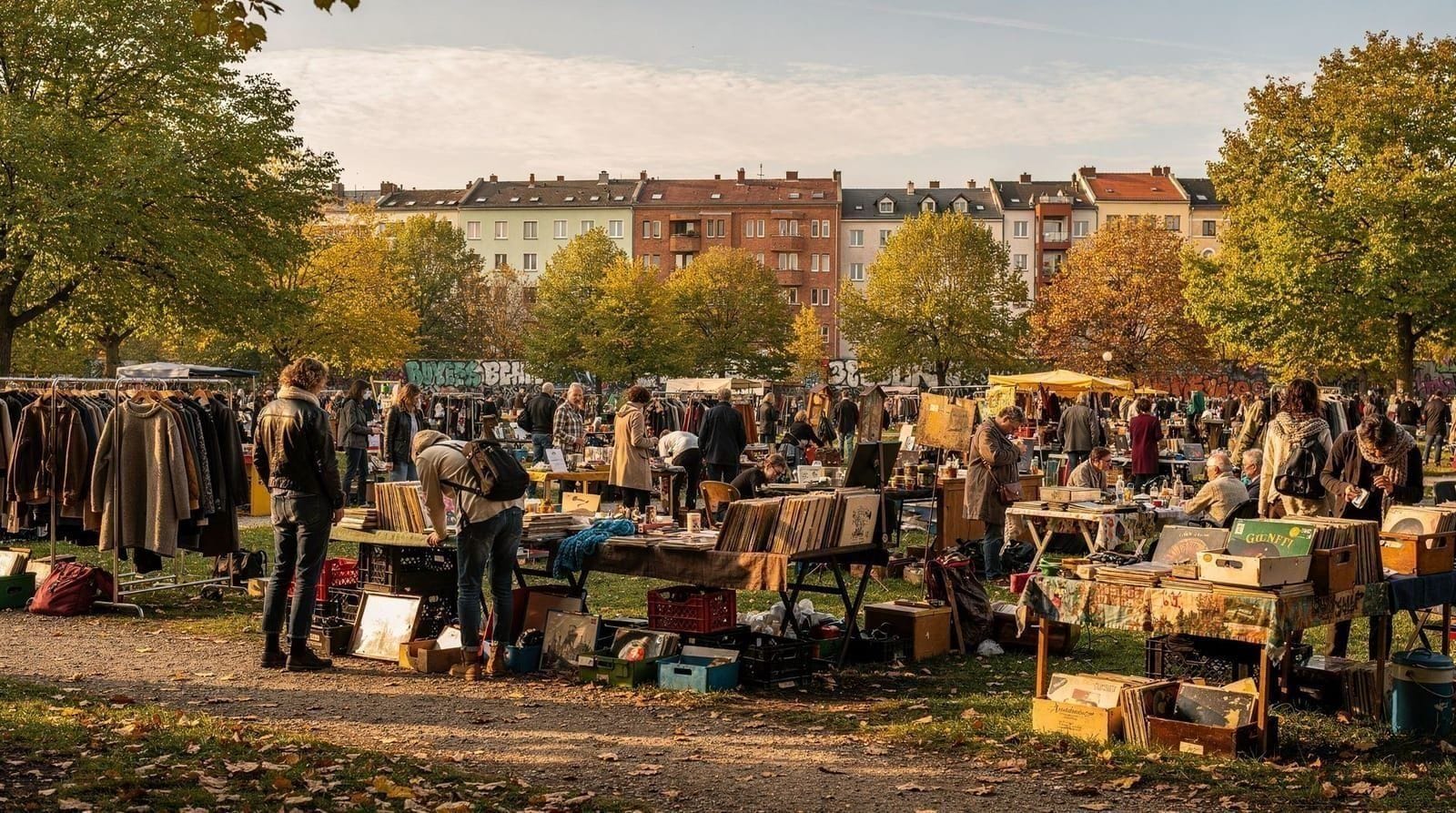
| Mauerpark flea market | Secondhand, vintage, crafts | Sunday | Tourist-heavy, browsing and bargaining |
| Winterfeldtmarkt | Upmarket produce, flowers, deli | Wed, Sat | Schöneberg residents, higher prices |
| Boxhagener Platz market | Antiques, secondhand, produce | Sunday | Friedrichshain flea-market mix |
If you’re comparing which markets to prioritise on a short trip, the Berlin flea markets guide covers the secondhand and vintage side of the city’s market scene, while the best markets to eat in Berlin guide ranks food-focused markets specifically. For the wider shopping picture beyond markets, see the Berlin shopping guide.
A few things first-timers get wrong
Many visitors arrive expecting a tourist-oriented spectacle and are thrown by how functional the market actually is — stalls are packed tightly, haggling is not really the custom here (prices are generally fixed and fair), and the crowd is doing genuine weekly shopping rather than posing for photos. Treat it as a working market, move at the pace of the shoppers around you, and the experience opens up much more naturally than if you’re waiting for a performance.
Frequently asked questions about Türkenmarkt Berlin
What do they sell at the Türkenmarkt?
The market has three main sections. Food stalls sell fresh vegetables, fruit, olives, dried goods, spices, nuts, pastries, bread (including simit rings), cheese, and dried herbs. Textile stalls sell fabrics by the metre, ready-made clothing, curtains, and towelling. Household stalls sell ceramics, kitchenware, cleaning products, and general homeware. A smaller number of stalls sell leather goods, jewellery, and accessories.Are prices at the Türkenmarkt lower than supermarkets?
For fresh vegetables and fruit, yes — significantly cheaper than Rewe or Edeka for many items. Spices and dried goods are also competitively priced. Textiles are often cheaper than similar items in fabric shops. Pre-packaged branded food items are not necessarily cheaper. Come for fresh produce, spices, and textiles; for everything else, compare before buying.Is the Türkenmarkt cash only?
Nearly all stalls are cash only. There are ATMs on Hermannstrasse (7 minutes walk) and on Karl-Marx-Strasse (10 minutes walk). Bring cash before arriving. The market itself has no ATM facilities.Is the Türkenmarkt suitable for tourists or mainly for locals?
Both, but the dynamic is primarily local. The market is used week to week by Neukölln and Kreuzberg residents for regular food shopping. It is not a tourist market and does not sell tourist merchandise. Visitors who come expecting a performance of culture may be surprised by how functional and workaday the market is — which is precisely what makes it worth visiting.How crowded does it get?
Friday afternoons (2pm–5pm) are the most crowded, as residents do end-of-week food shopping. Tuesday mornings (11am–1pm) are the most relaxed, with full stall selection but far fewer people. If you want to browse comfortably and photograph without being in the way, Tuesday morning is the better visit.Is there food to eat at the market?
Yes. Several stalls sell hot food — gözleme (stuffed flatbread), börek (filled pastry), simit (sesame bread rings), and cooked snacks. Turkish tea is served from several sellers. These are genuine market food items priced for the local market (€2–5 for most snacks) rather than tourist-oriented food stalls. Quality is good.What languages do stallholders speak?
Most stallholders speak Turkish and German. A significant number speak some English. Basic gestures and pointing work fine for most transactions. German phrases for quantities and prices will be understood and appreciated, but are not necessary.