Karneval der Kulturen guide — Kreuzberg's multicultural street festival and parade
Berlin: Kreuzberg Street-Art & Graffiti Self-Guided Tour
When is Karneval der Kulturen and what is it?
Karneval der Kulturen takes place annually over the Whitsun (Pentecost) long weekend in late May or early June — typically four days from Saturday to Whit Monday. The centrepiece is a street parade through Kreuzberg on Sunday, with decorated floats, dance groups, and musical performances from communities representing over 70 countries. The festival is free to attend.
When is Karneval der Kulturen? The Whitsun (Pentecost) long weekend in late May or early June — four days, typically Saturday to Monday. The street parade on Sunday is the main event, running through central Kreuzberg. The broader festival includes stages, food, and cultural performances across the weekend. All free to attend.
| When | Whitsun weekend, late May/early June — Friday to Whit Monday |
| Cost | Free (parade and street festival areas) |
| Where | Kreuzberg — parade from Hermannplatz to Yorckstrasse/Mehringdamm |
| Time needed | 2–3 hours for the parade, or a full day for the wider festival |
| Getting there | U8 to Hermannplatz or U7 to Gneisenaustrasse/Mehringdamm |
| Crowds | Very heavy on Sunday; lighter Friday, Saturday and Monday |
What Karneval der Kulturen is and how it started
Karneval der Kulturen was founded in 1996 by the Werkstatt der Kulturen cultural centre in response to a specific political context: the xenophobic attacks on asylum seekers and minority communities in Germany in the early 1990s (Rostock-Lichtenhagen 1992, Mölln 1992, Solingen 1993) had created a political climate in which Berlin’s multicultural communities — particularly the large Turkish-German population in Kreuzberg — faced public hostility.
The founders’ response was not a protest but a celebration — a street festival that displayed the cultural richness of Berlin’s communities as an affirmative political act. The format drew on Caribbean carnival traditions (the London Notting Hill Carnival was a direct reference point) adapted for Berlin’s specific multicultural mix.
By the early 2000s, Karneval der Kulturen had become one of the largest street events in Germany. The estimated attendance of 700,000 to 1 million people on parade Sunday makes it comparable in scale to Christopher Street Day (CSD) as a mass Berlin street event.
The festival’s founding purpose is still its defining character: the parade groups represent communities from over 70 countries, and participation is open to cultural associations, community organisations, school groups, and individuals who want to represent their background or artistic vision. This inclusive structure produces a more heterogeneous and less polished event than commercial carnivals, which is part of its appeal.
The Sunday parade — the main event
The parade is the most important element of the festival. It runs on Whit Sunday, starting at Hermannplatz (U8 to Hermannplatz) and moving through Kreuzberg over the course of the day. The route runs northwest along Hasenheide and through the central Kreuzberg streets.
What you will see: Decorated floats (on flatbed trucks), dance groups from specific national or cultural communities (West African drumming groups, Brazilian samba schools, Turkish folk dance troupes, Caribbean dancers, Latin American grupos), costumed walkers, and live music at the front and rear of each float. Several hundred groups typically participate, ranging from a few dozen people to large organised ensembles.
Scale: The full parade can take 3–4 hours to pass a given point on the route. The parade moves slowly. If you want to see specific groups, checking the programme in advance (published on the Karneval der Kulturen website in the weeks before the event) lets you time your arrival.
Best viewing positions: Hermannplatz, where the parade begins, is the most crowded but offers the freshest performances. Mid-route (around Gneisenaustrasse and Mehringdamm intersection) is typically less crowded and the performers have found their rhythm. The end of the route near Yorckstrasse is the least crowded but some groups have been performing for hours.
Arrive early: For parade Sunday, arrive at your chosen position by 11 am at the latest. By noon, the pavement along the entire route is standing-room-only. The parade typically begins at 12:00 or 12:30 pm.
The wider festival — Friday to Monday
The Sunday parade is the centrepiece, but Karneval der Kulturen runs for four days with a broader programme:
Friday evening: Festival opening, typically with concerts at the main stage areas. The character is more adult-oriented, with later hours and a younger crowd.
Saturday: Full day of music, food, and cultural events at the main festival grounds. Several stages operate from early afternoon. This is a good day for families — vibrant atmosphere without the extreme Sunday crowds.
Sunday (parade day): The parade from approximately noon. The festival grounds run concurrently. Sunday evenings are the most intensely attended period of the weekend.
Whit Monday: Traditionally the last day, with a final day of concerts and a more relaxed atmosphere. Crowds thin from Sunday night onward. Monday is often the best day for people who want the food and music atmosphere without the extreme density of Sunday.
| Day | Character | Best for |
|---|---|---|
| Friday evening | Opening concerts, younger crowd | Nightlife-focused visitors |
| Saturday | Full day of music, food, stages | Families, first-timers |
| Sunday | The parade, from ~noon; heaviest crowds | Anyone prioritising the parade itself |
| Whit Monday | Closing concerts, thinner crowds | A relaxed, less crowded festival experience |
Main stage areas:
- Around Blücherplatz and the adjacent streets
- Mariannenplatz in Kreuzberg (also used for the Mayday festival in May)
- Mehringdamm and Gneisenaustrasse area
Food at Karneval der Kulturen
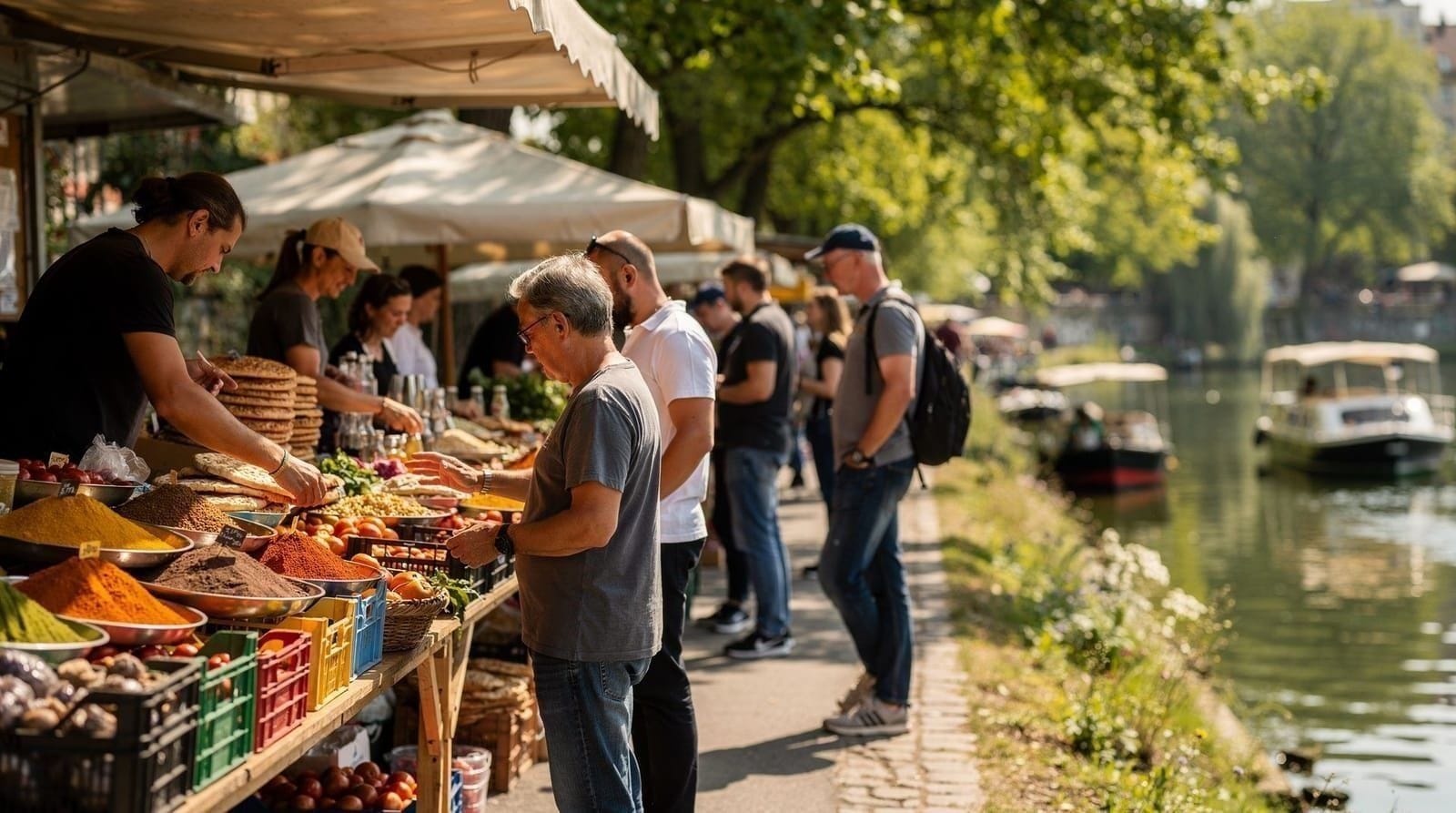
One of the festival’s particular pleasures is the food. Stalls representing the cuisines of participating communities cluster around the main festival areas and line the parade route. You will find:
- Turkish and Middle Eastern: Lahmacun, gözleme, falafel, mezze from community stalls
- West African: Jollof rice, suya, West African stews
- Caribbean and Latin American: Jerk chicken, arepas, empanadas
- South Asian: Biryani, various curry dishes, samosas
- Ethiopian and East African: Injera dishes, Eritrean coffee ceremony
Prices at festival stalls are roughly comparable to street food at other Berlin markets — €4–10 for a main dish. Cash is widely accepted; bring small denominations. Cards less commonly accepted at smaller community stalls.
For year-round Turkish and multicultural food options in Kreuzberg outside the festival season, see the Kreuzberg food guide.
Getting there and transport
Primary transport: U-Bahn to Hermannplatz (U8) for the parade start, or U7 to Gneisenaustrasse or Mehringdamm for mid-route positions. The U8 and U7 both run directly into central Kreuzberg.
On Sunday parade day, expect extreme overcrowding on U8 trains to Hermannplatz from mid-morning. BVG typically runs additional trains on Karneval Sunday. Arriving by S-Bahn to Südkreuz and walking 15 minutes north is sometimes faster than fighting through the Hermannplatz U-Bahn.
Cycling: Kreuzberg is bike-friendly outside the parade route itself. Cycling to a position near the route and locking your bike on a side street is practical on Friday and Saturday. On Sunday, the streets along the route itself are closed to cycling.
Driving: Not recommended. Kreuzberg is closed to through traffic during the parade and most festival areas. Parking is extremely limited. Public transport is the only practical option.
Accommodation and planning around Karneval
Karneval der Kulturen weekend is one of the busiest tourist weekends in Berlin (alongside CSD and the Berlinale). Hotels in central Berlin and Kreuzberg fill up early. Book accommodation 2–4 months in advance. Prices are higher than standard late-May/early-June rates.
Kreuzberg and Neukölln hotels are the most convenient for the festival grounds. Prenzlauer Berg and Mitte offer more affordable alternatives within 20–30 minutes by U-Bahn.
For guidance on accommodation areas and what to expect in Berlin in late spring, see the Berlin where to stay guide and the best time to visit Berlin guide.
What to bring
Sunday parade day:
- Water — it is often warm in late May/June and standing in crowds for several hours is dehydrating
- Cash — small denominations for food stalls
- Comfortable shoes — you will be standing for extended periods
- Sunscreen — the parade route has limited shade
- A small bag rather than a large backpack — easier to move in crowds
Weather: Late May to early June in Berlin averages 15–20°C during the day. Rain is possible; a light waterproof layer is worth having. Warm evenings (above 12°C) are common but not guaranteed.
Karneval der Kulturen and the neighbourhood context
Karneval der Kulturen is specifically a Kreuzberg event — rooted in the neighbourhood’s multicultural identity, organised by a Kreuzberg cultural institution, and running through Kreuzberg streets. Understanding the neighbourhood gives the festival more meaning.
The Turkish-German community that settled in Kreuzberg from the 1960s is a central element of the festival’s identity. The community’s presence in the neighbourhood predates Karneval by decades — the festival was partly created to celebrate and defend that presence. Walking Oranienstrasse, the main commercial street of SO36, the week after Karneval gives a sense of the neighbourhood in its everyday form.
For the neighbourhood in full detail, see the Kreuzberg neighbourhood guide.
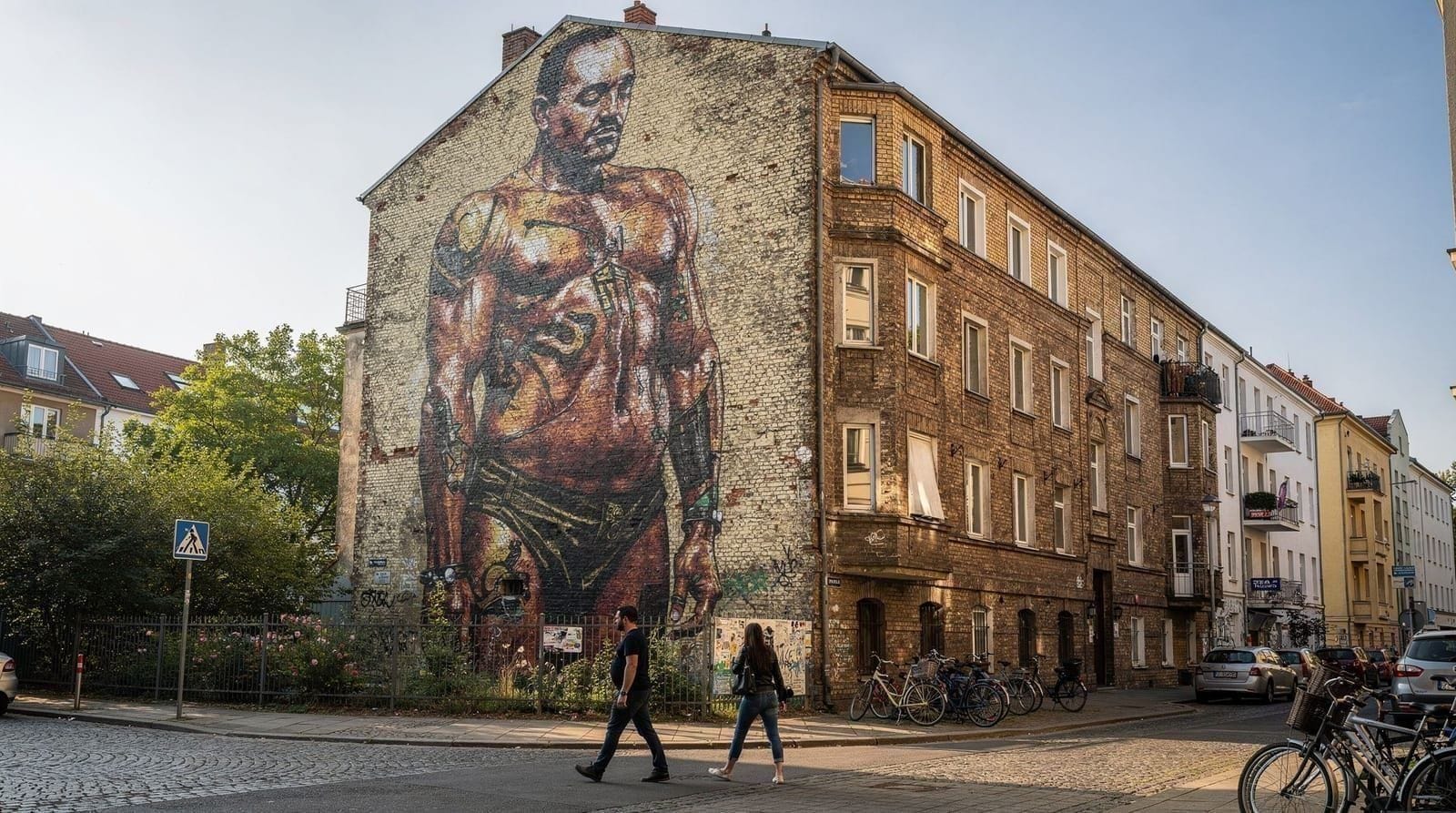
For the street art and murals that form another layer of Kreuzberg’s visual culture, see the Kreuzberg urban art guide.
If you’re in Kreuzberg on the quieter Friday or Monday, a self-guided or private walk through the neighbourhood’s murals fills the time well between festival sessions.
Self-guided Kreuzberg street art walkExtending the trip beyond Karneval
If Karneval der Kulturen is the anchor for your Berlin trip, it pairs naturally with a broader look at the city. A two-day Berlin itinerary fits well either side of the festival weekend, and general Berlin trip planning guidance helps with the logistics of booking around a peak-demand weekend. Berlin’s calendar has other major free festivals worth knowing about too — the Festival of Lights in autumn takes the city in a completely different, quieter direction, useful for comparison if you’re deciding when to visit.
Frequently asked questions about Karneval der Kulturen guide
What year did Karneval der Kulturen start?
Karneval der Kulturen was founded in 1996 by the Cultural Society for Kreuzberg (Werkstatt der Kulturen) as a response to xenophobic attacks in Germany in the early 1990s. It was explicitly designed as a celebration of Berlin's multicultural identity, particularly the Turkish-German community in Kreuzberg. By 2000 it had become one of Berlin's largest annual events.How long is the parade route?
The parade route runs approximately 2.5 km through central Kreuzberg, starting at Hermannplatz and ending at Yorckstrasse/Mehringdamm area. The route follows Hasenheide and turns through the Kreuzberg streets. The parade takes several hours to pass any fixed point — allow 2–3 hours if you want to see a significant portion.Is Karneval der Kulturen free?
Yes. The parade and street festival areas are public space with no entry charge. Some events within the Werkstatt der Kulturen venue (indoor concerts, workshops) may have ticket charges, but the main festival and parade are free.What is the Werkstatt der Kulturen?
The Werkstatt der Kulturen is the cultural centre that organises Karneval der Kulturen. Located at Wissmannstrasse 32 in Neukölln (just south of Kreuzberg), it is a cultural institution focused on multicultural arts programming year-round. During Karneval it operates stages, workshops, and food areas.Are there stages and music during the festival days (not just the parade)?
Yes. The four-day festival includes multiple stages across the Kreuzberg area, operating from Friday evening through Monday. The stage programme covers Caribbean, Latin American, African, Turkish, Asian, and electronic music. The stages around Blücherplatz and Mariannenplatz are the main anchors.How crowded is Karneval der Kulturen?
Very crowded. The parade on Sunday draws an estimated 700,000–1 million people over the course of the day. The streets along the parade route fill from mid-morning. For a comfortable position, arrive at your chosen viewing spot by 11 am at the latest. The festival grounds on non-parade days (Friday, Saturday, Monday) are busy but manageable.Is Karneval der Kulturen suitable for families?
Yes, during the day. The parade is visually spectacular and appropriate for all ages — decorated floats, costumes, drumming, dance. The later evening festival periods (after 9 pm) are adult-oriented and can be heavily intoxicated. Daytime events and the parade itself are family-appropriate.