Where to see the Berlin Wall in 2026 — what remains and what matters
The Berlin Wall fell on November 9, 1989. Within months, most of it was demolished — by citizens with hammers, by demolition crews, by souvenir hunters with chisels. Today, 36 years later, less than 5% of the original 155-kilometre barrier survives in any physical form. What remains is spread across the city in fragments, memorials, documentation centres, and marked routes. Knowing where to go and what you’re looking at makes a significant difference to whether the experience is moving or just bewildering. The Berlin Wall complete guide covers all locations with transport directions. This is the editorial version: what remains, why it matters, and how to prioritise.
| Longest surviving section | East Side Gallery, 1.3km, Friedrichshain |
| Most complete site | Bernauer Strasse memorial and documentation centre |
| Cost | Free at every outdoor site |
| Time needed | 2 hours minimum, half a day for the fuller picture |
| Getting there | S-Bahn/U-Bahn to Warschauer Strasse, Nordbahnhof, or Kochstrasse |
Why so little survives
The demolition of the Wall was not primarily a government decision — it happened organically, driven by the same popular energy that brought the Wall down. Berliners wanted it gone. The barrier had divided families, killed people, and defined 28 years of constrained existence. The emotional logic was: remove it completely and move forward.
By the time cultural institutions began arguing for preservation of sections as historical monuments, most of the Wall had already been cleared. Potsdamer Platz — the massive commercial development that rose on former death strip land — was under construction before any serious preservation conversation had happened for that section.
This is worth understanding as context: the limited surviving Wall is not a failure of preservation policy so much as a reflection of how rapidly and decisively the city moved to erase the barrier once it was politically possible to do so.
Today, the Mauerweg (Wall Trail) marks the entire 155-kilometre route of the original barrier as a cycling and walking path — you can follow the course even where no physical trace remains.
East Side Gallery — the most visited, the longest section
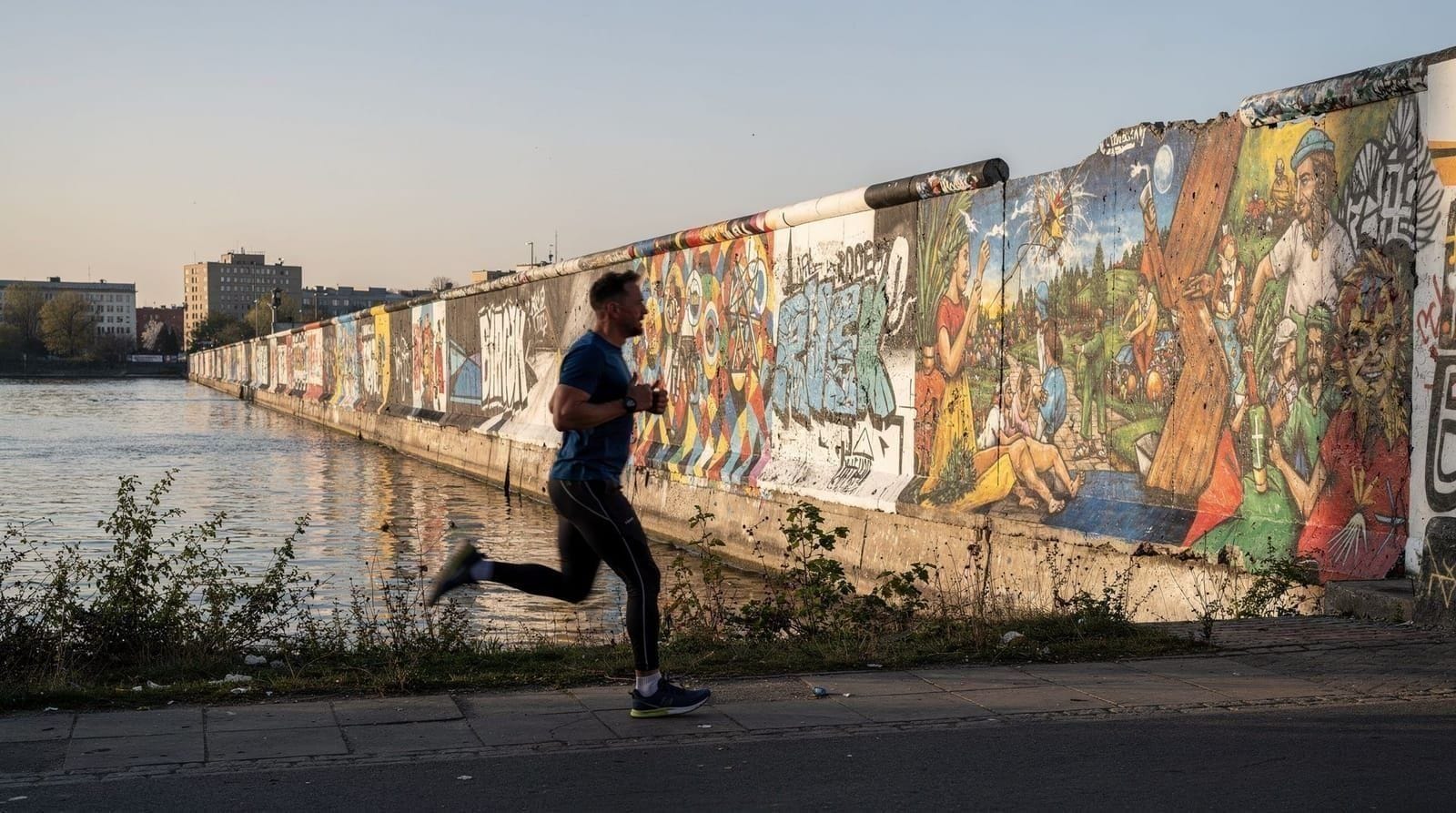
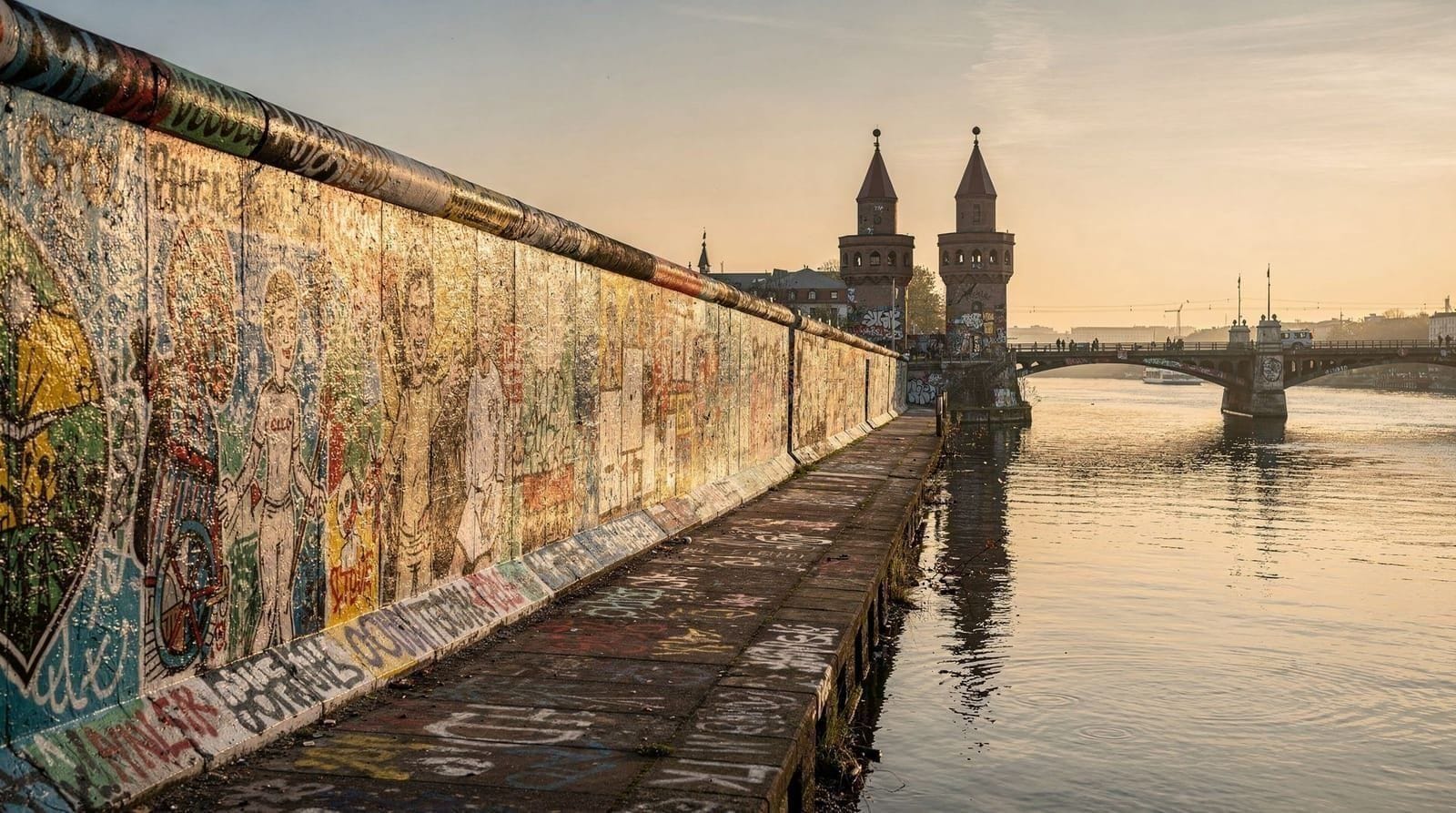
The East Side Gallery in Friedrichshain is the longest surviving Wall section at 1.3 kilometres. It runs along Mühlenstrasse beside the Spree River between Warschauer Strasse and Ostbahnhof.
In 1990, 118 artists from 21 countries painted murals on the eastern face (what had been the blank face toward East Berlin — the side citizens were not allowed to approach). The paintings range from overtly political to abstract and surreal. The most famous is Dmitri Vrubel’s “Fraternal Kiss” — Brezhnev and Honecker embracing — at the western end near Warschauer Str.
The gallery has been repeatedly repainted over the decades. The original 1990 versions are largely gone; most of what you see now is the 2009 repainting done for the 20th anniversary. Some artists repainted their own works; others were repainted by different people. There are ongoing disputes about authenticity and legal rights.
Practical notes for 2026:
- Open always, 24 hours, free
- Best light: morning before 10:00 or late afternoon (murals face east)
- Most crowded: midsummer midday, when light and crowds both peak poorly
- Length: about 30–45 minutes to walk at a reasonable pace
The gallery has been partly threatened by real estate development multiple times — sections have been temporarily displaced and reinstated. The full 1.3 km is currently intact.
East Side Gallery art tour — 75 minutes with an art historian covering the most important murals with their political and artistic contextBernauer Strasse — the most important surviving site
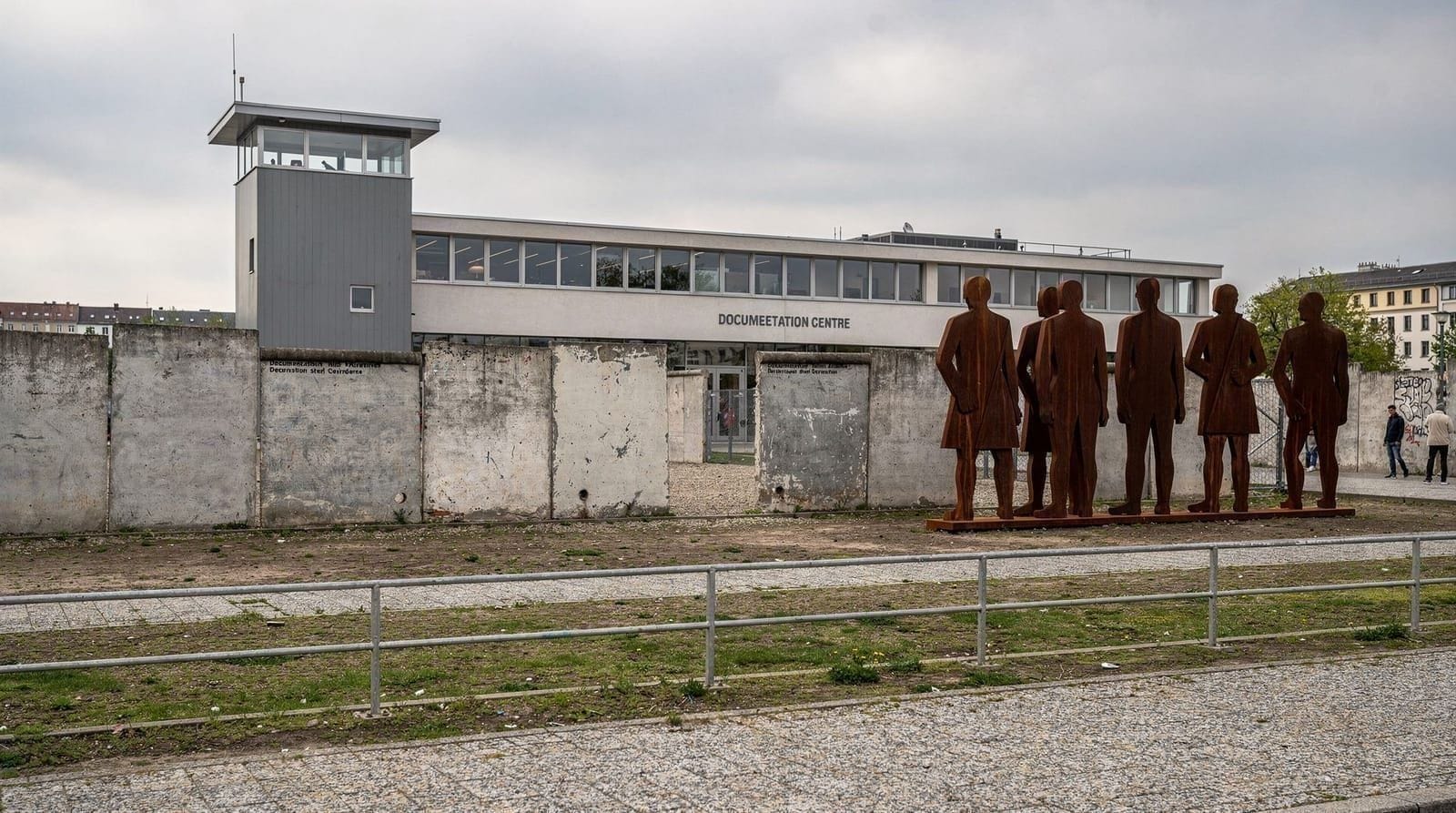
The Wall Memorial on Bernauer Strasse is the most historically significant surviving site, and the one that most comprehensively communicates what the Wall actually was.
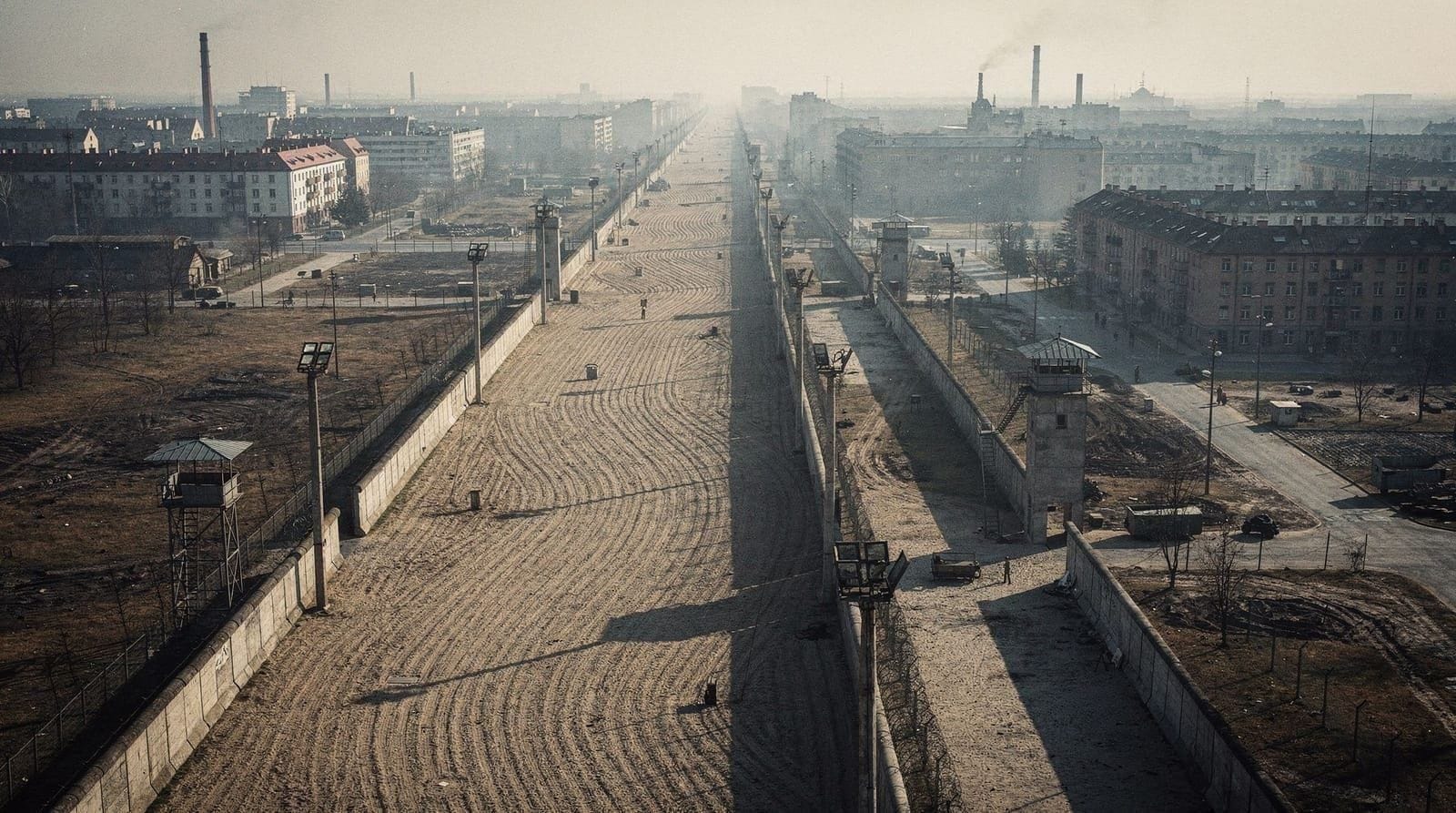
Unlike the East Side Gallery, which is a single face of the Wall serving as an art installation, Bernauer Strasse preserves an authentic section in its full original complexity: both the inner and outer walls, the death strip between them (the “no man’s land”), the original ground profile showing patrol tracks, one surviving watchtower, a reconstructed observation platform, and the foundation outlines of apartment buildings demolished to create the death strip.
This is where you understand that the Berlin Wall was not one wall but a complete barrier system. The “Wall” facing West was just the most visible element. Behind it: a death strip between 30 and 150 metres wide depending on location, with anti-vehicle trenches, tripwire systems, raked sand to show footprints, floodlighting, dog runs, guard patrol routes, and armed guards with explicit shoot-on-sight orders from 1961 to 1989.
At Bernauer Strasse specifically, you can also see the outline of the apartment buildings whose facades formed the early wall in 1961 — residents were literally sealed into their apartments on the West Berlin side, and some jumped to freedom in the early weeks before the buildings were demolished.
The documentation centre here is excellent, free, and provides substantial context. Allow at least two hours for the full site. The outdoor sections are always accessible; the documentation centre is open 10:00–18:00, closed Mondays.
Checkpoint Charlie — the most tourist-trap site
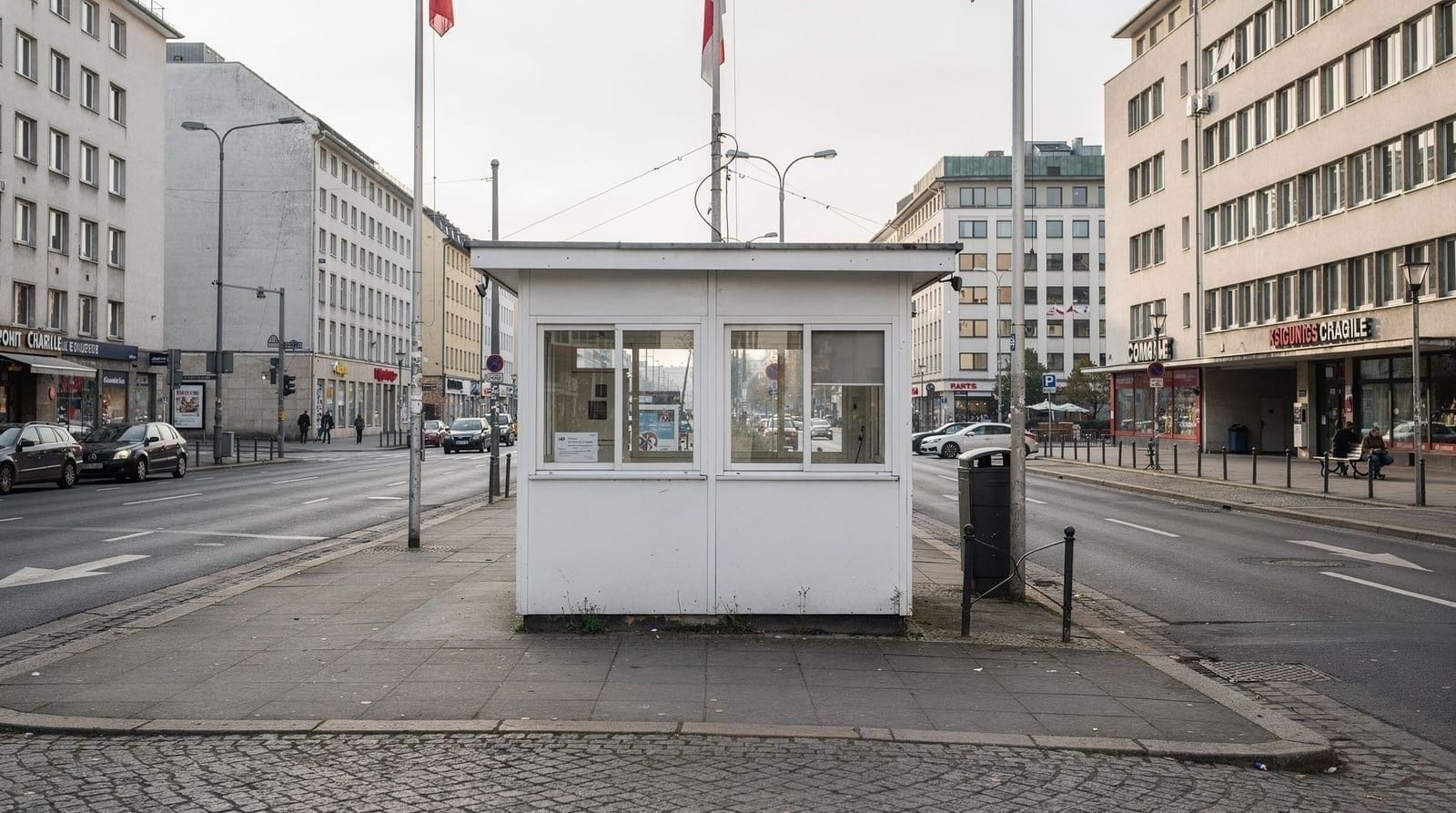
Checkpoint Charlie is the most-visited Cold War site in Berlin and also the most commercially exploited. The iconic white checkpoint booth in the middle of Friedrichstraße is a replica, installed by a private company in 2000. The original is in the Allied Museum in Zehlendorf (free entry, worth the trip for the genuine artefacts).
The area around Checkpoint Charlie is saturated: costumed “American soldiers” charging €5–10 for photographs, the privately operated Checkpoint Charlie Museum (widely regarded as overpriced and chaotic), souvenir stalls selling mass-produced Wall fragments of unverifiable origin, and tourist restaurants with inflated prices.
The historical significance is genuine — Checkpoint Charlie was the crossing point for foreigners between East and West Berlin, and it was the site of the October 1961 tank standoff when American and Soviet tanks faced each other across 100 metres for 16 hours. That story is important. The experience of visiting the site today is not proportionate to the historical significance.
The Checkpoint Charlie guide gives the full honest assessment of what’s worth seeing here, which documentation is genuinely useful, and what to skip.
Berlin Wall and East Side Gallery walking tour — covers the Wall history, the crossing point sites, and the mural gallery with a guide who provides political contextSurviving watchtowers — the overlooked physical remnants
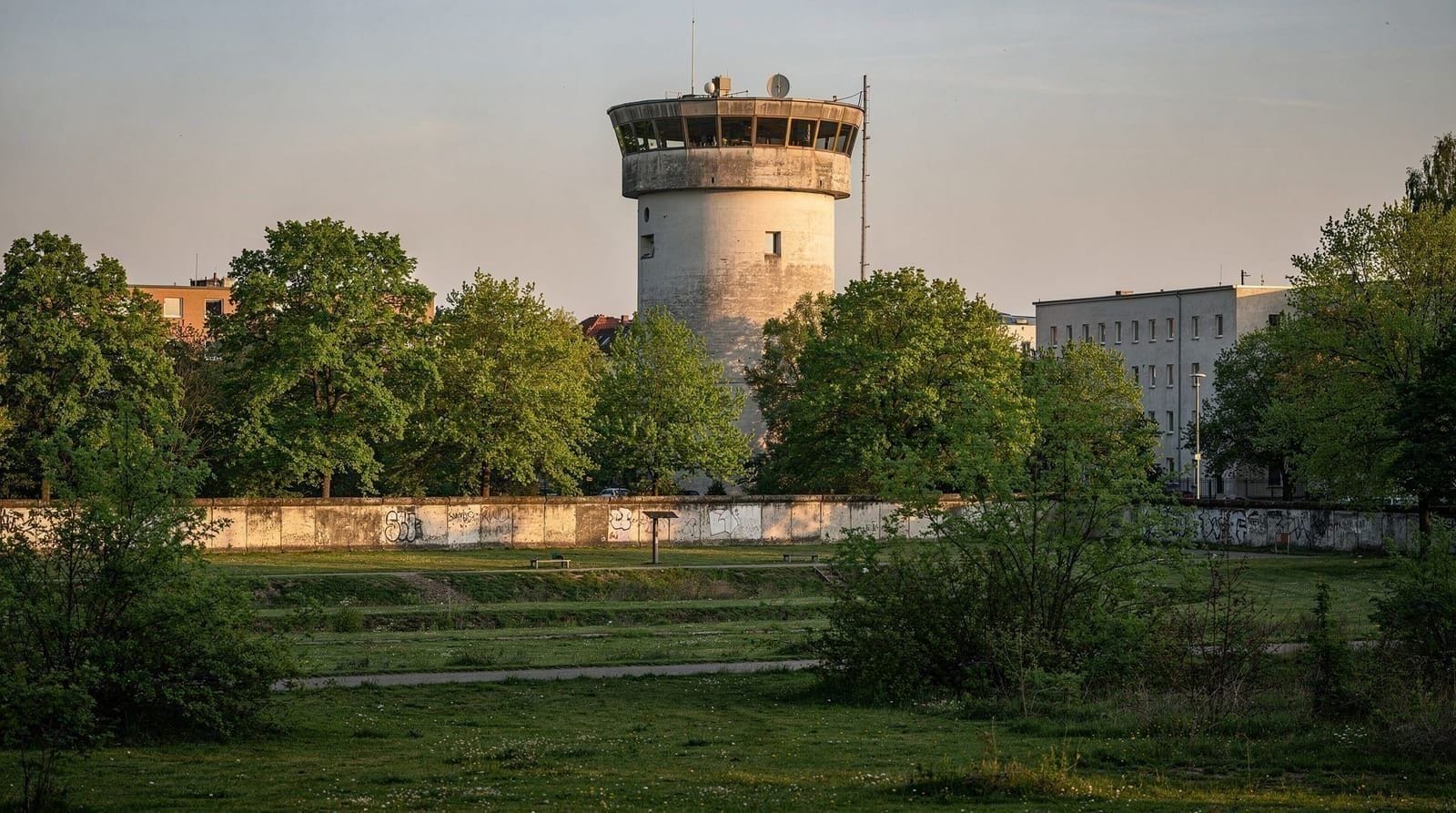
The death strip was covered by watchtowers approximately every 300 metres along the 155-kilometre route. Of the roughly 300 original towers, eight survive in various states. Three are accessible to visitors:
Erna-Berger-Strasse (near Potsdamer Platz): the most centrally located surviving tower, standing in open ground near the former Potsdamer Platz death strip. Externally viewable and unmissable once you know it’s there. The minimalist functional brutality of GDR border architecture is striking against the modern commercial development that now surrounds it.
Schlesischer Busch (near Treptower Park): visible from the Spree waterfront near Gröbenufer. Less known, worth seeing for the contrast with the East Side Gallery a few kilometres north — same historical period, very different current context.
Kieler Strasse (Wedding, northern Berlin): less central, more effort to reach, but the most interesting because it’s embedded in a residential neighbourhood — a reminder that the Wall cut through ordinary urban fabric, not just tourist districts.
The watchtower survival guide covers all eight surviving towers with transport directions and current access status.
Topography of Terror — context, not Wall fragments
The Topography of Terror on Niederkirchnerstrasse is a documentation centre rather than a Wall memorial specifically, but it sits along one of the few remaining sections of Berlin’s inner city Wall (approximately 200 metres of original Wall along its eastern boundary).
The site documents the perpetrators of Nazi terror from 1933–1945 — the Gestapo, SS, and Reich Security Main Office were all headquartered here. The outdoor excavation shows the foundations of the basement cells where suspects were interrogated. Free entry. The connection to the Berlin Wall is historical continuity: the same geographic area, the same spirit of state-enforced exclusion and violence, different decades.
Allow 90 minutes. The outdoor sections are year-round; the indoor exhibition has standard museum hours.
What the Wall numbers actually mean
Original length: 155 km
Surviving physical sections: roughly 3–4 km total across all sites
Minimum confirmed deaths at the Wall: 140 (Zentrum für Zeithistorische Forschung’s lowest estimate; some historians argue significantly higher)
Successful escapes: approximately 5,000 over 28 years — through tunnels, disguises, vehicle modifications, over the Wall, and by swimming the Spree
Duration: August 13, 1961 to November 9, 1989 — 28 years, 2 months, 28 days
The geography matters: Potsdamer Platz was a desolate no-man’s land for 28 years. The area now occupied by the Sony Centre, the Filmhaus, and the Lego Store was Wall and death strip until 1990. Standing there with this knowledge gives you something that the tourist infrastructure doesn’t provide.
The sites compared
| Site | What it shows | Time needed | Crowds |
|---|---|---|---|
| East Side Gallery | Murals on the eastern face, art rather than barrier | 30–45 min | High, especially midsummer midday |
| Bernauer Strasse | Full barrier system, death strip, watchtower | 2 hours+ | Moderate |
| Checkpoint Charlie | Crossing-point history, heavily commercialised | 20–30 min | Very high |
| Surviving watchtowers | Physical GDR border architecture, no crowds | 30–60 min each | Low |
| Topography of Terror | Nazi-era history plus ~200m of original Wall | 90 min | Moderate |
Combining Wall sites with nearby neighbourhoods
Bernauer Strasse sits in Mitte near Prenzlauer Berg, so a Wall memorial visit pairs naturally with a Prenzlauer Berg coffee stop or a walk through Mauerpark, which has its own preserved and legally paintable Wall section. The East Side Gallery in Friedrichshain is a short walk or one U-Bahn stop from RAW Gelände, so combining Wall history with the Friedrichshain neighbourhood makes for an efficient half-day rather than a single-purpose trip. Checkpoint Charlie sits at the edge of Kreuzberg and Mitte, close enough to the Topography of Terror to combine both in under three hours.
Building a Wall itinerary for your visit
The Berlin Wall complete guide includes prioritised itineraries for different time allowances:
- 2 hours: Topography of Terror plus the Wall section at Niederkirchnerstrasse
- Half-day: Bernauer Strasse memorial with documentation centre
- Full day: East Side Gallery in the morning, Bernauer Strasse in the afternoon, Checkpoint Charlie as a brief stop between
The Cold War Berlin history guide provides the political context for understanding what you’re seeing — the Wall didn’t emerge from nothing, and understanding the 1945–1961 period that preceded it makes the memorial sites significantly more meaningful.
FAQ
Which Berlin Wall site should I visit if I only have two hours? Bernauer Strasse. It’s the only surviving site that shows the complete barrier system — both walls, the death strip, and a watchtower — rather than a single painted face or a replica checkpoint.
Is it worth paying to enter the Checkpoint Charlie Museum? Generally no. It’s privately run, expensive, and widely regarded as poorly organised relative to the free alternatives nearby, including the Topography of Terror and the Allied Museum in Zehlendorf, which holds the original checkpoint booth.