Cycling in Berlin — bike routes, hire, Nextbike, rules and safety tips
Berlin: Guided Bike Tour to Explore the Highlights
Is Berlin good for cycling?
Yes. Berlin is flat, has around 1,800 km of cycling infrastructure, and is one of the most cycle-friendly large cities in Europe. Day hire from independent shops costs €12-20 for a city bike. Nextbike station-based hire is available across the city. The main hazard is tram rails — always cross at right angles.
Quick answer: Berlin is flat, has excellent cycling infrastructure, and is one of the most bicycle-friendly cities in Europe for casual riders. Independent bike hire runs €12-20/day; Nextbike is cheaper for short trips. The main hazard is tram rail tracks — always cross them at 90 degrees. Helmets are not legally required but are strongly recommended.
| Cost | around €12–20/day independent hire; from around €9–12/day Nextbike cap |
| Best beginner route | Tiergarten circuit, around 6 km, traffic-free |
| Main hazard | tram rails — always cross at close to 90 degrees |
| Bikes on transport | allowed on U-Bahn/S-Bahn with a Fahrradkarte (around €2.40), not on buses/trams |
| Best time | weekday mornings for quieter routes, avoid rush hour tram crossings |
With approximately 1,800 km of designated cycling infrastructure, a flat topography, and a culture that treats cycling as normal transportation rather than recreation, Berlin rewards visitors who cycle. The city has the highest cycling modal share of any German city at around 18%, and extensive investment in new Radschnellwege (cycle superhighways) is ongoing.
Bike hire in Berlin — options and prices
Independent hire shops (recommended for day use)
Independent bike rental shops offer the best value for full-day or multi-day hire. Most cluster near major S-Bahn stations and tourist areas.
Typical prices (2026):
- City bike (3-speed): €12-15/day, €45-60/week
- 7-speed hybrid: €15-20/day, €60-80/week
- E-bike: €20-35/day, €90-140/week
Deposits of €50-100 (cash or card hold) are standard. A padlock is usually included; a quality U-lock may cost extra. For a fuller shop-by-shop comparison, see the Berlin bike rental guide.
Areas with good hire shop concentration:
- Near Alexanderplatz (Mitte/Friedrichshain boundary)
- Near Zoologischer Garten (Charlottenburg)
- Kreuzberg (Bergmannstrasse area)
- Prenzlauer Berg (Kastanienallee)
Nextbike — station-based city scheme
Nextbike operates a docked bike-sharing scheme with stations across Berlin. Registration via the Nextbike app is required before use.
Pricing (2026, approximate):
- €1 to unlock
- First 30 minutes: free with certain subscription tiers, or included in rate
- Additional time: €1 per 30 minutes
- Day flat rate: Available in-app for unlimited use within 24 hours (~€9-12)
Nextbike stations are at most major U-Bahn and S-Bahn stations, many parks, and residential areas. Bikes must be returned to a station — not dockless.
Is Nextbike worth it? For spontaneous short trips (e.g., Alexanderplatz to Museum Island — 1.5 km), yes. For a full day of sightseeing, the pay-as-you-use rate makes it more expensive than a flat-rate hire shop unless you get the daily cap.
Dockless e-bikes and e-scooters
Bolt, Tier, Voi, and Lime operate dockless e-scooters and some e-bikes in central Berlin. Unlock typically €0.25-0.50 + €0.19-0.29/min. These are best for short gaps (one or two U-Bahn stops’ distance). Not economical for a full day.
Parking rules for dockless vehicles: must be within designated zone (shown in app), must not block footpaths, must be placed upright. BVG and the city have introduced stricter enforcement of improper parking since 2024.
Key cycling routes in Berlin
Tiergarten circuit
The simplest and most pleasant route for visitors. The Tiergarten park has car-free gravel and tarmac paths forming a circuit of approximately 6 km around the park interior. Accessible from the Victory Column (Siegessäule) at the centre or from any of the park entrances.
This route passes: Victory Column, the English Garden, the Bismarck Memorial, rose gardens, and the multiple small lakes. Entirely flat, family-friendly, no traffic. Allow 30-45 minutes at a relaxed cycling pace. See the Tiergarten guide for what to see on foot on the same visit.
Unter den Linden and Museumsinsel
From the Brandenburg Gate, the Unter den Linden boulevard has dedicated cycling lanes on each side. This 1.5 km ride leads directly to the Humboldt Forum and Museumsinsel. From here, cycling north along the Spree riverbank is traffic-light on dedicated paths.
Berlin Wall cycle route (Berliner Mauerweg)
The complete Berliner Mauerweg traces the path of the former Berlin Wall for approximately 160 km around the entire city — a full circuit taking 2-3 days. For shorter sections:
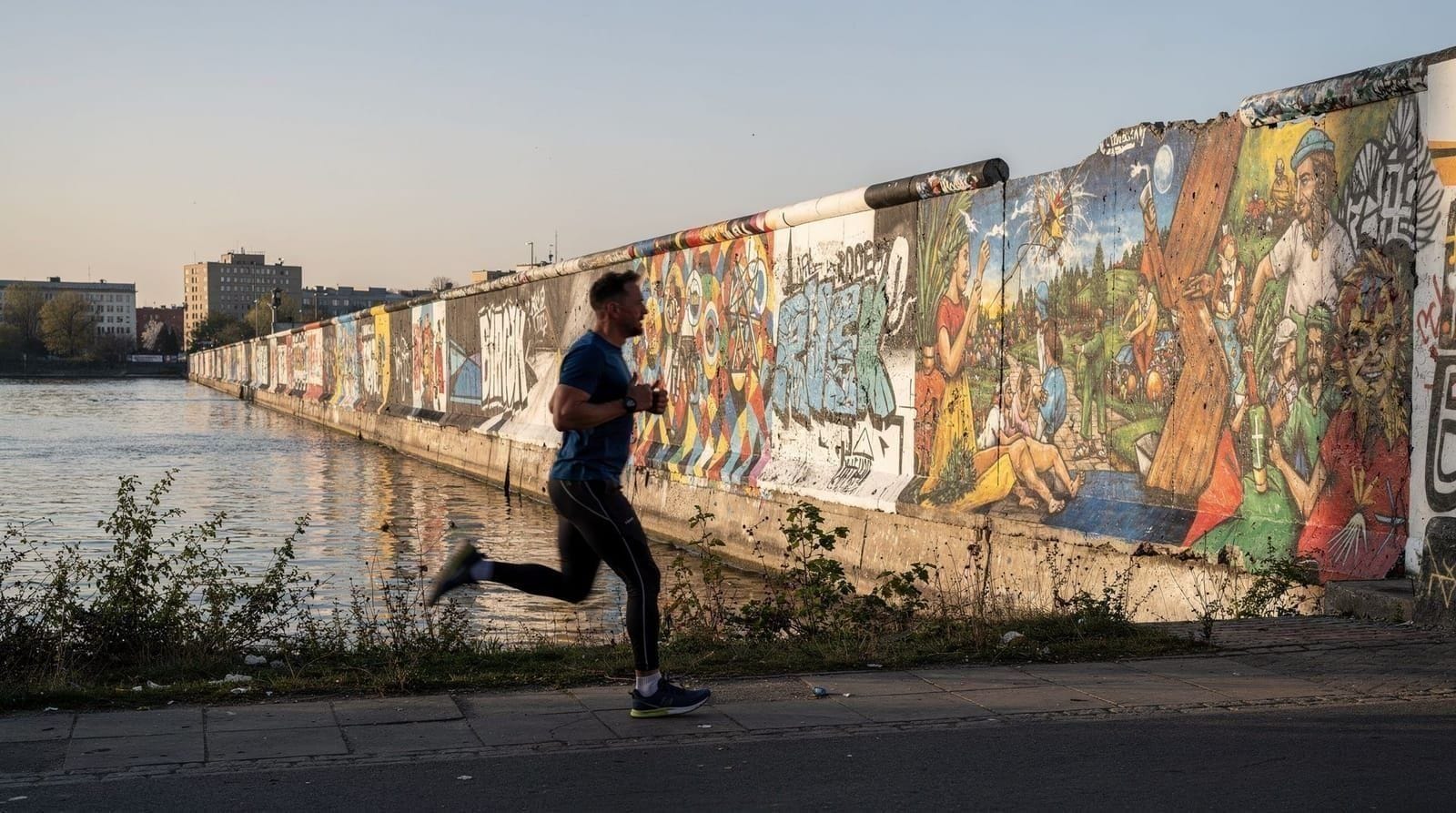
- East Side Gallery to Mauerpark: 4 km north along the eastern Wall line, passing Ostbahnhof, Nordbahnhof (with its Ghost Station memorial), and Mauerpark. The urban cycling version of the Wall trail.
- Bernauer Strasse section: The most historically dense section, 1.4 km with the Wall Memorial, the Chapel of Reconciliation, and documentation centre. See the Berlin Wall Memorial guide.
The full Mauerweg map is available free from the Berlin Tourism Office and most bike hire shops. The ADFC Berlin Radkarte (€7) shows the route in detail.
Spree riverfront
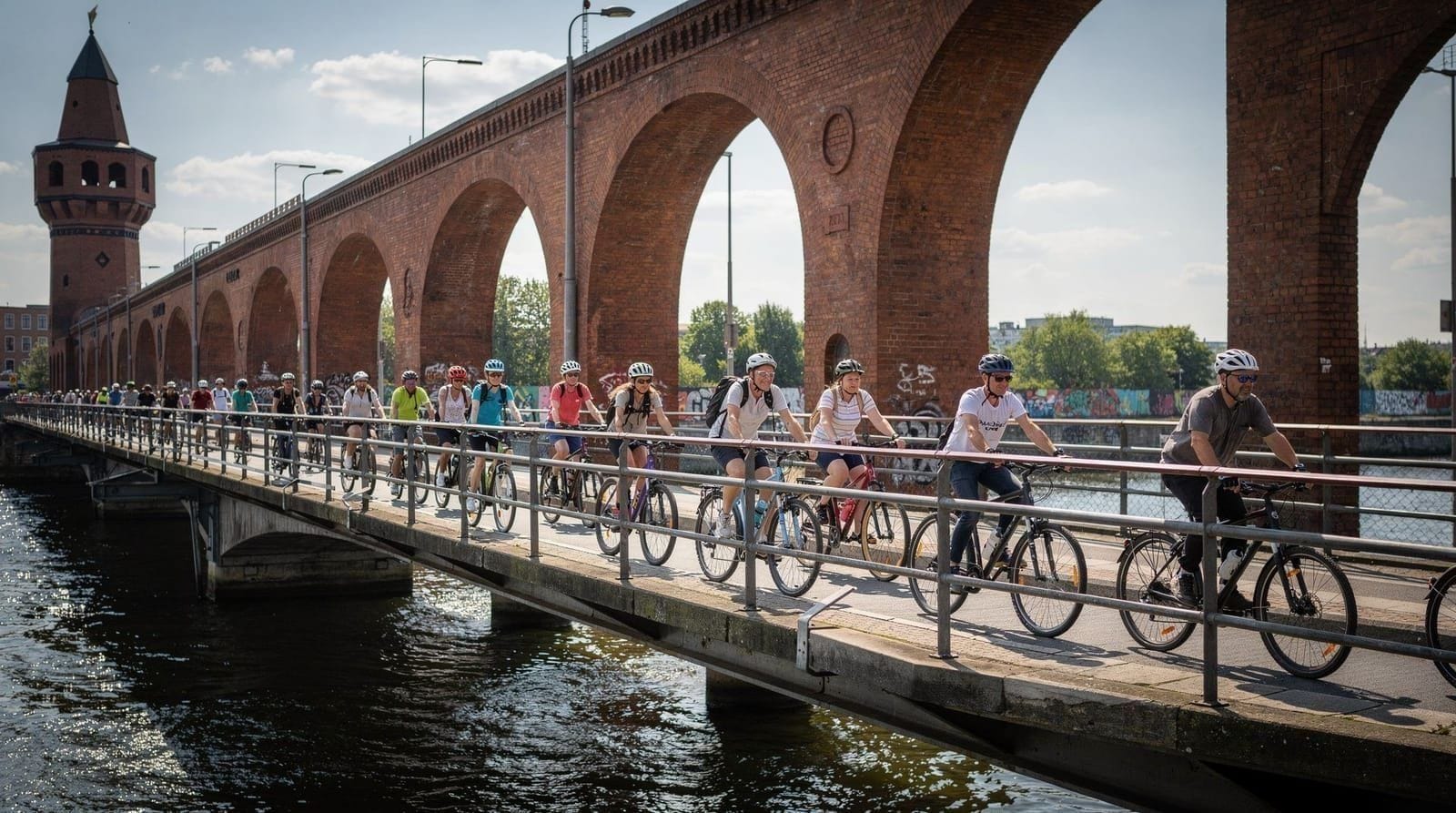
A loosely connected series of paths along the Spree river runs from Museum Island eastward to Treptower Park (7 km). The path is not continuous — some stretches use designated roads or shared paths — but the route is straightforward. Passes: Humboldt Forum, East Side Gallery, Oberbaumbrücke (the twin-towered bridge), and Treptower Park (with its Soviet War Memorial). Treptower Park guide.
Karl-Marx-Allee to Friedrichshain
The wide, Soviet-era boulevard Karl-Marx-Allee runs from Frankfurter Tor to Strausberger Platz (1.4 km), flanked by Stalinist neoclassical architecture built in the 1950s. Cycle lanes on the wide carriageway. From Strausberger Platz westward to Alexanderplatz is a further 1 km. This is a good approach to Friedrichshain from the east for visitors based in Mitte.
Cycling to Potsdam
Experienced cyclists can ride from Berlin to Potsdam (approximately 35-40 km from central Mitte) via the dedicated R1 long-distance cycling route. The route passes through Zehlendorf and Wannsee. A hybrid or e-bike is recommended. Allow 2.5-3.5 hours one way. The Wannsee lake section is pleasant. Bike hire shops at the Potsdam end are available if cycling one way and returning by RE1 or S7 train.
Bike tours — guided options
If navigating independently feels uncertain, guided cycling tours cover the major Berlin sights with a local guide. These are popular and well-reviewed — multiple operators run English-language tours covering Wall sites, government district, Cold War landmarks, and neighbourhood rides.
Join a guided cycling tour covering Berlin’s highlights in 3-4 hours Guided bike tour through Kreuzberg and Friedrichshain — street art, Wall, and neighbourhood cultureSafety — the honest picture
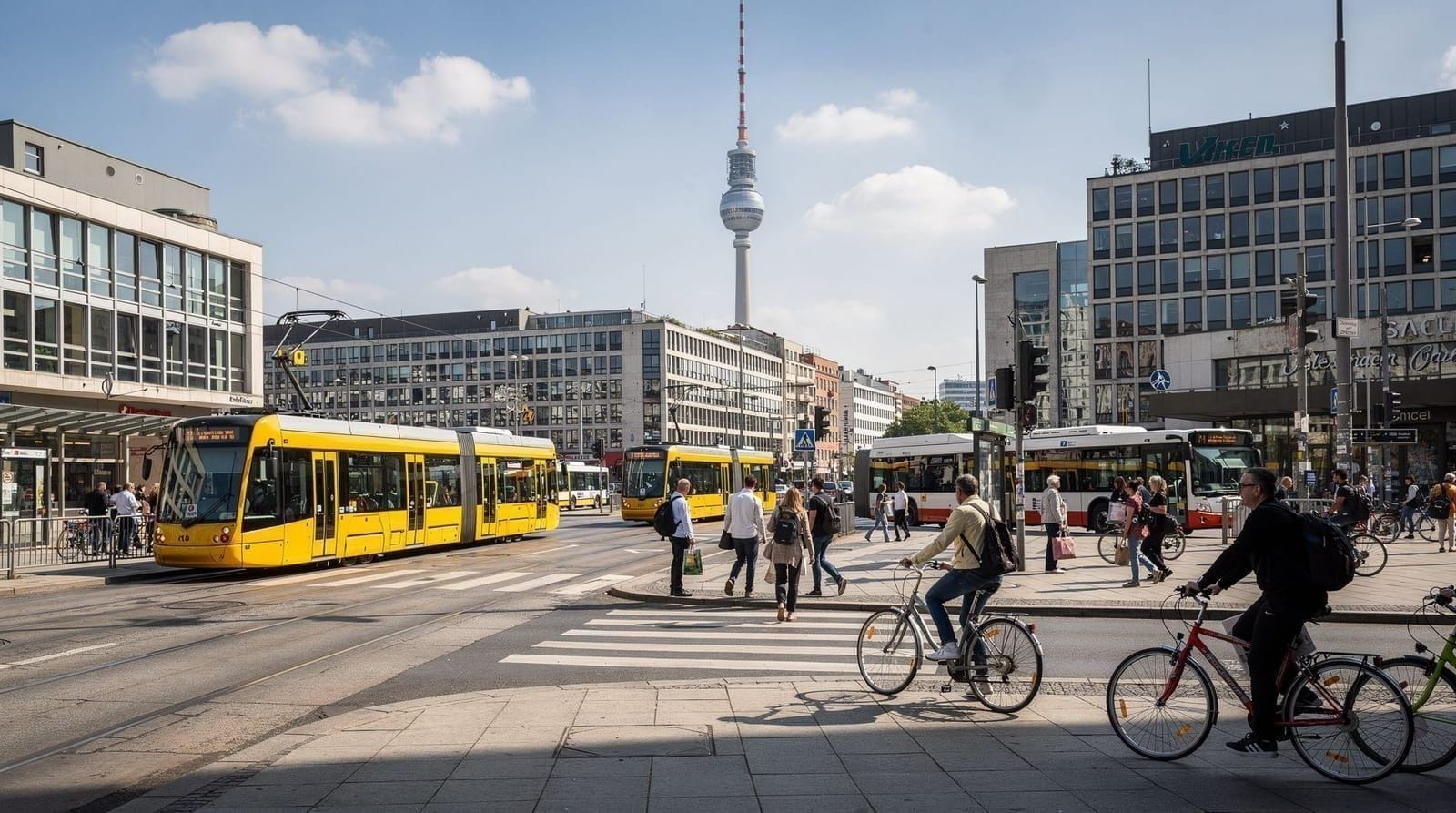
Tram tracks: The most significant hazard specific to Berlin. The M1, M4, M10, and other tram lines cross many cycling routes in Mitte and Prenzlauer Berg. The grooves in the rails can trap a 28mm or narrower tyre at any angle except close to perpendicular. This happens fast and causes immediate falls. The solution is simple: cross tracks at as close to 90 degrees as possible, always. This is the rule experienced Berlin cyclists follow automatically.
Dooring: Parking lanes alongside cycle lanes create a dooring risk (car door opening into the cyclist’s path). Leave 1-1.5m clearance from parked cars. The risk is highest on streets in Mitte and Charlottenburg with parking lanes bordering cycle lanes.
Traffic at roundabouts: Berlin has many complex intersections. Cyclists have the right of way on marked cycle lanes, but right-turning vehicles do not always check. At major junctions, use pedestrian crossing phases if unsure.
Theft: Bike theft is significant in Berlin. A hired bike should always be locked with its provided lock (usually a solid cable or integrated wheel lock) plus any additional D-lock to a fixed object. If leaving a bike for more than an hour in central areas, use two locks. Basic cable locks from hire shops are the minimum, not the ideal.
Lights after dark: Legally required — both a white front light and a red rear light. Hire shops should provide these; check before departing. Cycling without lights is a fineable offence.
Cycling rules in Berlin — what actually matters
German cycling law applied in Berlin:
- Radwege (red-painted or signed cycle lanes) must be used where they exist on a road. You cannot choose to ride in the main carriageway when a Radweg is present.
- Footpaths are not for cycling unless marked “Fahrrad frei” (cyclists permitted) or shared path (Gemeinsamer Geh- und Radweg).
- Red lights apply to cyclists at designated cyclist signals (Fahrradampeln, smaller lights at cycling level). Jumping red lights is a fineable offence. Enforcement is inconsistent but present.
- One-way streets: Cycling against the one-way direction is only permitted where explicitly signed (“Fahrradfahrer frei” in both directions).
- Handlebars: Both hands required for steering. No riding while holding a phone. Phone use while cycling carries the same penalties as for motorists.
- Passengers: A dedicated bike seat (rear mounted or front cargo) is required to carry a child. Adults cannot legally ride on the back of a standard bike without a proper seat.
E-scooter rules in Berlin
Bolt, Tier, and Voi e-scooters have specific rules distinct from bicycles:
- Maximum speed: 20 km/h
- Must use cycle lane or road — not footpath
- One rider only
- Must park within designated zones (no blocking pavements)
- Minimum age: 14 (with parent consent) in Germany, most operators set 18 in practice
- No use after drinking — same blood alcohol rules as cycling
Combining cycling with public transport
Berlin’s U-Bahn and S-Bahn allow bicycles with a Fahrradkarte (€2.40, separate ticket). Bikes go in designated bike carriages (marked with a bicycle icon on the door). This enables multi-modal journeys — for example, cycling to a suburban S-Bahn station and taking the train into the centre during peak hours when a full cycling commute is impractical.
Trams and buses do not accept bicycles.
See the getting around Berlin guide for a full comparison of transport modes.
Frequently asked questions about Cycling in Berlin
Where can I hire a bike in Berlin?
Independent hire shops near major S-Bahn stations are the best value for full-day use (€12-20/day city bike, €20-35/day e-bike). Nextbike operates a station-based dock scheme citywide; short trips cost €1/30 minutes after registration. Bolt and Tier offer dockless e-bikes and e-scooters. For guided cycling tours around Berlin's sights, multiple operators run daily departures.Do I need a helmet to cycle in Berlin?
Helmets are not legally required for cyclists in Germany. Most locals do not wear one for urban commuting. However, wearing a helmet is strongly recommended, especially at tram crossings, on busy roads, and at higher speeds on e-bikes. Helmet hire is not standard at most bike hire shops — bring your own if it matters to you.What are the rules for cycling in Berlin?
Cyclists must use designated Radwege (cycle lanes) or roads — footpaths are prohibited unless specifically marked as shared. Red lights apply to cyclists. Carrying a passenger on a standard bike without a proper seat is illegal. Cycling under the influence carries the same legal consequences as for motorists above 1.6 per mille blood alcohol (licence consequences). Lights front and rear are legally required after dark.How dangerous are tram tracks for cyclists?
Tram rails are the primary cycling hazard in Berlin. If crossed at an acute angle (rather than perpendicular), a narrow tyre can drop into the rail groove and cause an immediate fall. This is a common cause of cycling injuries in Berlin. Always cross tram tracks at close to 90 degrees, even if it means briefly riding out of your lane. The M10, M1, and M4 tram lines in Prenzlauer Berg and Mitte have multiple crossing points that cyclists use daily.Can I take my bike on the U-Bahn or S-Bahn?
Yes. Bicycles are allowed on U-Bahn (in designated bike carriages, marked with a bicycle icon on the door) and S-Bahn. A bicycle requires a separate Fahrradkarte ticket (€2.40). Bikes are not permitted on buses or trams. During peak hours (6-9am and 4-7pm Monday to Friday), bicycles are generally discouraged on busy lines but not strictly prohibited.Is Nextbike worth it in Berlin?
Nextbike is convenient for spontaneous short trips if you're already registered. The free-minutes model (first 30 min free with certain plans) makes it economical for short hops between tourist areas. For a full day of cycling, an independent hire shop with a flat daily rate is significantly cheaper than pay-per-minute Nextbike use.What are the best cycling routes in Berlin?
The Tiergarten circuit (6 km, car-free within the park) is the easiest for visitors. The Berlin Wall cycle path follows the former Wall for 160 km around the city. Mitte to Friedrichshain via Karl-Marx-Allee is flat and direct (5 km). The Spree riverfront route from Museum Island east to Treptower Park is mostly traffic-free. The ADFC Berlin Radkarte cycling map (available at bike shops, €7) shows all dedicated routes.Where can I park a bike in Berlin?
Bike parking in Berlin is generally unregulated on the street. Lock to any fixed public object (pole, railing) using at least a U-lock or high-quality chain lock. Bike theft is common — a cheap cable lock is not adequate for any hire or personal bike left unattended. Nextbike and dockless bikes must be docked at designated stations (Nextbike) or within app-designated parking zones (Bolt/Tier).Is it better to hire a bike independently or join a guided cycling tour?
Independent hire is cheaper and more flexible for anyone comfortable navigating with a map or app, especially for a leisurely Tiergarten loop. A guided tour is worth the extra cost for a first visit or a route with real historical content, such as Wall sites or Karl-Marx-Allee, where narration adds context you'd otherwise miss riding solo.What should a beginner cyclist in Berlin know before setting off?
Stick to marked Radwege, always cross tram tracks close to 90 degrees, and start with a flat, low-traffic route like the Tiergarten circuit before attempting street cycling in Mitte. Confidence with German traffic norms — especially right-turning vehicles at junctions — takes a ride or two to build.