Berlin street art self-guided tour — real murals, real neighborhoods, no Instagram bait
Berlin’s street art scene is old enough now that it has its own mythology, its own tourism infrastructure, and its own Instagram filter problem. You can book a “street art experience” on almost any booking platform, walk a curated route between commissioned murals, photograph every wall in order, and come away having seen street art without having experienced anything like the culture that produced it.
This guide is for people who want the real version — which means knowing which neighborhoods still have genuinely guerrilla work, which walls are commissioned pieces that have become landmarks (and why that distinction matters less than you think), and which areas have been so heavily curated that the “street art” is now essentially outdoor corporate decoration.
For context and history, the Berlin street art guide covers the scene’s roots and the key names who shaped it. This post is the walking version — neighborhoods, specific walls, and how to read what you’re looking at. If you want to combine street art with gallery-going, the Berlin contemporary art scene guide and Berlin Gallery Weekend are the natural companions.
| Where | Kreuzberg, Friedrichshain, Mitte (Scheunenviertel), Prenzlauer Berg |
| Cost | Free — self-guided walks cost nothing |
| Time needed | Half a day per neighbourhood, done properly |
| Best light | Early morning, especially East Side Gallery (faces east) |
| Getting there | U-Bahn/S-Bahn to Kottbusser Tor, Warschauer Strasse, or Hackescher Markt |
Kreuzberg — where the scene still lives
Kreuzberg is where Berlin’s street art culture has its deepest roots, and it’s still the best neighborhood for a self-guided walk even though parts of it have been heavily curated over the past decade.
Start at Kottbusser Tor and walk south on Oranienstrasse. The walls here shift constantly — paste-ups, wheat pastes, and tags change faster than any guide can track. What you’re looking for is density and layering. Good street art in this area tends to be stratified: you can see eight or ten works painted over each other on a single wall, the oldest ones bleeding through. That’s genuine urban accumulation, not a curated gallery.
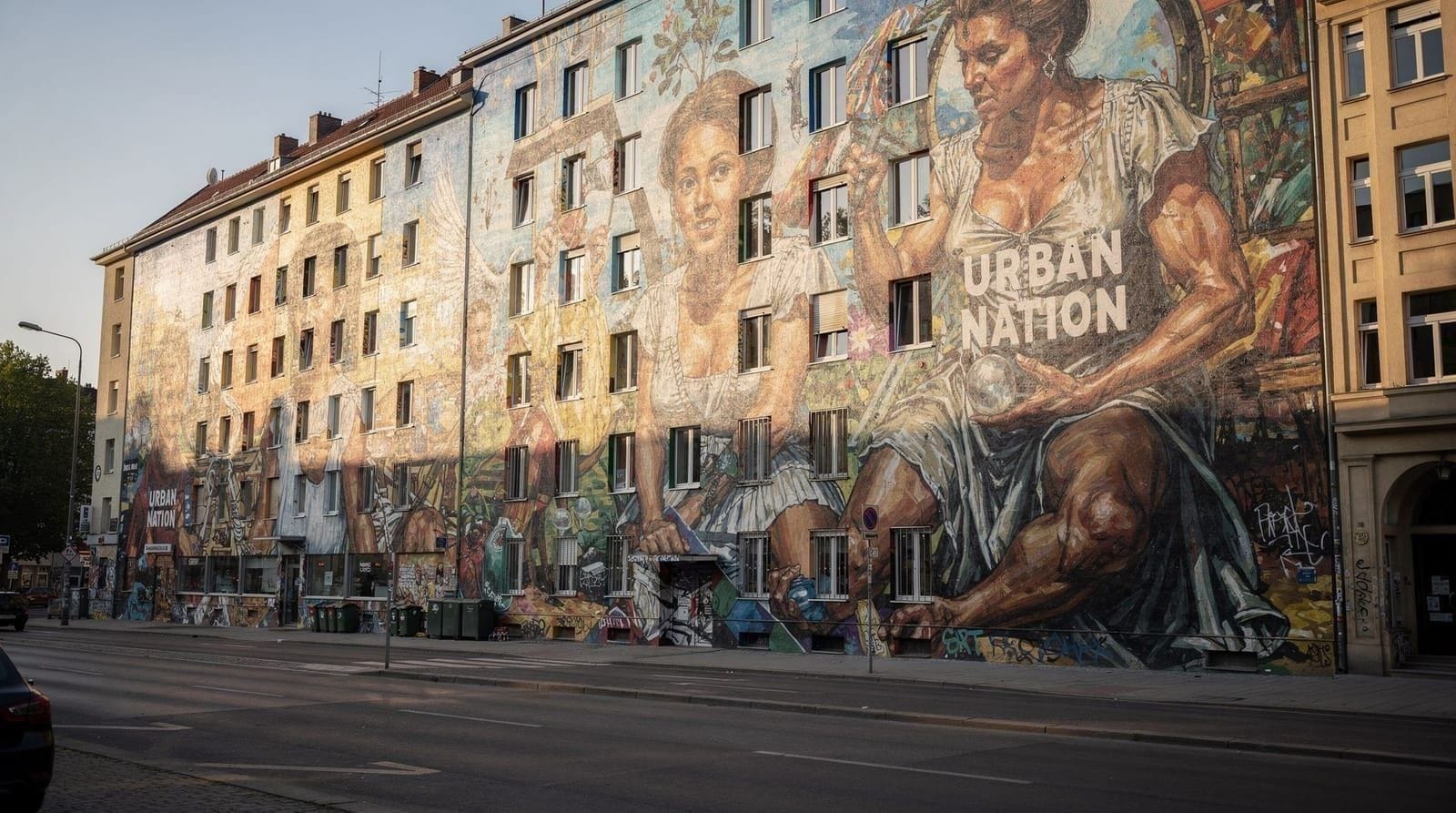
Turn east on Skalitzer Strasse and look above eye level. The larger murals on building facades tend to survive longer and these are often the most interesting works — not necessarily more artistic, but bigger in ambition. Several of these date from the early 2010s Berlin street art boom.
El Bocho — a Berlin-based artist known for the “Little Lucy” paste-up series featuring a small girl and a cat in increasingly dark scenarios — has work scattered throughout Kreuzberg and Mitte. His paste-ups are black-and-white, small enough to fit on a doorframe or mailbox, and dark enough in humour that many people walk past them without registering what they’re looking at. If you start noticing them, you’ll see them everywhere.
Alias produces paste-ups and stencils that are often photorealistic in style — figures in ambiguous situations, faces in extreme close-up, hands in action. His work appears throughout Kreuzberg and occasionally in Prenzlauer Berg and Mitte. Unlike some street artists who work large, Alias works at eye level, which makes his pieces easy to miss but striking when you find them.
The area around Lausitzer Platz and Wrangelstrasse has a high concentration of smaller-scale work — stickers, paste-ups, stencils — that represents the lower-budget end of the scene. Not all of it is good, but this is where the unofficial, unsponsored work tends to concentrate precisely because there’s no money and no fame in it.
The guerrilla vs. commissioned distinction — and why it’s more complicated than it sounds
People who care about authenticity often draw a hard line between guerrilla work (illegal, unsanctioned) and commissioned murals (paid, approved). This distinction is real but less meaningful than it’s often presented.
Many of Berlin’s most significant street artists started as illegal writers and have since moved into commissioned work — not as a betrayal but as a natural career progression. Blu, an Italian artist who painted one of the most famous (and now lost) murals in Berlin’s history on the East Side Gallery area, has done both commissioned and illegal work throughout Europe. His massive political murals in Friedrichshain — some of which survive, some of which he himself painted over in protest — are commissioned, but they carry more political and artistic weight than most illegal tags.
ROA — a Belgian artist known for large-scale animal murals, often depicting anatomically detailed creatures in states of decomposition or stress — has painted numerous walls in Berlin with varying degrees of official sanction. His monochrome animals are instantly recognizable and several remain on walls in Kreuzberg and Mitte. ROA’s work comments on urban ecology and human displacement of animals; the context of the city makes his pieces read differently than they would in a gallery.
The honest position: judge the work on its own terms. A commissioned mural by a serious artist is more interesting than an illegal scrawl with nothing to say. What you want to avoid is not commissioned work per se, but commercial work masquerading as street culture — which is a different thing.
Friedrichshain and RAW Gelände — the industrial canvas
Friedrichshain’s street art and graffiti scene is centred on a different tradition from Kreuzberg — larger, more stylistically associated with the classic graffiti writing culture (letters, pieces, wildstyles) rather than the stencil and paste-up tradition.
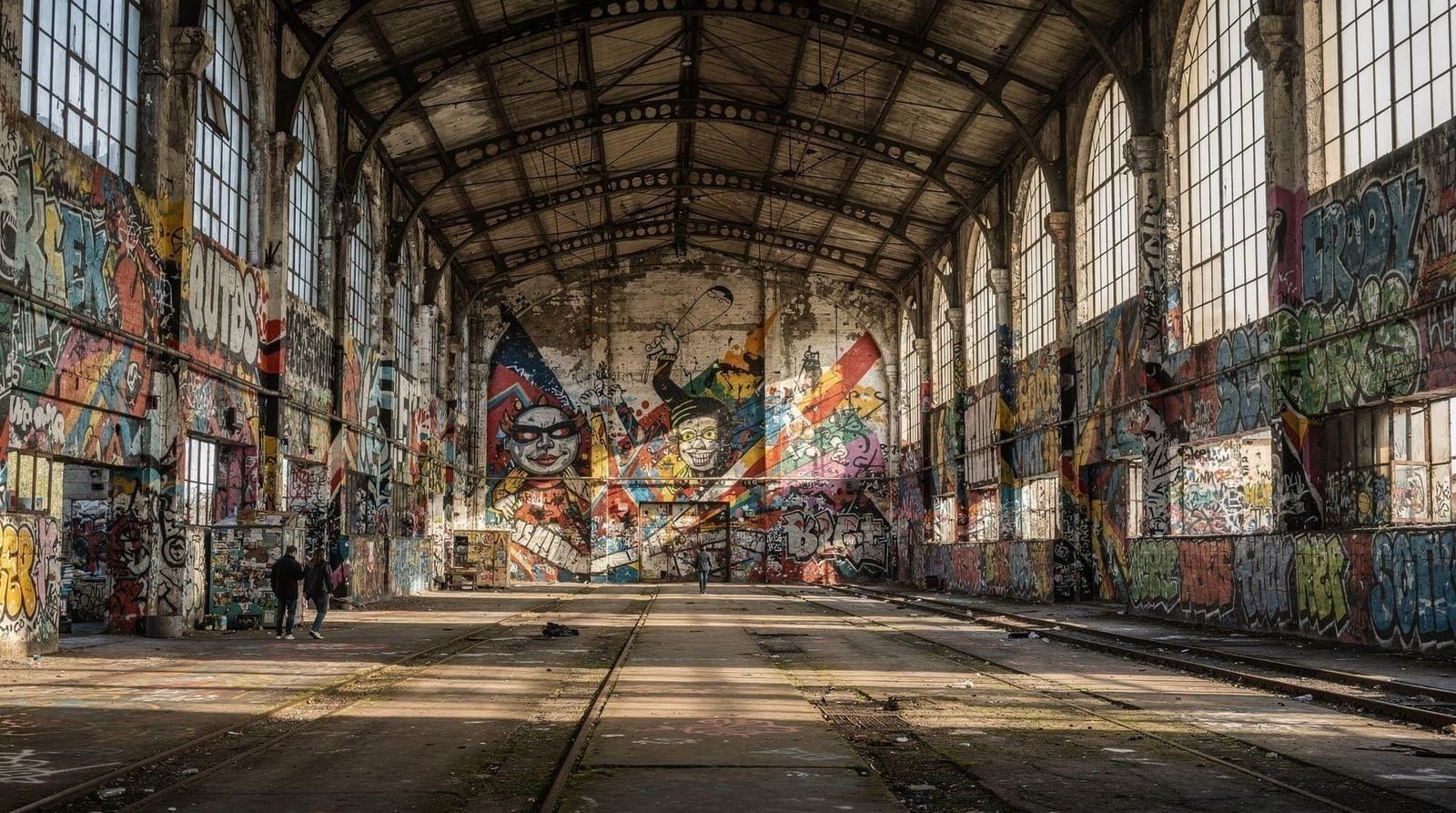
RAW Gelände is the starting point. This former railway repair yard on Revaler Strasse has been operating as an alternative cultural complex since the early 2000s, and its walls are covered in a constantly rotating display of graffiti and murals. The walls are officially designated as free painting zones, which makes this technically sanctioned work — but the quality is high enough that the distinction doesn’t diminish the experience. The complex includes bars, a skatepark, a climbing wall, and occasional markets. It’s worth an afternoon rather than just a quick walk-through.
The streets around Boxhagener Platz — Krossener Strasse, Simon-Dach-Strasse, Grünberger Strasse — have a mix of commissioned building-sized murals and smaller unofficial work on the older building stock. This area has gentrified significantly but retained more street art culture than equivalent neighborhoods in Mitte.
The East Side Gallery is the other main Friedrichshain landmark: the 1.3-kilometre preserved stretch of the Berlin Wall on Mühlenstrasse, now painted with murals by over 100 artists from around the world. This is entirely commissioned and official, and it gets enormous tourist traffic. Whether it counts as street art is a matter of definition, but the historical context — these are paintings on the actual Wall, on the eastern side — gives the work a weight that’s specific to Berlin. Dmitri Vrubel’s Brezhnev/Honecker kiss mural is the most reproduced, but the full stretch rewards a slower walk.
Note: the East Side Gallery is free and open at all times. The stretch faces the Spree, so the river light is best in morning.
Hackescher Markt and Mitte — curated but not worthless
The streets around Hackescher Markt — particularly the Heckmann-Höfe and Sophienstrasse — represent the curated end of the Berlin street art spectrum. Building owners have actively commissioned murals, the area is heavily photographed, and there’s a definite sense of street art as aesthetic product rather than cultural intervention.
This doesn’t make it bad. Some of the murals here are excellent work by serious artists. But you should approach it knowing you’re in a street art gallery, not a street.
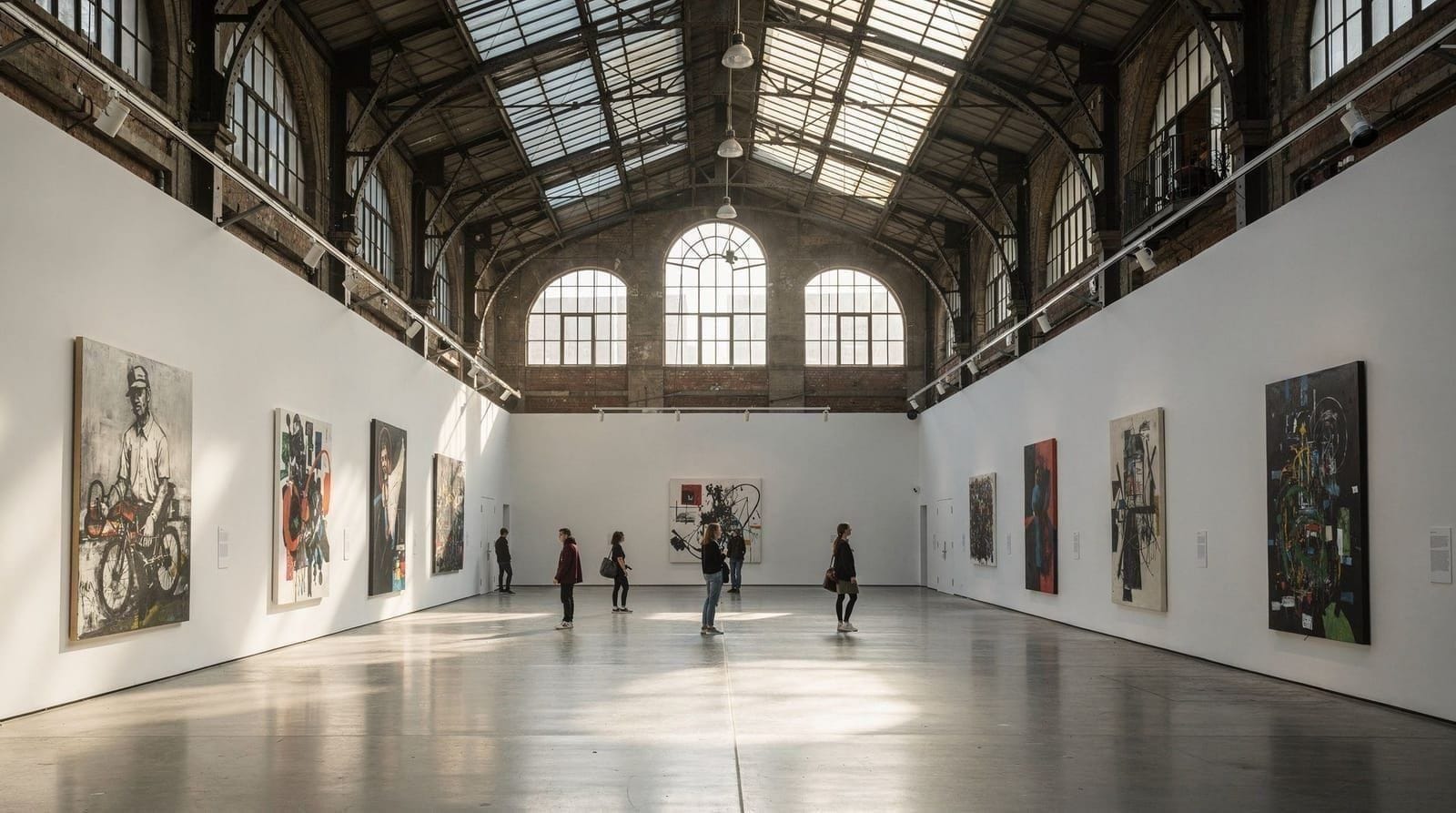
What’s more interesting in Mitte is the work that exists on peripheral walls and in the Scheunenviertel backstreets around Auguststrasse. The contemporary gallery district — which the Berlin contemporary art scene guide covers in depth — bleeds into street art culture in this area. Several galleries mount outdoor installations on their building exteriors. During Berlin Gallery Weekend in late April, the distinction between gallery art and street art collapses entirely in this neighborhood.
Prenzlauer Berg — less but better
Prenzlauer Berg has been more aggressively renovated than the other neighborhoods and has correspondingly less street art. What remains tends to be better preserved precisely because there’s less competition for wall space and more selective context.
The Mauerpark area — particularly the stretch along Bernauer Strasse and the backstreets north of the market — has a consistent population of paste-ups and smaller murals. The Sunday flea market brings additional temporary art installations and performance. The Mauerpark itself has a designated graffiti section on the remaining section of Wall where anyone can paint legally.
Walking along Schönhauser Allee toward the north reveals building-sized murals on the older housing stock that survived the renovation wave. These tend to be less documented and therefore more surprising.
How to approach a self-guided walk
A few practical observations:
Don’t use Google Maps street art walking routes. They’re out of date and lead you to works that may no longer exist or miss things that appeared last month. Street art changes faster than maps update.
Go early in the morning. The light is better for photography, you’ll be on your own rather than in a crowd of other visitors, and some works — particularly paste-ups at human scale — are easier to look at without other people standing in front of them.
Look up. A significant proportion of the larger murals are on the upper floors of buildings and are invisible if you’re walking with your head at street level.
Look in Hinterhöfe (courtyards). Many Berlin residential buildings have internal courtyards accessible through ground-floor archways. These are often not publicly accessible, but many are left open during the day. Some of the most interesting smaller-scale work is inside courtyards rather than on street-facing walls.
When a guided tour makes sense
If you want background on specific artists, techniques, and the history of specific walls and what was there before, a guided tour delivers things a self-guided walk can’t. An informed guide knows which walls have been repainted over significant historical works, which artists’ careers are worth tracking, and which neighborhoods are currently active vs. fading.
Kreuzberg street art self-guided audio tour Berlin alternative street art tour with local guideThe best use of a guided tour is once, early in a Berlin visit, to build a framework — after which the self-guided walks become much more legible.
If budget is a constraint, the Berlin free walking tours guide covers tip-based options that often include street art routes, particularly in Kreuzberg and Friedrichshain. These aren’t as specialist as a dedicated street art tour, but they orient you in the neighborhoods before you wander independently. And if you’re planning your trip budget more broadly, the Berlin budget guide covers the free outdoor experiences — street art, parks, the East Side Gallery — that cost nothing but reward knowing where to look. Getting to and between neighborhoods is easy enough on the U-Bahn and S-Bahn; the Berlin public transport guide covers everything you need for navigating between Kreuzberg, Friedrichshain, and Mitte without a car.
Neighbourhoods compared
| Neighbourhood | Character | Best for | Crowds |
|---|---|---|---|
| Kreuzberg | Guerrilla, layered, constantly changing | Authenticity, density | Moderate |
| Friedrichshain / RAW Gelände | Classic graffiti, industrial canvas | Large-scale pieces, atmosphere | Moderate to high (East Side Gallery) |
| Mitte (Hackescher Markt/Scheunenviertel) | Curated, gallery-adjacent | Polished murals, easy access | High near Hackescher Markt |
| Prenzlauer Berg | Sparse but well-preserved | Quiet walking, Mauerpark’s legal wall | Low, except Sunday market |
Getting between the neighbourhoods
None of these areas require a car or a tour bus. Kottbusser Tor (U1/U8) is the anchor for Kreuzberg, Warschauer Strasse (U1/S-Bahn) puts you at RAW Gelände and the East Side Gallery’s western end, and Hackescher Markt (S-Bahn) drops you into Mitte’s curated stretch. The Berlin public transport guide covers ticket zones — all of this is within the AB zone, so a standard day ticket covers the whole route. Walking between Kreuzberg and Friedrichshain across the Oberbaum Bridge takes about 15 minutes and is itself worth doing slowly; it’s one of the better photo spots in the city that has nothing to do with murals.
The Instagram bait problem
Berlin’s street art scene has attracted significant investment in deliberately Instagrammable murals — commissioned works designed primarily to be photographed rather than to say anything in particular. These appear most densely around Hackescher Markt and in some parts of Kreuzberg near the tourist accommodation corridor.
You can identify them: they tend to be large, colourful, often include some version of Berlin iconography (the TV Tower, the bear, the flag), and they’re invariably positioned at an angle where the viewer is clearly intended to stand for a selfie. There’s nothing wrong with photographing them. Just know what they are.
The counterpart to this is work that resists the camera — pieces that are deliberately small, deliberately text-based, deliberately located where you’d have to know they existed to find them. El Bocho’s Lucy series is an example: finding one feels like actually discovering something rather than completing a checklist. That’s the experience worth looking for.
The Berlin street art guide goes into the deeper history of how the scene developed and which artists remain most influential. For the contemporary gallery context that intersects with it, the Berlin contemporary art scene guide is the companion read.
Berlin’s street art isn’t frozen. The walls that exist today won’t all exist in six months. The best reason to go looking now rather than later is that you’ll see what’s there now — not what someone photographed three years ago and wrote a blog post about.
FAQ
Is Berlin street art legal or illegal? Both, and the line matters less than people assume. Some of the most significant walls (East Side Gallery, RAW Gelände’s designated zones, Mauerpark’s legal wall) are officially sanctioned; plenty of smaller guerrilla work in Kreuzberg is not. Judge the work on its merits rather than its legal status.
Can I do a Berlin street art walk without a guide? Yes, entirely — all the areas covered here are free, outdoors, and walkable independently using the neighbourhood breakdown above. A guide adds background and access to lesser-known walls but isn’t necessary for a satisfying afternoon.