Olympic Stadium 1936: Nazi propaganda, Jesse Owens, and the Games that shaped history
Berlin: Olympic Stadium Guided Tour
What was the historical significance of the 1936 Berlin Olympics?
The 1936 Games were the first to be broadcast on television and used as a calculated Nazi propaganda exercise. Hitler intended them to demonstrate Aryan racial superiority, but Jesse Owens — a Black American — won four gold medals, directly contradicting that ideology. The Games did not prevent war; most nations chose engagement over boycott.
What was the historical significance of the 1936 Berlin Olympics? The Games were staged as a global showcase for National Socialism — the most watched international event of the era, with 49 nations and over 3,900 athletes attending. Hitler intended them as proof of Aryan racial hierarchy and German national resurgence. Jesse Owens, an African American from Ohio, won four gold medals and directly demolished that premise. The Games simultaneously demonstrated Nazi organisational capacity, seduced international opinion, and failed utterly at their racial propaganda purpose.
| Where | Olympiastadion, Westend, west Berlin |
| Cost | Around €9–10 self-guided; guided tours cost more |
| Time needed | 2–3 hours for the full complex |
| Getting there | S5 to Olympiastadion, or U2 to Olympia-Stadion (Ost) |
| Related visit | Practical Olympiastadion guide for tickets and hours |
How Berlin won the Games — and what the Nazis inherited
Berlin was awarded the 1936 Summer Olympics in 1931, two years before the Nazi seizure of power. The International Olympic Committee awarded the Games to the Weimar Republic’s capital. When Hitler became Chancellor in January 1933, he initially viewed the Olympics with suspicion — the movement’s internationalism conflicted with Nazi ideology, and many party officials saw the participation of Black and Jewish athletes as an affront.
Propaganda minister Joseph Goebbels and IOC liaison Carl Diem eventually persuaded Hitler that the Games offered an unparalleled platform. The regime spent an estimated 100 million Reichsmarks on the event — roughly equivalent to €450 million today — transforming the existing 1913 stadium into the Olympiastadion, constructing the surrounding sports complex, and building the Olympic Village at Döberitz, 14 km west of the city.
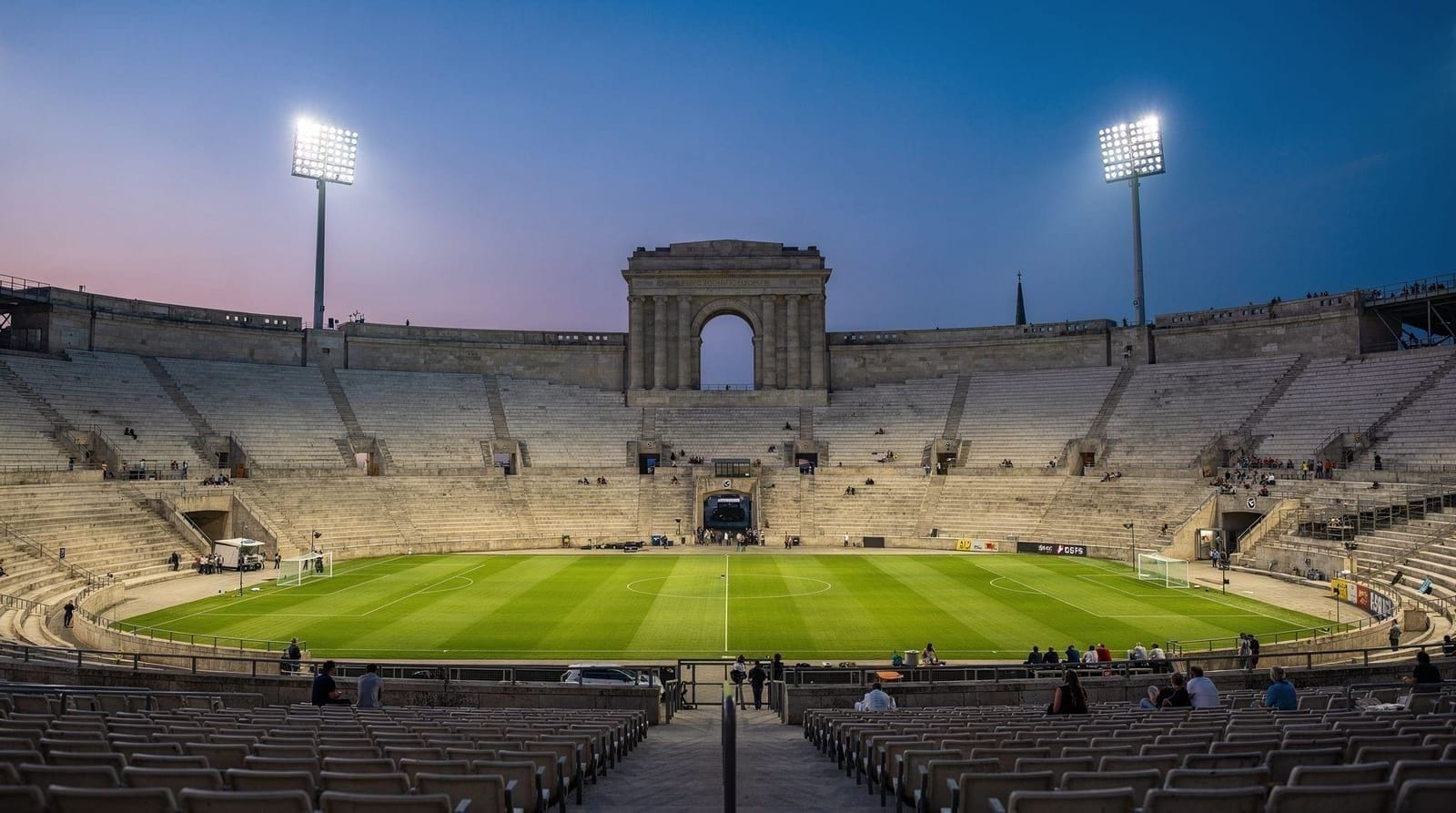
The complex was designed by architect Werner March in a monumental neoclassical style favoured by Albert Speer and approved by Hitler personally. The stadium’s capacity was expanded to 110,000. A 77-metre bell tower overlooked the main venue. The entire complex was intended as a permanent demonstration of National Socialist architecture — a built statement about racial destiny and German permanence.
The propaganda machinery
Goebbels coordinated the most sophisticated international media operation the world had seen to that point. Foreign visitors encountered a Berlin from which the most visible anti-Semitic signage had been temporarily removed. Julius Streicher’s virulently anti-Semitic newspaper Der Stürmer was withdrawn from public display in the capital. Gay bars that had been closed after 1933 were not reopened, but the general atmosphere of street-level intimidation was muted.
International journalists — many already sympathetic, some deliberately courted — reported on an orderly, welcoming, modern Germany. The Times of London and The New York Times ran broadly positive coverage of the organisation and atmosphere. American visitors included prominent politicians, industrialists, and public figures who returned with favourable impressions.
The BBC broadcast the opening ceremony live on radio to Britain. The Games were also the first to feature live television broadcast — to public viewing rooms in Berlin and Potsdam, with 162 hours of programming transmitted. Approximately 150,000 people watched events via this system, the world’s first live sports television.
Leni Riefenstahl received official backing to film the Games. She deployed 45 cameras, 16 cameramen, and over a year in editing to produce Olympia, released in two parts in 1938. The film’s technical innovation — underwater cameras in the diving pool, slow-motion sequences, aerial shots — established cinematographic techniques still used today. The film also aestheticised the athletes’ bodies in ways consistent with the regime’s racial aesthetic ideology. Its legacy is genuinely double: formal masterpiece and propaganda instrument.
Jesse Owens — the four gold medals
James Cleveland Owens, known as Jesse, arrived in Berlin as a 22-year-old from Ohio State University. He had set three world records and tied a fourth in a single afternoon at the Big Ten championships the previous year. His performance in Berlin exceeded even that.
On August 3, Owens won the 100 metres in 10.3 seconds, equalling the world record. On August 4, the long jump. His qualifying performance had been problematic — he fouled twice and had one jump remaining when German competitor Luz Long recommended he jump from a point well short of the take-off board to ensure qualification. Owens qualified, then in the final leapt 8.06 metres for the gold. Long finished with silver. The two men walked around the track arm in arm, visible to the crowd and cameras.
The 200 metres gold came on August 5, in a world-record 20.7 seconds around a bend. The 4x100 metre relay gold came on August 9. Owens’ total — four golds in a single Games — was a record that stood until Carl Lewis matched it at Los Angeles in 1984.
The stadium crowd, some reports indicate, cheered Owens warmly. The Nazi press struggled to contextualise his victories. One solution was to suggest that Black athletes were racially closer to animals and therefore unfair competition — a view that disgusted Owens and was not universally adopted even within the regime’s propaganda apparatus.
After the Games, Owens returned to the United States to a ticker-tape parade in New York. He was not received at the White House. President Roosevelt did not send a telegram. Owens later recalled that it was the American president, not the German dictator, who refused to acknowledge his achievement. The nuance has rarely survived the simplicity of the “Hitler snub” narrative.
The boycott movement that failed
From the moment Germany was awarded the Games, debate ran in democratic countries about participation. Germany’s treatment of Jewish citizens — legal discrimination from 1933, escalating boycotts and violence — made the appropriateness of athletic engagement a live political question.
In the United States, the Amateur Athletic Union held a vote in 1934 on whether to participate. The vote to accept Germany’s invitation was 58.25 to 55.75 — narrowly carried. Avery Brundage, head of the American Olympic Committee, toured Germany and accepted Nazi assurances that Jewish athletes would not be excluded from the German team. The assurance was largely false: Gretel Bergmann, Germany’s best female high jumper and a Jew, was trained, invited to the trials, and then dropped from the team two weeks before the Games on spurious grounds.
France sent a team. The United Kingdom sent a team. Spain — where civil war had broken out — withdrew. The Soviet Union, excluded from the Games on political grounds, did not attend. No major nation boycotted.
The Jewish American community was divided. Some argued participation legitimised the regime. Others argued that Jewish athletes deserved the right to compete. The argument was ultimately moot: America’s participation was decided by a handful of committee votes and diplomatic calculations.
The most direct American complicity in Nazi preferences came not from policy but from the relay decision. Jewish sprinters Marty Glickman and Sam Stoller were dropped from the 4x100 relay team the morning of the race, replaced by Owens and Ralph Metcalfe. The official explanation was athletic — that Owens and Metcalfe were faster. Glickman later wrote that the decision was made to avoid the spectacle of Jewish athletes winning gold medals on German soil. Brundage denied the allegation. The decision has never been definitively explained.
After the Games — what the propaganda achieved
The 1936 Olympics served the Nazi regime well in the short term. International opinion was softened. Germany appeared modern, organised, and tolerant. The aggressive remilitarisation of the Rhineland in March 1936 — which had alarmed European governments — had partly faded from public consciousness by August.
No country that attended the 1936 Games was led by its Olympic participation to a more accommodating position toward Germany in the years that followed. The Games did not prevent the annexation of Austria in 1938, the destruction of Czechoslovakia, or the outbreak of war in 1939. Whether boycott would have changed anything is a counterfactual that historians continue to debate.
What the Games did produce, documented in Riefenstahl’s film and in thousands of photographs, was an image of Germany as a confident, impressive nation — an image used for years afterward in neutral and sympathetic foreign media.
The Olympiastadion after 1945
British forces captured the stadium complex in May 1945. Unlike many Nazi structures, it was preserved — the British used it as a garrison facility (British headquarters of the British Army of the Rhine were located at the adjacent Maifeld until 2004). The relative architectural restraint of Werner March’s design, compared to Speer’s more overtly grandiose projects, made preservation easier to justify.
The stadium hosted the 1936 athletics records for decades — its track surface remained in competition use into the 1970s. Hertha BSC, Berlin’s major football club, has used it as a home ground since 1963. For the 2006 FIFA World Cup final — Germany vs. Italy — the stadium was renovated at a cost of €242 million, adding a partial roof and reducing capacity to 74,475.
The stadium’s Nazi-era sculptural programme remains largely intact. Werner March’s stone eagle reliefs, the carved figures by Josef Thorak, and the inscriptions in the architectural stone are still present. The structure is a heritage monument — alterations to its fabric require approval. Walking its grounds today means walking through a venue whose design still carries the explicit visual grammar of the Third Reich.
This preservation decision is itself historically significant. Unlike the Reich Chancellery or most of Speer’s other Berlin commissions — deliberately demolished by the Soviets and later the GDR — the Olympiastadion survived because it had a continuous practical use: first as a British garrison, then as a working football and athletics venue. Germany’s approach to the building since reunification has been neither to erase its origins nor to sanitise them, but to keep it in active civic use while retaining public information about its history — a deliberate contrast to how the country has handled more overtly criminal Nazi sites.
Guided tour of the Olympiastadion — history of the 1936 Games, architecture, and stadium todayA guided tour adds historical context to what would otherwise be a largely architectural experience. Self-guided visits (around €9) allow access to the main stadium bowl, the marathon gate, and the bell tower. Guided options include the locker rooms and VIP areas not accessible independently.
Third Reich and WWII walking tour — Berlin’s key sites from 1933–1945Visiting the Olympiastadion today
The stadium is in the Westend district, accessible via S-Bahn S5 to Olympiastadion station (direct from central Berlin in about 20 minutes). U-Bahn U2 to Olympia-Stadion (Ost) is an alternative.
Opening hours vary by season and match/event schedules. On days when Hertha BSC plays or events are scheduled, the stadium is closed to tourists. Check the official Olympiastadion website before visiting. Typical hours are 9:00–19:00 in summer.
The nearby Maifeld — the parade ground used for Nazi mass ceremonies — and the Waldbühne open-air amphitheatre (a 1936 construction that became Berlin’s major outdoor concert venue after the war) are worth including in a visit. Allow 2–3 hours for the full complex.
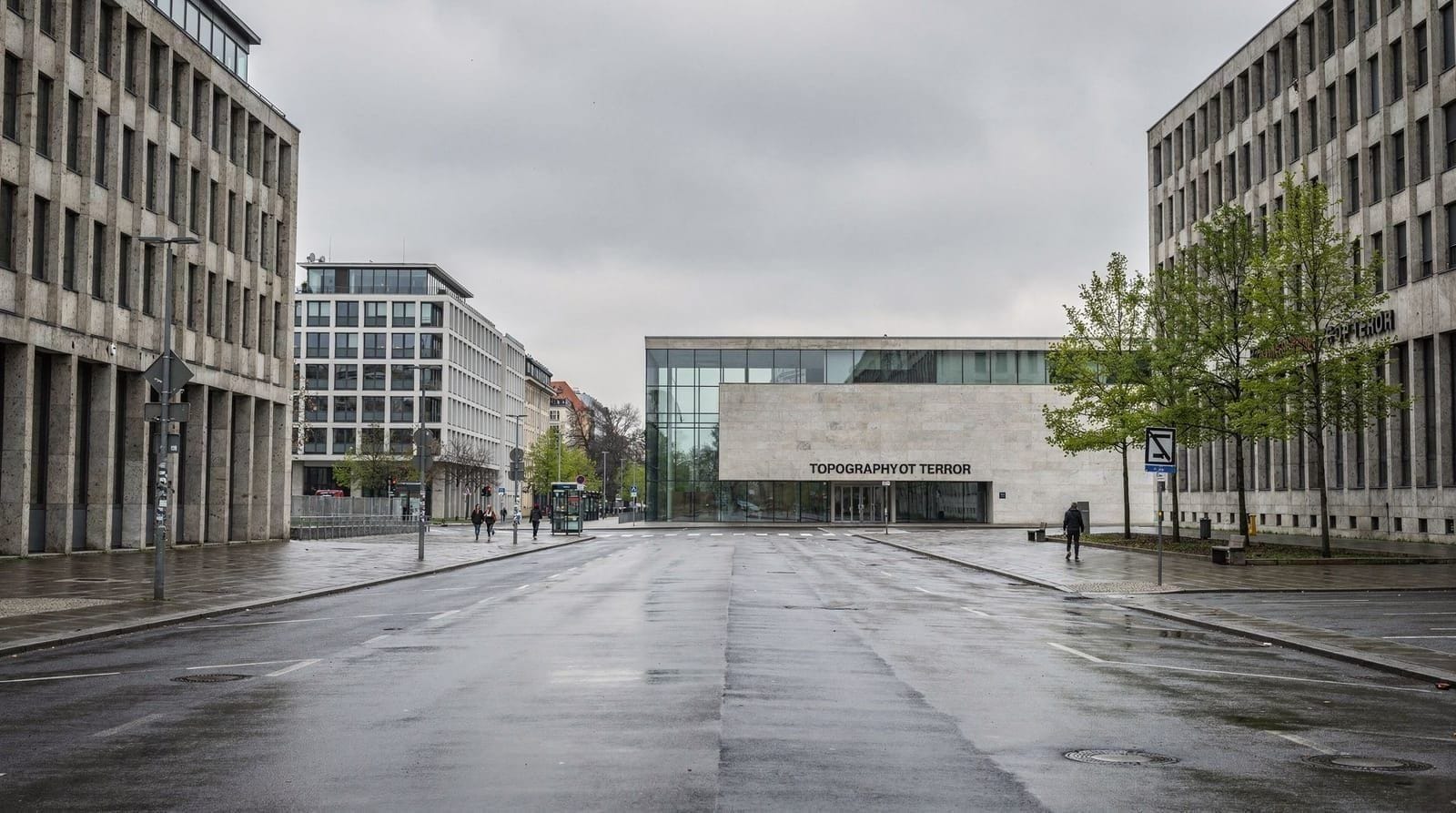
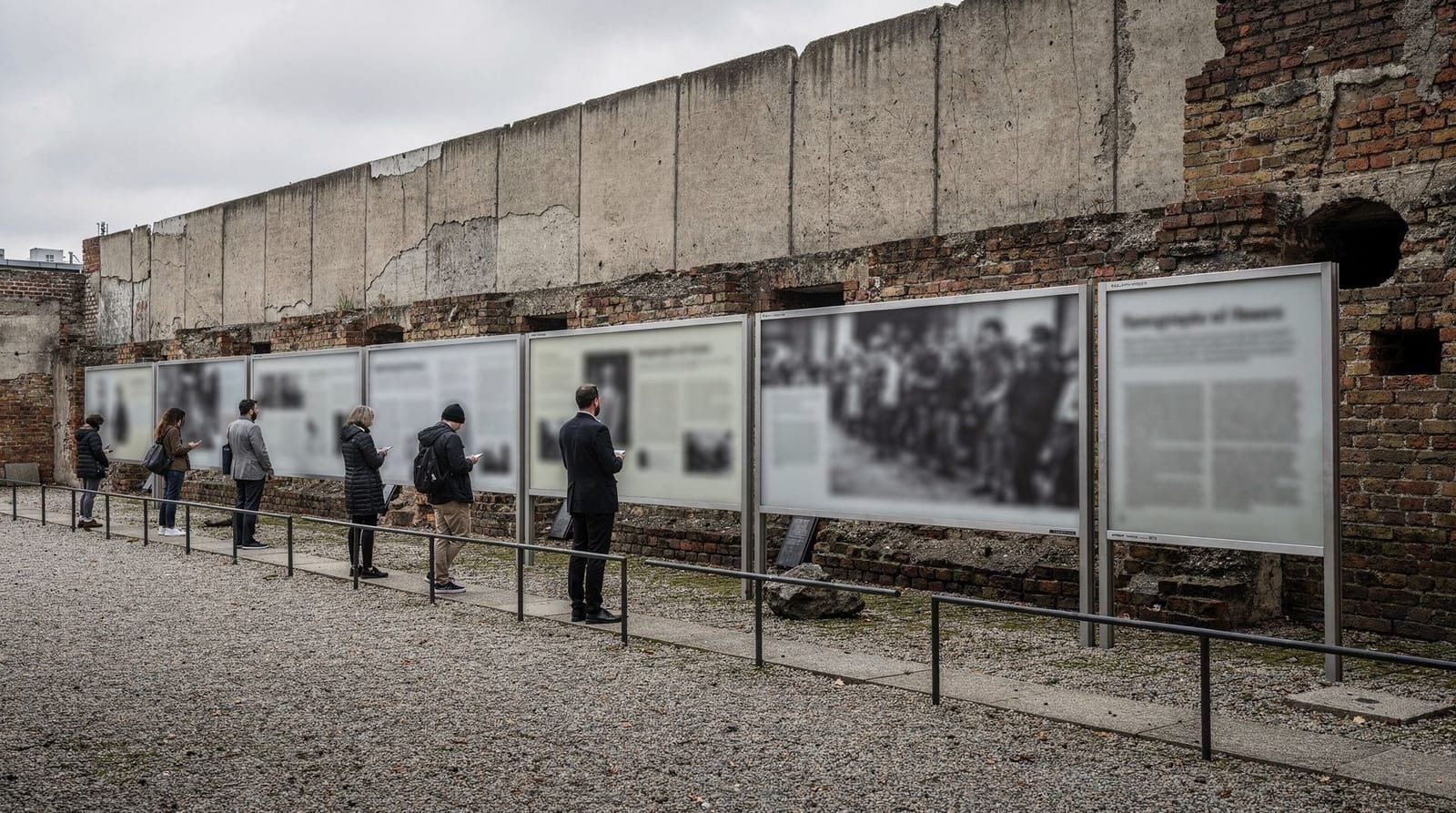
For a broader context of Third Reich sites across Berlin, the Topography of Terror guide and third-Reich sites overview provide systematic coverage. The third-Reich history trail itinerary links the Olympiastadion with Wannsee, Sachsenhausen, and the central memorial sites in a two-to-three day itinerary. For the specific planning decisions behind the Holocaust that followed only a few years later, the Wannsee Conference memorial guide is a sobering, essential companion visit. For practical tickets, hours, and tour logistics rather than history, see the dedicated Olympiastadion visitor guide.
Reading the 1936 Games against what followed
It is difficult to look at the 1936 Olympics without the knowledge of what came after. The same stadium that hosted Jesse Owens’s triumph, three years later, sat within a country beginning the invasion of Poland; within a decade, the regime that staged the Games had orchestrated the Holocaust. Historians remain divided on how much the Games actually delayed international recognition of the danger Nazi Germany posed, but the consensus is that the propaganda victory, while real in the short term, changed nothing about the regime’s underlying trajectory. Visiting the Olympiastadion today, most visitors find that this tension — between the genuine athletic achievement of 1936 and the historical catastrophe that followed — is precisely what makes the site worth understanding rather than simply photographing.
Frequently asked questions about Olympic Stadium 1936
Did Hitler snub Jesse Owens at the 1936 Olympics?
The story is more complicated than legend suggests. Hitler did not publicly congratulate any non-German or non-Finnish athlete after the first day, following IOC protocol requiring him to congratulate all or none. Owens himself later stated that it was President Franklin D. Roosevelt who snubbed him — Roosevelt sent no telegram and never invited Owens to the White House, while Hitler had at least acknowledged him in passing at the stadium. The "snub" narrative grew in the decades after the Games.How many gold medals did Jesse Owens win at the 1936 Olympics?
Jesse Owens won four gold medals — in the 100 metres, 200 metres, long jump, and 4x100 metre relay. His performance in the long jump included a famous moment where German competitor Luz Long advised him on his qualifying approach; the two became friends, corresponding until Long's death in World War II in 1943.Was there a boycott movement against the 1936 Olympics?
Yes. A significant boycott movement developed in the United States, the United Kingdom, France, and other democracies. The American Athletic Union initially voted to boycott. Avery Brundage, president of the American Olympic Committee, toured Germany and returned with assurances that Jewish athletes would be included — assurances that proved largely false. The US eventually participated. No major nation boycotted.What happened to Jewish athletes at the 1936 Olympics?
Germany excluded virtually all Jewish athletes from its Olympic squad. The one partial exception was fencer Helene Mayer, who was of partial Jewish descent and competed under pressure as a token inclusion. The US itself dropped two Jewish sprinters — Marty Glickman and Sam Stoller — from the 4x100 relay team at the last minute, reportedly to avoid embarrassing Hitler.Who was Leni Riefenstahl and what did she film at the 1936 Olympics?
Leni Riefenstahl was a German filmmaker commissioned by the Nazi government to document the Games. The result was Olympia (1938), a two-part film widely regarded as a landmark of cinema technique — pioneering tracking shots, underwater cameras, slow motion, and aerial photography. It was also a sophisticated propaganda exercise. The film received international awards but its legacy remains contested.Can you visit the 1936 Olympic Stadium today?
Yes. The Olympiastadion in the Westend district is still in active use — it is the home of Hertha BSC football club and hosts concerts. Guided tours run daily. The stadium was preserved by the British after the war and underwent major renovation for the 2006 FIFA World Cup. Entry costs around €9 for a self-guided visit; guided tours cost more.Was the 1936 Olympics the first to carry the Olympic torch relay?
Yes. The torch relay from Olympia in Greece to Berlin was invented for the 1936 Games by Carl Diem, the German organising committee's secretary general. It was presented as a link to ancient Greek tradition but was actually a Nazi innovation. The torch relay has been part of every Summer Olympics since.Did the 1936 Olympics actually help the Nazi regime internationally?
In the short term, yes — international opinion softened and Germany was presented as modern and organised, temporarily overshadowing the alarm caused by the remilitarisation of the Rhineland earlier that year. In the longer term, no country's policy toward Germany was meaningfully changed by attending, and the Games did not delay the annexation of Austria, the destruction of Czechoslovakia, or the outbreak of war in 1939.
Top experiences
Bookable activities with verified prices and instant confirmation on GetYourGuide.