Berlin Segway tours — what to know, where to book, and honest alternatives
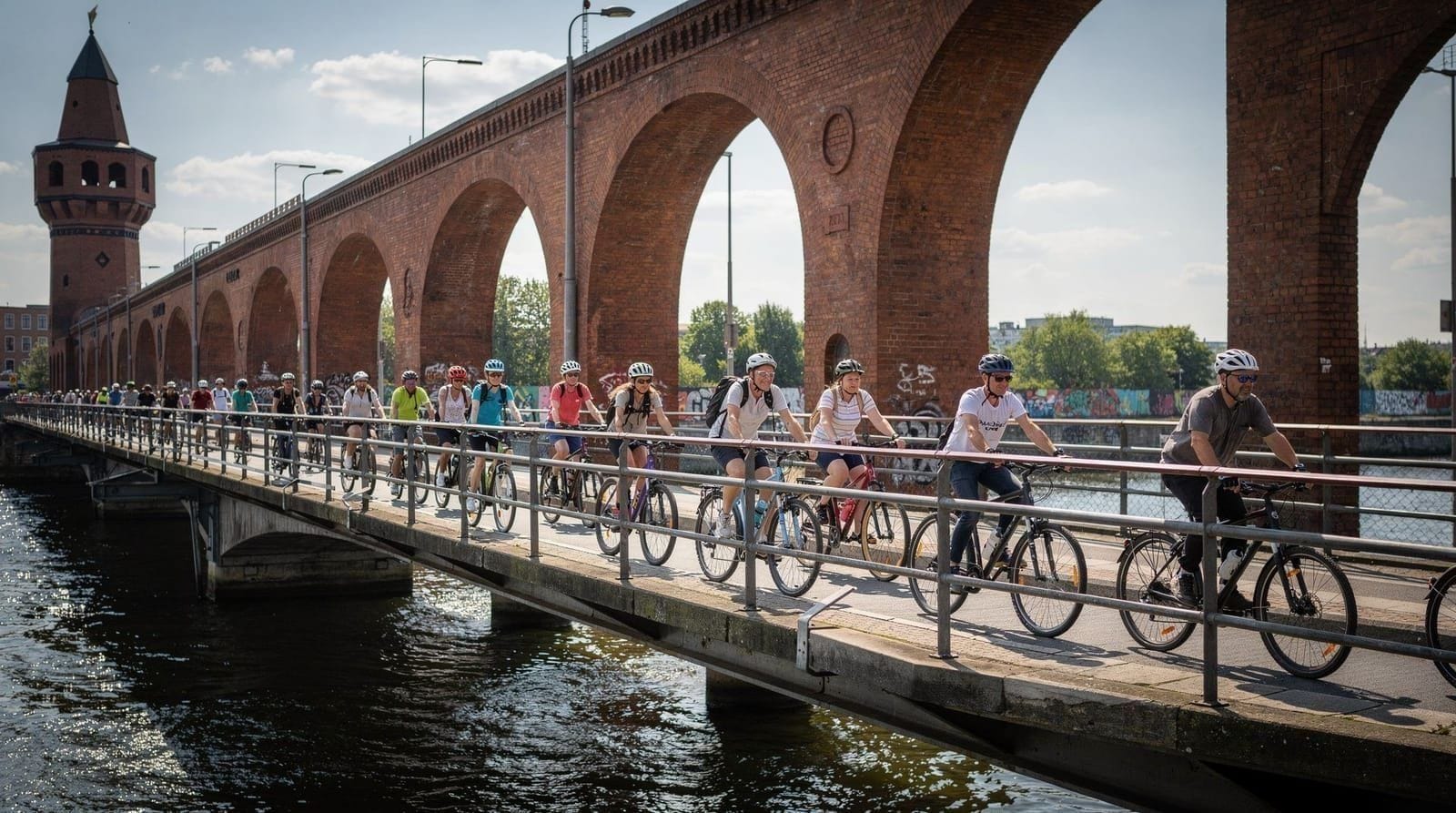
Berlin: Guided Bike Tour to Explore the Highlights
Are Segway tours available in Berlin?
Yes. Segway tours operate legally in Berlin on public roads and paths where speed does not exceed 12 km/h. Operators run 1.5–3 hour guided circuits covering central Mitte landmarks. Prices range from €35–60 per person. A training period of 10–15 minutes is mandatory before departure. Minimum age is usually 14.
Are Segway tours available in Berlin? Yes. Several operators run guided Segway circuits through central Mitte, covering Brandenburg Gate, the Holocaust Memorial, Potsdamer Platz, and Museum Island. Tours last 1.5–3 hours and cost €35–60 per person. A 10–15 minute training session is mandatory before joining public routes. Minimum age is typically 14 years. This guide covers legal status, what routes include, booking advice, and when alternatives make more sense.
| Cost | around €35-60 per person |
| Duration | 1.5-3 hours, plus 10-15 min training |
| Minimum age | usually 14 |
| Route | central Mitte, some extend to Prenzlauer Berg/Friedrichshain |
| Weight limit | around 45-110 kg |
| Cheaper alternative | guided bike tour, around €25-38 |
| Best for | mixed-ability groups who want to move together |
Legal status of Segways in Germany — brief explainer
Germany passed the Segway-Gesetz in 2009, making it one of the first European countries to create a legal framework for personal electric standing scooters. Under this law, Segways are classified as Elektrokleinstfahrzeuge (small electric vehicles) and are permitted on:
- Cycling paths (Radwege)
- Roads with speed limits of 30 km/h or below (in specific circumstances)
- Private property and designated tour routes with operator permits
They are not permitted on pedestrian zones (Fußgängerzonen) without specific authorisation, and not on public footpaths in general. Tour operators hold route-specific permits from the Berlin Senate and manage all compliance aspects. As a tourist on an organised tour, legal responsibility rests with the operator, not you.
The 2019 German e-scooter law (Elektrokleinstfahrzeuge-Verordnung) created a separate category for modern e-scooters (Tier, Lime, Bolt) — a different product. Segways and e-scooters are legally distinct.
What a Segway tour in Berlin actually covers
Standard 2-hour circuit — central Mitte
The baseline Segway tour (€35–45) departs from near the Brandenburg Gate and covers the following circuit over approximately 8–10 km at 10 km/h:
Brandenburg Gate (Brandenburger Tor): Start point and first stop. Guides explain the gate’s history and its position on the Cold War border. Good photo opportunity with the gate at moderate distance.
Holocaust Memorial: The 2,711-stele field is adjacent to the route on Cora-Berliner-Strasse. Groups pause at the perimeter for explanation. You do not ride through the memorial — the uneven surface is unsuitable for Segways, and it would be inappropriate.
Potsdamer Platz: The modern commercial square built on the former death strip. The route crosses through the Sony Center area and along the former Wall path (double cobblestone line).
Checkpoint Charlie area: Slow roll along Friedrichstrasse past the checkpoint location, with historical narration. Stopping in the pedestrian traffic at Checkpoint Charlie on a Segway is logistically difficult — expect a moving explanation rather than a stop.
Gendarmenmarkt and Bebelplatz (on some routes): Some operators include the neoclassical Gendarmenmarkt square and the book burning memorial on extended routes. Check the specific operator’s route map before booking.
Museum Island exterior: The Spree-side approach to Museum Island and the Berliner Dom provides good visual coverage without entering the museum grounds.
Extended 3-hour circuits
Longer tours (€50–65) add segments in Prenzlauer Berg or Friedrichshain. The Karl-Marx-Allee — the 2.3 km Stalinist boulevard in Friedrichshain — is particularly good for Segway touring: extremely wide lanes, clear paths, and dramatic Soviet-era architecture. Tours that include this segment offer significantly more than the standard central circuit.
The training session — what to expect
Every operator is legally required to conduct a training session before taking Segways onto public routes. In practice, 10–15 minutes is sufficient for almost all participants to reach a functional riding level.
What you learn:
- Mounting and dismounting
- Lean-forward-to-accelerate / lean-back-to-brake
- Steering via handlebar tilt
- Emergency stop procedure
- Signal awareness while riding in a group
The Segway’s self-balancing gyroscope does most of the work. You do not need to consciously balance — the machine adjusts automatically. The main skill is throttle modulation: avoiding sudden lurches by leaning gradually rather than sharply.
Who finds it hardest: People with inner ear conditions or strong motion sensitivity occasionally have difficulty with the self-balancing feedback. If you experience significant vertigo in lifts or on boats, mention this to the operator.
Who finds it easiest: Skiers, snowboarders, and surfers adapt within 5 minutes. Cyclists adapt within 10 minutes. People who have never ridden anything adapt within 15 minutes.
Operator landscape in Berlin (2026)
The Berlin Segway tour market has consolidated. Operators with consistent presences include:
Segway-City-Tour Berlin (multiple central locations): The largest operator, with departures from Brandenburg Gate and Alexanderplatz. Runs English, German, Spanish, and French language tours. The most departure times of any operator. Online booking via their website and GetYourGuide.
Berlin Segway Tours by Citytours: A mid-size operator with good reviews for guide knowledge. Emphasises historical narration over distance covered. Runs smaller groups (maximum 8–10) than some competitors.
Gorilla Sports (Prenzlauer Berg and Mitte): Sports and adventure operator that includes Segway tours alongside other activities. Less specialised in historical commentary but covers similar routes.
Practical booking advice: Check the operator’s minimum age and weight limits before booking for a mixed group. Confirm the group size maximum — tours of 15+ people move slowly and stop less efficiently than groups of 6–8. All major operators accept online booking via GetYourGuide or their own websites.
Honest assessment — is a Segway tour worth it?
The honest answer is: it depends on what you prioritise.
Where Segway tours add clear value:
- Visitors who cannot cycle (no experience, mobility limitations, or preference)
- Mixed groups where some members cannot cycle but all want the same activity
- The novelty of the riding experience itself, which some visitors genuinely enjoy
- Slightly higher ground speed than walking, giving better access to areas like Potsdamer Platz and the government district that reward passing-through rather than lingering
Where alternatives are stronger:
- Guided bike tours at €25–38 cover equal or greater distance at lower cost
- Walking tours provide more contextual depth per site visited
- The VW bus and vintage van tours provide a more distinctive vehicle experience at comparable pricing
- Independent cycling (rental from €10–15/day) gives full route freedom at a fraction of the cost
The Segway’s pricing premium (roughly double a bike tour) reflects the novelty and the training-and-equipment overhead. For visitors focused on historical depth, a walking or bike tour is better. For visitors who primarily want a kinetic experience of the city and either cannot or prefer not to cycle, the Segway tour earns its price.
E-scooters vs Segways — the 2024+ alternative
Since 2019, rental e-scooters (Tier, Lime, Bolt) have been available throughout Berlin. These are legally distinct from Segways — they are classified under the e-scooter regulations, not the Segway-Gesetz. E-scooters are:
- Cheaper: €0.15–0.25 per minute, no minimum hire period
- More flexible: Dockless, pick up and leave anywhere (legal parking zones)
- No guide: Fully independent
- Faster: Up to 20 km/h
- Higher risk: Greater speed on mixed-traffic roads, less stable than a Segway
E-scooters are not a substitute for a guided Segway tour if you want historical narration. They are an alternative to the Segway as a transport mode for covering distance between sites. For visitors comfortable with independent urban riding, Tier or Lime e-scooters (available via app) cover similar ground at much lower cost.
Safety note: E-scooter accidents in Berlin have been a growing problem. Wear a helmet (not legally required but strongly advised), avoid cycling paths that are also used by cyclists at speed, and do not ride with a passenger — it is illegal and significantly increases accident risk.
Accessibility considerations
Segways are more accessible than cycling for certain mobility profiles:
- No cardiovascular exertion (the Segway does the work)
- No balance skill required beyond the brief training
- Suitable for many people with lower-limb weakness who can stand for 2–3 hours
However, Segways require:
- Ability to stand for the full tour duration
- Weight below approximately 110–118 kg
- No severe balance disorders or inner ear conditions
For visitors with mobility needs that exclude both cycling and walking, the VW bus or vintage van tour (see Berlin VW bus vintage tours guide) or a private car tour are better options. The Berlin best tours for first-time visitors guide covers the full range.
Practical booking details
Departure points: Most operators depart from the Brandenburg Gate area — Ebertstrasse or Schöneberger Ufer. Some have secondary locations at Alexanderplatz. Meeting point coordinates are in the booking confirmation.
What to wear: Closed shoes (trainers/sneakers) are mandatory — flip-flops and heels are not permitted. Trousers or shorts are both fine. In cooler weather, gloves are useful because your hands are exposed on the handlebars. The operator does not provide gloves.
Duration including training: Book 30–45 minutes more than the advertised tour duration to account for the training session and group assembly.
Cancellation: Major operators offer free cancellation up to 24 hours before. Check the specific policy when booking — some operators have a 48-hour cancellation window.
Children: Minimum age of 14 is standard. Operators generally allow 14–17 year olds with parental consent and provided they meet the weight minimum (45 kg). Younger children cannot participate.
How it compares to other guided tours
If your priority is covering the most ground with a guide and no physical effort required, a guided bike tour is the closer comparison in price and pace — see the Berlin bike tours guide or book directly below. Renting your own bike and riding independently (see the Berlin bike rental guide) is the cheapest option if you don’t need narration. If historical depth matters more than novelty, a proper walking tour or the free self-guided walking route covers the same central sites with more context per stop. For a broader view of transport-based sightseeing options, including hop-on-hop-off buses, see getting around Berlin and the Berlin hop-on-hop-off guide.
Berlin highlights guided bike tour — similar route, lower costGroup bookings and mixed-ability travel
Segway tours are a genuinely useful option for mixed groups where fitness levels or cycling comfort vary widely — a group of six where two members cannot cycle but everyone wants to do the same activity together is a common scenario where a Segway tour outperforms both a bike tour (which excludes the non-cyclists) and a walking tour (which moves too slowly to keep the group engaged). Confirm the group size cap with the operator before booking for a party larger than 6-8 people, since larger groups move more slowly through the route and get less individual instruction time during the training session. If your group includes a mix of confident and nervous riders, ask whether the operator allows a slower sub-group to form within the tour — most do, but it’s worth confirming rather than assuming. Solo travellers should also check whether a tour requires a minimum group size to run — some smaller operators cancel or reschedule departures that don’t reach a minimum headcount, which is worth knowing before you build your day’s schedule around a specific slot.
Frequently asked questions about Berlin Segway tours
Are Segways legal on public roads in Germany?
Segways (personal electric scooters with standing platforms) are legal in Germany under the Segway-Gesetz (Segway Law) of 2009, which classifies them as Elektrokleinstfahrzeuge permitted on cycling paths and specific road sections at up to 12 km/h. Operators must hold a permit for their specific route. Riding a Segway on a public footpath or pedestrian zone without authorization is illegal. Tour operators manage legal compliance — as a passenger, this is not your concern.What does a Segway tour in Berlin cover?
Standard 2-hour circuits cover the central Mitte landmarks: Brandenburg Gate, Holocaust Memorial, Tiergarten edge, Potsdamer Platz, Checkpoint Charlie, and Museum Island exterior. Longer 3-hour tours may add Prenzlauer Berg or Friedrichshain. Tours move faster than walking but are limited to cycling paths and designated routes.How fast do Segways go on city tours?
Tour operators limit speed to 8–12 km/h in groups — roughly jogging pace. The standard Segway i2 can reach 20 km/h, but this is not used in guided tourist circuits. At 10 km/h, you cover approximately 8–10 km in a 2-hour circuit, comparable to a guided bike tour.Do I need experience to join a Segway tour?
No. Every tour begins with a 10–15 minute training session in a private area before joining traffic. Segways self-balance and lean-to-steer — most people reach a basic riding level within 10 minutes. The learning curve is shallower than cycling for complete beginners. Older adults and people with no cycling experience find them particularly accessible.Are Segway tours worth the price compared to bike tours?
Segway tours cost roughly double the price of guided bike tours (€35–60 vs €25–38) and cover similar or fewer sites. The Segway's advantage is accessibility — no cycling experience required, no physical effort, and a novel riding experience. The disadvantage is reduced access to narrow lanes and paths, and the novelty premium in pricing. For able-bodied visitors, a bike tour delivers more coverage at lower cost.What is the weight limit for Segway tours?
The Segway i2 has a maximum rider weight of 118 kg (260 lb). Most operators impose a practical limit of 110 kg to account for safety margins. Minimum weight is typically 45 kg. If you are close to the limit, confirm with the operator before booking.Are Segway tours available year-round in Berlin?
Most operators run year-round, weather permitting. Segways function in rain but tours are often paused or cancelled in heavy precipitation or icy conditions. Winter tours (November–March) are available but less popular. Summer (May–September) is peak season with the most departure times available.