Frankfurt (Oder) — Border City, Kleist Country & the Twin-City Bridge
Cross between two countries in minutes at this Oder border city — Kleist Museum, a Gothic cathedral and the German-Polish twin town of Słubice.
Quick facts
- Distance from Berlin
- ~85 km east of Berlin
- Train
- RE1 from Berlin Ostbahnhof (~1 hour, Brandenburg ticket valid)
- Admission
- Kleist Museum €5; churches free; Viadrina campus free to explore
- Season
- Year-round; summer best for cross-border strolls into Słubice
- Highlights
- Kleist Museum, St. Mary's Church, Viadrina University, Polish day-trip
There are two Frankfurts in Germany, and most people only know one of them. Frankfurt am Main — banking towers, airport, trade fairs — occupies the imagination. Frankfurt (Oder), 85 km east of Berlin on the Polish border, is its quieter, stranger sibling: a medieval city cleaved by history, straddling two countries, carrying the memory of one of Germany’s great Romantic writers, and harbouring what might be Europe’s most genuinely cross-border university. It rewards exactly the kind of visitor who has already done Potsdam and the Spreewald and is looking for something that doesn’t appear in most travel guides.
| Where | ~85 km east of Berlin, on the Polish border |
| Cost | Kleist Museum around €5; churches and border crossing free |
| Time needed | 1 day |
| Getting there | RE1 from Berlin Ostbahnhof, around 1 hour |
| Best time | May–October for cross-border strolling; December for the shared Christmas market |
Two names, one story: Frankfurt (Oder) and Słubice
The parenthetical in the city’s name — “(Oder)” — exists precisely because of that confusion with Frankfurt am Main. But the more revealing parenthesis in this city’s history is geographic: the Oder River, and what happened to it after 1945.
Before World War II, Frankfurt an der Oder was a single city. The Oder-Neisse line, established at the Potsdam Conference in 1945 as the border between Germany and Poland, ran straight through its eastern districts. Almost overnight, the neighbourhood of Dammvorstadt became the Polish city of Słubice. Families were separated. Streets were renamed. Two languages replaced one.
Today, you can walk between the two countries in under five minutes across the Stadtbrücke — the city bridge connecting Frankfurt (Oder) with Słubice. There are no passport checks (Poland has been in the Schengen Area since 2007), no border formalities, no queue. You step off the German pavement, cross the bridge over the wide, slow Oder, and arrive in Poland. The shift is tangible: signage switches to Polish, menus change, prices drop noticeably. It is one of the most quietly extraordinary border experiences in Europe, and it costs nothing.
Kleist Museum: a literary pilgrimage
Heinrich von Kleist was born in Frankfurt (Oder) in 1777. His name may not ring as loudly as Goethe or Schiller in English-speaking countries, but in Germany he is considered one of the most psychologically complex and formally innovative writers of the Romantic period. The Marquise of O, Michael Kohlhaas, The Prince of Homburg, Penthesilea — these works carved into German literature an intensity of moral crisis and emotional extremity that feels startlingly modern.
The Kleist Museum (Faberstraße 7, open Tuesday–Sunday 10:00–17:00, €5 adults) occupies an elegantly restored early 19th-century building and is the most important museum dedicated to a single writer in the Brandenburg region. The permanent collection traces Kleist’s turbulent life: his military career, his restless travel across Europe, his tortured friendships, and the circumstances of his death — he shot himself beside the Wannsee in 1811 at age 34. The exhibits are thoughtfully curated with original manuscripts, first editions, and period objects, with good English translations of key panels.
Even if you arrive knowing nothing of Kleist, the museum is absorbing. His story is one of extraordinary talent, financial ruin, and creative desperation — themes that feel perennial. The museum also hosts regular readings, exhibitions, and a prestigious annual Kleist Prize awarded to contemporary German-language writers. Check the programme on their website before visiting; an event can make an already good trip memorable.
St. Mary’s Church: Gothic brick on the Oder
Frankfurt (Oder)‘s skyline is anchored by the tower of St. Mary’s Church (Marienkirche), a monumental Gothic hall church built in red brick between the 13th and 15th centuries. This is the same North German brick Gothic tradition you encounter at the cathedrals of Lübeck and Schwerin — massive, austere, impressive in the specific way that red clay brick becomes when stacked to cathedral height.
The interior was severely damaged in 1945 and has been in various states of reconstruction since. Some of the original medieval stained glass panels — remarkably — survived the war and are displayed in the museum attached to the church. The scale of the nave, even partially restored, is genuinely stirring. Admission is typically free, with a donation box at the entrance.
The church sits on Marktplatz, the old market square, which gives a sense of the medieval town’s proportions. Several buildings around it have been sensitively restored, though Frankfurt (Oder) carries visible scars of wartime destruction and East German-era reconstruction that Potsdam, with its heavier post-reunification investment, does not.
Viadrina European University: an experiment in borders
The European University Viadrina — formally the Europa-Universität Viadrina Frankfurt (Oder) — is unlike any other institution in Germany. Founded in 1506, suppressed in 1811 (the same year Kleist died), and re-established in 1991 shortly after German reunification, Viadrina operates explicitly as a cross-border university. Around 6,500 students are enrolled, with roughly a third coming from Poland, and the institution runs joint degree programmes with the Collegium Polonicum in Słubice — a campus that is literally across the river in another country.
Walking through the compact university quarter near the old town gives a tangible sense of this European project. Students move between Frankfurt and Słubice as if crossing a street. The academic buildings — some in restored historic structures, some in modern additions — are open to curious visitors during working hours. The Viadrina is not a tourist attraction in any formal sense, but it represents something genuinely worth seeing: a living rebuttal to the idea that national borders are permanent or natural.
Crossing the bridge: a day in Słubice
Once you have crossed the Stadtbrücke into Słubice, you are in Poland — and the practical differences are immediate. Prices in restaurants and cafés are noticeably lower than in Berlin or Frankfurt (Oder). A proper lunch in Słubice — soup, main course, dessert — might cost 40–60 PLN (roughly €10–14 at current exchange rates of approximately 4.2 PLN/€). Bring some Polish zloty or pay by card; most places accept cards but some smaller spots prefer cash.
Słubice has its own café culture, a market, and several restaurants worth seeking out along the river embankment. The Collegium Polonicum building — a striking modern structure designed to be visible from the German bank — is worth a brief look. The old German buildings that predate 1945 are still visible if you know to look: architectural details that survived the transfer of population.
The symbolic value of this stroll should not be understated. In 1945, crossing this river with the wrong passport could get you killed. In 2026, you walk across in sandals. That is Europe at its most quietly extraordinary.
Museum Viadrina: local history in context
Back on the German side, the Museum Viadrina (Lebuser Straße 17, open Tuesday–Friday 10:00–17:00, weekends 11:00–17:00, around €4 adults) covers the city’s history from its medieval origins through to the post-war division and reunification. The collections span archaeology, decorative arts, and documentation of the city’s dramatic 20th-century transformations. It’s a modest museum by Berlin standards but contextualises everything else you’ll encounter in the city. The section on the post-1945 expulsions and resettlements — when German-speaking residents were replaced by Polish families displaced from eastern Poland — is sobering and clearly presented.
Practical information
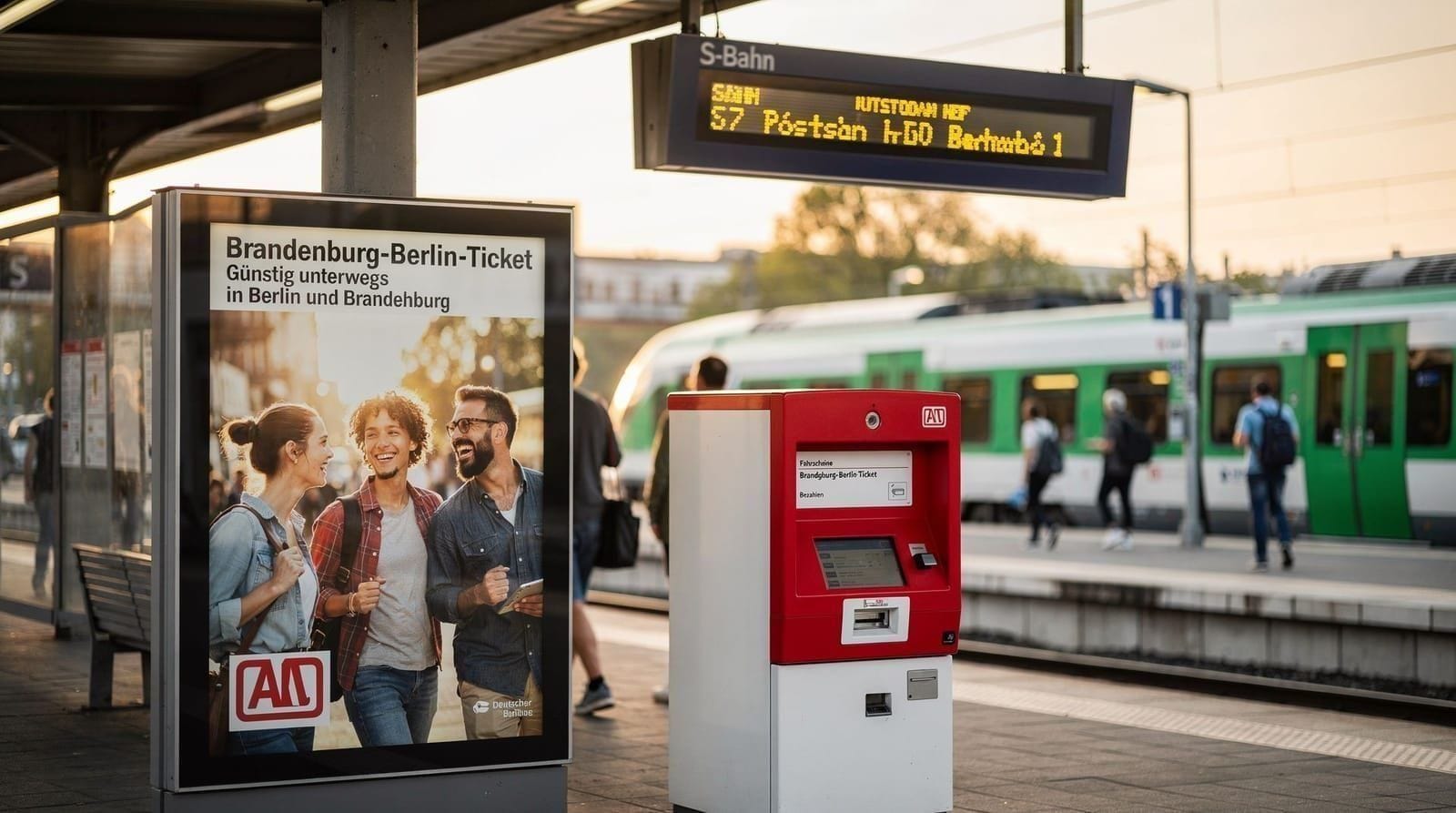
The RE1 regional train from Berlin Ostbahnhof runs direct to Frankfurt (Oder) roughly every 30 minutes, journey time just under one hour. The Brandenburg ticket (from around €29 for one to five passengers) covers the entire round trip and is valid all day on regional trains and local buses — a genuinely good deal. Individual return tickets run approximately €20–30.
Frankfurt (Oder) Hauptbahnhof is about 15 minutes’ walk from the old town and Kleist Museum; the Stadtbrücke to Słubice is a further 10 minutes on foot. The city is small enough to explore entirely on foot in a day without any public transport.
For lunch, the Oderpromenade (the riverside promenade on the German side) has several cafés and restaurants. Alternatively, crossing into Słubice for lunch is both more interesting and considerably cheaper.
Combining with other day trips
Frankfurt (Oder) pairs naturally with Seelow Heights, about 25 km north-west — the site of one of the final and bloodiest battles of World War II in Europe in April 1945, with a significant memorial and museum. Together they form a sober, historically serious day from Berlin.
If you want a longer eastern Brandenburg itinerary, consider Chorin for its ruined Gothic monastery, or the train on to Szczecin in Poland — though Szczecin deserves its own day. Both sit on the same train corridor as Frankfurt (Oder).
The Brandenburg ticket guide covers how to maximise the day pass for multi-stop eastern Brandenburg itineraries. And if you’re planning the wider trip, the best day trips from Berlin guide places Frankfurt (Oder) in context alongside the better-known options.
Who Frankfurt (Oder) suits
This is deliberately not a first-Berlin-visit day trip. It suits travellers who have already covered Potsdam or the Spreewald and want something with genuinely no equivalent elsewhere in the region — a lived, walkable border crossing rather than a museum exhibit about one. It also suits budget travellers, since the Brandenburg ticket covers the whole day and lunch in Słubice runs noticeably cheaper than Berlin. It suits it less well for visitors wanting polished tourist infrastructure — Frankfurt (Oder) carries visible wartime and GDR-era scars that Potsdam’s heavier post-reunification investment has largely smoothed over, and that rawness is part of its honesty rather than a flaw to apologise for.
For a wider sense of how this fits among Brandenburg’s eastern day trips, see the best day trips from Berlin overview and the Berlin destination guide for how to build a full Berlin stay around less conventional add-ons like this one.
Frequently asked questions about Frankfurt (Oder)
How long does the train take from Berlin?
The RE1 from Berlin Ostbahnhof runs direct to Frankfurt (Oder) in approximately 55–60 minutes. Trains depart every 30 minutes throughout the day, making it very easy to time your departure to suit a relaxed morning start.
Do I need a passport to cross into Słubice?
No. Poland is a Schengen Area member, so there are no passport or ID checks at the Stadtbrücke. You need only a valid EU ID card or, for non-EU visitors, any document you used to enter Germany. You are, however, technically entering another country, so your travel insurance and mobile roaming situation may technically change.
What currency is used in Słubice?
Polish zloty (PLN). As of 2026, the exchange rate is approximately 4.2 PLN per euro. Many places in Słubice accept cards, but having some zloty in cash is advisable for smaller cafés or market stalls. There are ATMs in Słubice that dispense PLN.
Is Frankfurt (Oder) the same as Frankfurt am Main?
No — they are entirely different cities. Frankfurt am Main (in Hesse, western Germany) is Germany’s financial capital and fifth-largest city. Frankfurt (Oder) is a historic border city in Brandenburg, eastern Germany, with a population of around 55,000. The parenthetical “(Oder)” refers to the Oder River on which it sits.
Is the Kleist Museum worth visiting if I don’t know his work?
Yes, genuinely. The museum is well designed and contextualises Kleist’s life and era effectively. His story — prodigious talent, perpetual crisis, early suicide — is compelling regardless of prior knowledge. The museum’s English-language materials are solid. Consider reading a short introduction to Michael Kohlhaas or The Marquise of O before visiting to get more from the exhibits.
What is the Brandenburg ticket and does it cover Frankfurt (Oder)?
Yes. Frankfurt (Oder) falls within the Brandenburg ticket’s validity zone. The ticket covers regional trains (RE and RB services) and local buses throughout Brandenburg for one full day, for one to five passengers on a single ticket. From Berlin, it comfortably covers the return journey. See the Brandenburg ticket guide for full details on purchasing and using it.
How much time do I need in Frankfurt (Oder)?
A comfortable day trip allows: arrival by late morning, Kleist Museum (allow 1–1.5 hours), lunch on the Oderpromenade or in Słubice, an afternoon walk across the Stadtbrücke and through Słubice (1–2 hours), and a look at St. Mary’s Church and the Viadrina campus before the train back. That fills a relaxed 6–7 hour visit without rushing.
When is Frankfurt (Oder) busiest with tourists?
It is never particularly crowded by Berlin standards. Summer weekends see some visitors, and the annual Kleist Festival (usually November, coinciding with the date of his death) draws literary visitors. The Christmas market — shared across both sides of the bridge in December — is charming and distinctly less hectic than Berlin’s major markets.
Is Frankfurt (Oder) worth it on a first trip to Berlin?
Probably not as a priority. First-time visitors with 3–5 days are better served by Berlin itself and the more essential day trips like Potsdam or Sachsenhausen. Frankfurt (Oder) is the reward for a return visit or a longer stay — its appeal (a lived border crossing, Kleist’s literary legacy) is genuinely distinctive but less immediately essential than the headline sights.