Berlin public transport tips — what tourists get wrong (and how to fix it)
Berlin’s public transport network — operated by BVG (Berliner Verkehrsbetriebe) — is genuinely excellent once you understand how it works. The problem is that the system has enough quirks to catch out first-time visitors in ways that cost real money. This is the stuff the BVG website buries three menus deep, translated into plain English.
For the comprehensive breakdown with timetables and full route maps, see the Berlin public transport guide. This post covers the practical shortcuts and the traps.
| Zone you need | AB for the city; ABC for Potsdam, BER, Sachsenhausen |
| Best value pass | 7-Tage-Karte, €36 (AB) for 5+ day stays |
| Fine if unvalidated | €60 on-the-spot, no exceptions |
| Airport ticket | ABC single, around €4.40–4.50 |
| Best app | BVG Fahrinfo for tickets and live departures |
The zone system — AB is almost always enough
Berlin’s fare network divides into three zones: A (the city centre, broadly everything inside the S-Bahn ring), B (the outer boroughs, up to the city limits), and C (Brandenburg, including Potsdam and Schönefeld airport on the old route).
Most tourist itineraries only need an AB ticket. That covers the U-Bahn, S-Bahn, trams, buses, and ferries anywhere inside the city. An AB single ticket costs €3.50. A day ticket (Tageskarte) is €9.50 for AB, which makes sense the moment you take three journeys or more in a day.
You only need to upgrade to ABC if you’re heading to Potsdam, Schönefeld area, or the Sachsenhausen memorial. An ABC day ticket is €10.70 — worth it if you’re doing a day trip, but don’t pay for it every day if you’re not leaving the city.
The mistake visitors consistently make: buying an ABC WelcomeCard for a five-day trip when they’re only leaving the city once. Run the maths before you commit.
Ticket types that are worth knowing
Single (Einzelfahrschein): €3.50, valid for two hours, unlimited transfers, no return journeys. Fine for one-off trips.
Short-trip (Kurzstrecke): €2.40, valid for three U/S-Bahn stops or six bus/tram stops with no transfers. Useful if you’re moving a short distance — say, two stops on the U8 to reach a restaurant.
Day ticket (Tageskarte): €9.50 AB. Valid until 3am the following day, not a rolling 24 hours. Buy one in the morning and it’s valid through midnight.
Weekly ticket (7-Tage-Karte): €36.00 AB. Covers an entire calendar week Monday to Sunday. If you’re in Berlin for 5+ days, run this against the WelcomeCard before deciding. See is the Berlin WelcomeCard worth it? for the full calculation.
Group day ticket (Kleingruppenkarte): €29.50 AB, valid for up to five people travelling together on the day. If you’re travelling as a family or group, this is dramatically cheaper than buying individual day tickets.
The WelcomeCard — when it makes sense
The WelcomeCard bundles unlimited transport with discounts at museums, attractions, and tours. It comes in several variants:
- AB, 48h: €23.00
- AB, 72h: €34.50
- AB, 5-day: €44.50
- ABC versions at roughly €4-6 more per tier
- All Inclusive version that adds Museum Island entry and several major attractions
The honest case for the WelcomeCard: it pays off if you’re visiting multiple paid museums and attractions in a 2-3 day stretch. The discounts run 10-25% at most venues. It doesn’t pay off if you’re spending most of your time walking, eating, and visiting free sites.
The Museum Island version is worth a separate look if you’re doing all five museums on the island in a couple of days:
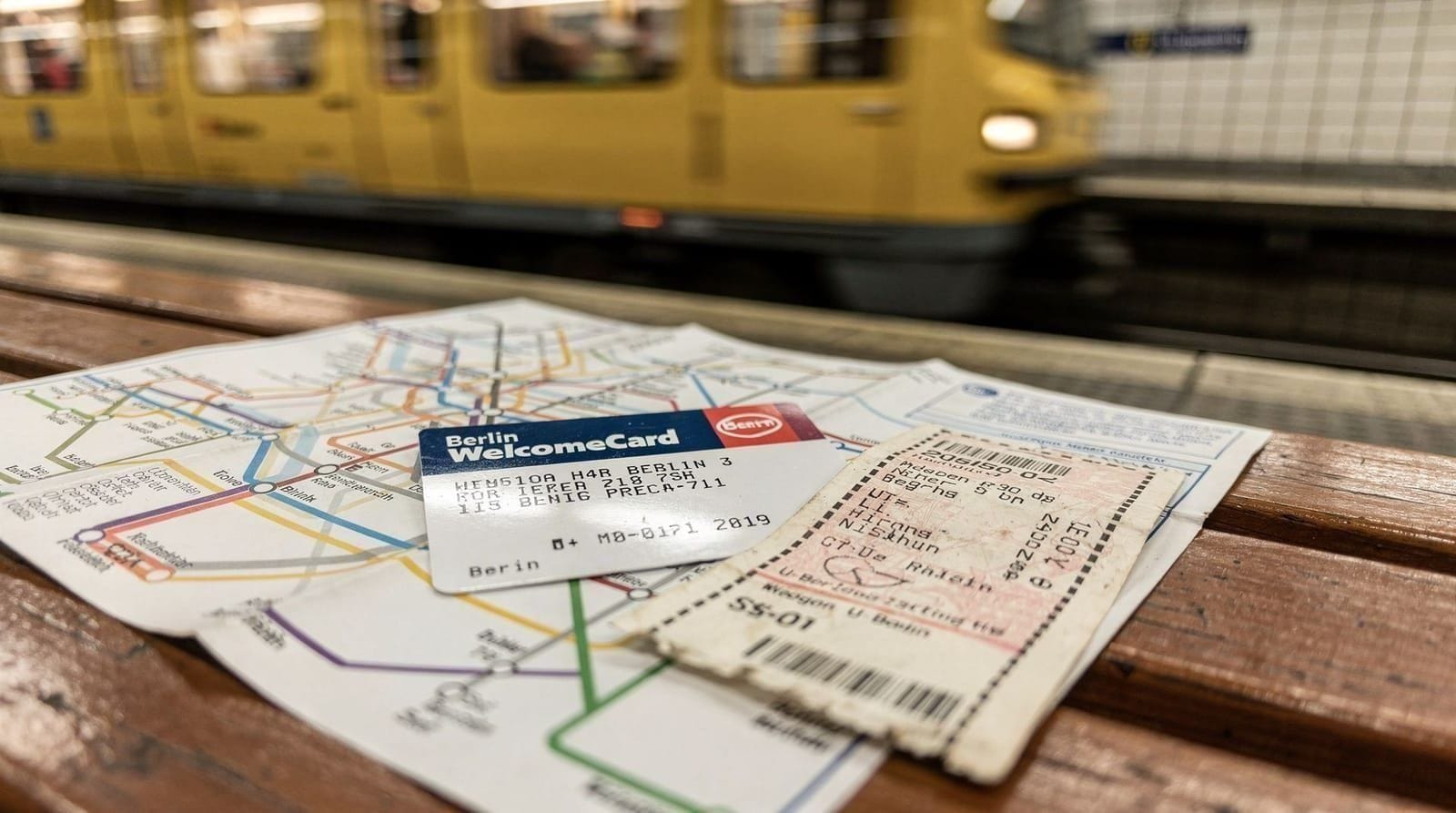
Berlin WelcomeCard with Museum Island — includes entry to all five museums plus transportFor the Museum Island guide and what’s currently open (Pergamon is partially closed for renovation), see that guide before buying this ticket.
Common mistakes that cost money
Mistake 1: Not validating your ticket. Berlin still runs on the honour system for most paper tickets — there are no gates on the U-Bahn or S-Bahn platforms. You stamp (validate) your ticket at the yellow machines before boarding. If you board without a validated ticket, you risk a €60 on-the-spot fine from plainclothes inspectors (Kontrolleure) who appear without warning. They check regularly on the M10, the S41/S42 ring, and U8.
Mistake 2: Assuming the airport runs on an AB ticket. BER (Berlin Brandenburg Airport, the new one) is in zone C. You need an ABC ticket or an airport express supplement. The Airport Express (FEX) runs to Hauptbahnhof and Ostbahnhof in about 30 minutes. An ABC single from the airport to Mitte is €4.50.
Mistake 3: Buying a ticket on the bus. You can buy on the bus, but it’s slow, you’ll hold up boarding, and bus drivers can’t make change for large notes. Buy at U-Bahn machines or use the BVG app.
Mistake 4: Assuming the U-Bahn runs all night. On weekdays, most U-Bahn lines stop around midnight. On Friday and Saturday nights, the U-Bahn runs all night on most lines, roughly every 15-20 minutes. Night buses (marked N) cover the gaps the rest of the week — they’re slower but they work. The S-Bahn ring lines (S41/S42) run all night.
Mistake 5: Not checking for construction disruptions. Berlin’s network has ongoing works and regular weekend shutdowns on specific sections. Check BVG.de or the app the day before a journey you’re planning around a specific line.
The apps that actually help
BVG Fahrinfo (official BVG app): This is the primary tool. Live departures, journey planning, and you can buy tickets directly in the app (including M-Tickets valid on your phone screen). The app covers BVG, S-Bahn, and regional trains in one journey planner.
DB Navigator: Better for regional and intercity trains (Deutsche Bahn), which is what you need if you’re heading to Dresden, Potsdam, or Spreewald for a day trip. Also covers the Berlin network. Use it alongside BVG Fahrinfo if you’re doing day trips by train.
Jelbi: BVG’s multimodal app that integrates U-Bahn, bus, tram, bike-sharing, scooters, and cars into one platform. Useful if you want to mix transport modes without juggling multiple apps.
None of these need a German SIM card — they work on any smartphone with data.
How to read Berlin’s network at a glance
The U-Bahn (underground, painted with the U prefix) runs on nine lines. The core east-west axis is the U2 and U5. The north-south axis is U6 (Tegel area to Mariendorf) and U8 (Wedding to Hermannstrasse). The U1 runs elevated through Kreuzberg and is one of the most scenic lines in the city.
The S-Bahn (suburban rail, painted with the S prefix) covers longer distances and has two circular lines: S41 (clockwise) and S42 (anti-clockwise). These ring lines are genuinely useful for reaching neighbourhoods like Prenzlauer Berg, Friedrichshain, and Tempelhof without going through the centre.
Regional Express (RE) and Regional Bahn (RB) trains run on the mainline network and reach day-trip destinations. RE1 goes to Potsdam. RE7 goes towards the Spreewald. RE50 goes south towards Wittenberg. All are covered in the day trips by train guide.
Trams only run in the former East Berlin. If you’re staying in Prenzlauer Berg or Friedrichshain, you’ll use the M10 (Warschauer Strasse to Wedding) and M4/M5 trams regularly. They share road lanes with cars and can get delayed, but they’re useful.
If you’re on a tight budget
The Berlin budget guide covers this in depth, but the transport shortcut: a weekly AB ticket at €36 beats individual day tickets if you’re in the city for five or more days. Pair it with walking — Berlin’s central attractions are surprisingly walkable between the Brandenburg Gate, Museum Island, Checkpoint Charlie, and Hackescher Markt.
Cycling is the other option. Berlin has an extensive cycle lane network. Bike rentals start at about €10-12/day through Nextbike (integrated into Jelbi). The Berlin bike tours guide covers both rental options and guided tours if you want structure.
Ticket value at a glance
| Ticket | Price (AB) | Break-even point |
|---|---|---|
| Single (Einzelfahrschein) | €3.50 | One journey, no transfers back |
| Short-trip (Kurzstrecke) | €2.40 | 1–3 stops only |
| Day ticket (Tageskarte) | €9.50 | 3+ single journeys in a day |
| Weekly ticket (7-Tage-Karte) | €36.00 | 4+ days in the city |
| Group day ticket (Kleingruppenkarte) | €29.50 | 3+ people travelling together |
Run this against the WelcomeCard guide before buying — the WelcomeCard only wins the maths when you’re also visiting several paid museums.
Regional trains for day trips
The RE and RB network isn’t just for the airport. RE1 reaches Potsdam in about 25 minutes and continues to Magdeburg. RE7 heads toward the Spreewald. These regional trains use the same BVG/VBB fare zones as the city network, so an ABC ticket covers most day-trip destinations without a separate DB ticket — the exception is longer-distance IC/ICE services to places like Dresden or Leipzig, which need a separate DB fare booked through DB Navigator. Confusing the two is a common and avoidable overspend: don’t buy a DB long-distance ticket for a trip an ABC day ticket already covers.
The ferry lines people forget about
BVG operates six ferry lines (F-lines) in Berlin — actual scheduled river ferries that are covered by a standard BVG ticket. F10 runs between Wannsee and Kladow in southwest Berlin. It’s a 20-minute crossing, free with any valid ticket, and one of the most pleasant ways to spend 20 minutes in the city. Berlin boat tours via the Spree are a separate thing (private tour operators), but the BVG ferries are the free public service version.
Winter vs summer — what changes
In winter, the network runs on the same schedule, but night services are slightly reduced in frequency. Heated waiting areas exist at major stations but not everywhere. The BVG app shows real-time departures — on cold platforms, knowing the bus is six minutes away rather than guessing is genuinely useful.
In summer, the ferries and outdoor transport options become more relevant. Weekend RE trains to the lakes fill up fast — book ahead on DB if you’re heading somewhere popular on a Saturday.
The bottom line: Berlin’s transport is cheap, comprehensive, and reliable once you know the rules. The traps — zone errors, unvalidated tickets, airport pricing, night service gaps — are entirely avoidable with an hour of preparation. The Berlin public transport guide has everything else you need in one place.
FAQ
Do I need a different ticket for BER airport? Yes. BER sits in zone C, so a standard AB ticket doesn’t cover it — you need an ABC ticket or the Airport Express (FEX) supplement, which reaches Hauptbahnhof and Ostbahnhof in about 30 minutes.
Can I use the same ticket on U-Bahn, S-Bahn, buses, trams and ferries? Yes — a valid BVG/VBB ticket for the right zone covers all of them, including the six BVG ferry (F-line) routes, with no separate fare needed.